
Paper:
The Study of Evacuation Simulation in Elevated MRT Stations: A Case Study of Taoyuan MRT A8 Chang Gung Memorial Hospital Station
Chun-Hao Shao*,† and Tzu-Chi Chien**
*Graduate School of Disaster Management, Central Police University
No.56 Shuren Road, Guishan District, Taoyuan 333322, Taiwan
†Corresponding author
**The Disaster Prevention and Rescue Office, Taichung City Fire Department
Taichung, Taiwan

The A8 Chang Gung Memorial Hospital Station is an important transportation hub on the Taoyuan Metro line, with a relatively high number of elderly passengers due to its proximity to a large hospital. In crowded areas, any incident poses a significant challenge for emergency evacuation. This study combined on-site surveys of pedestrian flow speeds with simulations using BuildingEXODUS and SMARTFIRE software, focusing on elderly individuals as the representative vulnerable group for A8 Station. By setting different proportions of elderly passengers, the study explored whether evacuation times met the requirements of the National Fire Protection Association 130 standards under both normal and fire-emergency conditions. The simulation results were validated through expert interviews, leading to recommendations for corresponding safety management strategies. The findings indicate that as the proportion of elderly passengers increases, there is a significant impact on evacuation time when using passenger walking speed parameters, which does not fully align with some results from the A8 Station disaster prevention plan, thereby increasing the risk to passengers during emergencies.
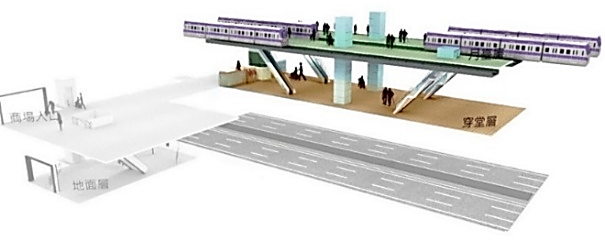
A8 Chang Gung Hospital Station
- [1] Taoyuan Metro Corporation, “Monthly inbound and outbound passenger numbers (January to December),” 2022. https://reurl.cc/nZkqXe [Accessed December 3, 2022]
- [2] Taoyuan Metro Corporation, “January statistics of elderly inbound and outbound passengers,” 2023. https://reurl.cc/p6XMnb [Accessed July 4, 2023]
- [3] S. W. Chien and W. J. Wen, “A research of the elevator evacuation performance and strategies for Taipei 101 Financial Center,” J. Disaster Res., Vol.6, No.6, pp. 581-590, 2011. https://doi.org/10.20965/jdr.2011.p0581
- [4] National Fire Protection Association, “NFPA 130: Standard for fixed guideway transit and passenger rail systems,” NFPA, 2023.
- [5] National Development Council, Republic of China (Taiwan), “Aging schedule,” 2024. https://reurl.cc/eLKLjR [Accessed March 15, 2024]
- [6] C. W. Chiu, “A study on emergency evacuation response in underground metro stations,” J. of Taiwan Police College, Vol.7, No.8, pp. 141-178, 2022.
- [7] C. F. Tsai, C. H. Shao, H. W. Jian, C. D. Hung, and S. Y. Hsieh, “A study on urban disaster prevention review for urban design review – A review of outdoor space evacuation for buildings,” Research Report Commissioned by the Architecture and Building Research Institute, Ministry of the Interior, 2016. https://reurl.cc/Wv8k8e [Accessed September 19, 2025]
- [8] C. W. Hsu, “A study on evacuation time of people in elevated metro station buildings: A case study of A18 High-Speed Rail Taoyuan Station on the Airport MRT Line,” Master’s thesis, Central Police University, Graduate Institute of Disaster Prevention, 2023.
- [9] L. Hong, J. Gao, and W. Zhu, “Self-evacuation modeling and simulation of passengers in metro stations,” Safety Science, Vol.110, Part B, pp. 127-133, 2018. https://doi.org/10.1016/j.ssci.2018.05.013
- [10] K. Guo, L. Zhang, and M. Wu, “Simulation-based multi-objective optimization towards proactive evacuation planning at metro stations,” Engineering Applications of Artificial Intelligence, Vol.120, Article No.105858, 2023. https://doi.org/10.1016/j.engappai.2023.105858
- [11] C. H. Shao, P. C. Shao, and F. M. Kuo, “Stampede events and strategies for crowd management,” J. Disaster Res., Vol.14, No.7, pp. 949-958, 2019. https://doi.org/10.20965/jdr.2019.p0949
- [12] A. Sekizawa and S. Nakahama, “Study on transportation efficiency of evacuation using elevators in comparison with evacuation using stairs in a high-rise building – Is use of elevator in evacuation really effective for general people?,” J. Disaster Res., Vol.6, No.6, pp. 591-599, 2011. https://doi.org/10.20965/jdr.2011.p0591
- [13] Japan Railway Bureau, “Technical regulatory standards on Japanese railways,” 2012. https://www.mlit.go.jp/english/2006/h_railway_bureau/Laws_concerning/14.pdf [Accessed May 21, 2020]
- [14] P. Gao, D. Wang, T. Zhou, and Z. Liang, “Analysis on the security challenges and organization strategy of evacuation in deep underground stations,” Chinese J. Underground Space and Engineering, Vol.18, No.4, pp. 1051-1061, 2022.
- [15] Ministry of Transportation and Communications, Taiwan, “Fire prevention and safety equipment specifications for railway tunnels and underground stations,” 2008. https://gpi.culture.tw/books/1009701741
- [16] D.-H. Shih, C.-H. Hsiao, C.-P. Wang, Y.-H. Tsao, H.-H. Huang, Y.-C. Chen, K.-K. Chang, C.-H. Lai, and H.-J. Wu, “A study on disaster prevention and emergency management for underground rail transit facilities,” Research Report of the Institute of Transportation, Ministry of Transportation and Communications, Report No.MOTC-IOT-97-SDB002, 2010.
- [17] G. Pan, D. C. Wang, T. J. Zhou, and Z. Liang, “Analysis of evacuation safety challenges and organizational strategies for deep underground stations,” Chinese J. of Underground Space and Engineering, Vol.18, No.4, pp. 1051-1061, 2022. https://doi.org/10.20174/j.JUSE.2025.S1.01
- [18] T. Tanaka, “Introduction to fire safety engineering in architecture (1st ed.),” Architectural Institute of Japan, 1986 (in Japanese).
- [19] J. J. Fruin, “Pedestrian planning and design,” Metropolitan Association of Urban Designers and Environmental Planners, 1971. https://trid.trb.org/view/114653 [Accessed September 19, 2025]
This article is published under a Creative Commons Attribution-NoDerivatives 4.0 Internationa License.