
Paper:
A Simple Decentralized 3D Collision-Avoidance Method for Mobile Agents Inspired by Animal Attention
Takeshi Kano*1
 , Mayuko Iwamoto*2,*3, and Ryo Kobayashi*2,*4
*1School of Systems Information Science, Future University Hakodate
116-2 Kamedanakano-cho, Hakodate, Hokkaido 041-8655, Japan
*2Future University Hakodate
116-2 Kamedanakano-cho, Hakodate, Hokkaido 041-8655, Japan
*3Graduate School of Advanced Mathematical Sciences, Meiji University
4-21-1 Nakano, Nakano-ku, Tokyo 164-8525, Japan
*4Graduate School of Integrated Sciences for Life, Hiroshima University
1-3-1 Kagamiyama, Higashi-hiroshima, Hiroshima 739-8526, Japan

Inspired by the attention mechanisms observed in animals, we propose a perceptually grounded and decentralized collision-avoidance model for multiple autonomous mobile agents in three-dimensional (3D) space. As the density of such agents is expected to increase in applications including aerial robots (e.g., drones), there is a growing need for lightweight, prediction-free control laws that ensure safety, quickness, and smooth motion. In the proposed model, each agent represents neighboring agents on a spherical screen corresponding to its visual field and evaluates two simple attention-like perceptual indices: a rate-of-approach index derived from an increase in apparent diameter under nearly stationary viewing direction, and a proximity index derived from the diameter itself. The velocity of each agent is updated based on variations in the viewing direction on a spherical screen, which provide the directional correction for collision avoidance. This update is realized through a combination of goal-directed and local avoidance terms, without prediction, optimization, or communication. Systematic simulations with extensive parameter sweeps demonstrate that the proposed model achieves a good balance of quickness, smoothness, and safety across multiple interaction scenarios, highlighting its potential as a practical and scalable control principle for 3D multi-agent systems.
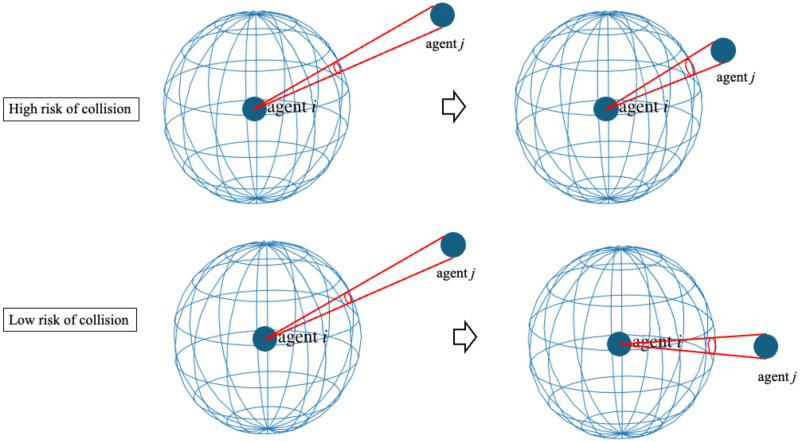
Collision risk on a spherical screen
1. Introduction
Collision avoidance for autonomous agents moving in three-dimensional (3D) space, such as swarms of multirotor drones, underwater robots, and mobile agents in virtual environments, is a fundamental and important problem. In particular, in drone systems, the number of operating vehicles is expected to increase significantly in the near future, making centralized traffic management impractical. This trend calls for decentralized control schemes in which each agent can avoid collisions based solely on locally available perceptual information. Beyond ensuring safety, it is desirable that collision avoidance can be achieved without excessive reduction in speed and while maintaining motion smoothness (i.e., avoiding abrupt acceleration or deceleration), so as to maintain energy efficiency. However, simultaneously satisfying quickness, smoothness, and safety in a decentralized manner remains a challenging problem, and a generally applicable and practical solution has yet to be established.
A wide variety of engineering approaches to collision avoidance have been proposed to date. Representative methods include collision avoidance based on the velocity obstacle (VO) framework 1 and the dynamic window approach, which explicitly accounts for nonholonomic kinematic constraints 2. These methods have been widely used as control laws that geometrically avoid collisions while respecting the motion constraints of robots. Extensions to multi-agent scenarios have also been actively studied, such as ORCA, which generalizes VO to reciprocal collision avoidance 3, and distributed planning methods that address safety in multi-agent settings 4. More recently, learning-based collision avoidance methods using deep reinforcement learning 5,6, as well as distributed collision-avoidance approaches that account for mutual interactions among agents 7,8,9, have demonstrated improved performance in densely populated environments. While these methods achieve high performance in terms of safety and reachability, they often rely on internal prediction or optimization processes. As a result, the design principles by which multiple motion properties, such as quickness, smoothness, and safety, are simultaneously balanced are not always made explicit. Moreover, perceptual information is often incorporated implicitly within cost functions or optimization processes, and its role in collision avoidance decisions is not always clearly identifiable.
The authors have previously investigated decentralized collision avoidance for autonomous agents through a series of prediction-based control models. In an initial study 10, future positions of neighboring agents were predicted by short-term integration of their equations of motion, and collision-prone directions were estimated to determine appropriate avoidance maneuvers. Within this framework, it was shown that multiple motion properties, including quickness, smoothness, and safety, could be evaluated and simultaneously balanced effectively. However, this approach required sequential prediction of the future motion of all nearby agents, resulting in high computational cost and posing challenges for practical implementation. In a subsequent study 11, computational complexity was reduced by introducing an attention mechanism that selectively focuses on agents with high collision risk and predicts the behavior of only those agents. By selecting attention targets using a simple perceptual index based on apparent size, this model retained the prediction-based control structure while achieving quickness, smoothness, and safety through purely local interactions. Nevertheless, both of these prior studies 10,11 were limited to motion in a two-dimensional (2D) plane and did not consider changes in motion direction or visual field structure in 3D space. For autonomous agents operating in 3D environments, directional information and visual geometry become more complex, and the direct application of existing 2D frameworks is therefore not straightforward.
To address this issue, we employ an interdisciplinary approach in which engineering systems are designed based on biological findings 12. Motivated by insights from biological sensing and attention mechanisms, the present study proposes a collision avoidance model for generic 3D autonomous agents, with potential applications to future drone systems. Many animals are known to employ active sensing, in which sensing behavior is adaptively modulated through action, while perception also relies on sensory information shaped by the environment 13,14. For example, humans can continuously perceive obstacles in their visual field without explicit attention, and selectively allocate attention to objects that pose a high risk of collision. Inspired by these biological characteristics, we construct a lightweight decentralized control model that maintains a global, low-cost sensing of the surrounding space while selectively attending to collision-critical agents to generate avoidance behavior. Furthermore, through numerical simulations with parameter sweeps, we demonstrate that there exists a region in parameter space where the three performance indices—quickness, smoothness, and safety—are simultaneously achieved. The key contribution of this study is to propose a qualitatively novel and perceptually interpretable decentralized control principle for 3D collision avoidance at a conceptual level.
2. Model
2.1. Modeling Concept and Key Idea
The 3D collision avoidance model proposed in this section is motivated by potential future applications to drone systems and related platforms. However, the primary aim of this study is to propose an abstract and general control concept rather than a detailed model tailored to a specific vehicle. Accordingly, we do not consider detailed agent geometry, aerodynamic effects, or vehicle-specific kinematics, and instead construct the model under a minimal set of assumptions. To clarify the essential structure of the model, all parameters are described in a nondimensional form throughout this study.
The fundamental principle of the proposed model is that each agent generates collision avoidance behavior solely based on perceptual information available from its own viewpoint. No assumptions are made regarding the absolute positions or velocities of other agents, nor are future trajectories estimated. Communication between agents and the use of a global coordinate frame are also not assumed. Each agent responds only to how surrounding agents appear, specifically in terms of their apparent direction and apparent size.
The key idea of the proposed model is extremely simple. Namely, it is based on the intuition that a neighbor whose apparent size increases while its apparent direction remains nearly unchanged poses a high collision risk. In the proposed model, this intuition is formulated mathematically, and collision avoidance behavior is generated by selectively attending to neighbors with high perceived risk. Rather than treating all neighbors equally, the model implicitly selects avoidance targets based on perceptual quantities, which constitutes a central feature of the proposed approach.
2.2. Basic Assumptions and Equation for Agent Motion
We consider \(N\) identical spherical agents of radius \(R\) moving in 3D space. The environment is assumed to be free of external obstacles (except for “narrow passage” case in Section 3). Each agent is equipped with a unit-radius spherical screen centered at itself, on which other agents are perceived as images at discrete time intervals \(\Delta t\) (Fig. 1).
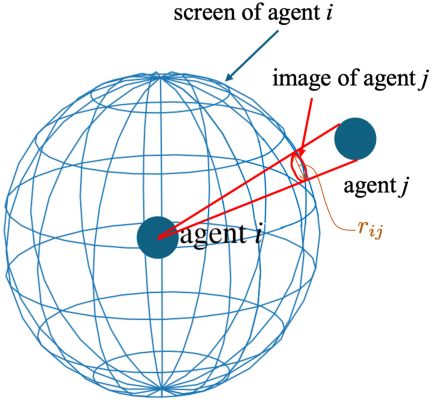
Fig. 1. Spherical-screen perception assumed in the proposed model. Agent \(i\) perceives a neighbor \(j\) on a unit-radius spherical screen. The diameter of the image of agent \(j\) on the screen is denoted by \(r_{ij}\).
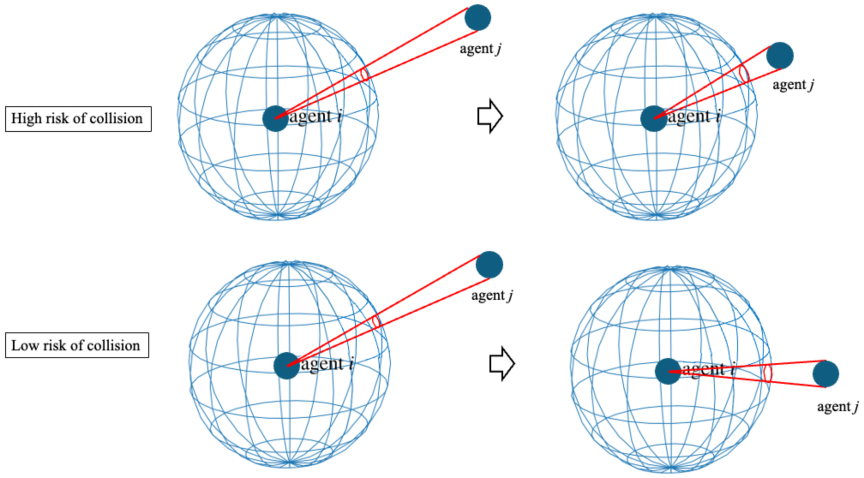
Fig. 2. Two typical situations on the spherical screen. A high approach risk arises when the apparent size increases while the screen direction changes little. (Top): A dangerous neighbor remains near the same direction on the screen while its apparent size increases. (Bottom): A passing neighbor exhibits large motion on the screen, resulting in a lower approach risk.
The position and velocity of agent \(i\) are denoted by \(\mathbf{r}_i(t)\) and \(\mathbf{v}_i(t)\), respectively. Each agent is assigned a unit vector \(\mathbf{e}_i\) representing its desired direction of motion.
Agent motion is described by the following first-order velocity dynamics:
2.3. Velocity Adjustment for Collision Avoidance
The velocity adjustment term \(\Delta \mathbf{v}_i\) is decomposed as
Lateral Avoidance of Approaching Neighbors: \(\Delta \mathbf{v} _A\)
The primary avoidance behavior in the proposed model is to modify the motion direction laterally when a neighbor’s image increases in size while remaining nearly stationary on the spherical screen (Fig. 2, top).
The viewing direction from agent \(i\) to agent \(j\) (i.e., the direction on the spherical screen) is defined as
The temporal change in the apparent diameter is defined as
The tangential displacement vector of the image on the screen, \(\delta \mathbf{d}^{\tan}_{ij}\), is obtained by projecting the change in viewing direction \(\delta \mathbf{d}_{ij} \equiv \mathbf{d}_{ij}(t) - \mathbf{d}_{ij}(t-\Delta t)\) onto the tangent plane of the spherical screen (see Appendix A for details).
Based on these quantities, the approach risk is defined as
Only neighbors satisfying \(K_{a,ij} > K_{a}^{\mathrm{th}}\) are selected as avoidance targets:
The avoidance direction \(\mathbf{n}_{ij}\) is defined based on the tangential motion of the image. When \(\lVert \delta \mathbf{d}_{ij}^{\tan} \rVert\) is sufficiently large (\(\lVert \delta \mathbf{d}_{ij}^{\tan} \rVert \ge \delta d_{\mathrm{th}}\)), it is defined as
When \(\lVert \delta \mathbf{d}_{ij}^{\tan} \rVert\) is very small (\(\lVert \delta \mathbf{d}_{ij}^{\tan} \rVert < \delta d_{\mathrm{th}}\)), the neighbor is located nearly straight ahead on the screen. In this case, due to sensor resolution limits and observation noise, the tangential direction cannot be reliably estimated. Therefore, a unit vector randomly chosen from the tangent plane orthogonal to \(\mathbf{d}_{ij}\) is used as \(\mathbf{n}_{ij}\). This stochastic choice reflects sensor limitations and prevents numerical instability when the tangential direction is ill-defined. Such situations are expected to occur only rarely, and once the agent moves slightly, the tangential displacement on the screen becomes distinguishable again. Therefore, the influence on the overall behavior is expected to be limited.
The lateral avoidance component is then given by
Repulsion from Overly Close Neighbors: \(\Delta \mathbf{v} _B\)
Lateral avoidance alone may be insufficient when neighboring agents move in nearly the same direction, as they can gradually approach each other while maintaining a small relative velocity. To address this situation, an additional repulsive component is introduced to respond directly to excessive proximity.
The proximity risk is defined as
The repulsive velocity adjustment is then given by
In summary, the proposed model explicitly reacts only to neighbors whose approach risk \(K_{a,ij}\) or proximity risk \(K_{b,ij}\) exceeds a prescribed threshold. Here, \(K_{a,ij}\) represents the risk of collision associated with increasing apparent size under small directional variation on the screen, whereas \(K_{b,ij}\) represents the risk associated with excessive proximity itself. By ignoring all other neighbors, the model localizes both computation and response, thereby realizing a lightweight decentralized collision avoidance mechanism.
3. Simulation
3.1. Simulation Setup
The mathematical model proposed in Section 2 is simulated using the explicit Euler method with a time step size \(\delta t\). Here, \(\delta t\) denotes the time step for numerical integration and is distinguished from the sensing interval \(\Delta t\). All agents are synchronously updated with the same time step. The simulation space is defined as a cubic domain with side length \(2L\),
Each agent is assigned a target point located on one of the faces of the cube and moves toward that target. When an agent passes through the face containing its target point, the target is reset to the opposite face, and the agent continues moving toward the new target. In this manner, agents continuously perform back-and-forth motion within the domain, and no termination condition based on goal arrival is imposed.
Interactions among agents are governed solely by the perceptual collision avoidance rule defined in Section 2. For simplicity, physical forces arising from direct contact between agents (physical forces) are not introduced.
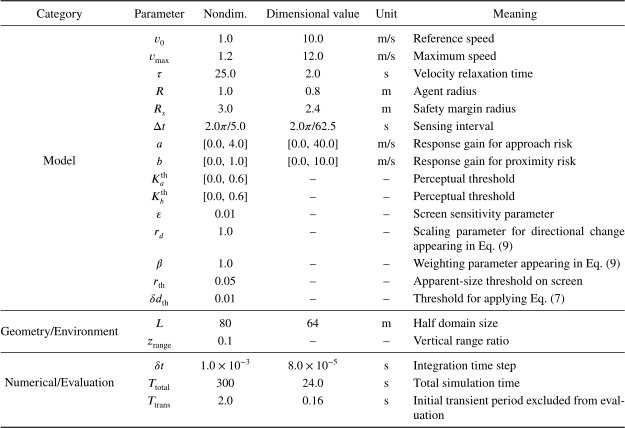
Table 1. Simulation parameters. Dimensional values are provided only for reference by assuming a characteristic length \(L_0=0.8\,\mathrm{m}\) and a time scale \(T_0=0.08\,\mathrm{s}\) (i.e., \(V_0=L_0/T_0=10\,\mathrm{m/s}\)), and are not used directly in the simulations.
To examine the behavior of the proposed model under different spatial conditions, three representative scenarios are considered: (1) an open arena, (2) passage through a narrow bottleneck, and (3) orthogonal crossing of two groups. Detailed conditions for each scenario are provided in Appendix B.
3.2. Performance Indices
In practical scenarios, it is desirable that autonomous agents move quickly and smoothly while avoiding collisions. For example, in drone delivery services, excessive reduction of speed, high energy consumption due to frequent acceleration and deceleration, and collisions should all be avoided. Therefore, we introduce the following three indices: quickness \(E_1\), smoothness \(E_2\), and safety \(E_3\). Details are described below.
Quickness (\(E_1\)) :
Smoothness (\(E_2\)) :
Safety (\(E_3\)) :
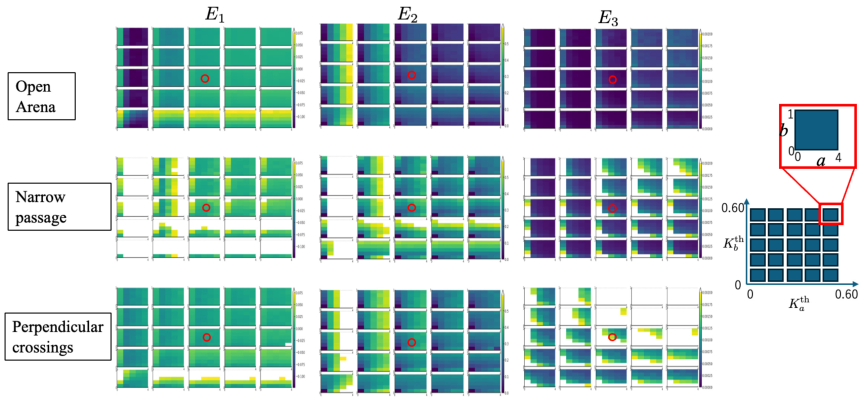
Fig. 3. Colormaps of performance indices. Simulation parameter values are listed in Table 1. Each value in the color maps is averaged over three trials. White regions indicate values exceeding the upper limit shown in the color bar. The red circles point the parameters where balanced performance in terms of quickness, smoothness, and safety is obtained for all considered environments (\(a=2.0\), \(b=0.5\), \(K_{a}^{\mathrm{th}}=K_{b}^{\mathrm{th}} = 0.3\)).
When computing the averages for the performance indices \(E_1\)–\(E_3\), transient behavior dominated by initial conditions appears immediately after the start of the simulation. Therefore, a fixed time interval \(T_{\mathrm{trans}}\) is defined as an initial transient period for each trial, and data within this interval are excluded from evaluation. In addition, agents located outside the domain defined by Eq. (12) are excluded from the evaluation because otherwise discrete velocity change which occurs when the goal is updated affects \(E_2\).
3.3. Parameter Sweep and Evaluation Method
The basic simulation parameters are listed in Table 1. Although the simulations are nondimensionalized, the parameters are selected such that, when dimensionalized assuming small aerial drones, neither unrealistic velocities nor accelerations arise.
The avoidance gain \(a\), the repulsion gain \(b\), and the threshold values \(K_a^{\mathrm{th}}\) and \(K_b^{\mathrm{th}}\) are systematically varied, and colormaps of the performance indices \(E_1\), \(E_2\), and \(E_3\) are generated for each scenario. Each trial is executed for \(T_{\rm{total}}\) time steps, and for each parameter set, three trials are conducted under identical conditions. The averaged values are used as the evaluation results.
3.4. Colormap Analysis
Figure 3 shows colormaps of the performance indices \(E_1\) (quickness), \(E_2\) (smoothness), and \(E_3\) (safety) obtained by varying the avoidance gain \(a\), the repulsion gain \(b\), and the threshold values \(K_{a}^{\mathrm{th}}\) and \(K_{b}^{\mathrm{th}}\). In each colormap, two parameters corresponding to the horizontal and vertical axes are varied, while the remaining parameters are fixed. Darker colors indicate smaller index values and thus better performance.
The colormaps reveal non-uniform but structured performance characteristics over the parameter space. In particular, different indices exhibit different sensitivities to the parameters: the quickness index \(E_1\) tends to deteriorate in regions where the repulsion gains are excessively large, whereas the safety index \(E_3\) degrades in regions where these gains are too small. These trends indicate that the three indices cannot be simultaneously optimized by monotonic tuning of a single parameter. In addition to the gain parameters, the threshold values \(K_{a}^{\mathrm{th}}\) and \(K_{b}^{\mathrm{th}}\) also have a significant impact on performance. Inappropriate threshold settings lead to degradation in at least one of the performance indices, highlighting the importance of properly selecting both the strength of avoidance responses and the conditions under which neighboring agents are taken into account.
Despite these differences, a region in which all three indices \(E_1\), \(E_2\), and \(E_3\) simultaneously exhibit relatively good values is consistently observed across all scenarios. In particular, when
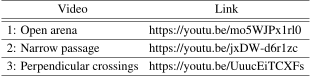
The collective motion of agents under this representative parameter setting is visualized in Supplementary Videos 1–3, with links listed in Table 2. These videos qualitatively confirm the correspondence between the quantitative evaluation based on the colormaps and the resulting 3D collective behavior.
Table 2. Links to the supplementary videos. In the videos, the light-gray translucent sphere around each agent represents the sensing range within which other agents are perceptible, while the dark-gray sphere indicates the safety margin. Red line segments originating from an agent point to neighboring agents satisfying \(K_{a,ij} > K_a^{\mathrm{th}}\), corresponding to high approach risk, whereas green line segments indicate agents satisfying \(K_{b,ij} > K_b^{\mathrm{th}}\), corresponding to high proximity risk. The black line represents the velocity correction \(\Delta \mathbf{v}_i\) applied to the agent. Video 1 shows random motion in an open arena, where agents avoid collisions with only slight reduction in speed. Video 2 demonstrates collision avoidance in a narrow passage scenario. Video 3 shows collision avoidance during perpendicular crossing of two groups of agents.
4. Discussion
The colormap analysis highlights the importance of appropriately balancing the perceptual thresholds and the strength of avoidance responses. When the threshold values \(K_a^{\mathrm{th}}\) and \(K_b^{\mathrm{th}}\) are set too small, agents tend to take many neighboring agents into account, resulting in overly conservative avoidance behavior that degrades quickness and motion smoothness. Conversely, excessively large threshold values restrict the set of attended agents, which increases the risk of insufficient avoidance and reduced safety. A similar tendency is observed for the avoidance and repulsion gains \(a\) and \(b\); values that are too small fail to provide adequate collision avoidance, whereas excessively large gains induce overly strong reactions that negatively affect quickness and smoothness. These results indicate that the threshold parameters determine which agents are attended, whereas the gain parameters control how strongly the agent responds; maintaining both aspects within moderate ranges is essential for achieving a balanced trade-off among quickness, smoothness, and safety.
In the field of pedestrian dynamics, frameworks such as the social force model 15, as well as extended models incorporating collision prediction 16, have been developed to reproduce realistic collective pedestrian behavior. More recently, models that explain pedestrian steering based on visual angular variation and optical expansion 17,18 have also been proposed, sharing an interesting commonality with the present study in that they emphasize apparent changes in other individuals. However, the primary objective of these pedestrian flow models is to understand the physical and social mechanisms underlying real pedestrian behavior, rather than to serve as engineering control models aimed at optimizing performance indices such as quickness, smoothness, and safety. Moreover, most pedestrian flow models are formulated on a 2D plane and represent directional changes using a single scalar angle, which makes the treatment of directional variation in 3D space inherently difficult.
5. Conclusion and Future Research
In this study, we proposed a decentralized collision-avoidance model for multiple mobile agents in 3D space, inspired by perceptual mechanisms observed in animal interactions. By projecting neighboring agents onto a spherical screen and combining the apparent size of each agent with changes in its viewing direction, the model assesses collision risk through simple perceptual indices representing approach risk (\(K_a\)) and proximity risk (\(K_b\)), and generates velocity corrections accordingly. This formulation enables geometrically consistent avoidance behavior without explicit prediction of future trajectories.
Systematic simulations demonstrated that the proposed model achieves a balance among quickness, smoothness, and safety across diverse 3D multi-agent scenarios, with broad parameter regions exhibiting stable performance. Compared with prediction- or optimization-based engineering approaches such as VOs and ORCA 1,2,3 and deep reinforcement learning 5,6, the proposed model is distinguished by its minimal structure, low computational cost, and direct reliance on perceptual quantities. While pedestrian flow models are primarily aimed at explaining human crowd behavior in 2D settings 15,16,17,18, the present model is explicitly formulated as a lightweight control law for 3D autonomous agents. In this sense, the proposed approach offers a complementary, lightweight, and practically relevant direction for safe and efficient multi-agent navigation in 3D environments.
There are, however, several limitations that should be addressed in future work. First, the agents are modeled as spheres with simple velocity dynamics; incorporating more realistic morphology, vehicle dynamics, and actuation constraints is necessary for direct application to real drones. Second, sensing is assumed to be ideal; we did not consider occlusion between agents, sensing delays, imperfect field of view, or measurement noise, all of which may affect the robustness of the indices \(K_a\) and \(K_b\). Therefore, further investigation of the robustness of the proposed model under more realistic sensing conditions remains an important direction for future work.
In addition, in the narrow passage scenario, agents are assigned goals located at the geometric center of the constricted region. While this setting is sufficient for evaluating local collision-avoidance behavior, it may lead to congestion or deadlock when the passage becomes extremely narrow. In such situations, throughput is more effectively maintained by adapting motion to nearby agents already moving through the constriction, rather than by directly aiming at a fixed geometric target. Future work will therefore explore the integration of simple following behaviors based on local perceptual cues, layered on top of the proposed collision-avoidance rule. Hardware experiments with small multirotor drones are also an important direction for future investigation.
Appendix A. Geometric Definitions on the Spherical Screen
This appendix summarizes the geometric definitions associated with the spherical screen representation used in Section 2, at the level of explicit mathematical expressions. Physical and perceptual interpretations, as well as design motivations of the model, are discussed in the main text.
First, the viewing direction from agent \(i\) toward agent \(j\), denoted by \(\mathbf{d}_{ij}\), is defined as in the main text. The apparent diameter \(r_{ij}\) of agent \(j\) on the spherical screen is defined using the agent radius \(R\) as
Next, directional change on the spherical screen is represented by \(\delta \mathbf{d}_{ij}\). The component tangential to the spherical screen is obtained by projecting \(\delta \mathbf{d}_{ij}\) onto the tangent plane orthogonal to the current viewing direction \(\mathbf{d}_{ij}\):
Appendix B. Details of Simulation Conditions
B.1. Simulation Domain and Goal Assignment
The simulation space is a cubic domain with side length \(2L\) (Eq. (12)). Each agent is assigned a goal point located on one of the faces of the cube and moves toward that point. When an agent passes through the face containing its goal, the goal point is reset to the opposite face.
The method for assigning goal points depends on the scenario and is described in detail below. When a goal point is updated, the agent velocity is updated to \(v_0 \mathbf e_i^{\mathrm{fix}}\) immediately after the update, wherein \(\mathbf e_i^{\mathrm{fix}}\) denotes the unit vector pointing from the agent position at that time toward the goal.
Here, we clarify the difference between \(\mathbf e_i\) in Eq. (1) and \(\mathbf e_i^{\mathrm{fix}}\). The vector \(\mathbf e_i\) denotes the unit vector pointing from the agent position toward the goal position at each time step and therefore varies continuously due to avoidance maneuvers. In contrast, \(\mathbf e_i^{\mathrm{fix}}\) is defined as the unit vector pointing toward the goal from the agent position at the moment the goal is updated and remains unchanged until the next goal update. The vector \(\mathbf e_i^{\mathrm{fix}}\) is used in the definition of the performance index \(E_1\).
B.2. Detailed Conditions for Each Scenario
(1) Open Arena (Counter-Flow)
In this scenario, all agents perform back-and-forth motion along the \(x\)-axis. Goal points are set on the planes \(x = \pm L\), and the \(y\)-coordinates are assigned using a uniform random distribution. To prevent excessive dispersion in the vertical direction, the \(z\)-coordinates are restricted to
Initial positions are randomly distributed inside the cubic domain, and the initial velocities of all agents are set to \(v_0 \mathbf e_i\). The number of agents in this scenario is set to 80.
(2) Narrow Passage
To construct a disk-shaped obstacle near the center of the domain, a large number of “static agents” are arranged in a ring-like configuration. The interior of the ring forms a hollow region, which functions as a narrow passage through which agents can pass.
Mobile agents are initially placed on the line that satisfies \(x=-L\) and \(z = 0\), and their goal points are assigned such that they pass through the center of the hollow region, namely the origin.
When an agent reaches its goal, its direction of motion is reversed, and a new goal is set so as to pass through the origin again. In this manner, agents repeatedly traverse the narrow passage.
The number of mobile agents is set to 40, and the number of static agents forming the obstacle is set to 320.
(3) Perpendicular Crossing of Groups
In this scenario, agents are divided into two groups. One group performs back-and-forth motion along the \(x\)-axis, while the other group moves along the \(y\)-axis.
Initial positions and goal points are restricted to narrow regions for each group. Specifically, agents in each group start from and aim for confined regions on the planes \(x = \pm L\) or \(y = \pm L\), so that dense crossings occur near the center of the domain.
This setup repeatedly generates situations in which inter-agent interactions become locally intense, allowing the collision avoidance performance of the proposed model to be evaluated under demanding conditions. The total number of agents in this scenario is set to 40.
Acknowledgments
This work was supported by JST K Program Grant Number JPMJKP24G4, Japan. The authors thank Dr. Hisashi Murakami of Kyoto Institute of Technology, Dr. Yusuke Tsunoda of University of Hyogo, Prof. Shizuko Hiryu of Doshisha University, Dr. Yasufumi Yamada of Future University Hakodate, Prof. Atsushi Kanno of Nagoya Institute of Technology, Dr. Atsushi Osedo of Japan Aerospace Exploration Agency, Mr. Kazuo Ichihara of Prodrone Co., Ltd., and Dr. Hiroki Fukagawa of DeepFlow, Inc. for their helpful suggestions. The authors used ChatGPT (OpenAI) as a writing-assistance tool for language polishing and organization. All scientific content, interpretation, and conclusions are the authors’ own.
- [1] P. Fiorini and Z. Shiller, “Motion planning in dynamic environments using velocity obstacles,” Int. J. Rob. Res., Vol.17, No.7, pp. 760-772, 1998. https://doi.org/10.1177/027836499801700706
- [2] D. Fox, W. Burgard, and S. Thrun, “The dynamic window approach to collision avoidance,” IEEE Robot. Autom. Mag., Vol.4, No.1, pp. 23-33, 1997. https://doi.org/10.1109/100.580977
- [3] J. van den Berg, M. Lin, and D. Manocha, “Reciprocal velocity obstacles for real-time multi-agent navigation,” Proc. 2008 IEEE Int. Conf. Robot. Autom. (ICRA), pp. 1928-1935, 2008. https://doi.org/10.1109/ROBOT.2008.4543489
- [4] K. E. Bekris, B. Y. Chen, A. M. Ladd, E. Plaku, and L. E. Kavraki, “Multiple query probabilistic roadmap planning using single query planning primitives,” Proc. 2003 IEEE/RSJ Int. Conf. Intell. Robots Syst. (IROS), pp. 656-661, 2003. https://doi.org/10.1109/IROS.2003.1250704
- [5] P. Long, T. Fan, X. Liao, W. Liu, H. Zhang, and J. Pan, “Towards optimally decentralized multi-robot collision avoidance via deep reinforcement learning,” Proc. 2018 IEEE Int. Conf. Robot. Autom. (ICRA), pp. 6252-6259, 2018.
- [6] M. Everett, Y. F. Chen, and J. P. How, “Motion planning among dynamic, decision-making agents with deep reinforcement learning,” Proc. 2018 IEEE/RSJ Int. Conf. Intell. Robots Syst. (IROS), pp. 3052-3059, 2018. https://doi.org/10.1109/IROS.2018.8593871
- [7] D. Hennes, D. Claes, W. Meeussen, and K. Tuyls, “Multi-robot collision avoidance with localization uncertainty,” Proc. 11th Int. Conf. Autonomous Agents and Multiagent Systems, pp. 147-154, 2012.
- [8] D. Claes and K. Tuyls, “Multi-robot collision avoidance in a shared workspace,” Autonomous Robots, Vol.42, pp. 1749-1770, 2018. https://doi.org/10.1007/s10514-018-9726-5
- [9] J. Alonso-Mora, A. Breitenmoser, P. Beardsley, and R. Siegwart, “Reciprocal collision avoidance for multiple car-like robots,” Proc. 2012 IEEE Int. Conf. Robot. Autom. (ICRA), pp. 360-366, 2012. https://doi.org/10.1109/ICRA.2012.6225166
- [10] T. Kano, M. Iwamoto, and D. Ueyama, “Decentralised control of multiple mobile agents for quick, smooth, and safe movement,” Physica A: Statistical Mechanics and its Applications, Vol.572, Article No.125898, 2021. https://doi.org/10.1016/j.physa.2021.125898
- [11] T. Kano, T. Kanno, T. Mikami, and A. Ishiguro, “Active-sensing-based decentralized control of autonomous mobile agents for quick and smooth collision avoidance,” Frontiers in Robotics and AI, Vol.9, Article No.992716, 2022. https://doi.org/10.3389/frobt.2022.992716
- [12] T. Kano, “Review of Interdisciplinary Approach to Swarm Intelligence,” J. Robot. Mechatron., Vol.35, No.4, pp. 890-895, 2023. https://doi.org/10.20965/jrm.2023.p0890
- [13] Y. Yamada, Y. Mibe, Y. Yamamoto, K. Ito, O. Heim, and S. Hiryu, “Modulation of acoustic navigation behaviour by spatial learning in the echolocating bat Rhinolophus ferrumequinum nippon,” Scientific Reports, Vol.10, Article No.10751, 2020. https://doi.org/10.1038/s41598-020-67470-z
- [14] E. Ahissar and E. Assa, “Perception as a closed-loop convergence process,” eLife, Vol.5, Article No.e12830, 2016. https://doi.org/10.7554/eLife.12830
- [15] D. Helbing and P. Molnár, “Social force model for pedestrian dynamics,” Phys. Rev. E, Vol.51, No.5, pp. 4282-4286, 1995. https://doi.org/10.1103/PhysRevE.51.4282
- [16] F. Zanlungo, T. Ikeda, and T. Kanda, “Social force model with explicit collision prediction,” Europhys. Lett., Vol.93, No.6, Article No.68005, 2011. https://doi.org/10.1209/0295-5075/93/68005
- [17] S. Feldmann, K. Veprek, and W. H. Warren, “Formation of lanes and stripes in crossing pedestrian flows using an empirical human model,” EPJ Web Conf., Vol.334, Article No.04011, 2025. https://doi.org/10.1051/epjconf/202533404011
- [a] K. Yoshida, H. Taylor, and W. H. Warren, “The influence of explicit and covert leaders on human crowd motion,” EPJ Web Conf., Vol.334, Article No.04010, 2025. https://doi.org/10.1051/epjconf/202533404010
This article is published under a Creative Commons Attribution-NoDerivatives 4.0 Internationa License.