
Paper:
A Simple Decentralized 3D Collision-Avoidance Method for Mobile Agents Inspired by Animal Attention
Takeshi Kano*1
 , Mayuko Iwamoto*2,*3, and Ryo Kobayashi*2,*4
*1School of Systems Information Science, Future University Hakodate
116-2 Kamedanakano-cho, Hakodate, Hokkaido 041-8655, Japan
*2Future University Hakodate
116-2 Kamedanakano-cho, Hakodate, Hokkaido 041-8655, Japan
*3Graduate School of Advanced Mathematical Sciences, Meiji University
4-21-1 Nakano, Nakano-ku, Tokyo 164-8525, Japan
*4Graduate School of Integrated Sciences for Life, Hiroshima University
1-3-1 Kagamiyama, Higashi-hiroshima, Hiroshima 739-8526, Japan

Inspired by the attention mechanisms observed in animals, we propose a perceptually grounded and decentralized collision-avoidance model for multiple autonomous mobile agents in three-dimensional (3D) space. As the density of such agents is expected to increase in applications including aerial robots (e.g., drones), there is a growing need for lightweight, prediction-free control laws that ensure safety, quickness, and smooth motion. In the proposed model, each agent represents neighboring agents on a spherical screen corresponding to its visual field and evaluates two simple attention-like perceptual indices: a rate-of-approach index derived from an increase in apparent diameter under nearly stationary viewing direction, and a proximity index derived from the diameter itself. The velocity of each agent is updated based on variations in the viewing direction on a spherical screen, which provide the directional correction for collision avoidance. This update is realized through a combination of goal-directed and local avoidance terms, without prediction, optimization, or communication. Systematic simulations with extensive parameter sweeps demonstrate that the proposed model achieves a good balance of quickness, smoothness, and safety across multiple interaction scenarios, highlighting its potential as a practical and scalable control principle for 3D multi-agent systems.
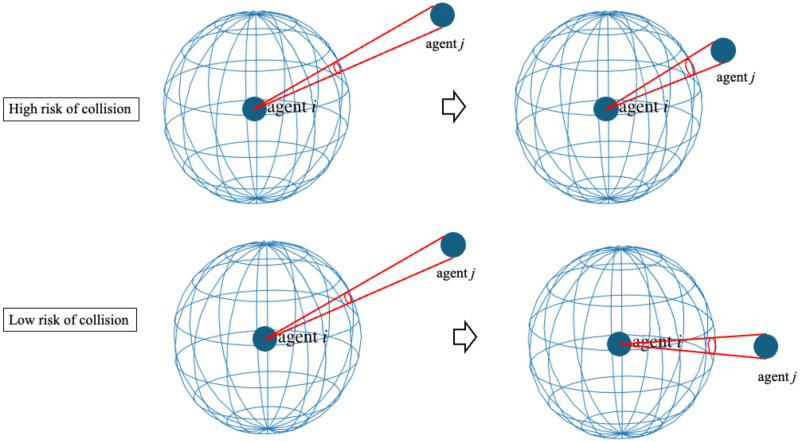
Collision risk on a spherical screen
- [1] P. Fiorini and Z. Shiller, “Motion planning in dynamic environments using velocity obstacles,” Int. J. Rob. Res., Vol.17, No.7, pp. 760-772, 1998. https://doi.org/10.1177/027836499801700706
- [2] D. Fox, W. Burgard, and S. Thrun, “The dynamic window approach to collision avoidance,” IEEE Robot. Autom. Mag., Vol.4, No.1, pp. 23-33, 1997. https://doi.org/10.1109/100.580977
- [3] J. van den Berg, M. Lin, and D. Manocha, “Reciprocal velocity obstacles for real-time multi-agent navigation,” Proc. 2008 IEEE Int. Conf. Robot. Autom. (ICRA), pp. 1928-1935, 2008. https://doi.org/10.1109/ROBOT.2008.4543489
- [4] K. E. Bekris, B. Y. Chen, A. M. Ladd, E. Plaku, and L. E. Kavraki, “Multiple query probabilistic roadmap planning using single query planning primitives,” Proc. 2003 IEEE/RSJ Int. Conf. Intell. Robots Syst. (IROS), pp. 656-661, 2003. https://doi.org/10.1109/IROS.2003.1250704
- [5] P. Long, T. Fan, X. Liao, W. Liu, H. Zhang, and J. Pan, “Towards optimally decentralized multi-robot collision avoidance via deep reinforcement learning,” Proc. 2018 IEEE Int. Conf. Robot. Autom. (ICRA), pp. 6252-6259, 2018.
- [6] M. Everett, Y. F. Chen, and J. P. How, “Motion planning among dynamic, decision-making agents with deep reinforcement learning,” Proc. 2018 IEEE/RSJ Int. Conf. Intell. Robots Syst. (IROS), pp. 3052-3059, 2018. https://doi.org/10.1109/IROS.2018.8593871
- [7] D. Hennes, D. Claes, W. Meeussen, and K. Tuyls, “Multi-robot collision avoidance with localization uncertainty,” Proc. 11th Int. Conf. Autonomous Agents and Multiagent Systems, pp. 147-154, 2012.
- [8] D. Claes and K. Tuyls, “Multi-robot collision avoidance in a shared workspace,” Autonomous Robots, Vol.42, pp. 1749-1770, 2018. https://doi.org/10.1007/s10514-018-9726-5
- [9] J. Alonso-Mora, A. Breitenmoser, P. Beardsley, and R. Siegwart, “Reciprocal collision avoidance for multiple car-like robots,” Proc. 2012 IEEE Int. Conf. Robot. Autom. (ICRA), pp. 360-366, 2012. https://doi.org/10.1109/ICRA.2012.6225166
- [10] T. Kano, M. Iwamoto, and D. Ueyama, “Decentralised control of multiple mobile agents for quick, smooth, and safe movement,” Physica A: Statistical Mechanics and its Applications, Vol.572, Article No.125898, 2021. https://doi.org/10.1016/j.physa.2021.125898
- [11] T. Kano, T. Kanno, T. Mikami, and A. Ishiguro, “Active-sensing-based decentralized control of autonomous mobile agents for quick and smooth collision avoidance,” Frontiers in Robotics and AI, Vol.9, Article No.992716, 2022. https://doi.org/10.3389/frobt.2022.992716
- [12] T. Kano, “Review of Interdisciplinary Approach to Swarm Intelligence,” J. Robot. Mechatron., Vol.35, No.4, pp. 890-895, 2023. https://doi.org/10.20965/jrm.2023.p0890
- [13] Y. Yamada, Y. Mibe, Y. Yamamoto, K. Ito, O. Heim, and S. Hiryu, “Modulation of acoustic navigation behaviour by spatial learning in the echolocating bat Rhinolophus ferrumequinum nippon,” Scientific Reports, Vol.10, Article No.10751, 2020. https://doi.org/10.1038/s41598-020-67470-z
- [14] E. Ahissar and E. Assa, “Perception as a closed-loop convergence process,” eLife, Vol.5, Article No.e12830, 2016. https://doi.org/10.7554/eLife.12830
- [15] D. Helbing and P. Molnár, “Social force model for pedestrian dynamics,” Phys. Rev. E, Vol.51, No.5, pp. 4282-4286, 1995. https://doi.org/10.1103/PhysRevE.51.4282
- [16] F. Zanlungo, T. Ikeda, and T. Kanda, “Social force model with explicit collision prediction,” Europhys. Lett., Vol.93, No.6, Article No.68005, 2011. https://doi.org/10.1209/0295-5075/93/68005
- [17] S. Feldmann, K. Veprek, and W. H. Warren, “Formation of lanes and stripes in crossing pedestrian flows using an empirical human model,” EPJ Web Conf., Vol.334, Article No.04011, 2025. https://doi.org/10.1051/epjconf/202533404011
- [18] K. Yoshida, H. Taylor, and W. H. Warren, “The influence of explicit and covert leaders on human crowd motion,” EPJ Web Conf., Vol.334, Article No.04010, 2025. https://doi.org/10.1051/epjconf/202533404010
This article is published under a Creative Commons Attribution-NoDerivatives 4.0 Internationa License.