
Paper:
Precision Control of Paramecium’s Swimming Behaviors for Automatic Object Manipulation
Akitoshi Ito
 and Kenta Tokuyama
Tokyo Denki University
5 Senju Asahi-cho, Adachi-ku, Tokyo 120-8551, Japan

We investigate Paramecium, which exhibits a negative galvanotactic response, as a biological actuator for bio-hybrid micromachines. Object transportation is difficult owing to low behavioral control accuracy, and tool attachment has a low success rate. In this study, control precision was significantly improved to increase collision probability without using mechanical tools. A 10 mm pool with electrode separation and continuous solution exchange was used to suppress pH variation, and the control algorithm was refined to determine the electric field angle from path deviation and swimming velocity. An automatic transportation system driven by a single Paramecium was constructed, in which repeated collisions enabled payload movement. A 330 µm gel particle was autonomously transported for 1.7 cycles along a star-shaped path (with a 3.24 mm side length) over 72 min in a horizontal pool. These results show that reducing control deviation to less than half the body length is critical for autonomous object transportation. This study demonstrates that reducing the behavioral control deviation of Paramecium to less than approximately half its body length is a critical prerequisite for autonomous object transportation.
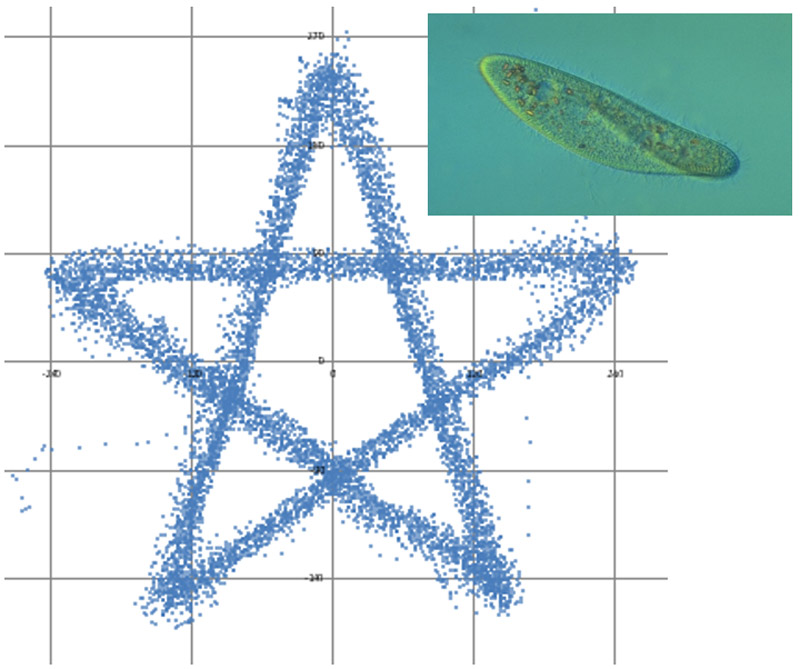
Precision swimming trajectory of a Paramecium
- [1] A. Itoh, “Motion control of protozoa for Bio-MEMS,” IEEE/ASME Trans. Mechatron., Vol.5, No.2, pp. 181-188, 2000. https://doi.org/10.1109/3516.847091
- [2] A. Itoh and W. Tamura, “Object manipulation by a formation-controlled Euglena group,” N. Kato and S. Kamimura (Eds.), “Bio-mechanisms of Swimming and Flying,” pp. 41-52, Springer, 2007. https://doi.org/10.1007/978-4-431-73380-5_4
- [3] H. Yoshida and A. Ito, “Installation of micro operation tool on the living paramecium for micro manipulation,” Proc. 17th JSME Bioeng. Conf., pp. 341-342, 2005 (in Japanese). https://doi.org/10.1299/jsmebs.2004.17.0_341
- [4] H. Yoshizawa, H. Kashimura, and A. Ito, “Motion control of protist using galvanotaxis: Improvements of the motion control property of Paramecium by using electrode rotation type large experimental pool,” Proc. 2013 JSME Conf. Robot. Mechatron. (Robomec), Session No.1A1-A14, 2013 (in Japanese). https://doi.org/10.1299/jsmermd.2013._1A1-A14_1
- [5] H. Yoshizawa and A. Ito, “Motion control of protist using galvanotaxis: Motion control property of Paramecium in the vertical plane,” Proc. 2013 JSME Conf. Robot. Mechatron. (Robomec), Session No.3A1-K04, 2014 (in Japanese). https://doi.org/10.1299/jsmermd.2014._3A1-K04_1
- [6] S. Miwa, H. Yoshizawa, and A. Itoh, “Motion control of protist using galvanotaxis: Transportation of gel object by Paramecium in the vertical plane pool,” Proc. 2015 JSME Conf. Robot. Mechatron. (Robomec), Session No.1P1-S06, 2015 (in Japanese). https://doi.org/10.1299/jsmermd.2015._1P1-S06_1
- [7] T. Kikuchi, S. Miwa, and A. Itoh, “Development of an automatic object transportation algorithm and a soft operation tool made of super gel for Paramecium,” Proc. 2017 JSME Conf. Robot. Mechatron. (Robomec), Session No.2A1-L03, 2017 (in Japanese). https://doi.org/10.1299/jsmermd.2017.2A1-L03
- [8] K. Tokuyama, K. Okubo, and A. Ito, “Establishment of an installing method for attaching a washer-like operation tool to a paramecium,” Proc. 2023 JSME Conf. Robot. Mechatron. (Robomec), Session No.1A1-E17, 2023 (in Japanese). https://doi.org/10.1299/jsmermd.2023.1A1-E17
- [9] T. Ishikawa, T. Morita, and T. Omori, “Soft microswimmer powered by fluid oscillation,” J. Robot. Mechatron., Vol.34, No.2, pp. 298-300, 2022. https://doi.org/10.20965/jrm.2022.p0298
- [10] K. Naniwa, Y. Sugimoto, K. Osuka, and H. Aonuma, “Novel method for analyzing flexible locomotion patterns of animals by using polar histogram,” J. Robot. Mechatron., Vol.32, No.4, pp. 812-821, 2020. https://doi.org/10.20965/jrm.2020.p0812
This article is published under a Creative Commons Attribution-NoDerivatives 4.0 Internationa License.