
Paper:
Pick-and-Place Motion by Two-Robot-Arm System Equipped with Variable-Stiffness and Deformable Link Using Shape-Memory Alloy and Jamming Transition Phenomenon
Kazuto Takashima*,†
 , Yuma Hirose*, Hidetaka Suzuki*, and Hiroki Cho**
*Graduate School of Life Science and Systems Engineering, Kyushu Institute of Technology
2-4 Hibikino, Wakamatsu-ku, Kitakyushu, Fukuoka 808-0196, Japan
†Corresponding author
**Faculty of Environmental Engineering, The University of Kitakyushu
1-1 Hibikino, Wakamatsu-ku, Kitakyushu, Fukuoka 808-0135, Japan

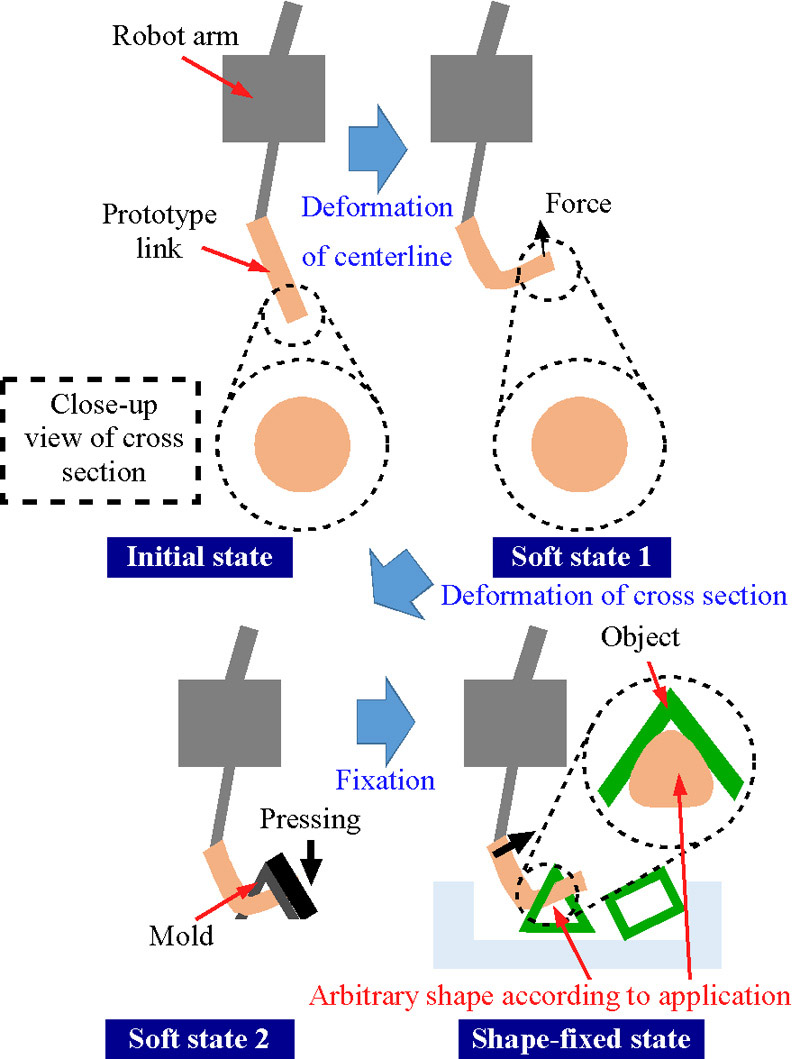
Robotics is applied in various fields and thus robot components with various shapes and stiffness values are required. We previously developed a variable-stiffness and deformable link using a shape-memory alloy and the jamming transition phenomenon. The link can be fixed in an arbitrary shape and then restored to its initial shape via the shape memory effect. We previously attached a prototype link to a robot arm and evaluated its pick-and-place motion for various objects with different shapes and weights. However, as we used a lubricant to facilitate deforming the link, objects sometimes slipped off the link. Therefore, in this study, we propose a method for deforming the link without a lubricant. Another robot arm is added to press a mold onto the link to increase operational efficiency. We compare three deformation methods in terms of the time required to change molds, weight capacity, structural change during repeated motion, force required to deform the link, and positioning accuracy. The experimental results show that the weight capacity increased when the link was deformed without a lubricant. Moreover, similar to our previous study, changing the link shape to suit the target object improved positioning accuracy. Using the two-robot-arm system, the time required to change molds decreased by 94% compared to that in our previous study. Furthermore, the pressing force of the link during the fixing of the shape affected the contact length between the link and the object and the positioning accuracy.
Application of variable-stiffness link
- [1] T. Liu, H. Xia, D.-Y. Lee, A. Firouzeh, Y.-L. Park, and K.-J. Cho, “A positive pressure jamming based variable stiffness structure and its application on wearable robots,” IEEE Robotics and Automation Letters, Vol.6, No.4, pp. 8078-8085, 2021. https://doi.org/10.1109/LRA.2021.3097255
- [2] S. Wolf, G. Grioli, O. Eiberger, W. Friedl, M. Grebenstein, H. Höppner, E. Burdet, D. G. Caldwell, R. Carloni, M. G. Catalano, D. Lefeber, S. Stramigioli, N. Tsagarakis, M. Van Damme, R. Van Ham, B. Vanderborght, L. C. Visser, A. Bicchi, and A. Albu-Schäffer, “Variable stiffness actuators: Review on design and components,” IEEE/ASME Trans. on Mechatronics, Vol.21, No.5, pp. 2418-2430, 2016. https://doi.org/10.1109/TMECH.2015.2501019
- [3] J. Shintake, V. Cacucciolo, D. Floreano, and H. Shea, “Soft robotic grippers,” Adv. Mater., Vol.30, Article No.1707035, 2018. https://doi.org/10.1002/adma.201707035
- [4] D. Rus and M. T. Tolley, “Design, fabrication and control of soft robots,” Nature, Vol.521, No.7553, pp. 467-475, 2015. https://doi.org/10.1038/nature14543
- [5] J. Hughes, U. Culha, F. Giardina, F. Guenther, A. Rosendo, and F. Iida, “Soft manipulators and grippers: A review,” Front. Robot. AI, Vol.3, Article No.69, 2016. https://doi.org/10.3389/frobt.2016.00069
- [6] N. G. Cheng, M. B. Lobovsky, S. J. Keating, A. M. Setapen, K. I. Gero, A. E. Hosoi, and K. D. Iagnemma, “Design and analysis of a robust, low-cost, highly articulated manipulator enabled by jamming of granular media,” Proc. of IEEE Int. Conf. on Robotics and Automation (ICRA), pp. 4328-4333, 2012. https://doi.org/10.1109/ICRA.2012.6225373
- [7] E. Brown, N. Rodenberg, J. Amend, A. Mozeika, E. Steltz, M. R. Zakin, H. Lipson, and H. M. Jaeger, “Universal robotic gripper based on the jamming of granular material,” Proc. Natl. Acad. Sci., Vol.107, No.44, pp. 18809-18814, U.S.A., 2010. https://doi.org/10.1073/pnas.1003250107
- [8] A. Jiang, P. Dasgupta, K. Althoefer, and T. Nanayakkara, “Robotic granular jamming: A new variable stiffness mechanism,” J. of the Robotics Society of Japan, Vol.32, No.4, pp. 333-338, 2014. https://doi.org/10.7210/jrsj.32.333
- [9] T. Nishida, D. Shigehisa, N. Kawashima, and K. Tadakuma, “Development of universal jamming gripper with a force feedback mechanism,” Proc. of 7th Int. Conf. on Soft Computing and Intelligent Systems (SCIS) and 15th Int. Symp. on Advanced Intelligent Systems (ISIS), pp. 242-246, 2014. https://doi.org/10.1109/SCIS-ISIS.2014.7044693
- [10] S. Yamane and S. Wakimoto, “Development of a flexible manipulator with changing stiffness by granular jamming,” Proc. of 24th Int. Conf. on Mechatronics and Machine Vision in Practice (M2VIP), 2017. https://doi.org/10.1109/M2VIP.2017.8211491
- [11] Z. Hu, A. Ahmed, W. Wan, T. Watanabe, and K. Harada, “A stiffness-changeable soft finger based on chain mail jamming,” Proc. of 2023 IEEE Int. Conf. on Robotics and Automation (ICRA), pp. 7405-7411, 2023. https://doi.org/10.1109/ICRA48891.2023.10161061
- [12] M. Yamano, N. Akiba, J. Gong, and H. Furukawa, “Experiments of a two-arm robot using shape memory gel,” Proc. of IEEE/SICE Int. Symp. on System Integration (SII), pp. 236-241, 2012. https://doi.org/10.1109/SII.2012.6426947
- [13] H. Nakai, Y. Hoshino, M. Inaba, and H. Inoue, “Softening deformable robot: Development of shape adaptive robot using phase change of low-melting-point alloy,” J. of the Robotics Society of Japan, Vol.20, No.6, pp. 625-630, 2002 (in Japanese). https://doi.org/10.7210/jrsj.20.625
- [14] X. Li, H. Wang, and S. Zuo, “A novel flexible catheter with integrated magnetic variable stiffness and actuation,” Smart Mater. Struct., Vol.33, No.2, Article No.025028, 2024. https://doi.org/10.1088/1361-665X/ad1dee
- [15] R. Berthold, J. Burgner-Kahrs, M. Wangenheim, and S. Kahms, “Investigating frictional contact behavior for soft material robot simulations,” Meccanica, Vol.58, pp. 2165-2176, 2023. https://doi.org/10.1007/s11012-023-01719-5
- [16] W. McMahan, V. Chitrakaran, M. Csencsits, D. Dawson, I. D. Walker, B. A. Jones, M. Pritts, D. Dienno, M. Grissom, and C. D. Rahn, “Field trials and testing of the OctArm continuum manipulator,” Proc. of 2006 IEEE Int. Conf. on Robotics and Automation (ICRA), pp. 2336-2341, 2006. https://doi.org/10.1109/ROBOT.2006.1642051
- [17] K. Suzumori, “New robotics pioneered by fluid power,” J. Robot. Mechatron., Vol.32, No.5, pp. 854-862, 2020. https://doi.org/10.20965/jrm.2020.p0854
- [18] H. Mochiyama, M. Gunji, and A. Niiyama, “Ostrich-inspired soft robotics: A flexible bipedal manipulator for aggressive physical interaction,” J. Robot. Mechatron., Vol.34, No.2, pp. 212-218, 2022. https://doi.org/10.20965/jrm.2022.p0212
- [19] T. Nakamura, “Fluid-driven soft actuators for soft robots,” J. Robot. Mechatron., Vol.36, No.2, pp. 251-259, 2024. https://doi.org/10.20965/jrm.2024.p0251
- [20] T. P. Chenal, J. C. Case, J. Paik, and R. K. Kramer, “Variable stiffness fabrics with embedded shape memory materials for wearable applications,” Proc. of IROS 2014, pp. 2827-2831, 2014. https://doi.org/10.1109/IROS.2014.6942950
- [21] A. Miriyev, K. Stack, and H. Lipson, “Soft material for soft actuators,” Nat. Commun., Vol.8, Article No.596, 2017. https://doi.org/10.1038/s41467-017-00685-3
- [22] Z. Zhakypov, F. Heremans, A. Billard, and J. Paik, “An origami-inspired reconfigurable suction gripper for picking objects with variable shape and size,” IEEE Robot. Autom. Lett., Vol.3, No.4, pp. 2894-2901, 2018. https://doi.org/10.1109/LRA.2018.2847403
- [23] Y. Piskarev, Y. Sun, M. Righi, Q. Boehler, C. Chautems, C. Fischer, B. J. Nelson, J. Shintake, and D. Floreano, “Fast-response variable-stiffness magnetic catheters for minimally invasive surgery,” Adv. Sci., Vol.11, No.12, Article No.2305537, 2024. https://doi.org/10.1002/advs.202305537
- [24] K. Suzumori, “Overview of the Kakenhi Grant-in-Aid for Scientific Research on Innovative Areas: Science of Soft Robots,” J. Robot. Mechatron., Vol.34, No.2, pp. 195-201, 2022. https://doi.org/10.20965/jrm.2022.p0195
- [25] K. Takashima, D. Iwamoto, S. Oshiro, T. Noritsugu, and T. Mukai, “Characteristics of pneumatic artificial rubber muscle using two shape-memory polymer sheets,” J. Robot. Mechatron., Vol.33, No.3, pp. 653-664, 2021. https://doi.org/10.20965/jrm.2021.p0653
- [26] K. Takashima, Y. Okamura, J. Nagaishi, H. Cho, T. Noritsugu, and T. Mukai, “Development and Application of Shape-Memory Polymer and Alloy Composite Sheets,” J. Robot. Mechatron., Vol.36, No.3, pp. 769-778, 2024. https://doi.org/10.20965/jrm.2024.p0769
- [27] K. Takashima, K. Ota, and H. Cho, “Variable-sensitivity force sensor based on structural modification,” Sensors, Vol.23, No.4, Article No.2077, 2023. https://doi.org/10.3390/s23042077
- [28] K. Takashima, S. Tsuji, and K. Ota, “Variable-sensitivity force sensor utilizing modified cross-sectional shape,” J. Robot. Mechatron., Vol.37, No.4, pp. 895-908, 2025. https://doi.org/10.20965/jrm.2025.p0895
- [29] K. Takashima, T. Imazawa, and H. Cho, “Variable-stiffness and deformable link using shape-memory material and jamming transition phenomenon,” J. Robot. Mechatron., Vol.34, No.2, pp. 466-477, 2022. https://doi.org/10.20965/jrm.2022.p0466
- [30] K. Takashima, H. Suzuki, T. Imazawa, and H. Cho, “Motion evaluation of variable-stiffness link based on shape-memory alloy and jamming transition phenomenon,” J. Robot. Mechatron., Vol.36, No.1, pp. 181-189, 2024. https://doi.org/10.20965/jrm.2024.p0181
- [31] N. Matsumoto, H. Cho, K. Takashima, and H. Suzuki, “Effect of R-phase on shape recovery speed of Ti-Ni shape memory alloy wire for variable-stiffness mechanism using jamming transition phenomenon,” Mech. Eng. J., Vol.11, No.6, Article No.24-00130, 2024. https://doi.org/10.1299/mej.24-00130
- [32] G. S. Chirikjian and J. W. Burdick, “A hyper-redundant manipulator,” IEEE Robot. Autom. Mag., Vol.1, No.4, pp. 22-29, 1994. https://doi.org/10.1109/100.388263
- [33] J. M. Jani, M. Leary, A. Subic, and M. A. Gibson, “A review of shape memory alloy research, applications and opportunities,” Mater. Des., Vol.56, pp. 1078-1113, 2014. https://doi.org/10.1016/j.matdes.2013.11.084
- [34] A. T. Tung, B. H. Park, D. H. Liang, and G. Niemeyer, “Laser-machined shape memory alloy sensors for position feedback in active catheters,” Sens. Actuators A: Phys., Vol.147, pp. 83-92, 2008. https://doi.org/10.1016/J.SNA.2008.03.024
- [35] Y. Haga, T. Mineta, T. Matsunaga, and N. Tsuruoka, “Micro-robotic medical tools employing SMA actuators for use in the human body,” J. Robot. Mechatron., Vol.34, No.6, pp. 1233-1244, 2022. https://doi.org/10.20965/jrm.2022.p1233
- [36] B. Calli, A. Singh, J. Bruce, A. Walsman, K. Konolige, S. Srinivasa, P. Abbeel, and A. M. Dollar, “Yale-CMU-Berkeley dataset for robotic manipulation research,” Int. J. Rob. Res., Vol.36, No.3, pp. 261-268, 2017. https://doi.org/10.1177/0278364917700714
- [37] N. Salomonski, M. Shoham, and G. Grossman, “Light robot arm based on inflatable structure,” CIRP Annals, Vol.44, No.1, pp. 87-90, 1995. https://doi.org/10.1016/S0007-8506(07)62281-1
This article is published under a Creative Commons Attribution-NoDerivatives 4.0 Internationa License.