
Paper:
Autonomous Agricultural Operations on Slope Terrain by Electric Vehicle Platform
Depeng Chen*
 , Michihisa Iida*
, Masashi Ishii**, and Kazuyoshi Nonami***
, Michihisa Iida*
, Masashi Ishii**, and Kazuyoshi Nonami***
*Graduate School of Agriculture, Kyoto University
Kitashirakawa Oiwake-cho, Sakyo-ku, Kyoto, Kyoto 606-8502, Japan
**Yoka Tekko Co., Ltd.
200 Asakura, Yoka-cho, Yabu, Hyogo 667-0024, Japan
***Faculty of Agriculture, Tottori University
4-101 Koyama-cho Minami, Tottori, Tottori 680-0945, Japan

This study proposes an electric crawler-type robot for autonomous weeding operations on steep slopes. We designed a coverage weeding path for autonomous travel for robots using a global navigation satellite system. The machine was designed to adjust the height of both crawlers to address variations in slope. In addition, the path following the deviation error of the robot with different roll angles was measured. The proposed robot demonstrated optimal performance when the roll angle was set to 17.7°, resulting in an average lateral deviation error of 0.02 m and a weeding area coverage of 99.3%.
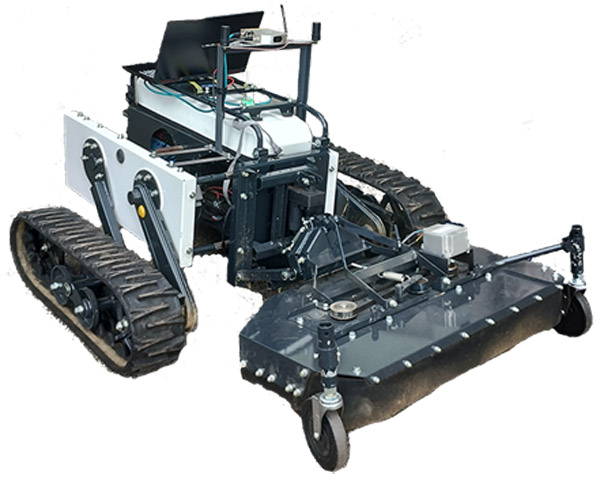
Autonomous electric agricultural robot
- [1] F. Yang et al., “Development and validation of sloped ground pressure prediction model for a tracked tractor in hilly and mountainous environments,” Soil Tillage Res., Vol.241, Article No.106135, 2024. https://doi.org/10.1016/j.still.2024.106135
- [2] H.-P. Liu, F.-Z. Yang, S. Liu, and Y. Lu, “Effect of mechanism of height difference on stability of miniature crawler hillside tractor,” Tract. Farm Transp., Vol.40, No.1, pp. 18-21, 2013 (in Chinese).
- [3] R. Vidoni, M. Bietresato, A. Gasparetto, and F. Mazzetto, “Evaluation and stability comparison of different vehicle configurations for robotic agricultural operations on side-slopes,” Biosyst. Eng., Vol.129, pp. 197-211, 2015. https://doi.org/10.1016/j.biosystemseng.2014.10.003
- [4] L. Yang, S. Kamata, Y. Hoshino, Y. Liu, and C. Tomioka, “Development of EV crawler-type weeding robot for organic onion,” Agriculture, Vol.15, No.1, Article No.2, 2025. https://doi.org/10.3390/agriculture15010002
- [5] Y. Nishimura and T. Yamaguchi, “Grass cutting robot for inclined surfaces in hilly and mountainous areas,” Sensors, Vol.23, No.1, Article No.528, 2023. https://doi.org/10.3390/s23010528
- [6] H.-Y. Hsu et al., “Automatic mowing by an electric agricultural machine,” J. Jpn. Soc. Agric. Mach. Food Eng., Vol.86, No.6, pp. 420-428, 2024 (in Japanese). https://doi.org/10.11357/jsamfe.86.6_420
This article is published under a Creative Commons Attribution-NoDerivatives 4.0 Internationa License.