
Paper:
Developing and Evaluating a Flood Disaster Risk Reduction Education Program Using the Web-GIS Teaching Material “YOU@RISK for Children–Flood”
Toshimitsu Nagata*,**,***,†
 , Tai-Young Yi**, and Reo Kimura**,***
*Niigata Local Meteorological Office, Japan Meteorological Agency
1-2-1 Misaki-cho, Chuo-ku, Niigata, Niigata 950-0954, Japan
**Disaster Resilience Research Division, National Research Institute for Earth Science and Disaster Resilience (NIED)
Tsukuba, Japan
***Faculty and Graduate School of Human Science and Environment, University of Hyogo
Himeji, Japan
†Corresponding author

This study developed a flood disaster risk reduction (DRR) education program using the Web-GIS teaching material “YOU@RISK for Children—Flood,” developed by the National Research Institute for Earth Science and Disaster Resilience, and evaluated its educational effectiveness by implementing it at junior high schools in Niigata Prefecture. This program adopts the three-step structure for flood learning presented in the Practical Guide for Disaster Education (Junior and Senior High School Edition) compiled by the Ministry of Education, Culture, Sports, Science and Technology, and was designed, based on the ADDIE model, which is a framework for instructional design, as a learning program that emphasizes understanding flood risk and making evacuation decisions using map information in an ICT learning environment. The first implementation targeted junior high school students in Murakami City, Niigata Prefecture, an area where flood damage occurred owing to the heavy rainfall in August 2022. Of the 16 items measuring the achievement of learning objectives through self-evaluation, 14 demonstrated significant improvements, while no significant changes were observed in two items related to understanding flood damage and identifying safe evacuation sites. Therefore, the program was improved by revising the visual materials, explanations, and hands-on operation activities, and implemented with junior high school students in Mitsuke City, Niigata Prefecture, an area with a history of flood damage from the July 13, 2004 flood disaster. The results demonstrated significant improvements in all items, including those that depicted limited improvement in the first implementation. In the follow-up surveys at the two schools, the scores of most items remained generally higher than the pre-learning levels, although they declined from the levels immediately after learning. Thus, the findings suggest the effectiveness of this program for flood DRR education targeting junior high school students, particularly in supporting learning from acquiring basic knowledge about floods to evacuation decision-making using map information.
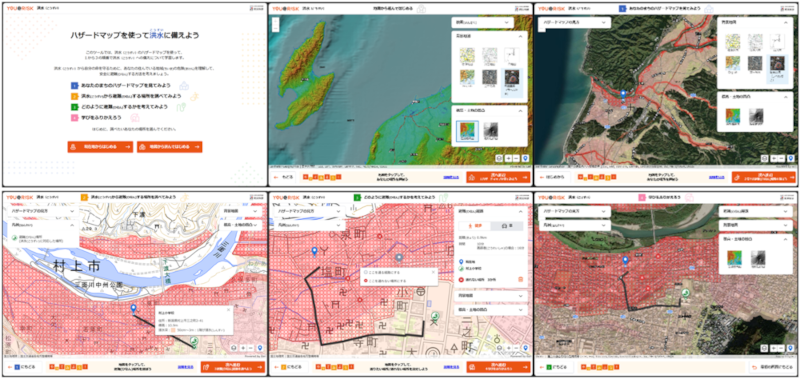
Example screens of “YOU@RISK for Children–Flood”
- [1] Cabinet Office, Government of Japan, “White Paper on Disaster Management 2025,” 2025 (in Japanese).
- [2] Ministry of Education, Culture, Sports, Science and Technology (MEXT), “The third plan for the promotion of school safety,” 2022 (in Japanese).
- [3] MEXT, “Practical guide for disaster education (junior and senior high school edition),” 2024 (in Japanese).
- [4] MEXT, “Education DX roadmap,” 2025 (in Japanese).
- [5] Okayama Prefectural Board of Education, “Report on verification of response in the July 2018 heavy rain disaster,” 2018 (in Japanese).
- [6] Kumamoto Prefectural Board of Education, “Instructional manual for school disaster risk reduction education,” 2018 (in Japanese). https://www.pref.kumamoto.jp/site/kyouiku/9097.html [Accessed April 19, 2026]
- [7] Miyagi Prefectural Board of Education, “Miyagi disaster risk reduction education supplementary reader,” 2026 (in Japanese).
- [8] Niigata Prefectural Board of Education, “Niigata Prefecture disaster risk reduction education program: Flood disaster edition,” 2014 (in Japanese).
- [9] Ministry of Land, Infrastructure, Transport and Tourism (MLIT), “Overlapping hazard maps” (in Japanese). https://disaportal.gsi.go.jp/hazardmap/maps/index.html [Accessed April 19, 2026]
- [10] MLIT, “My timeline guide, ver.1.0,” 2020 (in Japanese).
- [11] K. Iida and Y. Kubota, “Usefulness of 3DCG and physical models in flood forecasting based on understanding topography,” Jpn. J. Educ. Technol., Vol.48, No.1, pp. 191-205, 2024 (in Japanese). https://doi.org/10.15077/jjet.47054
- [12] S. Murakoshi, “Map Literacy of Hazard Maps: An examination from cognitive psychological point of view,” Map (J. Jpn. Cartogr. Assoc.), Vol.63, No.2, pp. 11-26, 2025 (in Japanese). https://doi.org/10.11212/jjca.63.2_11
- [13] A. Maebayashi and G. Urakawa, “A study on the misinterpretation of hazard maps from the perspective of design,” J. Soc. Saf. Sci., No.47, pp. 13-22, 2025 (in Japanese). https://doi.org/10.11314/jisss.47.13
- [14] T. Oda, M. Ikeda, T. Nagata, R. Kimura, and S. Nagamatsu, “Development of an in-service teacher training program for disaster risk reduction in a new compulsory high school geography course in Japan” E-J. GEO, Vol.18, No.2, pp. 199-213, 2023 (in Japanese). https://doi.org/10.4157/ejgeo.18.199
- [15] J. Song, H. Yamauchi, T. Oguchi, and T. Ogura, “Application of web hazard maps to high school education for disaster risk reduction,” Int. J. Disaster Risk Reduct., Vol.72, Article No.102866, 2022. https://doi.org/10.1016/j.ijdrr.2022.102866
- [16] T. Oda, A. Sakurai, T. Sato, C.-H. Lee, and C.-F. Ding, “Enhancing disaster risk reduction at school through the integration of geographic information system: Insights from Taiwan’s school safety GIS platform,” J. Disaster Res., Vol.20, No.5, pp. 746-756, 2025. https://doi.org/10.20965/jdr.2025.p0746
- [17] M. Intaramuean, A. Nonomura, and T. Boonrod, “Empowering flood preparedness: Enhancing flood knowledge, risk perception, and preparedness among primary school learners in flood-affected Southern Thailand,” Prog. Disaster Sci., Vol.26, Article No.100410, 2025. https://doi.org/10.1016/j.pdisas.2025.100410
- [18] M. Ikeda et al., “Development of disaster management education program to enhance disaster response capabilities of schoolchildren during heavy rainfall – Implementation at elementary school in Nagaoka City, Niigata Prefecture, a disaster-stricken area,” J. Disaster Res., Vol.16, No.7, pp. 1121-1136, 2021. https://doi.org/10.20965/jdr.2021.p1121
- [19] K. Suzuki, “Instructional design: Techniques to improve effectiveness, efficiency, and engagement of learning,” IEICE Commun. Soc. Mag., Vol.13, No.2, pp. 110-116, 2019 (in Japanese). https://doi.org/10.1587/bplus.13.110
- [20] T. Inagaki and K. Suzuki, “Instructional design manual for teachers, Ver.2,” Kitaohji Shobo, 2015 (in Japanese).
- [21] T. Nagata, T.-Y. Yi, R. Kimura, and M. Ikeda, “Development of the volcanic disaster risk reduction education program using the ICT tool ‘YOU@RISK Volcanic Disaster Edition’—Practical verification at a junior high school in the Mt. Nasu Area—,” J. Disaster Res., Vol.19, No.5, pp. 793-807, 2024. https://doi.org/10.20965/jdr.2024.p0793
- [22] T. Nagata, M. Ikeda, R. Kimura, and T. Oda, “Development of tsunami disaster risk reduction education program for children with no experience of earthquake disaster – Practice and verification at Shichigahama Town, Miyagi Prefecture,” J. Disaster Res., Vol.17, No.6, pp. 1000-1014, 2022. https://doi.org/10.20965/jdr.2022.p1000
- [23] R. Kimura and K. Aikawa, “Proposal for a disaster management drill program for high school students who have never experienced a disaster to foster a sense of ‘awareness that disaster affects everyone’,” J. Disaster Res., Vol.19, No.1, pp. 124-138, 2024. https://doi.org/10.20965/jdr.2024.p0124
- [24] Y. Hosokawa and R. Kimura, “Study of an educational program aimed at preparing expectant and nursing mothers for disaster,” J. Soc. Saf. Sci., No.44, pp. 111-120, 2024 (in Japanese). https://doi.org/10.11314/jisss.44.111
- [25] T. Higashino and N. Yoshimoto, “Creating an e-learning course for elementary school teachers on cloud observations,” JSSE Res. Rep., Vol.33, No.7, pp. 33-36, 2019 (in Japanese). https://doi.org/10.14935/jsser.33.7_33
- [26] K. Ishii, M. Nakano, and M. Mizutani, “Development of management and career design program in a liberal arts curriculum,” J. JSEE, Vol.65, No.2, pp. 21-25, 2017 (in Japanese). https://doi.org/10.4307/jsee.65.2_21
- [27] R. M. Gagné, W. W. Wager, K. C. Golas, and J. M. Keller, “Principles of instructional design,” Translation supervised by M. Iwasaki and K. Suzuki, Kitaohji Shobo, 2007 (in Japanese).
- [28] National Research Institute for Earth Science and Disaster Resilience, “Disaster risk reduction education literacy HUB” (in Japanese). https://bosai-kyoiku.jp/bousai/189/ [Accessed April 19, 2026]
This article is published under a Creative Commons Attribution-NoDerivatives 4.0 Internationa License.