
Paper:
Culturally Embedded Disaster Education and Intergenerational Preparedness Effects: Evidence from a Disaster Prevention Maena-Based Project on Nias Island, Indonesia
Iwao Kato*,†, Bambang Rudyanto*, and Kenichi Ishibashi**
*Faculty of Economics and Business, Wako University
5-1-1 Kanaigaoka, Machida, Tokyo 195-8585, Japan
†Corresponding author
**Department of Policy Studies, Aichi Gakuin University
Nisshin, Japan

Disaster risk reduction education for children is increasingly recognized as an effective tool to enhance household resilience. This study evaluates a child-centered disaster risk reduction education project implemented on Nias Island, Indonesia, a region highly vulnerable to earthquakes and tsunamis. The intervention integrated disaster preparedness messages into Maena, a traditional communal dance of Nias, embedding risk-reduction learning within local cultural practice. Using a quasi-experimental pre–post design with matched survey data (children: n=1,242; parents: n=415), statistically significant improvements were observed in children’s disaster knowledge and parental awareness and preparedness behaviors. Notably, household preparedness measures increased from 55.2% to 78.8% among parents (χ2=67.6, p<0.001). These findings provide quantitative evidence of intergenerational spillover effects, indicating that culturally grounded child-centered disaster education can transcend classrooms to strengthen family-level and community resilience.
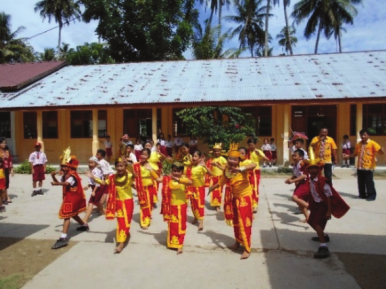
Children performing Disaster Prevention Maena
- [1] L. Guo, M. Fang, L. Liu, H. Chong, W. Zeng, and X. Hu, “The development of disaster preparedness education for public: A scoping review,” BMC Public Health, Vol.25, 2025. https://doi.org/10.1186/s12889-025-21664-0
- [2] C. Mutch, “How schools build community resilience capacity and social capital in disaster preparedness, response and recovery,” Int. J. of Disaster Risk Reduction, Vol.92, Article No.103735, 2023. https://doi.org/10.1016/j.ijdrr.2023.103735
- [3] B. Pfefferbaum, R. L. Pfefferbaum, and R. L. Van Horn, “Involving children in disaster risk reduction: The importance of participation,” European J. of Psychotraumatology, Vol.9, Issue sup2, 2018. https://doi.org/10.1080/20008198.2018.1425577
- [4] A. Sakurai and T. Ito, “Community-based disaster education in Japan: Lessons from local schools,” T. Ito, M. Tamura, A. Kotera, and Y. Ishikawa-Ishiwata (Eds.), “Interlocal Adaptations to Climate Change in East and Southeast Asia,” pp. 89-99, Springer, 2022. https://doi.org/10.1007/978-3-030-81207-2_8
- [5] UNDRR, “Sendai Framework for Disaster Risk Reduction 2015–2030,” United Nations, 2015.
- [6] A. Sakurai and T. Sato, “Promoting education for disaster resilience and the Sendai Framework for Disaster Risk Reduction,” J. Disaster Res., Vol.11, No.3, pp. 402-412, 2016. https://doi.org/10.20965/jdr.2016.p0402
- [7] M. Wahlstrom, “New Sendai Framework strengthens focus on reducing disaster risk,” Int. J. of Disaster Risk Science, Vol.6, pp. 200-201, 2015. https://doi.org/10.1007/s13753-015-0057-2
- [8] T. Mitchell, T. Tanner, and K. Haynes, “Children as agents of change for disaster risk reduction: Lessons from El Salvador and the Philippines,” Children in a Changing Climate Research, Working paper No.1, 2009.
- [9] L. Peek, “Children and disasters: Understanding vulnerability, developing capacities, and promoting resilience – An introduction,” Children, Youth and Environments, Vol.18, No.1, pp. 1-29, 2008.
- [10] W. Adiyoso and H. Kanegae, “Effectiveness of disaster-based school program on students’ earthquake-preparedness,” J. Disaster Res., Vol.8, No.5, pp. 1009-1017, 2013. https://doi.org/10.20965/jdr.2013.p1009
- [11] S. Torani, P. M. Majd, S. S. Maroufi, M. Dowlati, and R. A. Sheikhi, “The importance of education on disasters and emergencies: A review article,” J. of Education and Health Promotion, 2019. https://doi.org/10.4103/jehp.jehp_262_18
- [12] S. Wang and R. Noe, “Knowledge sharing: A review and directions for future research,” Human Resource Management Review, Vol.20, No.2, pp. 115-131, 2010. https://doi.org/10.1016/j.hrmr.2009.10.001
- [13] K. R. Ronan and D. Johnston, “Promoting community resilience in disasters: The role for schools, youth, and families,” Springer, 2005. https://doi.org/10.1007/b102725
- [14] H. Kawasaki, S. Yamasaki, M. M. Rahman, Y. Murata, M. Iwasa, and C. Teramoto, “Teachers-parents cooperation in disaster preparation when schools become as evacuation centers,” Int. J. of Disaster Risk Reduction, Vol.44, Article No.101445, 2020. https://doi.org/10.1016/j.ijdrr.2019.101445
- [15] J. C. Gaillard and J. Mercer, “From knowledge to action: Bridging gaps in disaster risk reduction,” Progress in Human Geography, Vol.37, No.1, pp. 93-114, 2013. https://doi.org/10.1177/0309132512446717
- [16] T. Matsukai and N. Itoigawa, “A research for effect that the disaster experience learning of the child at the disaster experience facility gives to a child and the parent—Tokyo Life Safety Learning Center as a target,” J. of Social Safety Science, Vol.31, 2017 (in Japanese). https://doi.org/10.11314/jisss.31.125
- [17] Y. Tsuchida, “Internationalization of the school and education on disaster prevention – Based on case study of primary school A in Ichihara,” Bulletin of the Faculty of Education, Chiba University, Vol.63, pp. 205-211, 2015 (in Japanese).
- [18] M. Rahmani, A. Muzwagi, and A. J. Pumariega, “Cultural factors in disaster response among diverse children and youth around the world,” Current Psychiatry Reports, Vol.24, pp. 481-491, 2022. https://doi.org/10.1007/s11920-022-01356-x
- [19] H. Ogawa, T. Ishikawa, and N. Imura, “Production of a picture book as disaster prevention education in early stage, based on evaluation of teachers and practice in kindergarten – Efforts to improve people’s ability for earthquake disaster prevention part 3,” Summaries of Technical Papers of Annual Meeting, Architectural Institute of Japan, 2006 (in Japanese).
- [20] Cabinet Office Japan (Disaster Management Office Japan), “Implementation handbook for disaster resilience education at the regional level,” Government of Japan, 2015 (in Japanese).
- [21] M. Mort, I. Rodriguez-Giralt, and A. Delicado, “Children and young people’s participation in disaster risk reduction, agency and resilience,” Policy Press, 2020. https://doi.org/10.51952/9781447354437
- [22] S. A. Sutton, D. Paton, P. Buergelt, S. Sagala, and E. Meilianda, “Sustaining a transformative disaster risk reduction strategy: Grandmothers’ telling and singing tsunami stories for over 100 years saving lives on Simeulue Island,” Int. J. of Environmental Research and Public Health, Vol.17, Issue 21, Article No.7764, 2020. https://doi.org/10.3390/ijerph17217764
- [23] E. N. Aroyandini, Supriyadi, A. Rusilowati, and Hartono, “The influence of disaster knowledge elaboration on disaster education implementation,” J. Disaster Res., Vol.20, No.2, pp. 215-221, 2025. https://doi.org/10.20965/jdr.2025.p0215
- [24] J. Tulius, “Lesson from the past, knowledge for the future: Roles of human memories in earthquake and tsunami narratives in Mentawai, Indonesia,” Paradigma: Jurnal Kajian Budaya, Vol.10, No.2, 2020. https://doi.org/10.17510/paradigma.v10i2.396
- [25] Juhadi, N. Hamid, E. Trihatmoko, M. Herlina, and E. N. Aroyandini, “Developing a model for disaster education to improve students’ disaster mitigation literacy,” J. Disaster Res., Vol.16, No.8, pp. 1243-1256, 2021. https://doi.org/10.20965/jdr.2021.p1243
- [26] M. Rusydi, Y. Mudin, Rahmawati, and Sabhan, “Disaster preparedness using local wisdom approach in Palu City,” J. Disaster Res., Vol.18, No.8, pp. 852-858, 2023. https://doi.org/10.20965/jdr.2023.p0852
- [27] A. Wardekker, S. Nath, and T. U. Handayaningsih, “The interaction between cultural heritage and community resilience in disaster-affected volcanic regions,” Environmental Science and Policy, Vol.145, pp. 116-128, 2023. https://doi.org/10.1016/j.envsci.2023.04.008
- [28] M. Chen and C. Wu, “Integrating science, technology, engineering, and mathematics (STEM) into indigenous education for sustainability: The development and implementation of a curriculum based on disaster prevention for young children,” Sustainability, Vol.16, Issue 21, 2024. https://doi.org/10.3390/su16219186
- [29] A. Bandura, “Self-efficacy: Toward a unifying theory of behavioral change,” Psychological Review, Vol.84, No.2, pp. 191-215, 1977. https://psycnet.apa.org/doi/10.1037/0033-295X.84.2.191
- [30] L. G. H. Midtbust, A. Dyregrov, and H. W. Djup, “Communicating with children and adolescents about the risk of natural disasters,” European J. of Psychotraumatology, Vol.9, Issue sup2, 2018. https://doi.org/10.1080/20008198.2018.1429771
- [31] M. Yasuda, R. Saito, and T. Muramoto, “Sustainability of disaster preparedness education effects in elementary school children and its diffusion effects on families: A comparison between coastal and inland schools,” J. of Natural Disaster Science, Vol.40, No.S08, pp. 125-142, 2021 (in Japanese). https://doi.org/10.24762/jndsj.40.S08_125
- [32] E. Eda, K. Maebayashi, M. Shibata, and A. Tanaka, “A survey study on disaster education and preparation at home: Focusing on the differences between men and women in the household,” Research J. of Disaster Education, Vol.3, No.1, pp. 97-106, 2022 (in Japanese). https://doi.org/10.51004/rjde.3.1_97
- [33] T. Harada, M. Shoji, and Y. Takafuji, “Intergenerational spillover effects of school-based disaster education: Evidence from Indonesia,” Int. J. of Disaster Risk Reduction, Vol.85, Article No.103505, 2023. https://doi.org/10.1016/j.ijdrr.2022.103505
This article is published under a Creative Commons Attribution-NoDerivatives 4.0 Internationa License.