
Review:
Methodological Advances in Longitudinal Life Recovery Research: Connecting the Natori Panel to Global Evidence
Shosuke Sato*,†
 and Shigeo Tatsuki**,***
*International Institute of Disaster Science, Tohoku University
468-1 Aramaki Aza-Aoba, Aoba-ku, Sendai, Miyagi 980-8572, Japan
†Corresponding author
**Doshisha University
Kyoto, Japan
***Research Center, Institute of Social Safety Science
Tokyo, Japan

This study reviews methodological developments in quantitative life recovery research in Japan, focusing on longitudinal approaches developed after the 2011 Great East Japan Earthquake. Rather than conducting a systematic review, this study provides a focused methodological synthesis centered on panel studies conducted in Natori City, Miyagi Prefecture. The review traces the evolution of analytical strategies from cross-sectional designs established after the 1995 Hanshin-Awaji Earthquake to advanced causal inference techniques, including propensity score matching, fixed-effects models, and synthetic control methods. These methodological advances enabled scholars to transcend descriptive correlations toward identifying causal mechanisms and dynamic recovery processes. The findings demonstrate that recovery disparities are driven primarily by pre-existing inequalities, that recovery follows non-linear trajectories, and that social ties and meaning-making processes play evolving roles over time. Furthermore, policy evaluations indicate that disaster case management significantly accelerates housing recovery. These findings are consistent with broader global evidence from epidemiological and social science research. By situating the Natori Panel within this wider body of knowledge, this study highlights how methodological advances contribute to the development of evidence-based disaster recovery policy.
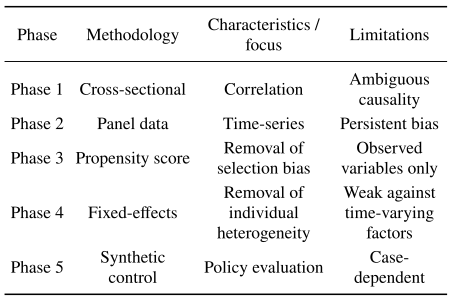
Phases of methodology in life recovery research
- [1] S. Tatsuki, “Long-term life recovery processes among survivors of the 1995 Kobe Earthquake: 1999, 2001, 2003, and 2005 life recovery social survey results,” J. Disaster Res., Vol.2, No.6, pp. 484-501, 2007. https://doi.org/10.20965/jdr.2007.p0484
- [2] S. Kino, J. Aida, K. Kondo, and I. Kawachi, “Long-term trends in mental health among older adults after the Great East Japan Earthquake: A longitudinal study,” JAMA Netw. Open, Vol.3, No.8, Article No. e2013437, 2020. https://doi.org/10.1001/jamanetworkopen.2020.13437
- [3] R. Goodwin, K. Sugiyama, S. Sun, M. Takahashi, and J. Aida, “Trajectories of psychological distress after the Great East Japan Earthquake: A five-wave longitudinal study,” Clin. Psychol. Sci., Vol.8, No.1, pp. 34-48, 2020. https://doi.org/10.1177/2167702620949156
- [4] S. Tatsuki and H. Hayashi, “Seven critical element model of life recovery: General linear model analyses of the 2001 Kobe panel survey data,” Proc. of the 2nd Workshop for Comparative Study on Urban Earthquake Disaster Management, pp. 27-46, 2002.
- [5] S. Tatsuki and F. Kawami, “Longitudinal impacts of pre-existing inequalities and social environmental changes on life recovery: Results of the 1995 Kobe Earthquake and the 2011 Great East Japan Earthquake recovery studies,” Int. J. Mass Emerg. Disasters, Vol.41, No.1, pp. 94-120, 2023. https://doi.org/10.1177/02807270231171504
- [6] Cabinet Office, “Transitions in emergency temporary housing following the Great East Japan Earthquake (Occupancy),” 2013 (in Japanese). https://www.bousai.go.jp/kaigirep/kentokai/hisaishashien2/wg/pdf/dai4kai/siryo2.pdf [Accessed February 29, 2025]
- [7] A. Matsukawa, F. Kawami, S. Sato, and S. Tatsuki, “A study of life recovery using a fixed effect model: Using the 2014, 2015, 2016, and 2017 Natori City survey four-wave panel data,” J. Soc. Saf. Sci., No.37, pp. 401-411, 2020 (in Japanese). https://doi.org/10.11314/jisss.37.401
- [8] F. Kawami, A. Matsukawa, S. Sato, and S. Tatsuki, “Did the designated temporary housing policy promote housing recovery?: Causal inference by using Natori City data,” J. Soc. Saf. Sci., No.35, pp. 217-224, 2019 (in Japanese). https://doi.org/10.11314/jisss.35.217
- [9] A. Kuromiya, S. Tatsuki, H. Hayashi, T. Noda, K. Tamura, and R. Kimura, “Four recovery patterns from the Hanshin-Awaji Earthquake: Using the 2001-2003-2005 panel data,” J. Nat. Dis. Sci., Vol.28, No.2, pp. 43-60, 2006. https://doi.org/10.2328/jnds.28.43
- [10] S. Fujimoto, F. Kawami, A. Matsukawa, S. Sato, and S. Tatsuki, “Pre-existing inequalities, post-event social environmental changes, and long-term trajectories of life recovery: Findings from Five-Wave Natori City Life Recovery Panel Survey,” J. Disaster Res., Vol.17, No.2, pp. 207-216, 2022. https://doi.org/10.20965/jdr.2022.p0207
- [11] F. Kawami and S. Tatsuki, “The effect of disaster case management on housing recovery: Analysis of disaster survivor support in Sendai City using synthetic control method,” J. Archit. Plan. (Trans. AIJ), Vol.87, No.797, pp. 1282-1293, 2022 (in Japanese). https://doi.org/10.3130/aija.87.1282
- [12] F. Kawami and S. Tatsuki, “The effect of disaster case management on housing recovery: Analysis of disaster survivor support in Sendai City using the synthetic control method,” Jpn. Archit. Rev., Vol.8, Article No.e70007, 2025. https://doi.org/10.1002/2475-8876.70007
- [13] X. Li, J. Aida, H. Hikichi, K. Kondo, and I. Kawachi, “Postdisaster depression and posttraumatic stress disorder and mortality among older survivors of the Great East Japan Earthquake,” JAMA Netw. Open, Vol.2, No.12, Article No.e1917550, 2019. https://doi.org/10.1001/jamanetworkopen.2019.17550
- [14] Y. Uchida, Y. Takahashi, and K. Kawahara, “Changes in hedonic and eudaimonic well-being after a severe nationwide disaster: The case of the Great East Japan Earthquake,” J. Happiness Stud., Vol.15, No.1, pp. 207-221, 2014. https://doi.org/10.1007/s10902-013-9463-6
- [15] D. P. Aldrich, “Building resilience: Social capital in post-disaster recovery,” University of Chicago Press, 2012.
- [16] A. Portes, “Social capital: Its origins and applications in modern sociology,” Annu. Rev. Sociol., Vol.24, No.1, pp. 1-24, 1998. https://doi.org/10.1146/annurev.soc.24.1.1
- [17] A. Portes, “The two meanings of social capital,” Sociol. Forum, Vol.15, No.1, pp. 1-12, 2000.
- [18] W. G. Peacock, S. Van Zandt, Y. Zhang, and W. E. Highfield, “Inequities in long-term housing recovery after disasters,” J. Am. Plan. Assoc., Vol.80, No.4, pp. 356-371, 2014. https://doi.org/10.1080/01944363.2014.980440
- [19] M. S. Granovetter, “The strength of weak ties,” Am. J. Sociol., Vol.78, No.6, pp. 1360-1380, 1973. https://doi.org/10.1086/225469
- [20] E. Ostrom, “Governing the commons: The evolution of institutions for collective action,” Cambridge University Press, 1990.
- [21] S. Sato, “Verification of three aspects of social response for 10 years after the Great East Japan Earthquake disaster,” J. Jpn. Soc. Nat. Dis. Sci., Vol.40, No.4, pp. 405-419, 2022 (in Japanese).
- [22] S. Ando, H. Kuwabara, T. Araki et al., “Mental health problems in children and adolescents after the Great East Japan Earthquake: A systematic review,” Harv. Rev. Psychiatry, Vol.25, No.1, pp. 15-28, 2017. https://doi.org/10.1097/hrp.0000000000000124
This article is published under a Creative Commons Attribution-NoDerivatives 4.0 Internationa License.