
Review:
Artificial Island Development as a Climate Change Adaptation Measure for Atoll Countries: A Country-by-Country Review
Mikiyasu Nakayama†
 , Yuto Kunitake
, Emiri Iwasaki, and Sae Koyama
, Yuto Kunitake
, Emiri Iwasaki, and Sae Koyama
Global Infrastructure Fund Research Foundation Japan
Shiodome City Center 5F, 1-5-2 Higashi Shimbashi, Minato-ku, Tokyo 105-7105, Japan
†Corresponding author

Low-lying atoll countries face existential threats from climate change, including sea-level rise, freshwater contamination, and coastal erosion. This review examines artificial island development as a transformational adaptation strategy for four atoll countries (the Maldives, Kiribati, the Marshall Islands, and Tuvalu) through a comparative analysis evaluating technical, financial, legal, and governance dimensions. Our findings reveal that artificial island development is technically achievable, as demonstrated by the Maldives’ Hulhumalé project, which has created approximately 4 km2 of elevated land at twice the elevation of natural islands. However, implementation feasibility varies substantially across nations depending on governance structures and land-tenure systems. Centralized state ownership in the Maldives enables rapid implementation, while customary land tenure in Pacific nations presents significant barriers. Financial requirements vastly exceed domestic fiscal capacities, with estimated adaptation costs ranging from hundreds of millions to billions of U.S. dollars, necessitating substantial international climate finance. The review identifies critical environmental trade-offs, because dredging operations damage coral reef ecosystems, which provide natural coastal protection, and highlights unresolved legal uncertainties under the United Nations Convention on the Law of the Sea (UNCLOS) regarding maritime zones and sovereignty preservation. Despite these challenges, artificial islands offer a pathway to honor atoll communities’ “right to stay” in their homelands, although successful implementation requires integrated governance reform, sustained international financing, and environmental safeguards in addition to engineering solutions.
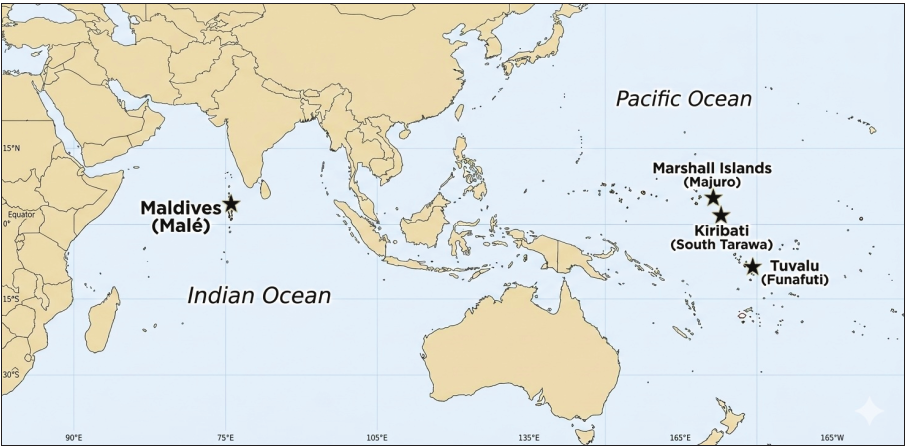
The four atoll countries reviewed
- [1] C. D. Storlazzi, S. B. Gingerich, A. van Dongeren et al., “Most atolls will be uninhabitable by the mid-21st century because of sea-level rise exacerbating wave-driven flooding,” Sci. Adv., Vol.4, No.4, Article No.eaap9741, 2018. https://doi.org/10.1126/sciadv.aap9741
- [2] R. T. Bailey, J. W. Jenson, and A. E. Olsen, “Numerical modeling of atoll island hydrogeology,” Groundwater, Vol.47, Issue 2, pp. 184-196, 2009. https://doi.org/10.1111/j.1745-6584.2008.00520.x
- [3] I. White and T. Falkland, “Management of freshwater lenses on small Pacific islands,” Hydrogeol. J., Vol.18, No.1, pp. 227-246, 2010. https://doi.org/10.1007/s10040-009-0525-0
- [4] F. Ferrario, M. W. Beck, C. D. Storlazzi et al., “The effectiveness of coral reefs for coastal hazard risk reduction and adaptation,” Nat. Commun., Vol.5, Article No.3794, 2014. https://doi.org/10.1038/ncomms4794
- [5] C. T. Perry, L. Alvarez-Filip, N. A. J. Graham et al., “Loss of coral reef growth capacity to track future increases in sea level,” Nature, Vol.558, No.7710, pp. 396-400, 2018. https://doi.org/10.1038/s41586-018-0194-z
- [6] IPCC, “Climate change: The physical science basis,” V. Masson-Delmotte et al. (Eds.), “Contribution of Working Group I to the Sixth Assessment Report of the Intergovernmental Panel on Climate Change,” Cambridge University Press, 2021. https://doi.org/10.1017/9781009157896
- [7] Intergovernmental Panel on Climate Change, “IPCC special report on the ocean and cryosphere in a changing climate,” Cambridge University Press, 2019. https://www.ipcc.ch/site/assets/uploads/sites/3/2019/12/SROCC_FullReport_FINAL.pdf [Accessed July 14, 2026]
- [8] T. P. Hughes, K. D. Anderson, S. R. Connolly et al., “Spatial and temporal patterns of mass bleaching of corals in the Anthropocene,” Science, Vol.359, No.6371, pp. 80-83, 2018. https://doi.org/10.1126/science.aan8048
- [9] O. Hoegh-Guldberg, E. S. Poloczanska, W. Skirving et al., “Coral reef ecosystems under climate change and ocean acidification,” Front. Mar. Sci., Vol.4, Article No.158, 2017. https://doi.org/10.3389/fmars.2017.00158
- [10] Australian Bureau of Meteorology, CSIRO, “Climate variability, extremes and change in the western tropical Pacific,” Pacific-Australia Climate Change Science and Adaptation Planning Program, 2014. https://www.pacificclimatechangescience.org/wp-content/uploads/2014/07/PACCSAP_CountryReports2014_WEB_140710.pdf [Accessed July 14, 2026]
- [11] T. Knutson, S. J. Camargo, J. C. L. Chan et al., “Tropical cyclones and climate change assessment: Part II,” Bull. Am. Meteorol. Soc., Vol.101, Issue 3, pp. E303-E322, 2020. https://doi.org/10.1175/BAMS-D-18-0194.1
- [12] Government of Kiribati, “Kiribati 2015 population and housing census,” National Statistics Office, 2016. https://microdata.pacificdata.org/index.php/catalog/199 [Accessed July 14, 2026]
- [13] National Bureau of Statistics, “Statistical yearbook of Maldives 2022,” Government of Maldives, 2022. https://statisticsmaldives.gov.mv/yearbook/2022/ [Accessed July 14, 2026]
- [14] J. D. Bell, I. Senina, T. Adams et al., “Pathways to sustaining tuna-dependent Pacific Island economies during climate change,” Nat. Sustain., Vol.4, No.10, pp. 900-910, 2021. https://doi.org/10.1038/s41893-021-00745-z
- [15] Ministry of Tourism, “Tourism yearbook 2022,” Government of Maldives, 2022. https://www.tourism.gov.mv/en/statistics/dashboard [Accessed July 14, 2026]
- [16] Asian Development Bank, “Climate risk country profile: Kiribati,” Asian Development Bank, 2020. https://climateknowledgeportal.worldbank.org/sites/default/files/2021-06/15816-WB_Kiribati%20Country%20Profile-WEB.pdf [Accessed July 14, 2026]
- [17] C. D. Storlazzi, E. P. L. Elias, and P. Berkowitz, “Many atolls may be uninhabitable within decades due to climate change,” Sci. Rep., Vol.5, Article No.14546, 2015. https://doi.org/10.1038/srep14546
- [18] J. Crawford, “The creation of states in international law,” 2nd Edition, Oxford University Press, 2006. https://doi.org/10.1093/acprof:oso/9780199228423.001.0001
- [19] R. Rayfuse, “W(h)ither Tuvalu? International law and disappearing states,” UNSW Law Research Paper, No.2009-9, 2009.
- [20] J. McAdam, “Climate change, forced migration, and international law,” Oxford University Press, 2012. https://doi.org/10.1093/acprof:oso/9780199587087.001.0001
- [21] K. M. Teaiwa, “Consuming Ocean Island: Stories of people and phosphate from Banaba,” Indiana University Press, 2015.
- [22] United Nations (UN) General Assembly, “Global compact for safe, orderly and regular migration,” A/RES/73/195, 2018. https://docs.un.org/en/A/RES/73/195 [Accessed July 14, 2026]
- [23] International Court of Justice (ICJ), “Advisory opinion on the obligations of states in respect of climate change,” 2025. https://icj-web.leman.un-icc.cloud/sites/default/files/case-related/187/187-20250723-adv-01-00-en.pdf [Accessed July 14, 2026]
- [24] M. Burkett, “The nation ex-situ: On climate change, deterritorialized nationhood and the post-climate era,” Clim. Law, Vol.2, No.3, pp. 345-374, 2011. https://doi.org/10.3233/CL-2011-040
- [25] Government of Australia and Government of Tuvalu, “Australia-Tuvalu Falepili Union Treaty,” Signed at Rarotonga, 9 November 2023; entered into force 28 August 2024. https://www.dfat.gov.au/geo/tuvalu/australia-tuvalu-falepili-union-treaty/treaty-text-falepili-union [Accessed July 14, 2026]
- [26] H.-O. Pörtner et al. (Eds.), “Climate Change 2022: Impacts, Adaptation, and Vulnerability: Contribution of Working Group II to the Sixth Assessment Report of the Intergovernmental Panel on Climate Change,” Cambridge University Press, 2022. https://doi.org/10.1017/9781009325844
- [27] P. D. Nunn, “Responding to the challenges of climate change in the Pacific Islands,” Clim. Res., Vol.40, pp. 211-231, 2009. https://doi.org/10.3354/cr00806
- [28] M. Mycoo, M. Wairiu, D. Campbell et al., “Small islands,” H.-O. Pörtner et al. (Eds.), “Climate Change 2022: Impacts, Adaptation, and Vulnerability: Contribution of Working Group II to the Sixth Assessment Report of the Intergovernmental Panel on Climate Change,” Cambridge University Press, pp. 2043-2121, 2022. https://doi.org/10.1017/9781009325844.017
- [29] A. K. Naylor, “Island morphology, reef resources, and development paths in the Maldives,” Prog. Phys. Geogr., Vol.39, Issue 6, pp. 728-749, 2015. https://doi.org/10.1177/0309133315598269
- [30] I. Saunders, “Artificial islands and territory in international law,” Vanderbilt J. Transnatl. Law, Vol.52, Issue 3, pp. 643-689, 2019.
- [31] A. H. A. Soons, “Artificial islands and installations in international law,” Occasional Paper, No. 22, Law of the Sea Institute, 1974. https://repository.library.noaa.gov/view/noaa/9935 [Accessed July 14, 2026]
- [32] C. M. Wang, E. Watanabe, and T. Utsunomiya (Eds.), “Very large floating structures,” Taylor and Francis, 2008. https://doi.org/10.1201/9781482265927
- [33] N. Lister and E. Muk-Pavic, “Sustainable artificial island concept for the Republic of Kiribati,” Ocean Eng., Vol.98, pp. 78-87, 2015. https://doi.org/10.1016/j.oceaneng.2015.01.013
- [34] A. Sakamoto, K. Nishiya, X. Guo et al., “Mitigating impacts of climate change induced sea level rise by infrastructure development: Case of the Maldives,” J. Disaster Res., Vol.17, No.3, pp. 327-334, 2022. https://doi.org/10.20965/jdr.2022.p0327
- [35] G. Díaz Musmanni, “Hulhumalé, Maldives: Monumental climate adaptation effort raises hope in a threatened paradise,” Global Center on Adaptation, February 25, 2022. https://gca.org/hulumale-maldives-monumental-climate-adaptation-effort-raises-hope-in-a-threatened-paradise/ [Accessed January 20, 2026]
- [36] R. J. Nicholls, D. Lincke, J. Hinkel et al., “A global analysis of subsidence, relative sea-level change and coastal flood exposure,” Environ. Res. Clim., Vol.2, No.1, Article No.012001, 2023. https://doi.org/10.1088/2752-5295/ac8594
- [37] P. L. A. Erftemeijer, B. Riegl, B. W. Hoeksema et al., “Environmental impacts of dredging and other sediment disturbances on corals: A review,” Mar. Pollut. Bull., Vol.64, Issue 9, pp. 1737-1765, 2012. https://doi.org/10.1016/j.marpolbul.2012.05.008
- [38] V. K. E. Duvat, “Human-driven atoll island expansion in the Maldives,” Anthropocene, Vol.32, Article No.100265, 2020. https://doi.org/10.1016/j.ancene.2020.100265
- [39] M. Montefalcone, C. Morri, C. N. Bianchi et al., “Synergic effect of global thermal anomalies and local dredging activities on coral reefs of the Maldives,” Mar. Pollut. Bull., Vol.160, 111585, 2020. https://doi.org/10.1016/j.marpolbul.2020.111585
- [40] Green Climate Fund, “Enhancing access to climate finance for small island developing states,” 2024. https://www.greenclimate.fund/event/enhancing-access-climate-finance-small-island-developing-states [Accessed July 14, 2026]
- [41] Climate Policy Initiative, “State and trends of climate adaptation finance in small island developing states,” Climate Policy Initiative, 2025. https://www.climatepolicyinitiative.org/publication/state-and-trends-of-climate-adaptation-finance-in-small-island-developing-states/? [Accessed July 14, 2026]
- [42] L. A. Nurse, R. F. McLean, J. Agard et al., “Small islands,” V. R. Barros, C. B. Field, D. J. Dokken et al. (Eds.) “Climate change 2014: Impacts, adaptation, and vulnerability,” pp. 1613-1654, Cambridge University Press, 2014. https://www.ipcc.ch/site/assets/uploads/2018/02/WGIIAR5-Chap29_FINAL.pdf [Accessed July 14, 2026]
- [43] A. Thomas and L. Benjamin, “Policies and mechanisms to address climate-induced migration in Pacific and Caribbean small island developing states,” Int. J. Clim. Chang. Strateg. Manag., Vol.10, Issue 1, pp. 86-104, 2017. https://doi.org/10.1108/IJCCSM-03-2017-0055
- [44] Coalition of Atoll Nations on Climate Change (CANCC), “Funafuti Declaration,” Funafuti (TV), October 7, 2016. https://mfed.gov.ki/sites/default/files/2025-06/Funafuti%20Declaration%20Signed%208%20Oct%202016.pdf [Accessed July 14, 2026]
- [45] L. Yamamoto and M. Esteban, “Atoll island states and international law,” Springer, 2014. http://ndl.ethernet.edu.et/bitstream/123456789/77531/1/35.pdf [Accessed July 14, 2026]
- [46] World Bank, “World Development Indicators 2023,” World Bank, 2023. https://databank.worldbank.org/source/world-development-indicators [Accessed July 14, 2026]
- [47] Central Intelligence Agency (CIA), “The World Factbook 2024,” 2024. https://www.cia.gov/the-world-factbook/ [Accessed July 14, 2026]
- [48] Pacific Community, “Pacific Data Hub 2023,” SPC, 2023. https://pacificdata.org/ [Accessed July 14, 2026]
- [49] Permanent Mission of the Republic of the Marshall Islands to the United Nations, “Country Facts,” United Nations. https://www.un.int/marshallislands/marshallislands/country-facts [Accessed January 20, 2026]
- [50] Malé City Council, “Statistics,” Malé City Council, 2026. https://malecity.gov.mv/en/statistics [Accessed January 20, 2026]
- [51] “South Tarawa – Population trends and demographics,” CityFacts. https://www.city-facts.com/tarawa/population [Accessed January 20, 2026]
- [52] M. Issitt, “Majuro, Marshall Islands,” EBSCO Information Services, 2025. https://www.ebsco.com/research-starters/geography-and-cartography/majuro-marshall-islands [Accessed January 20, 2026]
- [53] World Population Review, “Funafuti population 2025,” World Population Review, 2025. https://worldpopulationreview.com/cities/tuvalu/funafuti [Accessed January 20, 2026]
- [54] UNESCO World Heritage Centre, “The Pacific atoll-island cultural landscape of Tuvalu,” UNESCO, January 24, 2024. https://whc.unesco.org/en/tentativelists/6707/ [Accessed January 20, 2026]
- [55] D. Storey and S. Hunter, “Kiribati: An environmental ‘perfect storm’,” Aust. Geogr., Vol.41, Issue 2, pp. 167-181, 2010. https://doi.org/10.1080/00049181003742294
- [56] J. Connell, “Vulnerable islands: Climate change, tectonic change, and changing livelihoods in the Western Pacific,” Contemp. Pac., Vol.27, No.1, pp. 1-36, 2015. https://doi.org/10.1353/cp.2015.0014
- [57] Constitution of the Republic of Maldives, “Article 238,” 2008. https://faolex.fao.org/docs/pdf/mdv136135.pdf [Accessed July 14, 2026]
- [58] World Bank, “South Tarawa Water Supply Project (STWSP): Project information document – Integrated safeguards data sheet,” Report No.P162938, World Bank, 2018. https://documents.worldbank.org/en/publication/documents-reports/documentdetail/396751536746086581 [Accessed July 14, 2026]
- [59] L. M. Carucci, “Nuclear nativity: rituals of renewal and empowerment in the Marshall Islands,” Northern Illinois University Press, 1997.
- [60] B. R. Johnston (Ed.), “Half-lives, half-truths, and other radioactive legacies of the Cold War,” School for Advanced Research Press, 2007. https://sarpress.org/wp-content/uploads/2017/07/sar_press_half_live_and_half_truths.pdf [Accessed July 14, 2026]
- [61] “Falekaupule Act 1997,” Laws of Tuvalu, Chapter 4.08, 1997. https://faolex.fao.org/docs/pdf/tuv169401.pdf [Accessed July 14, 2026]
- [62] Housing Development Corporation, “Hulhumalé Phase II master plan,” HDC Ltd., 2019. https://www.hdc.mv/app/files//2024/10/Hulhumale-Phase-2-Planning-Development-Guidelines-V_1.0-2.pdf [Accessed January 22, 2026]
- [63] B. K. Sovacool, “Perceptions of climate change risks and resilient island planning in the Maldives,” Mitig. Adapt. Strateg. Glob. Chang., Vol.17, No.7, pp. 731-752, 2012. https://doi.org/10.1007/s11027-011-9341-7
- [64] Government of Kiribati, “Kiribati 20-year vision 2016–2036,” Office of the President, 2018. https://president.gov.ki/images/kiribati-20-year-vision-2016-2036%E2%80%A2sept.final.pdf [Accessed July 14, 2026]
- [65] Government of Tuvalu, “Tuvalu National Adaptation Plan,” Ministry of Home Affairs, Climate Change, and Environment, 2025. https://unfccc.int/sites/default/files/resource/NAP_Tuvalu_2025.pdf [Accessed July 14, 2026]
- [66] Republic of the Marshall Islands, “Adaptation Communication,” Climate Change Directorate, 2020. https://unfccc.int/sites/default/files/resource/RMI-AdaptationCommunication_Dec2020.pdf [Accessed July 14, 2026]
- [67] A. Voiland, “Preparing for rising seas in the Maldives: Satellite image pair February 3, 1997 and February 19, 2020,” NASA Earth Observatory, 2021. https://science.nasa.gov/earth/earth-observatory/preparing-for-rising-seas-in-the-maldives-148158/ [Accessed January 20, 2026]
- [68] J. Chase-Lubitz, “The Maldives is racing to create new land. Why are so many people concerned?,” Nature, April 24, 2024. https://doi.org/10.1038/d41586-024-01157-7
- [69] A. N. Ahmed, “Housing Development Corporation brings city of Hulhumalé to life,” World Finance. https://www.worldfinance.com/infrastructure-investment/housing-development-corporation-bringing-city-of-hulhumale-to-life [Accessed January 20, 2026]
- [70] P. Plewa, “Migration in Maldives: A country profile 2018,” International Organization for Migration, 2018. https://publications.iom.int/books/migration-maldives-country-profile-2018 [Accessed July 14, 2026]
- [71] Housing Development Corporation (HDC), “Commercial space allocation in Hulhumalé,” 2020. https://properties.hdc.mv/storage/assets/HFxTeZPwRI0hVBG9KpOwpaHZH3K06wcNH0pojBWe.pdf [Accessed July 14, 2026]
- [72] Ministry of Finance and Planning, “Housing Development Corporation Limited (HDC),” SOE Gateway, 2026. https://soegateway.finance.gov.mv/soe/hdc [Accessed January 20, 2026]
- [73] A. N. Ahmed, “The Authenti-City of an artificial city,” United Nations Development Programme (UNDP) Maldives, August 10, 2023. https://www.undp.org/maldives/blog/authenti-city-artificial-city [Accessed January 20, 2026]
- [74] I. Wood and B. Hendriksen, “Gulhifalhu reclamation project,” DFSI Magazine, International Association of Dredging Companies, 2025. https://www.iadc-dredging.com/article/gulhifalhu-reclamation-project [Accessed July 14, 2026]
- [75] Ministry of Finance, Republic of Maldives, “Thilafushi International Port Development Project: Project formulation, master planning, design and transaction advisory consultancy,” Ministry of Finance, 2019. https://www.finance.gov.mv/public/attachments/HYpr6wayEVMYWo7hs1ZYwxSruOG1dTWaDwiglBIM.pdf [Accessed July 14, 2026]
- [76] F. Zunaam, “First phase of Gulhifalhu reclamation project completed,” The Times of Addu, January 4, 2021. https://timesofaddu.com/2021/01/04/first-phase-of-gulhifalhu-reclamation-project-completed/ [Accessed January 20, 2026]
- [77] Z. Zalif, “Changes to Gulhifalhu spark widespread public outcry,” Raajje Television, 2025. https://raajje.mv/166144 [Accessed January 20, 2026]
- [78] F. Shaahunaz, “Govt discloses details of mega housing project Vilimalé 2,” The Edition, August 2, 2018. https://edition.mv/news/of-the-world/6705 [Accessed January 20, 2026]
- [79] Ministry of Environment of the Republic of Maldives, “Environmental impact assessment: Greater Malé Waste-to-Energy Project – Waste to Energy Plant Part B (Project No. 51077-003),” Asian Development Bank, 2020. https://www.adb.org/sites/default/files/project-documents/51077/51077-003-eia-en_22.pdf [Accessed July 14, 2026]
- [80] Ministry of Environment and Energy of the Republic of Maldives, “Initial environmental examination: Greater Malé environmental improvement and waste management project (Project No. 51077-002 Draft),” Ministry of Environment and Energy, 2018. https://www.adb.org/sites/default/files/project-documents/51077/51077-002-iee-en_3.pdf [Accessed July 14, 2026]
- [81] Ministry of Environment, Climate Change and Technology, “Environmental impact assessment: Maldives Greater Malé Waste-to-Energy Project – Waste to Energy Plant Part C,” Ministry of Environment, Climate Change and Technology, 2023. https://www.adb.org/sites/default/files/project-documents/51077/51077-003-eia-en_23.pdf [Accessed July 14, 2026]
- [82] United Nations Environment Programme, “Maldives: post-tsunami environmental assessment,” UNEP, September 29, 2005. https://wedocs.unep.org/handle/20.500.11822/8969 [Accessed July 14, 2026]
- [83] Human Rights Watch, “We still haven’t recovered: local communities harmed by reclamation projects in the Maldives,” Human Rights Watch, October 18, 2023. https://www.hrw.org/report/2023/10/18/we-still-havent-recovered/local-communities-harmed-reclamation-projects-maldives [Accessed January 20, 2026]
- [84] The Edition, “MATI voices concern over reclamation of lagoons near resorts,” The Edition, January 24, 2018. https://edition.mv/news/5004 [Accessed January 20, 2026]
- [85] E. N. Fonias, E. van Eekelen, B. van den Bosch, “Fine sediment dispersion in the Addu-City dredging and reclamation project,” J. Mar. Sci. Eng., Vol.13, No.3, 489, 2025. https://doi.org/10.3390/jmse13030489
- [86] Boskalis, “Project sheet: Gulhifalhu phase 2 — dredging, reclamation and revetment works,” Boskalis, 2025. https://boskalis.com/media/251n3m1y/gulhifalhu-phase-2-maldives.pdf [Accessed January 20, 2026]
- [87] World Bank, “Maldives: Country environmental analysis – Towards a more sustainable and resilient blue economy,” World Bank, 2024. https://documents1.worldbank.org/curated/en/099021524234511634/pdf/P1784891f12d1a0cd18d5516f8fcf6ceaf4.pdf [Accessed July 14, 2026]
- [88] P. L. A. Erftemeijer and R. R. Lewis, “Environmental impacts of dredging on seagrasses: A review,” Mar. Pollut. Bull., Vol.52, Issue 12, pp. 1553-1572, 2006. https://doi.org/10.1016/j.marpolbul.2006.09.006
- [89] Z. Rasheed, “MTCC not responsible for severe sand spill on Komandoo reef, says environment minister,” Minivan News (archived at Archive.mv), October 27, 2014. https://archive.mv/en/articles/LLEv4 [Accessed January 20, 2026]
- [90] Maldives Independent, “NGO criticises government reclamation project,” Maldives Independent, April 9, 2018. https://maldivesindependent.com/environment/ngo-criticises-government-reclamation-project-137331 [Accessed January 20, 2026]
- [91] A. Niyaz and D. Storey, “Environmental management in the absence of participation: A case study of the Maldives,” Impact Assess. Proj. Apprais., Vol.29, Issue 1, pp. 69-77, 2011. https://doi.org/10.3152/146155111X12913679730313
- [92] Japan International Cooperation Agency (JICA), “The project for the seawall construction in Malé Island (Phase II),” 2001. https://www.jica.go.jp/Resource/english/our_work/evaluation/reports/2001/pdf/2001_1212e.pdf [Accessed July 14, 2026]
- [93] Japan International Cooperation Agency (JICA), “Signing of Grant Agreement with Maldives: Contributing to environmental conservation, climate change measures, and disaster prevention through improvement of seawall and provision of equipment for stormwater drainage in the Malé Island,” September 9, 2025. https://www.jica.go.jp/english/information/press/2025/20250904_12.html [Accessed January 20, 2026]
- [94] B. Spilka, “Hulhumalé: Are artificial islands a solution or problem for island countries grappling with rising seas?,” Starting With Us; December 4, 2023. https://www.startingwithus.org/the-rundown/hulhumale-artificial-islands [Accessed January 20, 2026]
- [95] “Environment Protection and Preservation Act (Law No. 4/93),” Ministry of Tourism and Environment, 1993 (amended 2016). http://www.environment.gov.mv/biodiversity/wp-content/uploads/2016/01/environment_protection_and_preservation_act_1993_english.pdf [Accessed July 14, 2026]
- [96] H. Abdulghafoor, “Open letter to the people of The Netherlands, from the environmentally endangered Maldives,” Contested Ports, 2023. https://www.contestedports.com/gulhifalhu-maldives [Accessed January 20, 2026]
- [97] R. Newton, “Suing Maldives to enforce its environmental laws,” Human Rights Watch, February 29, 2024. https://www.hrw.org/news/2024/02/29/suing-maldives-enforce-its-environmental-laws [Accessed January 20, 2026]
- [98] World Bank, “Maldives country climate and development report,” World Bank, 2024. https://doi.org/10.1596/41729
- [99] World Bank, “Maldives development update: Towards resilient and affordable housing,” World Bank, 2022. https://documents1.worldbank.org/curated/en/099052823153532649/pdf/P1795600e808e508808dd204ee234055cf6.pdf [Accessed July 14, 2026]
- [100] Maldives Transport and Contracting Company Plc, “Reclamation and harbor development at Lh. Felivaru,” MTCC, 2021. https://mtcc.mv/project/reclamation-and-harbor-development-at-lh-felivaru [Accessed January 16, 2026]
- [101] World Trade Organization (WTO), “Trade policy review: report by the Secretariat – Maldives (WT/TPR/S/332),” February 15, 2016. https://www.wto.org/english/tratop_e/tpr_e/s332_e.pdf [Accessed July 14, 2026]
- [102] Transparency Maldives, “Maldives public procurement system study,” 2021. https://transparency.mv/wp-content/uploads/2022/02/Procurement-Study-1.pdf [Accessed July 14, 2026]
- [103] L. McIver, R. Kim, A. Woodward et al., “Health impacts of climate change in Pacific Island countries: a regional assessment of vulnerabilities and adaptation priorities,” Environ. Health Perspect., Vol.124, No.11, pp. 1707-1714, 2016. https://doi.org/10.1289/ehp.1509756
- [104] Government of Kiribati, “Kiribati joint implementation plan for climate change and disaster risk management (KJIP) 2019–2028,” 2019. https://policy.asiapacificenergy.org/node/4391 [Accessed July 14, 2026]
- [105] S. D. Donner and S. Webber, “Obstacles to climate change adaptation decisions: A case study of sea-level rise and coastal protection measures in Kiribati,” Sustain. Sci., Vol.9, No.3, pp. 331-345, 2014. https://doi.org/10.1007/s11625-014-0242-z
- [106] T. P. Hughes, J. T. Kerry, A. H. Baird et al., “Global warming transforms coral reef assemblages,” Nature, Vol.556, No.7702, pp. 492-496, 2018. https://doi.org/10.1038/s41586-018-0041-2
- [107] World Bank, “World development indicators: Kiribati,” 2023. https://data.worldbank.org/country/kiribati [Accessed July 14, 2026]
- [108] Asian Development Bank, “Asian Development Bank and Kiribati: Fact sheet,” 2020. https://www.adb.org/publications/kiribati-fact-sheet [Accessed July 14, 2026]
- [109] Government of Kiribati, “Republic of Kiribati national adaptation programme of action (NAPA),” Environment and Conservation Division, Ministry of Environment, Land, and Agricultural Development, 2007. https://unfccc.int/resource/docs/napa/kir01.pdf [Accessed July 14, 2026]
- [110] Kiribati Adaptation Project Phase II, “Report on the First National Consultation Workshop, 2007 Dec 4-7,” University of the South Pacific, 2007. https://repository.usp.ac.fj/id/eprint/7189/1/KAP_II_Workshop.pdf [Accessed January 27, 2026]
- [111] R. Teiwaki, “Lands Acquisition and Resettlement Policy Framework: Kiribati Adaptation Programme Pilot Investment Phase (KAP II),” Government of the Republic of Kiribati, 2005. https://documents1.worldbank.org/curated/en/764661468047112101/pdf/RP11370EAP1RPF10Box358345B01PUBLIC1.pdf [Accessed January 27, 2026]
- [112] J. Bryant-Tokalau, “Indigenous responses to environmental challenges: Artificial islands and the challenges of relocation,” P. D’Arcy and D. W. Kuan (Eds.), “Islands of hope: Indigenous resource management in a changing Pacific,” pp. 183-196, ANU Press, 2023. https://doi.org/10.22459/IH.2023.09
- [113] S. Watkin, M. Foon, and S. Liddell, “Temaiku land and urban development – Building sustainable climate change resilience for Kiribati,” Australasian Coasts & Ports 2019 Conf., 2019. https://search.informit.org/doi/pdf/10.3316/informit.801167569539750 [Accessed July 14, 2026]
- [114] M. N. Tran and D. Gallagher, “Marine site investigations for a dredging and reclamation study in Tarawa, Kiribati,” Australasian Coasts & Ports 2019 Conf., 2019. https://search.informit.org/doi/pdf/10.3316/informit.800962606855910 [Accessed July 14, 2026]
- [115] J. Hockings, M. Hefferan, L. A. Dawes et al., “Tarawa urban futures project: Kiribati (Unpublished project report),” Queensland University of Technology, 2004. https://eprints.qut.edu.au/215979/ [Accessed July 14, 2026]
- [116] J. S. Kupferberg, “Migration and dignity – relocation and adaptation in the face of climate change displacement in the Pacific – a human rights perspective,” Int. J. Hum. Rights, Vol.25, Issue 10, pp. 1793-1818, 2021. https://doi.org/10.1080/13642987.2021.1889515
- [117] D. Sasaki, A. Sakamoto, A. Laila et al., “Facilitating the smooth migration of inhabitants of atoll countries to artificial islands: Case of the Maldives,” Sustainability, Vol.16, Issue 11, Article No.4582, 2024. https://doi.org/10.3390/su16114582
- [118] M. Maekawa, R. Abdul Raheem, A. Khalid et al., “Motivations for voluntary migration to Hulhumalé in the context of climate change,” J. Disaster Res., Vol.20, No.1, pp. 25-36, 2025. https://doi.org/10.20965/jdr.2025.p0025
- [119] R. Ng Shiu, C. Newport, Y. Underhill-Sem et al., “St. John, Betio: A community case study on climate (im)mobility from Kiribati,” Waipapa Taumata Rau, University of Auckland, 2024. https://www.pacific-climate-research.auckland.ac.nz/ [Accessed July 14, 2026]
- [120] “Foreshore and Land Reclamation Ordinance (Cap 35),” Ministry of Environment, Lands and Agricultural Development, Government of Kiribati, 1969. https://www.melad.gov.ki/images/lmd/Legislation/CAP35_FORESHORE_AND_LAND_RECLAMATION_.pdf [Accessed July 14, 2026]
- [121] “State Lands Act 2001 (Kiribati),” Government of the Republic of Kiribati, 2001. https://www.melad.gov.ki/images/lmd/Legislation/Stateland_Act.pdf [Accessed July 14, 2026]
- [122] Housing Development Corporation, “Hulhumalé.” https://www.hdc.mv/hulhumale/ [Accessed July 14, 2026]
- [123] Maldives Financial Review, “Hulhumalé development and Hiya flats,” Maldives Financial Review, 2020. https://mfr.mv/policy/hulhumale-development-and-hiya-flats [Accessed July 14, 2026]
- [124] World Bank, “Reducing the risks of disasters and climate variability in the Pacific islands: Republic of the Marshall Islands country assessment,” 2010. https://library.sprep.org/content/reducing-risk-disasters-and-climate-variability-pacific-islands-republic-marshall-islands [Accessed July 14, 2026]
- [125] M. Nakayama, J. Seru, C. Vila et al., “Artificial island construction as an instrument for the right to stay: Case of the Marshall Islands,” J. Disaster Res., Vol.20, No.1, pp. 44-52, 2025. https://doi.org/10.20965/jdr.2025.p0044
- [126] Australian Department of Foreign Affairs and Trade, “Republic of the Marshall Islands (RMI) country brief,” Australian Government, 2021. https://www.dfat.gov.au/geo/republic-of-marshall-islands/republic-of-the-marshall-islands-country-brief [Accessed January 20, 2026]
- [127] World Bank, “Adapting to rising sea levels in the Marshall Islands,” 2021. https://storymaps.arcgis.com/stories/8c715dcc5781421ebff46f35ef34a04d [Accessed January 20, 2026]
- [128] Food and Agriculture Organisation of the United Nations (FAO), “TCP Marshall Islands (country report).” https://www.fao.org/countryprofiles/index/en/?iso3=MHL [Accessed July 14, 2026]
- [129] Republic of the Marshall Islands, “National Food Systems Summit Dialogue: Pre-Pathway Document,” Government of the Marshall Islands, 2021. https://www.unfoodsystemshub.org/docs/unfoodsystemslibraries/national-pathways/marshall-islands/2021-09-12-en-rmi-national-fssd-pre-pathway-10sept2021.pdf [Accessed July 14, 2026]
- [130] Pacific Centre for Environment and Sustainable Development (PaCE-SD), “Community Experience: Marshall Islands,” University of the South Pacific, 2024. https://www.usp.ac.fj/pace-sd/wp-content/uploads/sites/80/2024/12/Community-Experience-Marshall-Islands.pdf [Accessed July 14, 2026]
- [131] V. K. E. Duvat, “Coastal protection structures in Tarawa Atoll, Kiribati,” Sustain Sci., Vol.8, No.1, pp. 49-65, 2013. https://doi.org/10.1007/s11625-013-0205-9
- [132] Republic of the Marshall Islands, “Tile Til Eo 2050 climate strategy: Lighting the way,” Majuro: Government of the Republic of the Marshall Islands, 2018. https://unfccc.int/sites/default/files/resource/180924%20rmi%202050%20climate%20strategy%20final_0.pdf [Accessed July 14, 2026]
- [133] Republic of the Marshall Islands, “The national adaptation plan of the Republic of the Marshall Islands,” Government of the Republic of the Marshall Islands, 2023. https://unfccc.int/sites/default/files/resource/NAP-RMI-2023.pdf [Accessed July 14, 2026]
- [134] M. Nakayama, R. Fujikura, R. Okuda et al., “Alternatives for the Marshall Islands to cope with the anticipated sea level rise by climate change,” J. Disaster Res., Vol.17, No.3, pp. 315-326, 2022. https://doi.org/10.20965/jdr.2022.p0315
- [135] J. Barnett and W. N. Adger, “Climate dangers and atoll countries,” Clim. Change, Vol.61, No.3, pp. 321-337, 2003. https://doi.org/10.1023/B:CLIM.0000004559.08755.88
- [136] J. A. Tobin, “Land tenure in the Marshall Islands,” “Land tenure patterns: Trust Territory of the Pacific Islands,” Vol.1, Office of the High Commissioner, Trust Territory of the Pacific Islands, 1958. https://rmicourts.org/wp-content/uploads/tobin_land_tenure.pdf [Accessed July 14, 2026]
- [137] Radio New Zealand, “Marshall Islands seeks to invalidate land law undermining climate action,” 2025. https://www.rnz.co.nz/news/pacific/575724/marshall-islands-seeks-to-invalidate-land-law-undermining-climate-action [Accessed January 20, 2026]
- [138] G. Johnson, “RMI loses case – Landowners get landfill $$ benefits,” Marshall Islands Journal, pp. 1-2, January 16, 2026.
- [139] J. Bittle, “Inside the Marshall Islands’ life-or-death plan to survive climate change,” ICT News, December 16, 2023. https://ictnews.org/news/inside-the-marshall-islands-life-or-death-plan-to-survive-climate-change/ [Accessed January 20, 2026]
- [140] C. Xue, “Coastal erosion and management of Majuro Atoll, Marshall Islands,” J. Coast. Res., Vol.17, No.4, pp. 909-918, 2001.
- [141] Y. Osawa, K. Fujita, Y. Umezawa et al., “Human impacts on large benthic foraminifers near a densely populated area of Majuro Atoll, Marshall Islands,” Mar. Pollut. Bull., Vol.60, No.8, pp. 1279-1287, 2010. https://doi.org/10.1016/j.marpolbul.2010.03.014
- [142] World Bank, “Pacific possible: Long-term economic opportunities and challenges for Pacific island countries,” World Bank, 2017. https://documents1.worldbank.org/curated/en/168951503668157320/pdf/ACS22308-PUBLIC-P154324-ADD-SERIES-PPFullReportFINALscreen.pdf [Accessed July 14, 2026]
- [143] Organisation for Economic Co-operation and Development (OECD), “Development finance for climate and environment,” 2024. https://www.oecd.org/dac/financing-sustainable-development/development-finance-topics/climate-change.html [Accessed January 20, 2026]
- [144] M. Ishiwatari, M. Maekawa, and R. Fujikura, “Climate change adaptation strategies and economic challenges in atoll countries: A case study of the Republic of the Marshall Islands,” J. Disaster Res., Vol.20, No.1, pp. 53-61, 2025. https://doi.org/10.20965/jdr.2025.p0053
- [145] J. T. Locke, “Climate change-induced migration in the Pacific Region: Sudden crisis and long-term developments,” Geogr. J., Vol.175, Issue 3, pp. 171-180, 2009. https://doi.org/10.1111/j.1475-4959.2008.00317.x
- [146] World Bank, “Climate Risk Country Profile: Tuvalu,” World Bank Group, 2021. https://climateknowledgeportal.worldbank.org/sites/default/files/2021-06/15824-WB_Tuvalu%20Country%20Profile-WEB.pdf [Accessed July 14, 2026]
- [147] Ministry of Natural Resources, Environment, Agriculture and Lands, Department of Environment, “Tuvalu’s National Adaptation Programme of Action,” Government of Tuvalu, 2007. https://unfccc.int/resource/docs/napa/tuv01.pdf [Accessed July 14, 2026]
- [148] World Bank, “Implementation Status & Results Report: Tuvalu Coastal Adaptation Project,” World Bank, 2020. https://documents.worldbank.org/en/publication/documents-reports/documentdetail/099405003182320102/p156939040b1450a0b5f30eb9d7e9f72bf [Accessed January 22, 2026]
- [149] C. Klöck and P. D. Nunn, “Adaptation to climate change in small island developing states: A systematic literature review of academic research,” J. Environ. Dev., Vol.28, Issue 2, pp. 196-218, 2019. https://doi.org/10.1177/1070496519835895
- [150] World Bank, “Tuvalu Coastal Adaptation Project. Project Appraisal Document,” 2017. https://documents.worldbank.org/en/publication/documents-reports/documentdetail/458971497611577490/tuvalu-coastal-adaptation-project [Accessed January 22, 2026]
- [151] United Nations Development Programme (UNDP), “Tuvalu and partners deliver landmark coastal adaptation project creating new land for the future,” UNDP Pacific Office, October 15, 2025. https://www.undp.org/pacific/press-releases/tuvalu-and-partners-deliver-landmark-coastal-adaptation-project-creating-new-land-future [Accessed July 24, 2026]
- [152] Government of Tuvalu and United Nations Development Programme, “Environmental and social impact assessment: Funafuti – Tuvalu Coastal Adaptation Project (TCAP), Revision 1.1,” 2020. https://www.adaptation-undp.org/sites/default/files/resources/tcap_funafuti_island_environmental_and_social_impact_assessment_esia_final_october_2020.pdf_0.pdf [Accessed July 14, 2026]
- [153] United Nations Development Programme, “Tuvalu Coastal Adaptation Project (TCAP).” https://www.adaptation-undp.org/projects/tuvalu-coastal-adaptation-project [Accessed January 16, 2026]
- [154] R. Rayfuse, “International law and disappearing states: Utilising maritime entitlements to overcome the statehood dilemma,” UNSW Law Research Paper No.2010-52, 2011.
- [155] J. Barnett and J. Campbell, “Climate change and small island states: Power, knowledge and the South Pacific,” Earthscan, 2010. https://doi.org/10.4324/9781849774895
- [156] International Monetary Fund (IMF), “Tuvalu – IMF DataMapper country profile.” https://www.imf.org/external/datamapper/profile/TUV [Accessed January 16, 2026]
- [157] S. Robinson, “Climate change adaptation in SIDS: A systematic review of the literature pre and post the IPCC Fifth Assessment Report,” WIREs Clim. Chang., Vol.11, No.4, Article No.e653, 2020. https://doi.org/10.1002/wcc.653
- [158] S. Robinson and M. Dornan, “Climate finance for Pacific SIDS: Recipient needs and donor effectiveness,” Asia Pac. Policy Stud., Vol.4, Issue 3, pp. 533-549, 2017. https://doi.org/10.1002/app5.191
- [159] J. Hinkel, D. Lincke, A. T. Vafeidis et al., “Coastal flood damage and adaptation costs under 21st century sea-level rise,” Proc. Natl. Acad. Sci. U.S.A., Vol.111, No.9, pp. 3292-3297, 2014. https://doi.org/10.1073/pnas.1222469111
- [160] J. Campbell, “Climate change and population movement in Pacific island countries,” B. Burson (Ed.), “Climate change and migration: South Pacific perspectives,” pp. 29-50, Institute of Policy Studies, 2010.
- [161] Government of Tuvalu, “About – Tuvalu: The first digital nation.” https://www.tuvalu.tv/about [Accessed January 16, 2026]
- [162] P. S. Kench, D. Thompson, M. R. Ford et al., “Coral islands defy sea-level rise over the past century: Records from a central Pacific atoll,” Geology, Vol.43, No.6, pp. 515-518, 2015. https://doi.org/10.1130/G36555.1
- [163] J. P. Terry and T. F. M. Chui, “Evaluating the fate of freshwater lenses on atoll islands after eustatic sea-level rise and cyclone-driven inundation,” Glob. Planet. Change, Vols.88-89, pp. 76-84, 2012. https://doi.org/10.1016/j.gloplacha.2012.03.008
- [164] United Nations (UN), “United Nations Convention on the Law of the Sea,” 1982.
- [165] C. Schofield and D. Freestone, “Options to protect coastlines and secure maritime jurisdictional claims in the face of global sea level rise,” M. B. Gerrard and G. E. Wannier (Eds.), “Threatened island nations,” pp. 141-165, Cambridge University Press, 2013. https://doi.org/10.1017/CBO9781139198776.008
- [166] K. Zou, “Historic rights in international law,” J. Barrett and R. Barnes (Eds.), “Law of the sea: UNCLOS as a living treaty,” British Institute of International and Comparative Law, pp. 181-210, 2016.
- [167] A. G. O. Elferink, “Artificial islands, installations and structures,” R. Wolfrum (Ed.), “Max Planck Encyclopedia of Public International Law,” Oxford University Press, 2013. https://opil.ouplaw.com/display/10.1093/law:epil/9780199231690/law-9780199231690-e247 [Accessed July 14, 2026]
- [168] “Constitution of the Republic of the Marshall Islands,” 1979 (rev. 1995). https://rmiparliament.org/cms/?view=article&id=134:the-constitution&catid=87 [Accessed July 14, 2026]
- [169] Library of Congress, “Maldives: People’s Majlis passes amendment to constitution allowing foreign ownership of land,” 2015. https://www.loc.gov/item/global-legal-monitor/2015-07-30/maldives-peoples-majlis-passes-amendment-to-constitution-allowing-foreign-ownership-of-land/ [Accessed July 14, 2026]
- [170] J. E. Tobin, “Land tenure in the Marshall Islands,” Atoll. Res. Bull., Vol.11, pp. 1-36, 1956.
- [171] K. Langlois, “The Marshall Islands aren’t giving in to sea level rise,” Hakai Magazine, Jan. 29, 2024. https://hakaimagazine.com/news/the-marshall-islands-arent-giving-in-to-sea-level-rise/ [Accessed January 28, 2026]
- [172] Pacific Islands News Association (PINA), “Marshall Islands AG seeks to invalidate land law undermining climate action,” October 13, 2025. https://pina.com.fj/2025/10/13/marshalls-islands-ag-seeks-to-invalidate-land-law-undermining-climate-action/ [Accessed January 28, 2026]
- [173] Ministry of Tourism, “Tourism yearbook 2023,” Government of Maldives, 2024. https://www.tourism.gov.mv/en/statistics/dashboard [Accessed July 14, 2026]
- [174] U.S. Department of the Interior, “Compact of Free Association: Marshall Islands,” 2024. https://www.doi.gov/oia/compacts-of-free-association [Accessed July 14, 2026]
- [175] R. Edwards, “The first Falepili Union visa ballot: A preliminary assessment,” Devpolicy Blog, Development Policy Centre, The Australian National University, August 26, 2025. https://devpolicy.org/the-first-falepili-union-visa-ballot-a-preliminary-assessment-20250826/ [Accessed February 28, 2026]
- [176] A. Kubale, “Temaiku Land and Urban Development Project: Environmental and social impact assessment approach,” New Zealand Association for Impact Assessment Annual Conf., 2018. https://www.nzaia.org.nz/uploads/1/2/3/3/12339018/anthony_kubale.pdf [Accessed July 14, 2026]
- [177] Jacobs, “Temaiku Land and Urban Development,” 2022. https://www.jacobs.com/projects/kiribati [Accessed January 28, 2026]
- [178] Government of Kiribati, “Lands Acquisition and Resettlement Policy Framework,” Kiribati Adaptation Project Phase II, 2005. https://policycommons.net/artifacts/1466234/kiribati-third-phase-of-the-adaptation-of-the-least-developed-country-fund-project/2114091/ [Accessed July 14, 2026]
- [179] National Bureau of Statistics, “Census 2022,” Government of Maldives, 2022. https://census.gov.mv/2022/ [Accessed July 14, 2026]
- [180] M. R. Duke, “Marshall Islanders: Migration patterns and health-care challenges,” Migration Policy Institute, 2014. https://www.migrationpolicy.org/article/marshall-islanders-migration-patterns-and-health-care-challenges [Accessed July 23, 2026]
- [181] N. Mimura, L. Nurse, R. F. McLean et al., “Small islands,” M. L. Parry, O. F. Canziani, J. P. Palutikof et al. (Eds.) “Climate change 2007: Impacts, adaptation and vulnerability: Contribution of Working Group II to the Fourth Assessment Report of the Intergovernmental Panel on Climate Change,” pp. 687-716, Cambridge University Press, 2007.
- [182] United Nations Framework Convention on Climate Change, “Adoption of the Paris Agreement,” FCCC/CP/2015/L.9/Rev.1, UNFCCC, 2015. https://unfccc.int/resource/docs/2015/cop21/eng/l09r01.pdf [Accessed July 14, 2026]
- [183] Permanent Court of Arbitration, “In the Matter of the South China Sea Arbitration (the Republic of the Philippines v. the People’s Republic of China), PCA Case No.2013-19, Award,” PCA; July 12, 2016. https://docs.pca-cpa.org/2016/07/PH-CN-20160712-Award.pdf [Accessed July 14, 2026]
- [184] IPCC, “Global warming of 1.5°C,” Cambridge University Press, 2018. https://doi.org/10.1017/9781009157940
- [185] Pacific Islands Forum, “Declaration on Preserving Maritime Zones in the Face of Climate Change-Related Sea-Level Rise,” Pacific Islands Forum Secretariat, 2021. https://forumsec.org/publications/declaration-preserving-maritime-zones-face-climate-change-related-sea-level-rise [Accessed July 14, 2026]
This article is published under a Creative Commons Attribution-NoDerivatives 4.0 Internationa License.