
Material:
Transdisciplinary Approach to Enhance Citizens’ Disaster Resilience in Khovd, Western Mongolia
Yasuhiro Suzuki*1,†
 , Shoko Ishii*1, Yumiko Nara*2, Tetsuya Inamura*2, Hirofumi Takahashi*2, Sukhee Battulga*3, Dangaa Enkhtaivan*4, Serd-Yanjiv Narangerel*4, Byambajav Narmandakh*3, Chadraabal Ariunaa*5, Dalai Serjmyadag*6, Tuvdendorj Zorig*6, Yoshiyuki Takaichi*7, Tomonori Hasegawa*8, Ganzorig Nergui*9, and Batsukh Altanbadralt*6
*1Nagoya University
Furo-cho, Chikusa-ku, Nagoya, Aichi 464-8601, Japan
†Corresponding author
*2The Open University of Japan
Chiba, Japan
*3National University of Mongolia
Ulaanbaatar, Mongolia
*4Institute of Geography and Geoecology, Mongolian Academy of Sciences
Ulaanbaatar, Mongolia
*5UN Resident Coordinator Office, Mongolia
Ulaanbaatar, Mongolia
*6National Emergency Management Agency
Ulaanbaatar, Mongolia
*7Nakanihon Air Service Co., Ltd.
Toyoyama, Japan
*8Nihon Koei Urban Space Co., Ltd.
Nagoya, Japan
*9Khovd Emergency Management Department
Khovd, Mongolia

Residents, schools, universities, and governments in Khovd Province, Mongolia, have been working together since 2017 to increase awareness of and preparedness for disaster risk reduction (DRR). This DRR project is in partnership with Nagoya University, the Open University of Japan, the National University of Mongolia, the Institute of Geography and Geoecology at the Mongolian Academy of Sciences, and the National Emergency Management Agency of Mongolia, and is supported by the Japan International Cooperation Agency. The Sendai Framework for Disaster Risk Reduction 2015–2030 states the importance of enhancing citizens’ disaster resilience and understanding of disaster risk, strengthening risk governance, and investing in DRR. Although the goals of the Sendai Framework are rapidly being met, a proven methodology to inspire citizens remains a major issue. It is essential to disseminate citizen-led DRR that encourages citizens to understand that they must take action themselves. This material discusses and validates a methodology for a transdisciplinary approach for citizen-led DRR involving numerous related stakeholders in a remote area of western Mongolia. Transdisciplinary activities began in 2017, including the creation of a DRR educational card game by students, citizen-led workshops, hazard map creation by geographical methods, and production of educational online content. These activities were derived from anthropological interviews with regional ethnic groups, geographical surveys, and sociological risk communication. We conclude that the keys to success lie in understanding local cultures and needs, customization of methods and materials, and voluntary public participation. The methodology’s further verification is warranted through future nationwide dissemination in Mongolia.
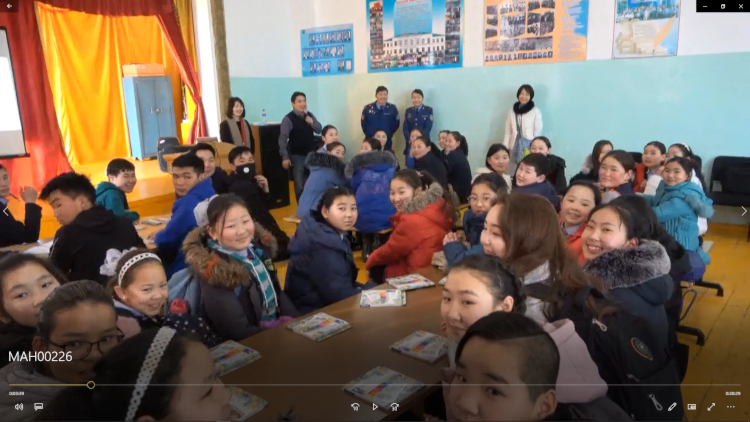
Mongolia DRR Card Game Co-creation Workshop 2019
- [1] R. Shaw (Ed.), “Community Practices for Disaster Risk Reduction in Japan,” Springer, 2014.
- [2] T. Inamura, Y. Suzuki, S. Ishii, S. Battulga, Y. Nara, A. Kawai, T. Yamada, and H. Takahashi, “Research and activity of resilience in Mongolia: Starting the JICA Partnership Project,” J. Open Univ. Jpn., Vol.35, pp. 61-76, 2018 (in Japanese).
- [3] Y. Suzuki, S. Ishii, T. Inamura, Y. Nara, H. Takahashi, S. Battulga, D. Enkhtaivan, S. Narangerel, C. Ariunaa, D. Serjmyadag, B. Altanbadralt, and T. Bandal, “Enhancing citizens’ disaster resilience through an international transdisciplinary research project in Mongolia,” Geog. Rev. Jpn. Series B, Vol.92, No.1, pp. 1-9, 2019. https://doi.org/10.4157/geogrevjapanb.92.1
- [4] N. Kapucu, D. V. Hawkins, and F. I. Rivera (Eds.), “Disaster Resiliency: Interdisciplinary Perspectives,” Taylor & Francis, 2013.
- [5] A. Miller and B. Birnbaum, “Preparing for disasters,” Science, Vol.348, No.6236, pp. 766-767, 2015. https://doi.org/10.1126/science.348.6236.766-c
- [6] I. Pal, J. Meding, S. Shrestha, I. Ahmed, and T. Gajendran (Eds.), “An Interdisciplinary Approach for Disaster Resilience and Sustainability,” Springer, 2020.
- [7] Y. Nara and T. Inamura (Eds.), “Resilience and Human History – Multidisciplinary Approaches and Challenges for a Sustainable Future,” Springer, 2020.
- [8] Y. Hayashi and Y. Suzuki (Eds.), “Resilience and Regional Revitalization – National Design Explored from Traditional Knowledge and Big Data,” Akashi Shoten, 2015 (in Japanese).
- [9] Y. Hayashi, Y. Suzuki, S. Sato, and K. Tsukahara (Eds.), “Disaster Resilient Cities: Concepts and Practical Examples,” Elsevier, 2016.
- [10] S. Ishii, “Loss of resilience of Mongolian nomadic life due to urbanization,” Y. Hayashi, Y. Suzuki, S. Sato, and K. Tsukahara (Eds.), “Disaster Resilient Cities: Concepts and Practical Examples,” pp. 51-61, Elsevier, 2016. https://doi.org/10.1016/B978-0-12-809862-2.00007-3
- [11] United Nations Inter-Agency Secretariat of the International Strategy for Disaster Reduction (UN/ISDR), “Hyogo Framework for Action 2005–2015: Building the Resilience of Nations and Communities to Disasters,” 2005.
- [12] T. Sternberg and B. Batbuyan, “Integrating the Hyogo Framework into Mongolia’s disaster risk reduction policy and management,” Int. J. Disaster Risk Reduct., Vol.5, pp. 1-9, 2013. https://doi.org/10.1016/j.ijdrr.2013.05.003
- [13] United Nations Office for Disaster Risk Reduction (UNDRR), “Sendai Framework for Disaster Risk Reduction 2015–2030,” 2015.
- [14] NEMA and JICA, “White paper on disaster risk reduction in Mongolia (Summary),” 2017. http://www.jica.go.jp/project/mongolia/016/materials/ku57pq0000316w3f-att/2017WhitePaper_Summary_Eng.pdf [Accessed March 26, 2026]
- [15] E. A. Rogozhin, S. Lar’kov, and S. Demberel, “Recurrence of strong earthquakes in the active Hovd Fault Zone, Mongolian Altay,” Geotectonics, Vol.47, pp. 340-350, 2013. http://doi.org/10.1134/S0016852113050051
- [16] T. Dugarmaa, A. Schlupp, M. Adiya, D. Ankhtsetseg, T. S. Baasanbat, G. Bayar, C. Bayarsaikhan, D. Erdenezul, D. Mungunsuren, A. Munkhsaikhan, D. Munkhuu, R. Narantsetseg, C. Odonbaatar, L. Selenge, B. Tsembel, M. Ulziibat, K. Urtnasan, and DASE/LDG team, “One century of seismicity in Mongolia (1900–2000),” Research Centre of Astronomy & Geophysics of the Mongolian Academy of Sciences and Department of Analysis, Monitoring and Environment, Laboratory of Detection and Geophysics, 2003.
- [17] I. A. Baljinnyam, B. A. Bayasgalan, A. Borisov, M. G. Cisternas, L. Dem’yanovich, V. M. Ganbaatar, R. A. Kochetkov, P. M. Kurushin, P. Hervé, and Y. Y. Vashchilov, “Ruptures of major earthquakes and active deformation in Mongolia and its surroundings,” Geol. Soc. America, Vol.181, 1993. https://doi.org/10.1130/MEM181-p1
- [18] A. Lin and S. Lin, “Tree damage and surface displacement: The 1931 M 8.0 Fuyun earthquake,” J. Geol., Vol.106, pp. 751-757, 1998. https://doi.org/10.1086/516058
- [19] Y. Klinger, M. Etchebes, P. Tapponnier, and C. Narteau, “Characteristic slip for five great earthquakes along the Fuyun fault in China,” Nat. Geosci., Vol.4, No.6, pp. 389-392, 2011. https://doi.org/10.1038/ngeo1158
- [20] P. Batima, L. Natsagdorj, P. Gombluudev, and B. Erdenetsetseg, “Observed climate change in Mongolia,” AIACC Working Paper, Vol.12, 2005.
- [21] P. S. Borodavko, E. S. Volkova, M. A. Melnik, A. S. Litvinov, and O. Demberel, “Climate change impact on high-altitude geomorphological systems,” IOP Conf. Series: Earth Environ. Sci., Vol.211, Article No.012004, 2018. https://doi.org/10.1088/1755-1315/211/1/012004
- [22] J. G. Cogley, “Glacier shrinkage across high mountain Asia,” Ann. Glaciolo., Vol.57, pp. 41-49, 2016. https://doi.org/10.3189/2016AoG71A040
- [23] D. A. Ganyushkin, K. V. Chistyakov, I. V. Volkov, D. V. Bantcev, E. P. Kunaeva, T. A. Andreeva, A. V. Terekhov, and D. Otgonbayar, “Present glaciers of Tavan Bogd Massif in the Altai Mountains, Central Asia, and their Changes since the Little Ice Age,” Geosci. J., Vol.8, No.11, Article No.414, 2018. https://doi.org/10.3390/geosciences8110414
- [24] Z. Batjargal, “Third national communication of Mongolia under the united nations framework convention on climatic change,” Ministry of Environment and Tourism of Mongolia, 2018. https://unfccc.int/sites/default/files/resource/06593841_Mongolia-NC3-2-Mongolia%20TNC%202018%20pr.pdf [Accessed March 26, 2026]
- [25] Z. Batjargal, R. Oyun, N. Togtokh, and S. Sangidansranjav, “Lessons learnt from the Dzud 1999–2000: Fundamental issues affecting sustainability of the Mongolian steppe,” International Institute for the Study of Nomadic Civilizations, 2002.
- [26] A. Hahn, “Complexity of Mongolian stakeholders’ dzud preparation and response,” Nat. Hazards, Vol.92, pp. 127-143, 2018. https://doi.org/10.1007/s11069-017-2907-2
- [27] B. Nandintsetseg, M. Shinoda, and B. Erdenetsetseg, “Contributions of multiple climate hazards and overgrazing to the 2009/2010 winter disaster in Mongolia,” Nat. Hazards, Vol.92, No.s1, pp. 109-126, 2018. https://doi.org/10.1007/s11069-017-2954-8
- [28] S. Ishii, Y. Nara, T. Inamura, H. Takahashi, S. Battulga, and Y. Suzuki, “Life and natural disaster in a local city and nomadic society in western Mongolia: Report of field research in Khovd Aimag,” J. Open Univ. Jpn., Vol.36, pp. 93-111, 2019 (in Japanese).
- [29] Y. Suzuki, “Utilization of Hazard Maps Toward Disaster Mitigation,” Iwanami Shoten, 2015 (in Japanese).
- [30] Y. Nara, S. Battulga, T. Inamura, Y. Suzuki, S. Ishii, H. Takahashi, Y. Takaichi, T. Hasegawa, and B. Narmandakh, “Practical research for topographic estimation of flood hazard and enhancing DRR activities with the participation of citizens in Khovd City, western Mongolia,” J. Open Univ. Jpn., Vol.37, pp. 83-92, 2020 (in Japanese).
- [31] Y. Nara and S. Battulga, “Action research for the implementation of community disaster prevention activities with the participation of citizens in Khovd City, Mongolia,” Risk Insur. Manag., Vol.51, pp. 173-193, 2020.
- [32] S. Ishii, T. Inamura, Y. Suzuki, D. Enkhtaivan, Y. Nara, H. Takahashi, S. Battulga, B. Narmandakh, and K. Has-Erdene, “The nomad’s memory and cognition of disasters and ‘disaster awareness enlightenment project’ in Khovd Province, Mongolia,” J. Open Univ. Jpn., Vol.37, pp. 93-108, 2020 (in Japanese).
- [33] S. Ishii, Y. Nara, T. Inamura, Y. Suzuki, H. Takahashi, S. Battulga, B. Narmandakh, D. Enkhtaivan, O. Sukhbaatar, and K. Has-Erdene, “Disaster awareness enlightenment project and remote education for the reinforcement of resilience in Mongolia,” J. Open Univ. Jpn., Vol.38, pp. 1-21, 2021 (in Japanese).
- [34] S. Narangerel, Y. Suzuki, T. Hasegawa, and Y. Takaichi, “Flood hazard mapping and disaster prevention recommendations based on detailed topographical analysis in Khovd City,” Nat. Hazards Earth Syst. Sci., Vol.25, pp. 4563-4576, 2025. https://doi.org/10.5194/nhess-25-4563-2025
- [35] Y. Nara and S. Battulga, “Practical research and education to enhance disaster resilience of citizens: Lessons from Japan’s disasters and collaboration with Mongolia,” Proc. of the Int. Sci. Conf. on Strengthening Urban Disaster Resilience, pp. 51-61, 2019.
- [36] Y. Suzuki, S. Ishii, and S. Battulga, “Cooperation toward enhancing citizens’ disaster resilience among Mongolian government, Mongolian university and Japanese universities,” Asian Ministerial Conf. on Disaster Risk Reduction, 2018.
- [37] Y. Suzuki, S. Ishii, T. Inamura, Y. Nara, S. Battulga, D. Enkhtaivan, S. Narangerel, C. Ariunaa, D. Serjmyadag, B. Altanbadralt, and T. Badral, “Cooperative project toward enhancing citizens’ disaster resilience conducted by Japanese universities and Mongolian government/academia in 2014–2018,” American Geophysical Union, Fall Meeting 2018, PA21F-1003, 2018. https://ui.adsabs.harvard.edu/abs/2018AGUFMPA21F1003S/abstract [Accessed March 26, 2026]
- [38] S. Ishii, Y. Suzuki, Y. Nara, T. Inamura, S. Battulga, D. Enkhtaivan, B. Altanbadralt, C. Ariunaa, and D. Serjmyadag, “Disaster awareness enlightenment project for large-scale natural disasters caused by global environmental change in Khovd Province, Mongolia,” Asian Ministerial Conf. on Disaster Risk Reduction, 2018.
- [39] Y. Nara and S. Battulga, “Observations on residents’ risk awareness and practice of countermeasures against natural disasters in Mongolia: Questionnaire survey data of Khovd citizens,” Procedia Comput. Sci., Vol.159, pp. 2345-2354, 2019. https://doi.org/10.1016/j.procs.2019.09.409
- [40] Y. Suzuki, M. Watanabe, and T. Nakata, “Impact of active fault discovery on disaster risk reduction,” Proc. of the Int. Science Conf. on Strengthening Urban Disaster Resilience, pp. 65-70, 2019.
- [41] Y. Suzuki, T. Nakata, M. Watanabe, S. Battulga, D. Enkhtaivan, S. Demberel, C. Odonbaatar, A. Bayasgalan, and T. Badral, “Discovery of Ulaanbaatar Fault: A new earthquake threat to the capital of Mongolia,” Seismol. Res. Lett., Vol.92, No.1, pp. 437-447, 2020. https://doi.org/10.1785/0220200109
This article is published under a Creative Commons Attribution-NoDerivatives 4.0 Internationa License.