
Paper:
Disaster Risk Reduction and Climate Resilience in Malaysia: A Decade of Progress and Accelerated Action
Khamarrul Azahari Razak*1,†
 , Siow Yuet Mei*1, Liyana Hayatun Syamila Ramlee*1
, Haslinda Mohamad Hamran*1,*2
, Muhammad Fauzie Ismail*1,*3
, Ezrein Faizal Ahmad*1,*4, Zamri Ramli*5, Nursalbiah Hamidun*6, Sabri Abdul Mulok*1, Rabieahtul Abu Bakar*7
, Norazam Ab Samah*1,*8, Fitri Yakub*1
, Mohdoor Anuar Mohd Zain*1,*9, Khairul Afnan Khalid*1, and Zakaria Mohamad*10
, Siow Yuet Mei*1, Liyana Hayatun Syamila Ramlee*1
, Haslinda Mohamad Hamran*1,*2
, Muhammad Fauzie Ismail*1,*3
, Ezrein Faizal Ahmad*1,*4, Zamri Ramli*5, Nursalbiah Hamidun*6, Sabri Abdul Mulok*1, Rabieahtul Abu Bakar*7
, Norazam Ab Samah*1,*8, Fitri Yakub*1
, Mohdoor Anuar Mohd Zain*1,*9, Khairul Afnan Khalid*1, and Zakaria Mohamad*10
*1Disaster Preparedness and Prevention Center (DPPC), Malaysia-Japan International Institute of Technology (MJIIT), Universiti Teknologi Malaysia (UTM)
Jalan Sultan Yahya Petra, Kuala Lumpur 54100, Malaysia
†Corresponding author
*2Department of Irrigation and Drainage, Ministry of Energy Transition and Water Transformation
Cyberjaya, Malaysia
*3National Disaster Management Agency (NADMA)
Putrajaya, Malaysia
*4Department of Town and Country Planning (PLANMalaysia), Ministry of Housing and Local Government
Putrajaya, Malaysia
*5Department of Mineral and Geoscience Malaysia (JMG)
Putrajaya, Malaysia
*6Slope Engineering Branch (CKC), Public Works Department (JKR)
Kuala Lumpur, Malaysia
*7Enforcement, Leadership and Management University (ELMU)
Nilai, Negeri, Malaysia
*8Malaysian Medical Relief Society (MERCY) Malaysia
Kuala Lumpur, Malaysia
*9NATECH Management PLT
Iskandar Puteri, Malaysia
*10National Association for Geo Disaster and Community Resilience (Geo-Resilience Malaysia), DRR-IEI Lab, Bangunan National Energy Centre (NEC), Universiti Tenaga Nasional (UNITEN)
Selangor, Malaysia

This study provides retrospective views, stocktaking, and commitments to accelerate the local implementation of the Sendai Framework for Disaster Risk Reduction (SFDRR) 2015–2030 in Malaysia. Employing a transdisciplinary approach, this study integrates systematic reviews, document analysis, stakeholder needs assessment, focus group discussions, field observations, and expert consultations. The findings are structured according to the SFDRR’s priorities, revealing significant advancements. However, persistent systemic challenges are evident, including fragmented data governance, limited risk communication strategies, poor investments by private sector, chronic underinsurance, and gaps in inclusive preparedness for vulnerable groups. This study underscores the coexistence of structured progress and deep-seated implementation gaps. Thus, intensified efforts are required to meet the 2030 global target by strengthening cross-sectoral coordination, co-implementing risk-based planning, enhancing financial risk protection, institutionalizing “build back better” for resilient recovery, and ensuring that resilience-building is both locally grounded and equitably distributed.
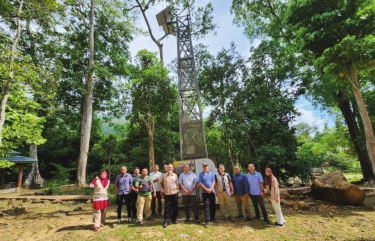
People-centred EWS in Jerai Geopark
- [1] United Nations Office for Disaster Risk Reduction, “Sendai Framework for disaster risk reduction,” 2015. https://www.preventionweb.net/files/43291_sendaiframeworkfordrren.pdf [Accessed March 23, 2026]
- [2] United Nations Office for Disaster Risk Reduction, “Strategic approach to capacity development for implementation of the Sendai Framework for disaster risk reduction,” 2019. https://www.unisdr.org/files/58211_fullconciseguide.pdf [Accessed December 15, 2025]
- [3] United Nations Office for Disaster Risk Reduction, “The Report of the midterm review of the implementation of the Sendai Framework for disaster risk reduction 2015–2030,” 2023. https://sendaiframework-mtr.undrr.org/publication/report-midterm-review-implementation-sendai-framework-disaster-risk-reduction-2015-2030 [Accessed December 15, 2025]
- [4] United Nations Office for Disaster Risk Reduction, “Disaster Risk Reduction in Malaysia Status Report 2020,” 2020. https://www.undrr.org/media/48531/download?startDownload=20250801 [Accessed December 20, 2025]
- [5] Z. Ujang, “Flood facts and mitigation,” Institut Perubahan Iklim, 2025.
- [6] R. A. Bakar, “Seismotectonic geohazards and geospatial framework for disaster risk reduction in Kundasang Sabah,” Ph.D. thesis, Universiti Kebangsaan Malaysia, 2019. https://ptsldigital.ukm.my/jspui/handle/123456789/515311 [Accessed March 23, 2026]
- [7] H. M. Hamran, “Integrated flood hazard assessment for strengthening urban resilience in George Town, Penang,” Master’s thesis, Universiti Teknologi Malaysia, Kuala Lumpur, 2021.
- [8] NADMA, “Dasar Pengurangan Risiko Bencana Negara 2030,” 2024 (in Malaysian). https://www.nadma.gov.my/images/2024/RujukanDalaman/DASAR_PENGURANGAN_RISIKO_BENCANA_NEGARA_2030_FINAL_COPY.pdf [Accessed December 20, 2025]
- [9] L. H. S. Ramlee, K. A. Razak, Z. Ramli, and Z. Mohamed, “Impact-based early warning system for debris flow in Malaysia: A science-based and localization approach for strengthening disaster resilience,” EGU General Assembly 2024, 2024. https://doi.org/https://doi.org/10.5194/egusphere-egu24-19871
- [10] International Federation of Red Cross and Red Crescent Societies, “Final report – Malaysia: Floods,” 2021.
- [11] Ministry of Energy and Natural Resources, “Study report on geological disaster debris flood 2022 Sungai Kupang, Baling, Kedah,” 2022 (in Malaysian). https://www.nres.gov.my/ms-my/pustakamedia/Penerbitan/Laporan%20Kajian%20Bencana%20Geologi%20Banjir%20Puing%202022%20di%20Sungai%20Kupang%20Kedah.pdf [Accessed December 22, 2025]
- [12] M. R. Mohd Noh, Q. A. Z. Rosle, T. R. Tuan Mohamed, F. Ahmad, A. R. Harun, and Z. Ramli, “Geological factors contributing to landslide incident in Malaysia – Case study Batang Kali Landslide Disaster, Hulu Selangor, Selangor,” Thai Geoscience J., Vol.5, No.8, pp. 34-44, 2024.
- [13] H. S. Rosmadi, M. F. Ahmed, M. B. Mokhtar, and C. K. Lim, “Reviewing challenges of flood risk management in Malaysia,” Water, Vol.15, No.13, Article No.2390, 2023. https://doi.org/10.3390/w15132390
- [14] Agensi Pengurusan Bencana Negara, “Letupan paip gas Putra Heights: Nilai kerosakan rumah RM65.4 juta,” 2025 (in Malaysian). https://www.nadma.gov.my/bi/media-en/news/3676-letupan-paip-gas-putra-heights-nilai-kerosakan-rumah-rm65-4-juta [Accessed March 23, 2026]
- [15] World Bank and Bank Negara Malaysia (BNM), “Managing flood risks: Leveraging finance for business resilience in Malaysia,” 2024.
- [16] W. Azad, M. H. Hassan, H. N. Ghazali, A. Weisgerber, and F. Ahmad, “National flood forecasting and warning system of Malaysia: An overview,” Proc. of the 1st Int. Conf. on Dam Safety Management and Engineering (ICDSME’2019), pp. 264-273, 2020. https://doi.org/10.1007/978-981-15-1971-0_27
- [17] M. Ismail, A. Ishak, W. Majid, and T. Sekaran, “Malaysia’s national water balance management system: Tool for water resources manager,” Proc. of the 1st Int. Conf. on Dam Safety Management and Engineering (ICDSME’2019), pp. 274-279, 2020. https://doi.org/10.1007/978-981-15-1971-0
- [18] PLANMalaysia, “Garis Panduan Perancangan Bandar Berdaya Tahan Bencana di Malaysia,” 2019 (in Malaysian). https://www.planmalaysia.gov.my/uploads/content-downloads/file_20251114203026.pdf [Accessed March 23, 2026]
- [19] NADMA, “Arahan Nadma No.1,” 2023 (in Malaysian). https://www.nadma.gov.my/images/2024/RujukanDalaman/Arahan_NADMA_No_1.pdf [Accessed March 23, 2026]
- [20] N. Omar Chong and K. H. Kamarudin, “Disaster risk management in Malaysia: Issues and challenges from the perspective of agencies,” Planning Malaysia, Vol.16, Issue 1, pp. 105-117, 2018. https://doi.org/10.21837/pm.v16i5.415
- [21] PLANMalaysia, “Panduan Mengarus Perdana Pengurusan Risiko Geobencana Dalam Penyediaan Rancangan Tempatan,” 2022 (in Malaysian). https://www.planmalaysia.gov.my/planmalaysia/resources/data%20migration/garis%20panduan/khidmatan/PEKELILING_KP-Panduan_Mengarus_Perdana_Pengurusan_Risiko_Geobencana_dalam_Penyediaan_RT.pdf
- [22] N. Isah and M. Binti, “A review of the literature on the roles and features of SMART tunnel, Kuala Lumpur, Malaysia,” Int. J. of Research & Review, Vol.2, Issue 7, pp. 465-475, 2015.
- [23] United Nations Office for Disaster Risk Reduction, “Words into action: Implementation guide for land use and urban planning,” 2020. https://www.undrr.org/words-into-action/implementation-guide-land-use-and-urban-planning [Accessed March 23, 2026]
- [24] G. Chin Guan, O. F. Marzuki, E. Lih, P. H. Yiu, M. I. Adam Assim, and N. Adam, “The Sungai Sarawak regulation scheme: A comprehensive analysis of its 3-in-1 infrastructure and associated risks,” J. of Maritime Research, Vol.XXII, pp. 228-238, 2025.
- [25] Think City, “Penang breaks ground with the rejuvenation of the Historic Esplanade Seawall,” 2022. https://thinkcity.com.my/about/media-centre/press-releases/penang-breaks-ground-with-the-rejuvenation-of-the-historic-esplanade-seawall [Accessed December 22, 2025]
- [26] Department of Drainage and Irrigation, “Annual report,” 2023.
- [27] Agensi Pengurusan Bencana Negara, “Annual report NADMA 2024,” 2024 (in Malaysian). https://www.nadma.gov.my/images/2025/TerbitanDalaman/FULL_BUKU_LAPORAN_TAHUNAN_NADMA_2024.pdf [Accessed March 23, 2026]
- [28] GDRN, “GLC Demi Rakyat & Negara.” https://gdrnbantu.online/ [Accessed December 23, 2025]
- [29] United Nations Office for Disaster Risk Reduction, “Disaster risk reduction private sector partnership post 2015 Framework – Private sector blueprint five private sector visions for a resilient future,” 2015. https://www.unisdr.org/files/42926_090315wcdrrpspepublicationfinalonli.pdf [Accessed December 23, 2025]
- [30] Adaptation Fund, “Penang’s urban green revolution: How nature is leading climate adaptation in Malaysia,” 2025. https://www.adaptation-fund.org/penangs-urban-green-revolution-how-nature-is-leading-climate-adaptation-in-malaysia/ [Accessed December 23, 2025]
- [31] MERCY Malaysia, “Resilience living Lab Hulu Langat,” 2023. https://mercy.org.my/wp-content/uploads/2025/01/Resilience-Living-Lab-Hulu-Langat.pdf [Accessed December 23, 2025]
- [32] Agensi Pengurusan Bencana Negara, “Garis Panduan Pelaksanaan Pengurusan Risiko Bencana Berasaskan Komuniti (CBDRM) di Malaysia,” Jabatan Perdana Menteri, Putrajaya, 2024 (in Malaysian). https://www.nadma.gov.my/bi/publication/nadma [Accessed December 23, 2025]
- [33] Ministry of Women, Family and Community Development, Department of Social Welfare, “Statistic Report 2022,” 2022 (in Malaysian). https://www.jkm.gov.my/uploads/content-downloads/file_20241025154333.pdf [Accessed December 23, 2025]
- [34] B. M. K. Halim, N. S. A. Shamsuddin, R. Abdullah, and K. H. Kamarudin, “Factors contributing to Participation in Community-led DRR Programmes in Malaysia,” Disaster Advances, Vol.17, No.8, pp. 41-48, 2024. https://doi.org/10.25303/178da041048
- [35] Z. Nkombi and G. J. Wentink, “The role of public participation in disaster risk reduction initiatives: The case of Katlehong township,” Jamba, Vol.14, No.1, Article No.1203, 2022. https://doi.org/10.4102/jamba.v14i1.1203
- [36] M. Samiri, A. Nilwana, N. Nonci, J. Ahmad, and F. Fitriani, “Community engagement and participation in flood disaster mitigation: A case study of Sidenreng Rappang Regency, Indonesia,” Society, Vol.12, No.1, pp. 129-139, 2024. https://doi.org/10.33019/society.v12i1.472
- [37] M. J. Rana, K. H. Rahi, T. Ray, and R. Sarker, “An efficient optimization approach for flexibility provisioning in community microgrids with an incentive-based demand response scheme,” Sustainable Cities and Society, Vol.74, Article No.103218, 2021, https://doi.org/https://doi.org/10.1016/j.scs.2021.103218
- [38] IRDR, “Disaster risk reduction products and processes: Knowledge sharing for place- and context-specific actions. Policy Brief,” Integrated Research on Disaster Risk, Int. Programme Office, 2025.
- [39] AHA Centre, “ASEAN Risk Monitor and Disaster Management Review (2nd Ed.): Time Is Running Out: Why ASEAN Must Act Now against Climate Emergencies,” ASEAN Coordinating Centre for Humanitarian Assistance on Disaster Management, 2020.
- [40] R. Jati, O. Andaresta, P. Wijaksono, T. Yanuarto, and F. Hidayati, “Building sustainable resilience: Navigating systemic risks, enhancing resilience,” AHA Centre, “ASEAN Risk Monitor and Disaster Management Review (4th Ed.),” ASEAN Coordinating Centre for Humanitarian Assistance on Disaster Management (AHA Centre), 2024.
This article is published under a Creative Commons Attribution-NoDerivatives 4.0 Internationa License.