
Research Paper:
Explaining Patent Citation Lag Through Inventor Networks, Prior Knowledge Bases, and Atypical Recombination: Evidence from Battery Electric Vehicle Technologies
Iori Nakaoka*,†
 , Yousin Park**
, and Yunju Chen***
*Shimonoseki City University
2-1-1 Daigaku-cho, Shimonoseki, Yamaguchi 751-8510, Japan
†Corresponding author
**Prefectural University of Hiroshima
1-1-71 Ujina-Higashi, Minami-ku, Hiroshima, Hiroshima 734-8558, Japan
***Shiga University
1-1-1 Banba, Hikone, Shiga 522-8522, Japan

Timely recognition of technological knowledge is critical in rapidly evolving industries such as battery electric vehicles (BEVs). Prior research on patent citation lag has mainly examined patent-level and team-level attributes. Building on this, this study broadens the framework to consider factors such as social network position, prior knowledge bases, semantic proximity to established technological positions, atypical recombination, and repeated collaboration. Analysis using BEV-related patent data and Cox proportional hazards models revealed that patents with a diverse prior art base tend to be cited earlier, while those closer to established positions in the technological space of the industry are more strongly associated with early citation. In contrast, patents containing technological co-occurrences that are rare across the industry tended to experience delayed first citation. Taken together, these findings suggest that patents are recognized earlier when they draw on diverse technological bases while remaining semantically close to established industry technology, whereas excessively atypical technological combinations may delay early recognition. This study advances research on patent citation lag, knowledge diffusion, and innovation strategies in BEVs.
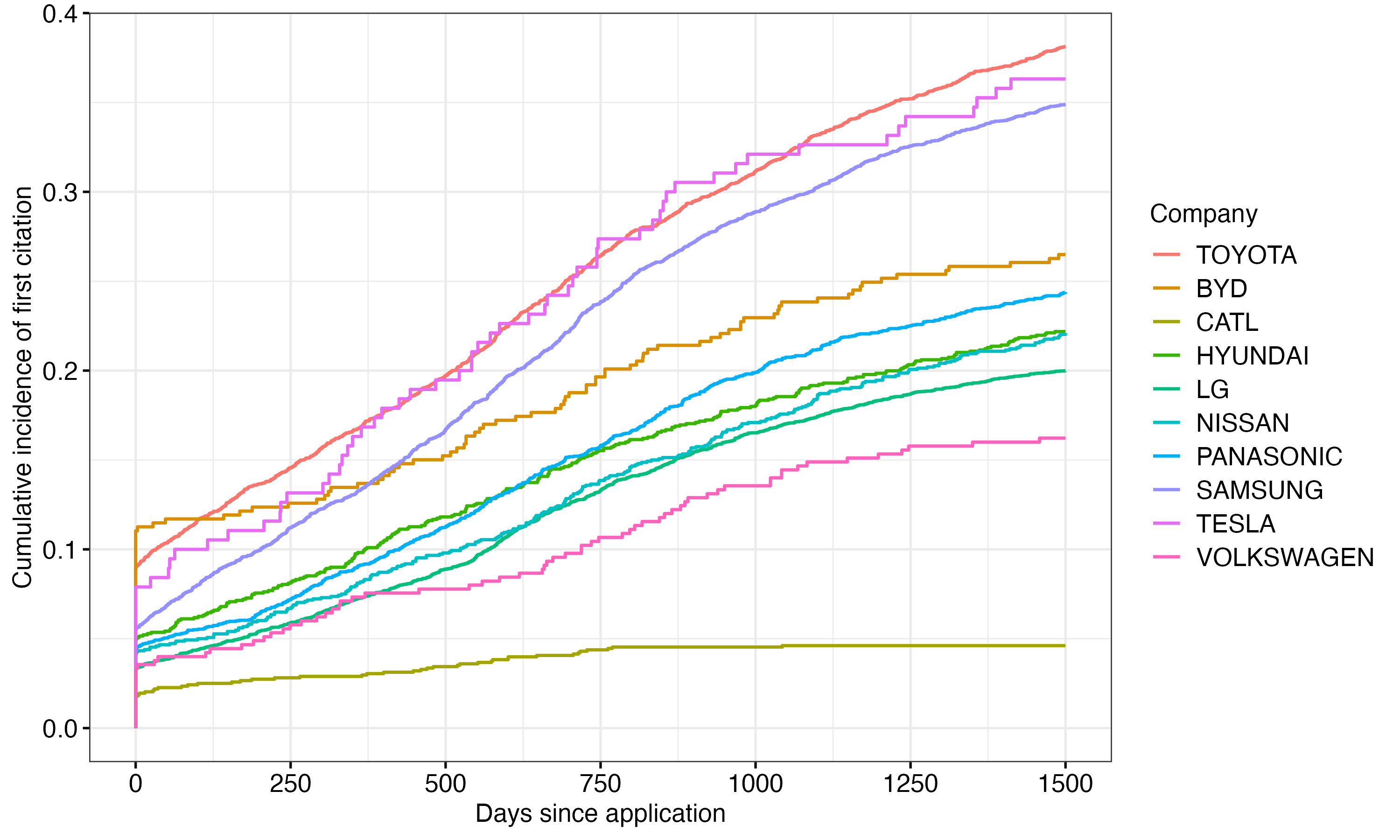
Survival curves of target companies
- [1] I. Nakaoka, Y. Park, H. Akaoka, and Y. Chen, “Visualization of corporate R&D capabilities: Patent data analysis of major EV-related firms,” Global Business and Management Research: An Int. J., Vol.16, No.4s, pp. 1850-1860, 2024.
- [2] M. Trajtenberg, “A penny for your quotes: Patent citations and the value of innovations,” The RAND J. of Economics, Vol.21, No.1, pp. 172-187, 1990. https://doi.org/10.2307/2555502
- [3] A. B. Jaffe, M. Trajtenberg, and R. Henderson, “Geographic localization of knowledge spillovers as evidenced by patent citations,” The Quarterly J. of Economics, Vol.108, No.3, pp. 577-598, 1993. https://doi.org/10.2307/2118401
- [4] B. H. Hall, A. B. Jaffe, and M. Trajtenberg, “Market value and patent citations,” The RAND J. of Economics, Vol.36, No.1, pp. 16-38, 2005.
- [5] I. Nakaoka, Y. Park, and Y. Chen, “Modeling early diffusion of AI patents: Institutional roles, compute intensity, and knowledge diversity,” Int. J. of Academic Research in Business and Social Sciences, Vol.16, No.3, pp. 1289-1303, 2026. https://doi.org/10.6007/IJARBSS/v16-i3/27976
- [6] J. A. Schumpeter, “The theory of economic development,” Harvard University Press, 1934.
- [7] J. G. March, “Exploration and exploitation in organizational learning,” Organization Science, Vol.2, No.1, pp. 71-87, 1991. https://doi.org/10.1287/orsc.2.1.71
- [8] L. Fleming, “Recombinant uncertainty in technological search,” Management Science, Vol.47, No.1, pp. 117-132, 2001. https://doi.org/10.1287/mnsc.47.1.117.10671
- [9] R. Katila and G. Ahuja, “Something old, something new: A longitudinal study of search behavior and new product introduction,” The Academy of Management J., Vol.45, No.6, pp. 1183-1194, 2002. https://doi.org/10.2307/3069433
- [10] Y. Park, I. Nakaoka, and Y. Chen, “The dynamics of the power balance in inter-organizational relationships: The relationship between body assemblers and supplier firms in BEVs,” J. Adv. Comput. Intell. Intell. Inform., Vol.29, No.5, pp. 1091-1098, 2025. https://doi.org/10.20965/jaciii.2025.p1091
- [11] D. R. Cox, “Regression models and life-tables,” J. of the Royal Statistical Society: Series B (Methodological), Vol.34, No.2, pp. 187-220, 1972. https://doi.org/10.1111/j.2517-6161.1972.tb00899.x
- [12] P. D. Allison, “Event history and survival analysis: Regression for longitudinal event data,” 2nd ed., Sage Publications, 2014.
- [13] L. C. Freeman, “Centrality in social networks conceptual clarification,” Social Networks, Vol.1, No.3, pp. 215-239, 1979. https://doi.org/10.1016/0378-8733(78)90021-7
- [14] M. S. Granovetter, “The strength of weak ties,” American J. of Sociology, Vol.78, No.6, pp. 1360-1380, 1973. https://doi.org/10.1086/225469
- [15] R. S. Burt, “Structural holes: The social structure of competition,” Harvard University Press, 1992.
- [16] W. W. Powell, K. W. Koput, and L. Smith-Doerr, “Interorganizational collaboration and the locus of innovation: Networks of learning in biotechnology,” Administrative Science Quarterly, Vol.41, No.1, pp. 116-145, 1996. https://doi.org/10.2307/2393988
- [17] G. Ahuja, “Collaboration networks, structural holes, and innovation: A longitudinal study,” Administrative Science Quarterly, Vol.45, No.3, pp. 425-455, 2000. https://doi.org/10.2307/2667105
- [18] L. Fleming and O. Sorenson, “Technology as a complex adaptive system: Evidence from patent data,” Research Policy, Vol.30, No.7, pp. 1019-1039, 2001. https://doi.org/10.1016/S0048-7333(00)00135-9
- [19] W. M. Cohen and D. A. Levinthal, “Absorptive capacity: A new perspective on learning and innovation,” Administrative Science Quarterly, Vol.35, No.1, pp. 128-152, 1990. https://doi.org/10.2307/2393553
- [20] G. Dosi, “Technological paradigms and technological trajectories: A suggested interpretation of the determinants and directions of technical change,” Research Policy, Vol.11, No.3, pp. 147-162, 1982. https://doi.org/10.1016/0048-7333(82)90016-6
- [21] R. R. Nelson and S. G. Winter, “An evolutionary theory of economic change,” Harvard University Press, 1982.
- [22] D. J. Teece, G. Pisano, and A. Shuen, “Dynamic capabilities and strategic management,” Strategic Management J., Vol.18, No.7, pp. 509-533, 1997. https://doi.org/10.1002/(SICI)1097-0266(199708)18:7<509::AID-SMJ882>3.0.CO;2-Z
- [23] B. Uzzi, S. Mukherjee, M. Stringer, and B. Jones, “Atypical combinations and scientific impact,” Science, Vol.342, No.6157, pp. 468-472, 2013. https://doi.org/10.1126/science.1240474
- [24] H. Youn, D. Strumsky, L. M. A. Bettencourt, and J. Lobo, “Invention as a combinatorial process: Evidence from US patents,” J. of The Royal Society Interface, Vol.12, No.106, Article No.20150272, 2015. https://doi.org/10.1098/rsif.2015.0272
- [25] D. Verhoeven, J. Bakker, and R. Veugelers, “Measuring technological novelty with patent-based indicators,” Research Policy, Vol.45, No.3, pp. 707-723, 2016. https://doi.org/10.1016/j.respol.2015.11.010
- [26] J. S. Coleman, “Social capital in the creation of human capital,” American J. of Sociology, Vol.94, Supplement, pp. S95-S120, 1988. https://doi.org/10.1086/228943
- [27] B. Uzzi, “Social structure and competition in interfirm networks: The paradox of embeddedness,” Administrative Science Quarterly, Vol.42, No.1, pp. 35-67, 1997. https://doi.org/10.2307/2393808
- [28] J. E. Mathieu, T. S. Heffner, G. F. Goodwin, E. Salas, and J. A. Cannon-Bowers, “The influence of shared mental models on team process and performance,” J. of Applied Psychology, Vol.85, No.2, pp. 273-283, 2000. https://doi.org/10.1037/0021-9010.85.2.273
- [29] S.-S. Wong, “Distal and local group learning: Performance trade-offs and tensions,” Organization Science, Vol.15, No.6, pp. 645-656, 2004. https://doi.org/10.1287/orsc.1040.0080
This article is published under a Creative Commons Attribution-NoDerivatives 4.0 Internationa License.