
Research Paper:
Modeling Robot Head-Direction Duration and Switching Frequency During Side-by-Side Walking with a Human
Shudai Deguchi*,**
 , Takashi Minato**
, and Takamasa Iio*,**
*Graduate School of Culture and Information Science, Doshisha University
1-3 Tataramiyakodani, Kyotanabe, Kyoto 610-0394, Japan
**Guardian Robot Project, RIKEN
2-2-2 Hikaridai, Keihanna Science City, Kyoto 619-0288, Japan

Recent advancements in robotics have led to extensive research on social robots capable of moving alongside humans. However, existing studies on mobile robotics have largely overlooked head-direction behavior in the context of side-by-side interactions during walking. As an initial step toward addressing this gap, the present study investigated human head-direction behavior during side-by-side conversational walking. We developed a robot head-direction model based on the collected data and examined its implementation in a mobile robot. This approach provides a data-driven basis for designing robot head-direction behavior during side-by-side walking, rather than relying solely on fixed or manually specified head movements. Specifically, we conducted experiments comparing three conditions: (1) a data-driven condition, in which the robot’s head-direction behavior was governed by the data-driven model; (2) a control condition, in which head-direction durations were randomly assigned based on a uniform distribution between the minimum and maximum values of the data-driven model; and (3) a baseline condition, in which the robot exhibited no head-direction behavior. The results demonstrated that the robot in the data-driven and control conditions received significantly higher ratings than those in the baseline condition, with no discernible difference between the data-driven and control conditions. Notably, participants also rated the control condition favorably, despite its divergence from natural human head-direction patterns, implying that a mobile robot’s head-direction behavior need not necessarily mimic human head-direction behavior to be perceived positively. These findings have important implications for the future design and implementation of head-direction behaviors in mobile robots, highlighting the potential of non-human-like head-direction strategies to enhance human-robot interaction.
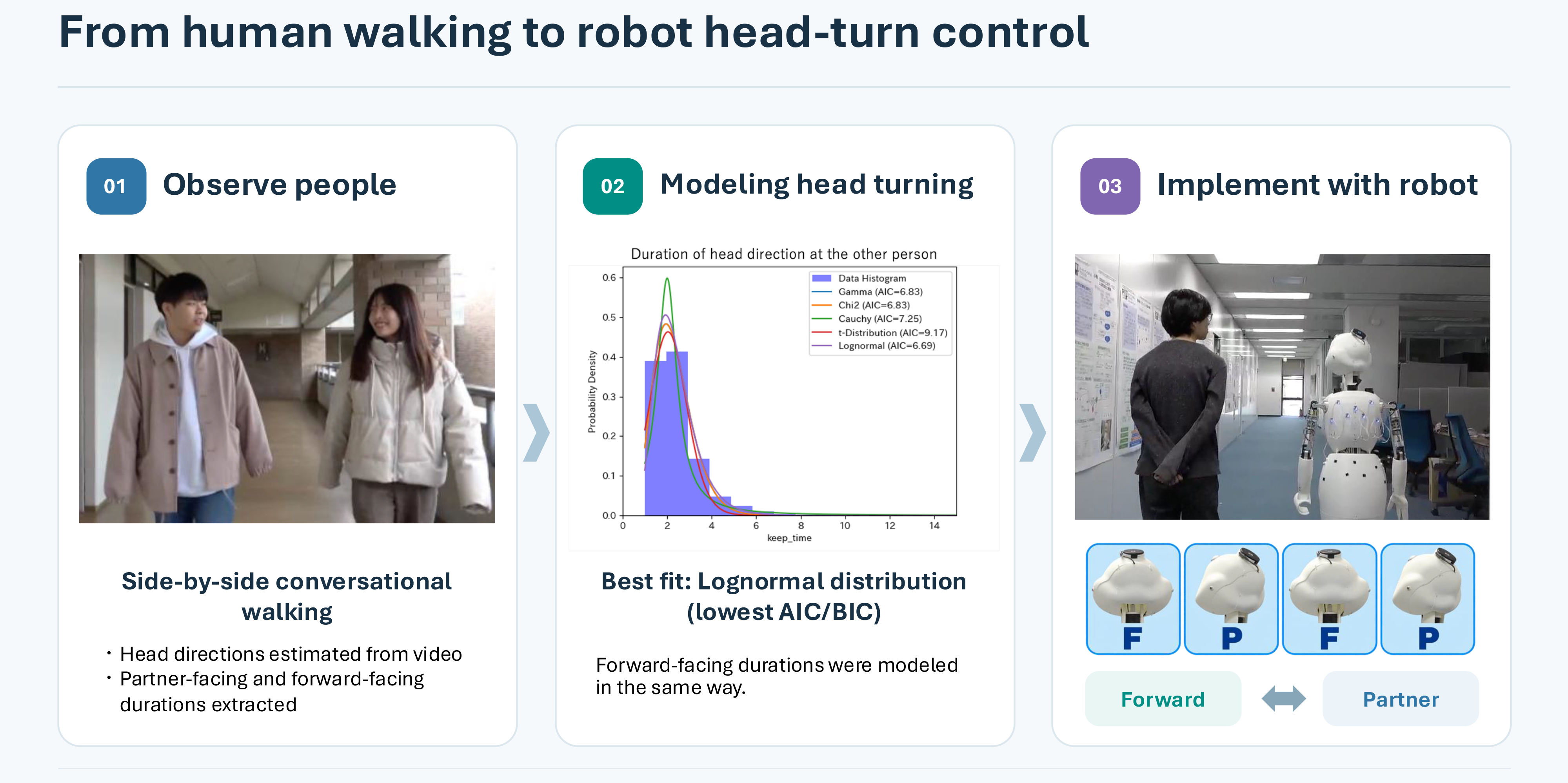
Overview of the proposed approach
- [1] N. Ise, Y. Nakata, Y. Nakamura, and H. Ishiguro, “Gaze Motion and Subjective Workload Assessment While Performing a Task Walking Hand in Hand with a Mobile Robot,” Int. J. of Social Robotics, Vol.14, pp. 1875-1882, 2022. https://doi.org/10.1007/s12369-022-00919-5
- [2] Y. Kuno et al., “Museum guide robot based on sociological interaction analysis,” Proc. of the SIGCHI Conf. on Human Factors in Computing Systems (CHI ’07), pp. 1191-1194, 2007. https://doi.org/10.1145/1240624.1240804
- [3] Y. Iwamura et al., “Do elderly people prefer a conversational humanoid as a shopping assistant partner in supermarkets?,” Proc. of the 6th Int. Conf. on Human-Robot Interaction (HRI ’11), pp. 449-456, 2011. https://doi.org/10.1145/1957656.1957816
- [4] E. Repiso, F. Zanlungo, T. Kanda, A. Garrell, and A. Sanfeliu, “People’s V-Formation and Side-by-Side Model Adapted to Accompany Groups of People by Social Robots,” 2019 IEEE/RSJ Int. Conf. on Intelligent Robots and Systems (IROS), pp. 2082-2088, 2019. https://doi.org/10.1109/IROS40897.2019.8968601
- [5] E. Repiso, A. Garrell, and A. Sanfeliu, “Adaptive Social Planner to Accompany People in Real-Life Dynamic Environments,” Int. J. of Social Robotics, Vol.16, pp. 1189-1221, 2022. https://doi.org/10.1007/s12369-022-00937-3
- [6] E. Coronado, T. Shinya, and G. Venture, “Hold My Hand: Development of a Force Controller and System Architecture for Joint Walking with a Companion Robot,” Sensors, Vol.23, No.12, Article No.5692, 2023. https://doi.org/10.3390/s23125692
- [7] M. Cheng, M. Kato, J. A. Saunders, and C.-h. Tseng, “Paired walkers with better first impression synchronize better,” PLOS ONE, Vol.15, No.2, Article No.e0227880, 2020. https://doi.org/10.1371/journal.pone.0227880
- [8] C. L. Kleinke, “Gaze and Eye Contact: A Research Review,” Psychological Bulletin, Vol.100, No.1 pp. 78-100, 1986. https://doi.org/10.1037/0033-2909.100.1.78
- [9] J. Cassell, O. E. Torres, and S. Prevost, “Turn taking vs. Discourse Structure: How Best to Model Multimodal Conversation,” Kluwer, 1998.
- [10] A. Kendon, “Some functions of gaze-direction in social interaction,” Acta Psychologica, Vol.26, pp. 22-63, 1967. https://doi.org/10.1016/0001-6918(67)90005-4
- [11] S. Andrist et al., “Conversational Gaze Aversion for Virtual Agents,” Proc. of Intelligent Virtual Agents (IVA 2013), pp. 249-262, 2013. https://doi.org/10.1007/978-3-642-40415-3_22
- [12] S.-H. Kang et al., “Towards building a virtual counselor: Modeling nonverbal behavior during intimate self-disclosure,” Proc. of the 11th Int. Conf. on Autonomous Agents and Multiagent Systems (AAMAS ’12), pp. 63-70, 2012.
- [13] M. Argyle and J. B. Dean, “Eye-Contact, Distance and Affiliation,” Sociometry, Vol.28, No.3 pp. 289-304, 1965. https://doi.org/10.2307/2786027
- [14] B. Mutlu, T. Kanda, J. Forlizzi, J. Hodgins, and H. Ishiguro, “Conversational gaze mechanisms for humanlike robots,” ACM Trans. Interact. Intell. Syst., Vol.1, No.2, Article No.12, 2012. https://doi.org/10.1145/2070719.2070725
- [15] T. Shintani et al., “Expression of Personality by Gaze Movements of an Android Robot in Multi-Party Dialogues,” 2022 31st IEEE Int. Conf. on Robot and Human Interactive Communication (RO-MAN), pp. 1534-1541, 2022. https://doi.org/10.1109/RO-MAN53752.2022.9900812
- [16] J. Ham, R. H. Cuijpers, and J.-J. Cabibihan, “Combining Robotic Persuasive Strategies: The Persuasive Power of a Storytelling Robot that Uses Gazing and Gestures,” Int. J. of Social Robotics, Vol.7, pp. 479-487, 2015. https://doi.org/10.1007/s12369-015-0280-4
- [17] P. Auer and B. Laner, “Laughter and gaze among talkers on a walk,” E. Zima and A. Stukenbrock (Eds.), “Mobile eye tracking: New avenues for the study of gaze in social interaction,” John Benjamins Publishing, 2025. https://doi.org/10.1075/pbns.351.08aue
- [18] R. Vertegaal et al., “Eye gaze patterns in conversations: There is more to conversational agents than meets the eyes,” Proc. of the SIGCHI Conf. on Human Factors in Computing Systems (CHI ’01), pp. 301-308, 2001. https://doi.org/10.1145/365024.365119
- [19] M. Argyle and R. Ingham, “Gaze, mutual gaze, and proximity,” Semiotica, Vol.6, No.1, pp. 32-49, 1972. https://cir.nii.ac.jp/crid/1571135650380249472
- [20] J. N. Cappella and C. Pelachaud, “Rules for Responsive Robots: Using Human Interactions to Build Virtual Interactions,” A. L. Vangelisti, H. T. Reis, and M. A. Fitzpatrick (Eds.), “Stability and change in relationships,” pp. 325-354, Cambridge University Press, 2002. https://doi.org/10.1017/CBO9780511499876.018
- [21] K. He, W. P. Chan, A. Cosgun, A. Joy, and E. A. Croft, “Robot Gaze During Autonomous Navigation and Its Effect on Social Presence,” Int. J. of Social Robotics, Vol.16, No.5, pp. 879-897, 2024. https://doi.org/10.1007/s12369-023-01023-y
- [22] D. Karunarathne, Y. Morales, T. Nomura, T. Kanda, and H. Ishiguro, “Will Older Adults Accept a Humanoid Robot as a Walking Partner?,” Int. J. of Social Robotics, Vol.11, pp. 343-358, 2019. https://doi.org/10.1007/s12369-018-0503-6
- [23] H. Admoni and B. Scassellati, “Social eye gaze in human-robot interaction: A review,” J. Hum.-Robot Interact., Vol.6, No.1, pp. 25-63, 2017. https://doi.org/10.5898/JHRI.6.1.Admoni
- [24] H. Zhou, F. Jiang, and H. Lu, “DirectMHP: Direct 2D Multi-Person Head Pose Estimation with Full-range Angles,” arXiv preprint, arXiv:2302.01110, 2023. https://doi.org/10.48550/arXiv.2302.01110
- [25] H. Akaike, “A new look at the statistical model identification,” IEEE Trans. on Automatic Control, Vol.19, No.6, pp. 716-723, 1974. https://doi.org/10.1109/TAC.1974.1100705
- [26] C. Bartneck, D. Kulić, E. Croft, and S. Zoghbi, “Measurement instruments for the anthropomorphism, animacy, likeability, perceived intelligence, and perceived safety of robots,” Int. J. of Social Robotics, Vol.1, No.1, pp. 71-81, 2009. https://doi.org/10.1007/s12369-008-0001-3
- [27] L. Moshkina, “Reusable semantic differential scales for measuring social response to robots,” Proc. of the Workshop on Performance Metrics for Intelligent Systems (PerMIS ’12), pp. 89-94, 2012. https://doi.org/10.1145/2393091.2393110
- [28] M. Heerink, B. Kröse, V. Evers, and B. Wielinga, “Assessing Acceptance of Assistive Social Agent Technology by Older Adults: The Almere Model,” I. J. Social Robotics, Vol.2, pp. 361-375, 2010. https://doi.org/10.1007/s12369-010-0068-5
- [29] F. D. Davis, “Perceived Usefulness, Perceived Ease of Use, and User Acceptance of Information Technology,” MIS Quarterly, Vol.13, No.3, pp. 319-340, 1989. https://doi.org/10.2307/249008
- [30] S. C. Kumaran et al., “A Social Approach for Autonomous Vehicles: A Robotic Object to Enhance Passengers’ Sense of Safety and Trust,” Proc. of the 2024 ACM/IEEE Int. Conf. on Human-Robot Interaction (HRI ’24), pp. 86-95, 2024. https://doi.org/10.1145/3610977.3634998
This article is published under a Creative Commons Attribution-NoDerivatives 4.0 Internationa License.