
Review:
Data Mining Public Health Social Media User Engagement Trends and Future Directions: A Systematic Literature Review
Daimler Benz Alebaba*
 , Suaini Sura*,†
, Muzaffar Hamzah**
, Nooralisa Mohd Tuah**
, Hadzariah Ismail**
, and Seungwon Lee***
*Faculty of Computing and Informatics, Universiti Malaysia Sabah
Jalan UMS, Kota Kinabalu, Sabah 88400, Malaysia
†Corresponding author
**Faculty of Computing and Informatics, Universiti Malaysia Sabah
UMS Kampus Antarabangsa Labuan, Wilayah Persekutuan Labuan, Labuan 87000, Malaysia
***Bundang Convergence Technology Campus of Korea Polytechnic
5 Hwangsaeul-ro 329beon-gil, Bundang-gu, Seongnam-si, Gyeonggi-do 13590, Republic of Korea

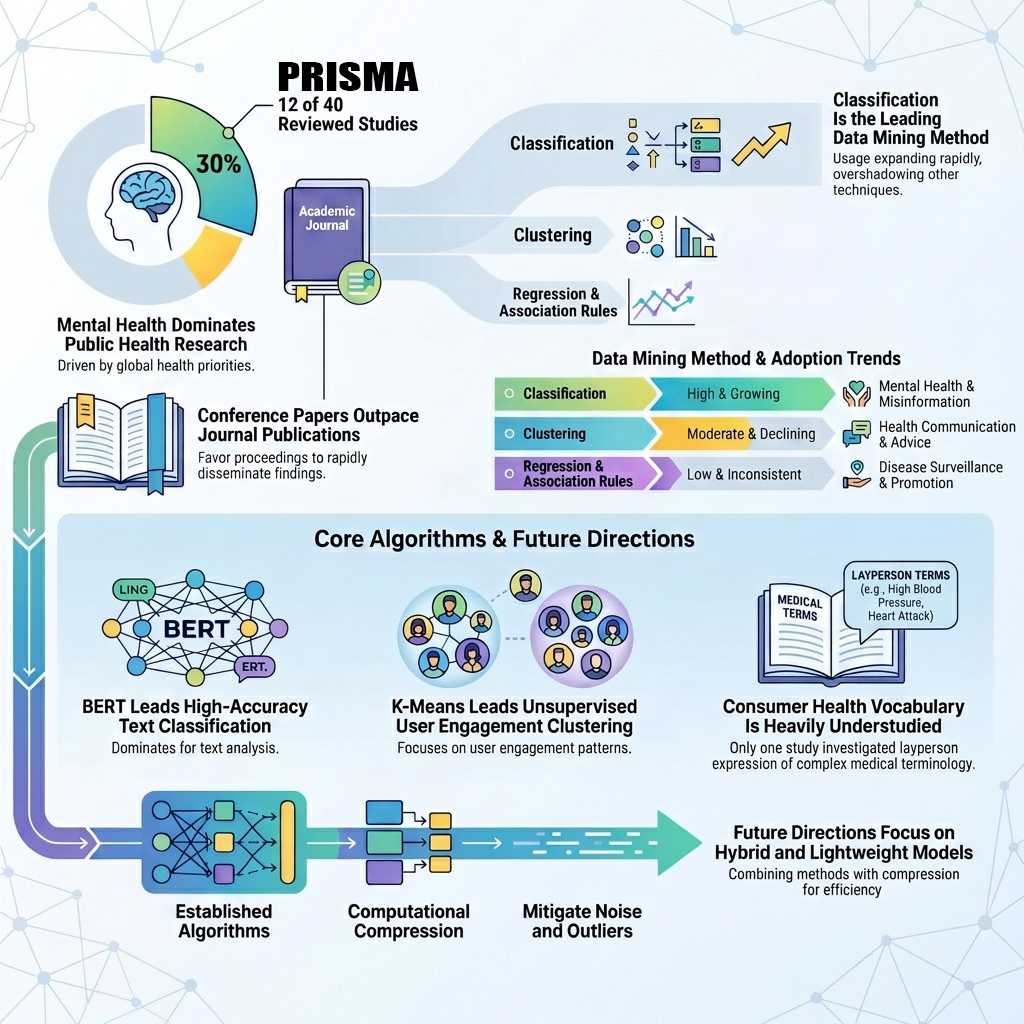
Exploring data mining methods and algorithms through reviews is crucial, as it might be useful for researchers who need effective decision-making criteria in applying relevant methods and algorithms for specific data mining tasks. So far, most of the previous reviews still lack an in-depth discussion of what data mining practices offer regarding trends and opportunities for future research direction. Therefore, we conducted a review to systematically assess the current practice of data mining methods and algorithms in public health research and identify future research direction opportunities. The review follows PRISMA technique, examining 40 peer-reviewed articles published in computer science proceedings and journals between 2016 and 2025. The review resulted in three key contributions. 1) Exploration of four data mining methods across nine public health research areas by trends. 2) Discovery of 15 data mining algorithms categorized by data mining methods. 3) Mapping of data mining methods and algorithms within the public health research area for future research direction opportunities. The review examined popular and underutilized data mining methods and algorithms, highlighting the need for further investigation into optimizing the underutilized algorithms to enhance computational efficiency against outliers and noise. We suggest planning hybrid methods that integrate the strengths of well-established algorithms and computational techniques to improve reliability and accuracy.
Public health social media data mining
- [1] S. Pagoto, M. E. Waring, and R. Xu, “A call for a public health agenda for social media research,” J. Med. Internet Res., Vol.21, No.12, Article No.e16661, 2019. https://doi.org/10.2196/16661
- [2] A. Bartschat, M. Reischl, and R. Mikut, “Data mining tools,” WIREs Data Min. Knowl. Discov., Vol.9, No.4, Article No.e1309, 2019. https://doi.org/10.1002/widm.1309
- [3] K. Mendoza-Herrera, “An overview of social media use in the field of public health nutrition: Benefits, scope, limitations, and a Latin American Experience,” Prev. Chronic. Dis., Vol.17, Article No.200047, 2020. https://doi.org/10.5888/pcd17.200047
- [4] Z. Yin, L. M. Sulieman, and B. A. Malin, “A systematic literature review of machine learning in online personal health data,” J. Am. Med. Inform. Assoc., Vol.26, No.6, pp. 561-576, 2019. https://doi.org/10.1093/jamia/ocz009
- [5] A. Singhal and V. Mago, “Exploring how healthcare organizations use twitter: A discourse analysis,” Informatics, Vol.10, No.3, Article No.65, 2023. https://doi.org/10.3390/informatics10030065
- [6] S. Mesbah et al., “Training data augmentation for detecting adverse drug reactions in user-generated content,” Proc. of the 2019 Conf. on Empirical Methods in Natural Language Processing and the 9th Int. Joint Conf. on Natural Language Processing (EMNLP-IJCNLP), pp. 2349-2359, 2019. https://doi.org/10.18653/v1/D19-1239
- [7] B. Roberto et al., “Monitoring adolescents’ distress using social web data as a source: The insideout project,” CEUR Workshop Proc., Rome: CEUR-WS, 2017. https://hdl.handle.net/2108/359298
- [8] N. Straton et al., “Big social data analytics for public health: Facebook engagement and performance,” 2016 IEEE 18th Int. Conf. on e-Health Networking, Applications and Services (Healthcom), 2016. https://doi.org/10.1109/HealthCom.2016.7749497
- [9] N. Straton, R. R. Mukkamala, and R. Vatrapu, “Big social data analytics for public health: Predicting facebook post performance using artificial neural networks and deep learning,” 2017 IEEE Int. Congress on Big Data (BigData Congress), pp. 89-96, 2017. https://doi.org/10.1109/BigDataCongress.2017.21
- [10] J. R. Saura and D. R. Bennett, “A three-stage method for data text mining: Using UGC in business intelligence analysis,” Symmetry, Vol.11, No.4, Article No.519, 2019. https://doi.org/10.3390/sym11040519
- [11] K. Cortis and B. Davis, “Over a decade of social opinion mining: A systematic review,” Artif. Intell. Rev., Vol.54, pp. 4873-4965, 2021. https://doi.org/10.1007/s10462-021-10030-2
- [12] M. Injadat, F. Salo, and A. B. Nassif, “Data mining techniques in social media: A survey,” Neurocomputing, Vol.214, pp. 654-670, 2016. https://doi.org/10.1016/j.neucom.2016.06.045
- [13] D. Karmegam, T. Ramamoorthy, and B. Mappillairajan, “A systematic review of techniques employed for determining mental health using social media in psychological surveillance during disasters,” Disaster Med. Public Health Prep., Vol.14, No.2, pp. 265-272, 2020. https://doi.org/10.1017/dmp.2019.40
- [14] M. J. Page et al., “The PRISMA 2020 statement: An updated guideline for reporting systematic reviews,” Syst. Rev., Vol.10, Article No.89, 2021. https://doi.org/10.1186/s13643-021-01626-4
- [15] M. S. Islam, M. M. Hasan, X. Wang, H. D. Germack, and M. Noor-E-Alam, “A systematic review on healthcare analytics: Application and theoretical perspective of data mining,” Healthcare, Vol.6, No.2, Article No.54, 2018. https://doi.org/10.3390/healthcare6020054
- [16] M. J. Page et al., “Updating guidance for reporting systematic reviews: Development of the PRISMA 2020 statement,” J. Clin. Epidemiol., Vol.134, pp. 103-112, 2021. https://doi.org/10.1016/j.jclinepi.2021.02.003
- [17] A. Heath, P. Levay, and D. Tuvey, “Literature searching methods or guidance and their application to public health topics: A narrative review,” Health Inf. Libr. J., Vol.39, No.1, pp. 6-21, 2022. https://doi.org/10.1111/hir.12414
- [18] N. M. Tuah, D. L. Goh, S. Nasirin, F. Ahmedy, and M. Hossin, “Mapping data mining technique and gamification approach for studying post-stroke rehabilitation training: A systematic literature review,” IEEE Access, Vol.11, pp. 31323-31340, 2023. https://doi.org/10.1109/ACCESS.2023.3262260
- [19] H. I. Purnama, I. Wilujeng, and C. S. A. Jabar, “Blended learning in elementary school science learning: A systematic literature review,” Int. J. Eval. Res. Educ., Vol.12, No.3, pp. 1408-1418, 2023. https://doi.org/10.11591/ijere.v12i3.25052
- [20] S. Laacke, R. Mueller, G. Schomerus, and S. Salloch, “Artificial intelligence, social media and depression. A new concept of health-related digital autonomy,” Am. J. Bioeth., Vol.21, No.7, pp. 4-20, 2021. https://doi.org/10.1080/15265161.2020.1863515
- [21] T. Hoel and W. Chen, “Privacy and data protection in learning analytics should be motivated by an educational maxim—Towards a proposal,” Res. Pract. Technol. Enhanc. Learn., Vol.13, No.1, Article No.20, 2018. https://doi.org/10.1186/s41039-018-0086-8
- [22] S. Quach, P. Thaichon, K. D. Martin, S. Weaven, and R. W. Palmatier, “Digital technologies: Tensions in privacy and data,” J. Acad. Mark. Sci., Vol.50, pp. 1299-1323, 2022. https://doi.org/10.1007/s11747-022-00845-y
- [23] F. Alhamed, J. Ive, and L. Specia, “Predicting moments of mood changes overtime from imbalanced social media data,” Proc. of the Eighth Workshop on Computational Linguistics and Clinical Psychology, pp. 239-244, 2022. https://doi.org/10.18653/v1/2022.clpsych-1.23
- [24] H. Almeida, A. Briand, and M.-J. Meurs, “Detecting early risk of depression from social media user-generated content,” CEUR Workshop Proc., Dublin: CEUR-WS, 2017.
- [25] Y. Bi, B. Li, and H. Wang, “Detecting depression on sina microblog using depressing domain lexicon,” 2021 IEEE Int. Conf. on Dependable, Autonomic and Secure Computing, Int. Conf. on Pervasive Intelligence and Computing, Intl. Conf. on Cloud and Big Data Computing, Int. Conf. on Cyber Science and Technology Congress (DASC/PiCom/CBDCom/CyberSciTech), pp. 965-970, 2021. https://doi.org/10.1109/DASC-PICom-CBDCom-CyberSciTech52372.2021.00161
- [26] A. Jaiswal and P. Washington, “Using #Actually autistic on twitter for precision diagnosis of autism spectrum disorder: Machine learning study,” JMIR Form. Res., Vol.8, No.1, Article No.e52660, 2024. https://doi.org/10.2196/52660
- [27] H. Kim, B. Choi, and J. Huh-Yoo, “Unpacking college students’ mental health discourse through youtube comments: Insights from topic modeling and sentiment analysis,” Proc. Assoc. Inf. Sci. Technol., Vol.62, No.1, pp. 956-961, 2025. https://doi.org/10.1002/pra2.1321
- [28] A. S. Liaw and H. N. Chua, “Depression detection on social media with user network and engagement features using machine learning methods,” 2022 IEEE Int. Conf. on Artificial Intelligence in Engineering and Technology (IICAIET), 2022. https://doi.org/10.1109/IICAIET55139.2022.9936814
- [29] A. Mauri et al., “Complementing studies on vulnerable youths with reddit data,” Proc. of the 14th Biannual Conf. of the Italian SIGCHI Chapter, 2021. https://doi.org/10.1145/3464385.3464703
- [30] R. Mohamed, E. M. G. Younis, and A. A. Ali, “Leveraging large language models and ensemble techniques for real-time mental health monitoring on social media,” Netw. Model. Anal. Health Inform. Bioinforma., Vol.14, No.1, Article No.157, 2025. https://doi.org/10.1007/s13721-025-00608-z
- [31] U. Singla, N. Sharma, and S. S. Khurshid, “Real-time sentiment analysis for monitoring mental health from social media posts,” OPJU Int. Technol. Conf. Smart Comput. Innov. Adv. Ind. 5.0, 2025. https://doi.org/10.1109/OTCON65728.2025.11069429
- [32] S. Subramani and M. O’Connor, “Extracting actionable knowledge from domestic violence discourses on social media,” arXiv:1807.02391, 2018. https://doi.org/10.48550/arXiv.1807.02391
- [33] H. Zogan, I. Razzak, S. Jameel, and G. Xu, “DepressionNet: Learning multi-modalities with user post summarization for depression detection on social media,” Proc. of the 44th Int. ACM SIGIR Conf. on Research and Development in Information Retrieval, pp. 133-142, 2021. https://doi.org/10.1145/3404835.3462938
- [34] S. Houda, A. Naila, and B. Samir, “Machine learning based knowledge organization in online communities,” Proc. of the 4th Int. Conf. on Big Data and Internet of Things, Article No.27, 2020. https://doi.org/10.1145/3372938.3372965
- [35] Y.-H. Liu, X. Song, and S.-F. Chen, “Long story short: Finding health advice with informative summaries on health social media,” Aslib J. Inf. Manag., Vol.71, No.6, pp. 821-840, 2019. https://doi.org/10.1108/AJIM-02-2019-0048
- [36] K. Platonov, K. Svetlov, and V. Saifulina, “Discourse on vaccination on Russian social media: Topics and controversy,” 2022 32nd Conf. of Open Innovations Association (FRUCT), 2022. https://doi.org/10.23919/FRUCT56874.2022.9953888
- [37] U. N. Wisesty, R. Rismala, W. Munggana, and A. Purwarianti, “Comparative study of Covid-19 tweets sentiment classification methods,” 2021 9th Int. Conf. on Information and Communication Technology (ICoICT), pp. 588-593, 2021. https://doi.org/10.1109/ICoICT52021.2021.9527533
- [38] F.-C. Yang, A. J. T. Lee, and S.-C. Kuo, “Mining health social media with sentiment analysis,” J. Med. Syst., Vol.40, No.11, Article No.236, 2016. https://doi.org/10.1007/s10916-016-0604-4
- [39] H.-Y. Kuo and S.-Y. Chen, “Predicting user engagement in health misinformation correction on social media platforms in Taiwan: Content analysis and text mining study,” J. Med. Internet Res., Vol.27, Article No.e65631, 2025. https://doi.org/10.2196/65631
- [40] X. Tian, W. He, Y. He, S. Albert, and M. Howard, “Using health belief model and social media analytics to develop insights from hospital-generated twitter messaging and community responses on the COVID-19 pandemic,” J. Enterp. Inf. Manag., Vol.36, No.6, pp. 1483-1507, 2023. https://doi.org/10.1108/JEIM-06-2021-0267
- [41] J. Du, S. Michalska, S. Subramani, H. Wang, and Y. Zhang, “Neural attention with character embeddings for hay fever detection from twitter,” Health Inf. Sci. Syst., Vol.7, No.1, Article No.21, 2019. https://doi.org/10.1007/s13755-019-0084-2
- [42] D. Hu, D. Wu, E. Kasson, P. Cavazos-Rehg, H. Liu, and M. Huang, “Understanding negative health outcomes of vaping by mining millions of posts and comments in reddit,” AMIA Annu. Symp. Proc. AMIA Symp., Vol.2024, pp. 490-499, 2024.
- [43] H.-H. Nguyen, “Enhancing sentiment analysis on social media data with advanced deep learning techniques,” Int. J. Adv. Comput. Sci. Appl., Vol.15, No.5, pp. 970-980, 2024. https://doi.org/10.14569/IJACSA.2024.0150598
- [44] H. Samuel, B. Noori, S. Farazi, and O. Zaiane, “Context prediction in the social web using applied machine learning: A study of Canadian tweeters,” 2018 IEEE/WIC/ACM Int. Conf. on Web Intelligence (WI), pp. 230-237, 2018. https://doi.org/10.1109/WI.2018.00-85
- [45] B. Zou, V. Lampos, R. Gorton, and I. J. Cox, “On infectious intestinal disease surveillance using social media content,” Proc. of the 6th Int. Conf. on Digital Health Conf., pp. 157-161, 2016. https://doi.org/10.1145/2896338.2896372
- [46] A. Abbasi, J. Li, D. Adjeroh, M. Abate, and W. Zheng, “Don’t mention it? Analyzing user-generated content signals for early adverse event warnings,” Inf. Syst. Res., Vol.30, No.3, pp. 1007-1028, 2019. https://doi.org/10.1287/isre.2019.0847
- [47] D. Kellner, M. Lowin, and O. Hinz, “Improved healthcare disaster decision-making utilizing information extraction from complementary social media data during the COVID-19 pandemic,” Decis. Support Syst., Vol.172, Article No.113983, 2023. https://doi.org/10.1016/j.dss.2023.113983
- [48] V. Lampos, B. Zou, and I. J. Cox, “Enhancing feature selection using word embeddings: The case of flu surveillance,” Proc. of the 26th Int. Conf. on World Wide Web (WWW ’17), pp. 695-704, 2017. https://doi.org/10.1145/3038912.3052622
- [49] X. Liu, B. Zhang, A. Susarla, and R. Padman, “Go to youtube and call me in the morning: Use of social media for chronic conditions,” MIS Quarterly, Vol.44, No.1, pp. 257-284, 2020. https://doi.org/10.25300/MISQ/2020/15107
- [50] E. Manousogiannis, S. Mesbah, A. Bozzon, R.-J. Sips, Z. Szlanik, and S. Baez, “Normalization of long-tail adverse drug reactions in social media,” Proc. of the 11th Int. Workshop on Health Text Mining and Information Analysis, pp. 49-58, 2020. https://doi.org/10.18653/v1/2020.louhi-1.6
- [51] J. Xie, Z. Zhang, X. Liu, and D. Zeng, “Unveiling the hidden truth of drug addiction: A social media approach using similarity network-based deep learning,” J. Manag. Inf. Syst., Vol.38, No.1, pp. 166-195, 2021. https://doi.org/10.1080/07421222.2021.1870388
- [52] M. Zhao and C. C. Yang, “Exploiting OHC data with tensor decomposition for off-label drug use detection,” 2018 IEEE Int. Conf. on Healthcare Informatics (ICHI), pp. 22-28, 2018. https://doi.org/10.1109/ICHI.2018.00010
- [53] M. H. A. Walid, D. M. Anisuzzaman, and A. F. M. S. Saif, “Data analysis and visualization of continental cancer situation by twitter scraping,” Int. J. Mod. Educ. Comput. Sci., Vol.11, No.7, pp. 23-31, 2019. https://doi.org/10.5815/ijmecs.2019.07.03
- [54] Q. Ping, C. C. Yang, S. A. Marshall, N. E. Avis, and E. H. Ip, “Breast cancer symptom clusters derived from social media and research study data using improved K-medoid clustering,” IEEE Trans. Comput. Soc. Syst., Vol.3, No.2, pp. 63-74, 2016. https://doi.org/10.1109/TCSS.2016.2615850
- [55] A. Ghahramani, M. Prokofieva, and M. P. d. Courten, “Health promotion campaigns using social media: Association rules mining and co-occurrence network analysis of Twitter hashtags,” BMC Public Health, Vol.25, No.1, Article No.67, 2025. https://doi.org/10.1186/s12889-024-21255-5
- [56] S.-Y. Lin et al., “Social media data mining of antitobacco campaign messages: Machine learning analysis of facebook posts,” J. Med. Internet Res., Vol.25, No.1, Article No.e42863, 2023. https://doi.org/10.2196/42863
- [57] Z. He, Z. Chen, S. Oh, J. Hou, and J. Bian, “Enriching consumer health vocabulary through mining a social Q&A site: A similarity-based approach,” J. Biomed. Inform., Vol.69, pp. 75-85, 2017. https://doi.org/10.1016/j.jbi.2017.03.016
- [58] S. J. Kumbet et al., “Common adolescent mental health disorders seen in family medicine clinics in Ghana and Nigeria,” PLOS ONE, Vol.18, No.11, Article No.e0285911, 2023. https://doi.org/10.1371/journal.pone.0285911
- [59] L. Psychiatry, “Global, regional, and national burden of 12 mental disorders in 204 countries and territories, 1990–2019: A systematic analysis for the global burden of disease study 2019,” The Lancet Psychiatry, Vol.9, No.2, pp. 137-150, 2022. https://doi.org/10.1016/S2215-0366(21)00395-3
- [60] G. Brown, A. L. Rathbone, and J. Prescott, “Social media use for supporting mental health (SMILE),” Ment. Health Rev. J., Vol.26, No.3, pp. 279-297, 2021. https://doi.org/10.1108/MHRJ-10-2020-0079
- [61] A. Wang et al., “The drainage of interstitial fluid in the deep brain is controlled by the integrity of myelination,” Aging Dis., Vol.10, No.5, pp. 937-948, 2019. https://doi.org/10.14336/AD.2018.1206
- [62] F. Arias, M. Z. Núñez, A. Guerra-Adames, N. Tejedor-Flores, and M. Vargas-Lombardo, “Sentiment analysis of public social media as a tool for health-related topics,” IEEE Access, Vol.10, pp. 74850-74872, 2022. https://doi.org/10.1109/ACCESS.2022.3187406
- [63] K. Anandhan, D. Damodharan., A. Lakhanpal, K. M. Sagar, K. Murugan, and A. S. Singh, “Discover pretend disease news misleading data in social media networks using machine learning techniques,” 2021 Int. Conf. on Advance Computing and Innovative Technologies in Engineering (ICACITE), pp. 784-788, 2021. https://doi.org/10.1109/ICACITE51222.2021.9404648
- [64] J. P. Li, A. U. Haq, S. U. Din, J. Khan, A. Khan, and A. Saboor, “Heart disease identification method using machine learning classification in E-healthcare,” IEEE Access, Vol.8, pp. 107562-107582, 2020. https://doi.org/10.1109/ACCESS.2020.3001149
- [65] S. D. Pande, S. K. H. Ahammad, M. N. Gurav, O. S. Faragallah, M. M. A. Eid, and A. N. Z. Rashed, “Depression detection based on social networking sites using data mining,” Multimed. Tools Appl., Vol.83, pp. 25951-25967, 2024. https://doi.org/10.1007/s11042-023-16564-7
- [66] Y.-C. Chen, W.-W. Liao, M.-C. Su, and Y.-H. Lin, “Personalized and self-management: Systematic search and evaluation quality factors and user preference of drug reference apps in Taiwan,” J. Pers. Med., Vol.11, No.8, Article No.790, 2021. https://doi.org/10.3390/jpm11080790
- [67] N. Alon, A. D. Stern, and J. Torous, “Assessing the food and drug administration’s risk-based framework for software precertification with top health apps in the United States: Quality improvement study,” JMIR mHealth uHealth, Vol.8, No.10, Article No.e20482, 2020. https://doi.org/10.2196/20482
- [68] M. Javaid, A. Haleem, R. P. Singh, R. Suman, and S. Rab, “Significance of machine learning in healthcare: Features, pillars and applications,” Int. J. Intell. Netw., Vol.3, pp. 58-73, 2022. https://doi.org/10.1016/j.ijin.2022.05.002
- [69] M. Tandan, Y. Acharya, S. Pokharel, and M. Timilsina, “Discovering symptom patterns of COVID-19 patients using association rule mining,” Comput. Biol. Med., Vol.131, Article No.104249, 2021. https://doi.org/10.1016/j.compbiomed.2021.104249
- [70] M. M. Hossain, M. S. Hossain, M. F. Mridha, M. Safran, and S. Alfarhood, “Multi task opinion enhanced hybrid BERT model for mental health analysis,” Sci. Rep., Vol.15, No.1, Article No.3332, 2025. https://doi.org/10.1038/s41598-025-86124-6
- [71] F. A. Wagay, Jahiruddin, and Y. Altaf, “MentalRoBERTa-Caps: A capsule-enhanced transformer model for mental health classification,” MethodsX, Vol.15, 2025. https://doi.org/10.1016/j.mex.2025.103483
- [72] A. M. Ikotun, A. E. Ezugwu, L. Abualigah, B. Abuhaija, and J. Heming, “K-means clustering algorithms: A comprehensive review, variants analysis, and advances in the era of big data,” Inf. Sci., Vol.622, pp. 178-210, 2023. https://doi.org/10.1016/j.ins.2022.11.139
- [73] Y. Hozumi, R. Wang, C. Yin, and G.-W. Wei, “UMAP-assisted K-means clustering of large-scale SARS-CoV-2 mutation datasets,” Comput. Biol. Med., Vol.131, Article No.104264, 2021. https://doi.org/10.1016/j.compbiomed.2021.104264
- [74] C. Janiesch, P. Zschech, and K. Heinrich, “Machine learning and deep learning,” Electron. Mark., Vol.31, No.3, pp. 685-695, 2021. https://doi.org/10.1007/s12525-021-00475-2
- [75] D. Bemme and L. J. Kirmayer, “Global mental health: Interdisciplinary challenges for a field in motion,” Transcult. Psychiatry, Vol.57, No.1, pp. 3-18, 2020. https://doi.org/10.1177/1363461519898035
- [76] M. Moitra et al., “Global mental health: Where we are and where we are going,” Curr. Psychiatry Rep., Vol.25, No.7, pp. 301-311, 2023. https://doi.org/10.1007/s11920-023-01426-8
- [77] A. F. Bulagang, N. G. Weng, J. Mountstephens, and J. Teo, “A review of recent approaches for emotion classification using electrocardiography and electrodermography signals,” Inform. Med. Unlocked, Vol.20, Article No.100363, 2020. https://doi.org/10.1016/j.imu.2020.100363
- [78] N. S. Suhaimi, J. Mountstephens, and J. Teo, “EEG-based emotion recognition: A state-of-the-art review of current trends and opportunities,” Comput. Intell. Neurosci., Vol.2020, No.1, Article No.8875426, 2020. https://doi.org/10.1155/2020/8875426
This article is published under a Creative Commons Attribution-NoDerivatives 4.0 Internationa License.