
Research Paper:
Effects of Digital Trade Facilitation on China’s Cross-Border E-Commerce Export: An Empirical Study Based on RCEP Member Countries
Yanjing Liang, Xiuwu Zhang
 , and Bing Feng†
Institute for Big Data of Digital Fujian “the Belt and Road” Service Industry, Huaqiao University
No.668 Jimei Avenue, Xiamen, Fujian 361021, China
†Corresponding author

The conventional sources of competitive advantage for countries and sectors are changing in light of the fast growth of the global digital economy. Whether and how digital trade facilitation can become a new engine for enhancing national export competitiveness has emerged as a critical issue. This paper utilizes panel data from Regional Comprehensive Economic Partnership (RCEP) member states spanning 2010 to 2023 to construct a comprehensive evaluation index system for digital trade facilitation across three dimensions: digital infrastructure, application, and security. An extended gravity model is used to experimentally investigate the impact of digital trade facilitation levels on the competitiveness of China’s electronic commerce exports. Research findings: (1) The RCEP member states’ overall degree of digital trade facilitation is trending increasing, but significant internal divergence exists. Countries like Singapore, Japan, and Australia lead the way, while Myanmar and Laos lag behind. (2) China’s electronic commerce export performance is much improved by the degree of digital transaction facilitation among RCEP nations, the conclusion that still holds after robustness tests. (3) Economic scale, population size, bilateral free trade agreement status, and geographic distance remain crucial factors influencing export. This study offers policy insights for promoting high-quality development of China’s cross-border e-commerce, deepening digital trade cooperation, and building sustainable regional export competitiveness in the digital era.
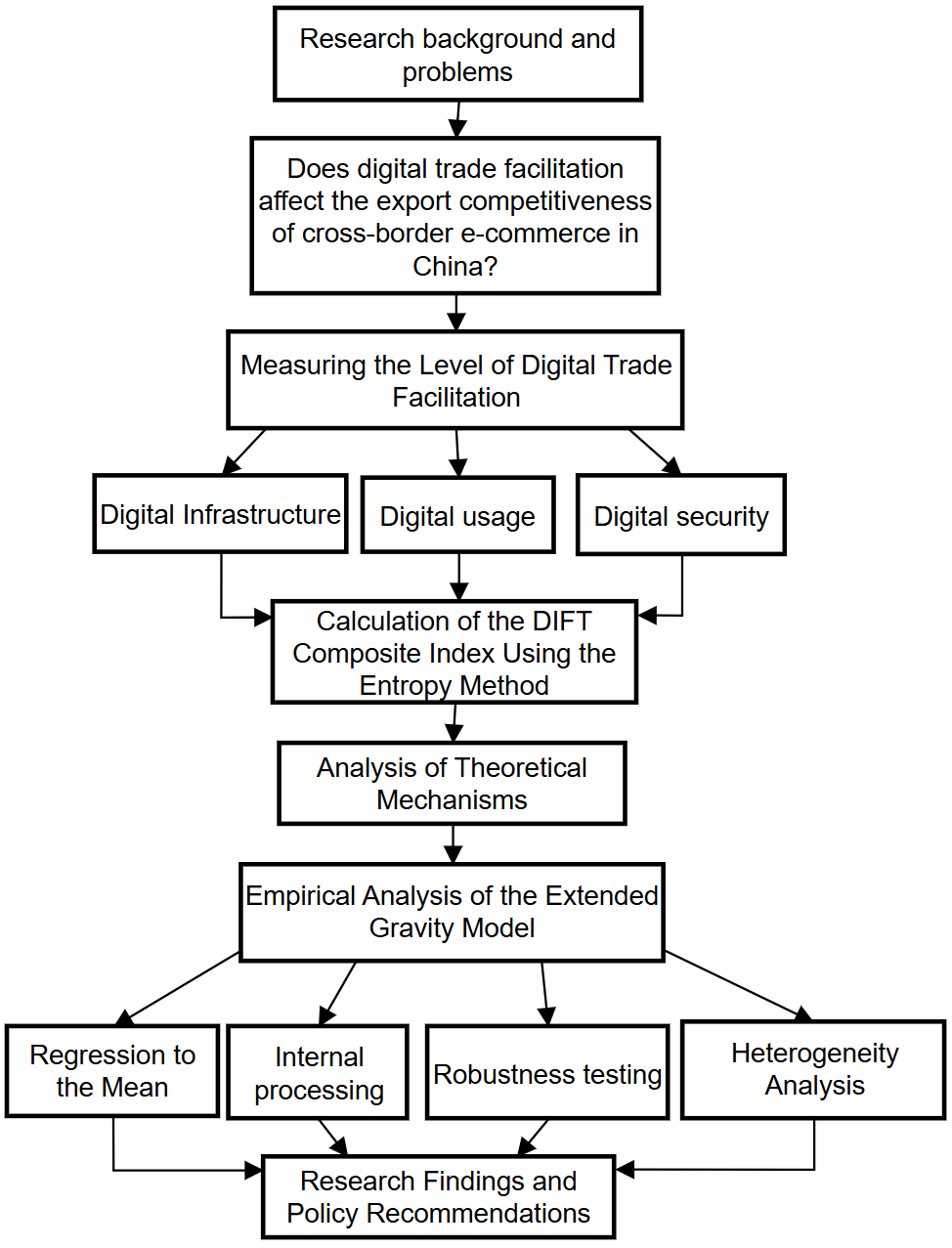
Research flowchart
1. Introduction
In the era of the digital economy, the swift rise of cross-border e-commerce and digital trade has become a new driving force behind the growth of global trade. China’s transnational electronic commerce industry has developed steadily and quickly in recent years, rising from its beginnings to a position of excellence because of quick developments in information technology and changes in consumer behavior. China’s transnational electronic commerce imports and exports reached over 2.71 trillion yuan in 2024, a 14% rise from the previous year, according to data from the General Administration of Customs. It represents 6.2% of the overall import and export value of trade in products, which is nine percentage points greater than the growth rate of China’s trade in goods in 2024. In this regard, the largest free trade zone in the world is now the Regional Comprehensive Economic Partnership (RCEP), which went into force on January 1, 2022. With their combined trade volume accounting for approximately 30.0% of China’s total yearly goods imports and exports in 2024, RCEP member nations have become essential partners in China’s international trade. For China’s transnational electronic commerce industry, this offers enormous market prospects.
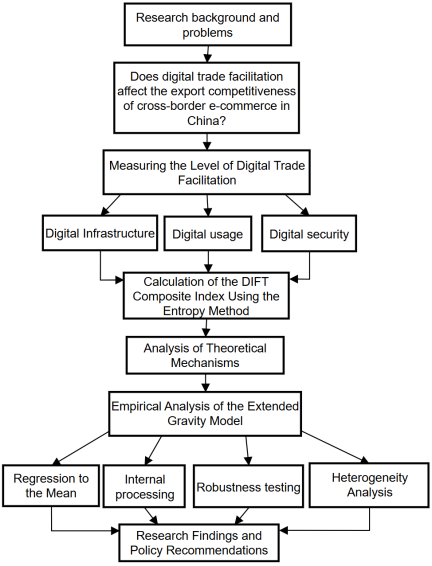
Fig. 1. Research flowchart.
Research on trade facilitation has evolved from traditional trade facilitation to digital trade facilitation. Trade facilitation generally refers to streamlining trade processes and reducing trade costs 1. With the development and application of modern information and communication technologies, an increasing number of digital technologies are being applied to cross-border trade in goods and services. This phenomenon has been termed by some scholars as digital trade facilitation or paperless trade 2,3. Unlike the broad concept of trade facilitation, digital trade facilitation places greater emphasis on reducing trade costs through digital technologies 4. An increasing number of scholars are beginning to focus on the impact of digital factors on trade, gradually forming the research field of digital trade facilitation. However, while existing studies have primarily examined the determinants of cross-border e-commerce exports from the perspective of traditional trade facilitation or a single digital dimension, this paper shifts its focus to the emerging field of digital trade facilitation. By integrating transaction cost theory with research on digital trade facilitation, we have constructed a comprehensive analytical framework comprising three dimensions—digital infrastructure, digital applications, and digital security—and revealed the heterogeneous impacts of these dimensions on China’s cross-border e-commerce exports. This finding provides new empirical evidence for understanding the mechanism of digital trade facilitation and holds significant theoretical value and practical implications for promoting the sustained, healthy, and high-quality development of China’s cross-border e-commerce exports. To clearly illustrate the research flowchart and logical structure of this paper, Fig. 1 presents a flowchart of the overall research process.
2. Literature Review
From the perspective of academic development, early research primarily focused on the impact of traditional trade facilitation measures—such as simplifying customs procedures and enhancing port efficiency—on trade flows 5. An increasing number of academics are studying how digitization affects commerce due to the close connection of digital technology and trade development. Currently, literature directly relevant to this research topic falls into three main categories. First, the conceptual definition and measurement methods of digital trade facilitation. Zhang and Ma define digital trade facilitation from a technology-empowerment perspective as a series of reform measures that primarily leverage new digital infrastructure and digital technology applications to optimize and reconstruct the software and hardware conditions related to digital trade, thereby creating a simplified, efficient, transparent, and predictable digital trade environment 6. Zhou defines digital trade and digital trade facilitation by analyzing legal documents, arguing that digital trade facilitation represents the evolution of trade facilitation in the era of the digital economy. It encompasses areas such as transnational electronic commerce, digital product trade, and digital service trade facilitation 7. In terms of measurement, Ismail pioneered a framework for assessing digital trade facilitation by constructing an indicator system across three dimensions: digital infrastructure, usage, and security 8. Subsequent research has largely followed this framework. Cao et al. applied this framework to measure the level of digital trade facilitation in Belt and Road countries, finding it significantly promotes the upgrading of global value chains 9. Li and Wang further applied this framework to manufacturing upgrading research, validating the positive role of digital trade facilitation in developing countries 10. In addition to holistic assessments, some scholars have also approached the issue from a policy perspective. Yu and Zheng examined how “single window” rules affected the improvement of export quality through digital trade facilitation, finding that implementing such policies significantly promotes export quality enhancement 11. Moreover, numerous scholars have explored the significant role trade facilitation plays in promoting high-quality development of China’s foreign trade 12, fostering high-quality innovation among enterprises 13, and advancing export trade development 14,15,16.
Second, research on transnational e-commerce trade has developed two main lines of inquiry. Some scholars focus on studying the impact mechanisms of transnational e-commerce development on trade. For instance, Wang et al., Ning et al., and Feng et al. have conducted research from different perspectives, delving into the role of transnational e-commerce development in promoting export growth, optimizing trade structures, and expanding trade markets 17,18,19. The effect of digital economic development on international e-commerce trade has been the focus of another set of academics. Researchers such as Han and Li and Shi have employed theoretical modeling and empirical analysis to reveal the critical role of the digital economy in enhancing transnational e-commerce efficiency, reducing trade costs, and strengthening trade competitiveness 20,21. These studies have begun to explore the relationship between digital environments and cross-border e-commerce, but analysis at the institutional level—particularly regarding “facilitation”—remains relatively weak. Furthermore, several academics have investigated techniques for developing transnational electronic commerce in relation to the Belt and Road Initiative. By building a trade gravity model based on the trade characteristics of nations along the Belt and Road routes, Dong et al. experimentally confirmed that China’s transnational e-commerce exports are greatly boosted by the development of digital financial infrastructure in importing nations 22. This study offers valuable insights into the relationship between regional institutional arrangements and the development of cross-border e-commerce.
Third, regarding the impact of digitized trade facilitation on transnational electronic commerce exports. Current literature has largely focused on studying trade facilitation or examining its effects on transnational e-commerce exports within the Belt and Road context 23,24,25. However, the definition of “trade facilitation” it outlines remains primarily based on traditional indicators and fails to fully reflect the characteristics of the digital age. Some scholars have also investigated the influence of digital trade agreements on transnational electronic commerce exports 26. It has begun to address the role of digital institutional arrangements but lacks a systematic measurement of the level of facilitation.
In summary, although considerable research exists on the relationship between cross-border e-commerce and foreign trade, there remains room for further exploration. First, studies examining the impact mechanism and empirical analysis of digital trade facilitation levels on cross-border e-commerce exports are relatively scarce. Second, previous research has largely focused on the context of the Belt and Road Initiative, while the RCEP agreement has been in effect for a short period, resulting in limited studies on digital trade facilitation. Based on this, this paper will construct an evaluation system for digital trade facilitation levels to measure the development of digital trade facilitation among RCEP member states from 2010 to 2023. Building upon this foundation, we conduct an in-depth analysis of how digital trade facilitation among RCEP member states impacts the competitiveness of China’s transnational electronic commerce exports. This aims to provide practical recommendations and strategies for enhancing China’s transnational electronic commerce exports, thereby supporting the sector’s pursuit of higher-quality and more sustainable development within the RCEP framework.
3. Assessment of Digital Trade Facilitation Levels Among RCEP Countries
3.1. Construction of the Indicator System
Academic research on the conceptualization and measurement of traditional trade facilitation has been relatively systematic, but studies on digital trade facilitation remain in their infancy. Regarding the indicator system for evaluating digital trade facilitation, most scholars have adopted Ismail’s 8 framework. For instance, Zhang and Ma 6, Li and Wang 27, and Cao et al. 9 all measure the level of digital trade facilitation across three dimensions: digital infrastructure, digital usage, and digital security. Building upon this foundation, this paper constructs a comprehensive evaluation index system for digital trade facilitation based on the theoretical framework of digital trade facilitation, drawing upon the research contributions of Ismail 8 and Cao et al. 9.
-
(1)
Digital infrastructures: This paper selects three indicators—fixed telephones, mobile cellular services, and broadband. Fixed telephones represent traditional telecommunications, while mobile cellular and broadband reflect modern digital characteristics in the information and communications technology sector. In the specific estimation process, the development level of digital infrastructure is measured using the number of fixed telephone subscriptions, fixed broadband subscriptions, and cellular telephone subscriptions per 100 people.
-
(2)
Digital usage: This study employs the percentage of internet users relative to the total population as an indicator to reflect the prevalence of digital technology adoption at the societal level.
-
(3)
Digital security: For a nation actively promoting e-commerce transactions, the state of digital security is undoubtedly a critical assessment factor. This study utilizes the indicator of safe internet servers per million people to measure the digital security level of a country or region.
3.2. Results of Digital Trade Facilitation Level Assessment
This study evaluates the degree of digital trade facilitation across RCEP nations and uses the entropy approach to determine the weights of assessment indicators based on a thorough evaluation methodology. The formula is as follows:
-
(1)
Standardize the selected data:
\begin{equation} S_{ij} = \frac{X_{ij} - \min\bigl(X_{ij}\bigr)}{\bigl(\max X_{ij} - \min X_{ij}\bigr)}. \label{eq:eq1} \tag{1} \end{equation} -
(2)
Calculate the proportion \(P_{ij}\) for each indicator:
\begin{equation} P_{ij} = \frac{X_{ij}}{\displaystyle \sum_{i=1}^{n} x_{ij}^{n}}. \label{eq:eq2} \tag{2} \end{equation} -
(3)
Determine the \(j\)-th evaluation index’s entropy value:
\begin{equation} e_{j} = -\frac{1}{\ln n} \sum_{i=1}^{n} p_{ij} \ln p_{ij},{\qquad} 0 \le e_{j} \le 1. \label{eq:eq3} \tag{3} \end{equation} -
(4)
Calculate the coefficient of variance:
\begin{equation} g_{i} = 1 - e_{j}. \label{eq:eq4} \tag{4} \end{equation}
In Eq. (4), the higher the value of \(g_{i}\), the greater the emphasis should be placed on the role of this indicator within the comprehensive evaluation system.
-
(5)
Calculate indicator weights:
\begin{equation} W_{j} = \frac{g_{j}}{\displaystyle \sum_{i=1}^{m} g_{j}},{\qquad} j = 1, 2, 3, \dots, m, \label{eq:eq5} \tag{5} \end{equation}where \(W_{j}\) represents the final weighting coefficient for each secondary indicator.
-
(6)
Determine the degree of digital commerce facilitation in a nation for a specific year:
\begin{equation} \mathit{ditf}_{{\!}j} = \sum_{i=1}^{m} w_{j}x_{ij}^{\ast},{\qquad} \left(0 \le w_{j} \le 1,{\ }{\sum_{i=1}^{m} w_{j}=1} \right), \label{eq:eq6} \tag{6} \end{equation}
where \(\mathit{ditf}_{{\!}j}\) represents a country’s trade facilitation level in a given year, and \(w_{j}\) is the weighting coefficient for evaluation indicator \(x_{j}\).
Substituting the obtained data into the aforementioned formula results in the weight coefficients for each secondary indicator within the digital trade facilitation system. The calculation outcomes are presented in Table 1.
| First-level indicators | Secondary indicators | Weight of secondary indicators |
| Digital infrastructures | Subscriptions for fixed-line phones (per 100 individuals) | 0.146 |
| Fixed broadband subscriptions (per 100 people) | 0.162 | |
| Cellular subscription rates (per 100 people) | 0.016 | |
| Digital usage | Percentage of Internet users | 0.051 |
| Digital security | Secure Internet servers owned (per 100 people) | 0.625 |
According to the aforementioned comprehensive assessment model for the facilitation of digital trade, specific scores for digital trade facilitation among RCEP states from 2010 to 2023 can be derived. Table 2 presents digital trade facilitation levels of each country, ranked from lowest to highest according to 2023 data.
The extent to which RCEP countries facilitate digital commerce largely rose between 2010 and 2023, as Table 2 illustrates. However, significant disparities exist among member states, resulting in a substantial “digital divide.” Analysis of growth trends reveals that Singapore, Japan, Australia, and China have made particularly significant strides in enhancing the level of digital trade facilitation. Specifically, Singapore, Japan, Australia, and South Korea have consistently maintained leading positions. In 2010, the digital trade facilitation levels of these countries generally exceeded 0.2, and by 2018, all had increased to above 0.3. However, countries such as Myanmar, Cambodia, and Indonesia lag behind in digital trade facilitation, with their levels remaining below 0.1 as of 2023.
| Year | ||||||
| 2010 | 2014 | 2018 | 2020 | 2022 | 2023 | |
| Myanmar | 0.002 | 0.010 | 0.027 | 0.041 | 0.046 | 0.050 |
| Cambodia | 0.011 | 0.024 | 0.035 | 0.042 | 0.049 | 0.052 |
| Indonesia | 0.053 | 0.046 | 0.050 | 0.063 | 0.072 | 0.075 |
| Philippines | 0.033 | 0.041 | 0.052 | 0.070 | 0.084 | 0.082 |
| Laos | 0.012 | 0.044 | 0.071 | 0.079 | 0.084 | 0.086 |
| Thailand | 0.058 | 0.072 | 0.106 | 0.125 | 0.137 | 0.131 |
| Vietnam | 0.077 | 0.070 | 0.105 | 0.118 | 0.138 | 0.143 |
| Malaysia | 0.098 | 0.109 | 0.144 | 0.157 | 0.179 | 0.180 |
| Brunei | 0.100 | 0.106 | 0.143 | 0.206 | 0.244 | 0.211 |
| China | 0.102 | 0.119 | 0.165 | 0.187 | 0.215 | 0.227 |
| New Zealand | 0.234 | 0.256 | 0.264 | 0.267 | 0.261 | 0.264 |
| South Korea | 0.300 | 0.312 | 0.314 | 0.322 | 0.335 | 0.340 |
| Australia | 0.241 | 0.241 | 0.331 | 0.332 | 0.372 | 0.367 |
| Japan | 0.253 | 0.270 | 0.310 | 0.349 | 0.369 | 0.384 |
| Singapore | 0.225 | 0.231 | 0.463 | 0.584 | 0.831 | 0.870 |
4. Empirical Analysis
4.1. Theoretical Analysis
The most direct impact of digital trade facilitation on China’s transboundary e-commerce exports is the reduction of trade costs, enhancement of transaction efficiency, and expansion of market reach. According to the transaction cost theory proposed by Coase 28 and Williamson 29, market transactions involve various costs such as information search costs, negotiation costs, and compliance costs. First, the improvement of digital infrastructure reduces information search costs. Through online platforms, enterprises can reach global consumers, significantly expanding market reach. For Chinese overseas e-commerce exporters, digital trade platforms enable access to international markets and greater business opportunities. Second, the application of digital technologies like electronic certification and digital signatures substantially enhances transaction efficiency by reducing intermediary steps and lowering negotiation and contract costs. Third, the widespread adoption of secure internet servers strengthens transaction security, diminishes performance risks, and reduces post-transaction monitoring costs, thereby boosting China’s cross-border e-commerce exports.
4.2. Construction of a Measurement Model
The dependent variable in the study is the transaction value of China’s international electronic commerce exports to other RCEP nations between 2010 and 2023. As China currently lacks official statistics on transnational electronic commerce exports to other countries, a review of relevant literature reveals that most scholars adopt the estimation methodology proposed by iResearch Consulting Group 30,31. Therefore, this paper also adopts the calculation method of iResearch Consulting, as shown in Eq. (7): where China’s transnational electronic commerce export transaction value is sourced from the e-commerce big data database compiled by NetEase, while China’s export volume to a specific country and China’s total export volume data are sourced from the UN Comtrade database. This approach inevitably introduces some error relative to actual values. However, after reviewing relevant literature, we found this method to be a common practice in current academic research.
This paper builds upon the traditional gravity model, incorporating the methodology proposed by Ismail 8. It introduces the digital trade facilitation index (\(\mathit{DITF}_{j}\)) of the importing country, the distance between the two countries’ capitals (\(\mathit{DIS}\)), and the presence of a bilateral free trade agreement (\(\mathit{FTA}\)) with China. This enhanced gravity model looks at how China’s transnational electronic commerce export performance is affected by digital trade facilitation. The particular model is as follows:
The description of explanatory variables and data sources is shown in Table 3.
| Explanatory variable | Expectation symbol | Theoretical basis | Data source |
| \(\mathit{GDP}_{it}\) | \(+\) | The higher a country’s GDP, the stronger its production capacity and the greater its export potential. | World Bank |
| \(\mathit{GDP}_{jt}\) | \(+\) | An importing nation’s capacity for consumption and import potential both increase with its GDP. | |
| \(\mathit{POP}_{it}\) | \(+\) | An exporting nation’s labor force, cost advantages in manufacturing, and export competitiveness all increase with population size. | |
| \(\mathit{POP}_{jt}\) | \(+\) | The more populous an importing country is, the higher its potential market demand and import demand will be. | |
| \(\mathit{DIS}_{ij}\) | \(-\) | Trade expenses rise and trade decreases with increasing distance between the exporting and importing nations. | CEPII |
| \(\mathit{FTA}_{ijt}\) | \(+\) | Bilateral free trade agreements will lower trade obstacles and promote the growth of export commerce. | China Free Trade Zone Service Network |
4.3. Regression Analysis Results
This study employed Stata 17.0 software to conduct regression analysis using the least squares method. The regression results are presented in Table 4.
| (1) EX | (2) EX | |
| \(\mathit{DITF}_{jt}\) |
5.293\(^{***}\) (6.69) |
1.372\(^{*}\) (2.49) |
| \(\mathit{GDP}_{it}\) |
0.921 (1.08) |
|
| \(\mathit{GDP}_{jt}\) |
0.663\(^{***}\) (10.20) |
|
| \(\mathit{POP}_{it}\) |
25.15\(^{*}\) (2.19) |
|
| \(\mathit{POP}_{jt}\) |
0.255\(^{***}\) (4.31) |
|
| \(\mathit{DIS}_{ij}\) |
\(-0.403^{***}\) (\(-5.21\)) |
|
| \(\mathit{FTA}_{ijt}\) |
0.591\(^{***}\) (3.77) |
|
| _cons |
5.041\(^{***}\) (27.38) |
\(-570.4^{**}\) (\(-2.64\)) |
| \(N\) | 196 | 196 |
Note: \(t\) statistics in parentheses; *\(p < 0.05\), **\(p < 0.01\), ***\(p < 0.001\).
Regression analysis results show that China’s exports of electronic commerce are greatly increased by the level of digital trade facilitation among RCEP member nations. This effect remains statistically significant even after controlling for other variables. This demonstrates that a favorable digital trade environment in partner countries is indeed a key external factor enabling Chinese transnational electronic commerce to gain competitive advantages in these markets. Enhanced digital trade facilitation reduces trade costs for electronic commerce exports, creates additional market opportunities, and consequently drives growth in the scale of electronic commerce exports.
The expansion of China’s international electronic commerce exports is also positively impacted by the GDP and population size of RCEP member nations. An importing nation’s domestic consumption potential and demand increase with its GDP level and population size. This undoubtedly creates highly favorable conditions for China’s exports of transnational electronic commerce, which propels the growth of export volume.
China’s large population has also significantly boosted the expansion of its electronic commerce exports. A substantial population base translates to abundant labor resources. Generally, a larger population correlates with relatively lower labor costs. This cost advantage enhances the price competitiveness of Chinese exports in international markets, thereby laying a solid foundation for the sustained expansion of cross-border e-commerce exports.
Geographical distance exhibits a significant negative correlation in regression models. Greater distances imply higher trade costs, and these increased costs are often partially or fully passed on to domestic consumers through price mechanisms, thereby reducing the competitiveness of China’s transnational electronic commerce exports.
The growth of China’s exports of electronic commerce has also been greatly aided by the signing of bilateral free trade agreements with RCEP countries. These agreements typically lower trade barriers, streamline customs clearance procedures, and enhance clearance efficiency, thereby driving an increase in China’s transnational electronic commerce export volume.
4.4. Robust Test
4.4.1. Endogeneity Treatment
This study may be subject to endogeneity issues. First, higher exports may prompt partner countries to improve their digital infrastructure and security, thereby enhancing digital trade facilitation and potentially leading to endogeneity. Second, although this study incorporates as many control variables as possible, some may inevitably be omitted, which could also cause endogeneity issues. Therefore, we conduct endogeneity tests using two methods: a first-order lag of the core explanatory variable and instrumental variables. First of all, drawing upon the research of Cao et al. 9 as well as Guo and Luo 32, this paper employs a regression model where the core explanatory variable is replaced by its first-order lagged value. The regression results in Table 5 indicate that after accounting for endogeneity issues, the estimated coefficient for digital trade facilitation remains statistically significant at the 5% level. This confirms that enhanced digital trade facilitation in partner countries effectively promotes China’s cross-border e-commerce exports.
| (1) EX | (2) EX | |
| \(\mathit{L.DITF}_{jt}\) |
5.254\(^{***}\) (6.35) |
1.477\(^{*}\) (2.32) |
| \(\mathit{GDP}_{it}\) |
0.979 (1.14) |
|
| \(\mathit{GDP}_{jt}\) |
0.645\(^{***}\) (9.11) |
|
| \(\mathit{POP}_{it}\) |
21.37 (1.83) |
|
| \(\mathit{POP}_{jt}\) |
0.265\(^{***}\) (4.12) |
|
| \(\mathit{DIS}_{ij}\) |
\(-0.403^{***}\) (\(-5.06\)) |
|
| \(\mathit{FTA}_{ijt}\) |
0.632\(^{***}\) (3.88) |
|
| _cons |
5.221\(^{***}\) (28.15) |
\(-492.3^{*}\) (\(-2.24\)) |
| \(N\) | 182 | 182 |
Note: \(t\) statistics in parentheses: *\(p < 0.05\), **\(p < 0.01\), ***\(p < 0.001\).
Second, this paper employs the instrumental variables method to conduct two-stage least squares estimation. In selecting the instrumental variables, we draw on the research by Zhang and Chen 33 and refer to the methods of Nunn and Qian 34 and Zhao et al. 35, choosing the number of fixed-line telephone subscriptions per 100 people in RCEP member countries in 2008 as the preliminary instrumental variable. As a traditional telecommunications infrastructure, the historical development of landline telephones provided the physical foundation for the subsequent deployment of broadband networks. On the other hand, countries with high early landline penetration rates tend to have a stronger awareness of information technology; these factors continue to influence the subsequent development and application of digital technologies. Therefore, the historical landline subscription rates of RCEP member states meet the requirements for instrumentality. Furthermore, the level of telecommunications infrastructure in 2008 had a negligible impact on the scale of China’s cross-border e-commerce exports more than a decade later, thereby satisfying the exogeneity requirement for instrumental variables.
Since this study uses panel data, to introduce a panel instrumental variable that varies over time, we further draw on the methodology of Nunn and Qian 34 to construct an interaction term between the 2008 fixed-line telephone subscription figures and the level of digital trade facilitation from 2010 to 2023. This interaction term is then included in the model as the final instrumental variable (IV) for testing 34.
| (1) First-stage | (2) 2SLS | |
| \(\mathit{DITF}_{jt}\) |
2.129\(^{***}\) (3.46) |
|
| IV |
1.148\(^{***}\) (25.54) |
|
| Control variable | YES | |
| Anderson canon. corr. LM statistic | 152.137\(^{***}\) | |
| Weak IV test | 652.080 [16.380] | |
| Observations | 196 | 196 |
| \(R^{2}\) | 0.912 | |
Note: a: \(t\) statistics in parentheses: *\(p < 0.05\), **\(p < 0.01\), ***\(p < 0.001\).
b: The values in brackets are the critical values for the Stock-Yogo test at the 10% significance level.
The test results are shown in Table 6. Both the non-identifiability test and the weak instrumental variable test were passed, indicating that the instrumental variables were appropriately selected and the regression results are reliable. Column (1) presents the results of the first-stage regression, where the estimated coefficient of the instrumental variable is significantly positive, indicating a significant correlation between the instrumental variable and the endogenous dependent variable. Column (2) presents the results of the two-stage least squares regression of the instrumental variable, showing that after controlling for endogeneity, the impact of digital trade facilitation levels in RCEP countries on China’s cross-border e-commerce exports remains significant. In summary, after addressing the endogeneity issue, the main conclusions of this paper remain robust.
4.4.2. Replace Key Explanatory Variables
To further enhance the reliability of this paper’s conclusions, robustness tests were conducted by replacing key explanatory variables. The entropy technique was used in the previous study to gauge the overall degree of digital trade facilitation among RCEP nations. Principal component analysis (PCA) was then used to recalculate the degree of digital commerce development in order to reduce any biases from depending just on one measuring method. The influence of partner nations’ degrees of digital trade facilitation on China’s transnational electronic commerce export size was reexamined in this reevaluation. Table 7 displays the regression findings.
After recalculating the primary explanatory variables using PCA and including control variables in the regression model, the results demonstrate that China’s exports of transnational electronic commerce are still significantly positively impacted by the degree of digital trade facilitation. This demonstrates the validity and dependability of the empirical results from the previous regression study.
| (1) PCA | (2) PCA | |
| \(\mathit{DITF}_{jt}\) |
0.562\(^{***}\) (8.63) |
0.381\(^{***}\) (4.56) |
| \(\mathit{GDP}_{it}\) |
0.325 (0.39) |
|
| \(\mathit{GDP}_{jt}\) |
0.335\(^{**}\) (3.13) |
|
| \(\mathit{POP}_{it}\) |
27.54\(^{*}\) (2.49) |
|
| \(\mathit{POP}_{jt}\) |
0.532\(^{***}\) (5.72) |
|
| \(\mathit{DIS}_{ij}\) |
\(-0.250^{**}\) (\(-2.95\)) |
|
| \(\mathit{FTA}_{ijt}\) |
0.601\(^{***}\) (3.98) |
|
| _cons |
5.910\(^{***}\) (53.41) |
\(-599.8^{**}\) (\(-2.88\)) |
| \(N\) | 196 | 196 |
Note: \(t\) statistics in parentheses: *\(p<0.05\), **\(p<0.01\), ***\(p<0.001\).
4.5. Analysis of Heterogeneity in Factors Facilitating Digital Trade
To examine the differential effects of digital infrastructure, digital applications, and digital security on promoting China’s cross-border e-commerce exports, a heterogeneity test was conducted on these three factors. The regression results are presented in Table 8.
| (1) EX | (2) EX | (3) EX | |
| Digital infrastructures |
8.365\(^{***}\) (6.26) |
||
| Digital usage |
47.91\(^{***}\) (7.53) |
||
| Digital security |
5.492\(^{***}\) (3.46) |
||
| _cons |
5.025\(^{***}\) (25.83) |
4.177\(^{***}\) (15.66) |
5.848\(^{***}\) (44.11) |
| \(N\) | 196 | 196 | 196 |
Note: \(t\) statistics in parentheses: *\(p<0.05\), **\(p<0.01\), ***\(p<0.001\).
As shown in Table 8, all three dimensions of digital trade facilitation significantly promote China’s cross-border e-commerce exports, though their impact varies markedly. Specifically, digital applications exert the most pronounced effect, followed by digital security, while digital infrastructure has a relatively smaller influence. The substantial promotional role of digital applications aligns closely with network externalities theory. Network externalities theory posits that the value of a product or service increases with the number of users. In the cross-border e-commerce sector, higher digital application penetration means more internet users, a larger potential consumer base for cross-border e-commerce, and broader market opportunities for exporting enterprises. The second-strongest impact comes from digital security, a finding consistent with institutional theory. Institutional theory emphasizes that a stable institutional environment promotes economic exchange by reducing uncertainty and enhancing trust. In cross-border e-commerce, digital security facilitates exports by lowering transaction risks and compliance costs while strengthening institutional trust. Digital infrastructure has a relatively minor promotional effect. Developed RCEP member countries possess relatively well-developed digital infrastructure with limited scope for further improvement, whereas developing countries have lower infrastructure levels with room for enhancement. Therefore, digital infrastructure still promotes China’s cross-border e-commerce exports, albeit to a lesser extent.
5. Research Conclusions and Policy Recommendations
5.1. Conclusion
This paper constructs a comprehensive evaluation index system for digital trade facilitation across three dimensions—digital infrastructure, digital applications, and digital security—and uses the entropy method to measure the level of digital trade facilitation among RCEP member states from 2010 to 2023. Subsequently, an empirical analysis was conducted using an extended gravity model to examine the impact of digital trade facilitation levels in partner countries on China’s cross-border e-commerce exports. The study also explored the heterogeneous effects across three dimensions, drawing the following conclusions and proposing corresponding policy recommendations.
-
(1)
Although the RCEP member states’ aggregate level of digital trade facilitation increased between 2010 and 2023, there was still a “digital divide” between them. Singapore, Japan, Australia, and China demonstrated significant improvements in facilitation levels, with Singapore, Japan, Australia, and South Korea consistently ranking among the top performers. In contrast, countries such as Myanmar, Cambodia, and Indonesia lag behind in terms of digital trade facilitation and still have significant room for improvement.
-
(2)
The level of digital trade facilitation among RCEP member states has significantly boosted the export performance of China’s cross-border e-commerce sector. Among the contributing factors, digital applications have had the greatest impact, followed by digital security, while digital infrastructure has played a relatively minor role.
-
(3)
Traditional gravitational variables—economic scale, population, geographic distance, and institutional arrangements—remain crucial factors influencing China’s cross-border e-commerce export competitiveness. Specifically, the GDP and population size of RCEP member countries, along with China’s bilateral free trade agreements with RCEP nations, significantly promote the growth of China’s transnational electronic commerce export volume. Conversely, the rise of China’s transnational electronic commerce exports is significantly impeded by the geographical distance between China and RCEP nations.
5.2. Policy Recommendations
-
(1)
Building regional digital competitiveness and strengthening infrastructure cooperation. Given the significant gap between lagging and leading nations in digital trade facilitation within the RCEP region, China should collaborate with member states to advance infrastructure development in countries with delayed progress. Priority support should be given to constructing 5G base stations and data centers in nations like Myanmar and Cambodia to narrow the digital divide among members. Simultaneously, while ensuring data security, China should actively engage in in-depth discussions with RCEP members to jointly establish a facilitation mechanism for cross-border data flows, providing smoother data support for cross-border e-commerce operations.
-
(2)
Deepen cooperation to advance mutual recognition of standards and security safeguards. China should continuously deepen cooperation with RCEP members, a key measure for enhancing coordinated development in regional digital trade facilitation. On one hand, actively promote mutual recognition of standards such as electronic authentication and electronic signatures among RCEP members to streamline cross-border e-commerce transaction processes and improve efficiency. On the other hand, establish a digital security cooperation mechanism within the RCEP region to jointly combat cyber fraud, data theft, and other criminal activities. This will create a trustworthy environment for cross-border e-commerce transactions, bolstering the confidence of both businesses and consumers in cross-border trade.
-
(3)
Optimize logistics systems and formulate differentiated export strategies. To mitigate the impact of geographical distance on China’s transnational electronic commerce exports, Chinese transnational electronic commerce enterprises should be encouraged to strengthen cooperation with logistics companies to jointly optimize distribution systems. For instance, increased investment in logistics infrastructure could be directed toward establishing overseas warehouses in key cities across RCEP member states. This would enable local storage and distribution of goods, shortening delivery times and improving logistics efficiency. Additionally, technologies like big data and artificial intelligence can be leveraged to optimize logistics route planning, enhance the intelligence of transportation operations, and reduce logistics costs. Concurrently, China should fully leverage its strengths by developing differentiated transnational electronic commerce export strategies tailored to the distinct GDP and demographic characteristics of each country. For nations with higher GDP and stronger purchasing power, high-quality, high-value-added products can be promoted. For countries with large populations and significant market potential, diverse, cost-effective products can be offered.
- [1] B. Shepherd and J. S. Wilson, “Trade facilitation in ASEAN member countries: Measuring progress and assessing priorities,” J. Asian Econ., Vol.20, No.4, pp. 367-383, 2009. https://doi.org/10.1016/j.asieco.2009.03.001
- [2] Y. Duval, T. Wang, C. Utoktham, and A. Kravchenko, “Next-generation trade facilitation for Asian integration: Cross-border paperless trade,” Asian Econ. Integr., Vol.1, No.6, pp. 11-31, 2019. https://doi.org/10.1177/2631684618821473
- [3] M. Ismail and M. F. Ruslan, “Digitalisation, data governance, and cross-border commerce: New directions for international business theory,” Int. J. Res. Innov. Soc. Sci., Vol.9, No.11, pp. 3123-3132, 2025. https://doi.org/10.47772/IJRISS.2025.91100248
- [4] X. Li and S. Wei, “International trend of digital trade facilitation and China’s practice,” Economist, Vol.2022, No.8, pp. 77-85, 2022 (in Chinese). https://doi.org/10.16158/j.cnki.51-1312/f.2022.08.004
- [5] J. S. Wilson, C. L. Mann, and T. Otsuki, “Trade facilitation and economic development: A new approach to quantifying the impact,” World Bank Econ. Rev., Vol.17, No.3, pp. 367-389, 2003. https://doi.org/10.1093/wber/lhg027
- [6] Y. Zhang and L. Ma, “Digital trade facilitation and rising in the global value chain of the manufacturing industry: From the perspective of analyzing the adjustment of the intermediate input structure,” Mod. Finance Econ. (J. Tianjin Univ. Finance Econ.), Vol.44, No.12, pp. 35-51, 2024. https://doi.org/10.19559/j.cnki.12-1387.2024.12.003
- [7] Y. Zhou, “Digital trade and digital trade facilitation: Concept clearance and rules correlation,” J. Chengdu Univ. Technol. (Soc. Sci.), Vol.32, No.6, pp. 71-83, 2024 (in Chinese). https://doi.org/10.3969/j.issn.1672-0539.2024.06.007
- [8] N. W. Ismail, “Digital trade facilitation and bilateral trade in selected Asian countries,” Stud. Econ. Finance, Vol.38, No.2, pp. 257-271, 2021. https://doi.org/10.1108/SEF-10-2019-0406
- [9] Y. Cao, Z. Deng, and J. Wen, “The impact of digital trade facilitation on global value chain upgrading: Empirical evidence from belt and road countries,” East China Econ. Manag., Vol.38, No.6, pp. 56-65, 2024 (in Chinese). https://doi.org/10.19629/j.cnki.34-1014/f.231212008
- [10] Y. Li and Z. Wang, “Digital trade facilitation and GVC restructuring: Implications for manufacturing upgrading in developing countries,” Finance Res. Lett., Vol.86, Part B, Article No.108413, 2025. https://doi.org/10.1016/j.frl.2025.108413
- [11] P. Yu and F. Zheng, “Digital trade facilitation policies and export product quality upgrading: An empirical test based on cross-country panel data of ‘single windows’,” Stat. Res., Vol.42, No.5, pp. 47-61, 2025 (in Chinese). https://doi.org/10.19343/j.cnki.11-1302/c.2025.05.004
- [12] X. Wang and Z. Ding, “Research on the impact of trade facilitation on high-quality development of foreign trade—Based on the analysis of industrial upgrading,” China Bus. Mark., Vol.38, No.11, pp. 51-66, 2024 (in Chinese). https://doi.org/10.14089/j.cnki.cn11-3664/f.2024.11.005
- [13] M. Shuaibu and S. O. Mamman, “Trade facilitation and economic growth in ECOWAS member states: Does government size matter?,” J. Ind. Compet. Trade, Vol.25, No.1, Article No.13, 2025. https://doi.org/10.1007/s10842-025-00445-w
- [14] S. Wang and Y. Zhu, “An inquiry into the effect of trade facilitation on China’s digital product exports to countries along the ‘belt and road’,” Int. Rev. Econ. Finance, Vol.93, Part B, pp. 1246-1259, 2024. https://doi.org/10.1016/J.IREF.2024.04.041
- [15] F. Zhang, L. Wang, L. Wei, and Z. Zou, “The impact of industrial spatial agglomeration on the quality of export products under trade facilitation reform: Evidence from China,” Rev. World Econ., Vol.161, No.4, pp. 1599-1636, 2025. https://doi.org/10.1007/s10290-025-00597-1
- [16] C. Li and H. Shen, “Does trade facilitation contribute to export product quality upgrading in China?,” World Econ., Vol.48, No.3, pp. 460-499, 2025. https://doi.org/10.1111/twec.13649
- [17] Y. Wang, Y. Wang, and S. H. Lee, “The effect of cross-border e-commerce on China’s international trade: An empirical study based on transaction cost analysis,” Sustainability, Vol.9, No.11, Article No.2028, 2017. https://doi.org/10.3390/su9112028
- [18] K. Ning, X. Chen, and Y. Xiao, “Cross-border e-commerce, foreign investment and export trade resilience,” Finance Res. Lett., Vol.82, Article No.107595, 2025. https://doi.org/10.1016/j.frl.2025.107595
- [19] C. Feng, Z. Shi, C. Ma, and Y. Tian, “Cross-border e-commerce promoting the high-quality development of China’s sporting goods export trade under the ‘belt and road’ initiative,” Sports Cult. Guide, Vol.25, No.4, pp. 89-96, 2025 (in Chinese).
- [20] G. Han and F. Li, “Digital economy of trading partner countries, outward investment, and cross-border E-commerce exports,” Finance Res. Lett., Vol.85, Part B, Article No.108034, 2025. https://doi.org/10.1016/j.frl.2025.108034
- [21] K. Shi, “Analysis of the relationship between digital economic development, the dual-mode approach to cross-border E-commerce, and cross-border E-commerce export trade,” J. Commer. Econ., Vol.2025, No.15, pp. 150-153, 2025 (in Chinese).
- [22] H. Dong, S. Chen, S. Su, W. Zhu, and Y. Yang, “Research on cross-border E-commerce development strategies in the context of the belt and road Initiative: Guided by digital finance development,” J. Commer. Econ., Vol.2025, No.17, pp. 135-138, 2025 (in Chinese).
- [23] Y. Liang, L. Guo, J. Li, S. Zhang, and X. Fei, “The impact of trade facilitation on cross-border e-commerce transactions: Analysis based on the marine and land cross-border logistical practices between China and countries along the ‘Belt and Road’,” Water, Vol.13, No.24, Article No.3567, 2021. https://doi.org/10.3390/w13243567
- [24] Y. Liang, “The impact of trade facilitation on cross-border e-commerce exports of China based on the gravity model,” Int. J. Bus. Econ. Aff., Vol.5, No.4, pp. 138-155, 2020.
- [25] P. Guo, H. Z. Hamzah, and L. Chin, “Has trade facilitation of the ‘Belt and Road’ countries promoted China’s cross-border E-commerce exports?,” World Econ., Vol.48, No.2, pp. 238-266, 2025. https://doi.org/10.1111/twec.13646
- [26] A. H. Rafi et al., “Digital trade agreements and their effect on e-commerce expansion in emerging markets,” World J. Adv. Res. Rev., Vol.12, No.2, pp. 712-721, 2021. https://doi.org/10.30574/wjarr.2021.12.2.0575
- [27] Y. Li and Z. Wang, “Digital trade facilitation and GVC restructuring: Implications for manufacturing upgrading in developing countries,” Finance Res. Lett., Vol.86, Part B, Article No.108413, 2025. https://doi.org/10.1016/J.FRL.2025.108413
- [28] R. H. Coase, “The nature of the firm,” Economica, Vol.4, No.16, pp. 386-405, 1937. https://doi.org/10.1111/j.1468-0335.1937.tb00002.x
- [29] O. E. Williamson, “The economic institutions of capitalism. Firms, markets, relational contracting,” C. Boersch and R. Elschen (Eds.), “Das Summa Summarum des Management: Die 25 wichtigsten Werke für Strategie, Führung und Veränderung,” Gabler Verlag, pp. 61-75, 2007. https://doi.org/10.1007/978-3-8349-9320-5_6
- [30] Y. Liu, “Research on the impact of trade facilitation on China’s cross-border E-commerce imports and exports under RCEP framework,” Master’s thesis, Chongqing Technology and Business University, 2023 (in Chinese). https://doi.org/10.27713/d.cnki.gcqgs.2023.000385
- [31] S. Zhu, “The impact of trade facilitation in partner countries on China’s cross-border e-commerce export scale,” Master’s thesis, Jiangxi University of Finance and Economics, 2023 (in Chinese). https://doi.org/10.27175/d.cnki.gjxcu.2023.000515
- [32] J. Guo and P. Luo, “Does the internet promote total factor productivity in China?,” Manag. World, Vol.2016, No.10, pp. 34-49, 2016 (in Chinese). https://doi.org/10.19744/j.cnki.11-1235/f.2016.10.003
- [33] Z. Zhang and T. Chen, “Research on the impact of digital trade in RCEP countries on China’s cross-border e-commerce exports,” Prices Mon., Vol.2025, No.10, pp. 84-94, 2025 (in Chinese). https://doi.org/10.14076/j.issn.1006-2025.2025.10.09
- [34] N. Nunn and N. Qian, “US food aid and civil conflict,” Am. Econ. Rev., Vol.104, No.6, pp. 1630-1666, 2014. https://doi.org/10.1257/aer.104.6.1630
- [35] T. Zhao, Z. Zhang, and S. Liang, “Digital economy, entrepreneurship, and high-quality economic development: Empirical evidence from urban China,” Manag. World, Vol.36, No.10, pp. 65-76, 2020 (in Chinese). https://doi.org/10.19744/j.cnki.11-1235/f.2020.0154
This article is published under a Creative Commons Attribution-NoDerivatives 4.0 Internationa License.