
Research Paper:
Effects of Digital Trade Facilitation on China’s Cross-Border E-Commerce Export: An Empirical Study Based on RCEP Member Countries
Yanjing Liang, Xiuwu Zhang
 , and Bing Feng†
Institute for Big Data of Digital Fujian “the Belt and Road” Service Industry, Huaqiao University
No.668 Jimei Avenue, Xiamen, Fujian 361021, China
†Corresponding author

The conventional sources of competitive advantage for countries and sectors are changing in light of the fast growth of the global digital economy. Whether and how digital trade facilitation can become a new engine for enhancing national export competitiveness has emerged as a critical issue. This paper utilizes panel data from Regional Comprehensive Economic Partnership (RCEP) member states spanning 2010 to 2023 to construct a comprehensive evaluation index system for digital trade facilitation across three dimensions: digital infrastructure, application, and security. An extended gravity model is used to experimentally investigate the impact of digital trade facilitation levels on the competitiveness of China’s electronic commerce exports. Research findings: (1) The RCEP member states’ overall degree of digital trade facilitation is trending increasing, but significant internal divergence exists. Countries like Singapore, Japan, and Australia lead the way, while Myanmar and Laos lag behind. (2) China’s electronic commerce export performance is much improved by the degree of digital transaction facilitation among RCEP nations, the conclusion that still holds after robustness tests. (3) Economic scale, population size, bilateral free trade agreement status, and geographic distance remain crucial factors influencing export. This study offers policy insights for promoting high-quality development of China’s cross-border e-commerce, deepening digital trade cooperation, and building sustainable regional export competitiveness in the digital era.
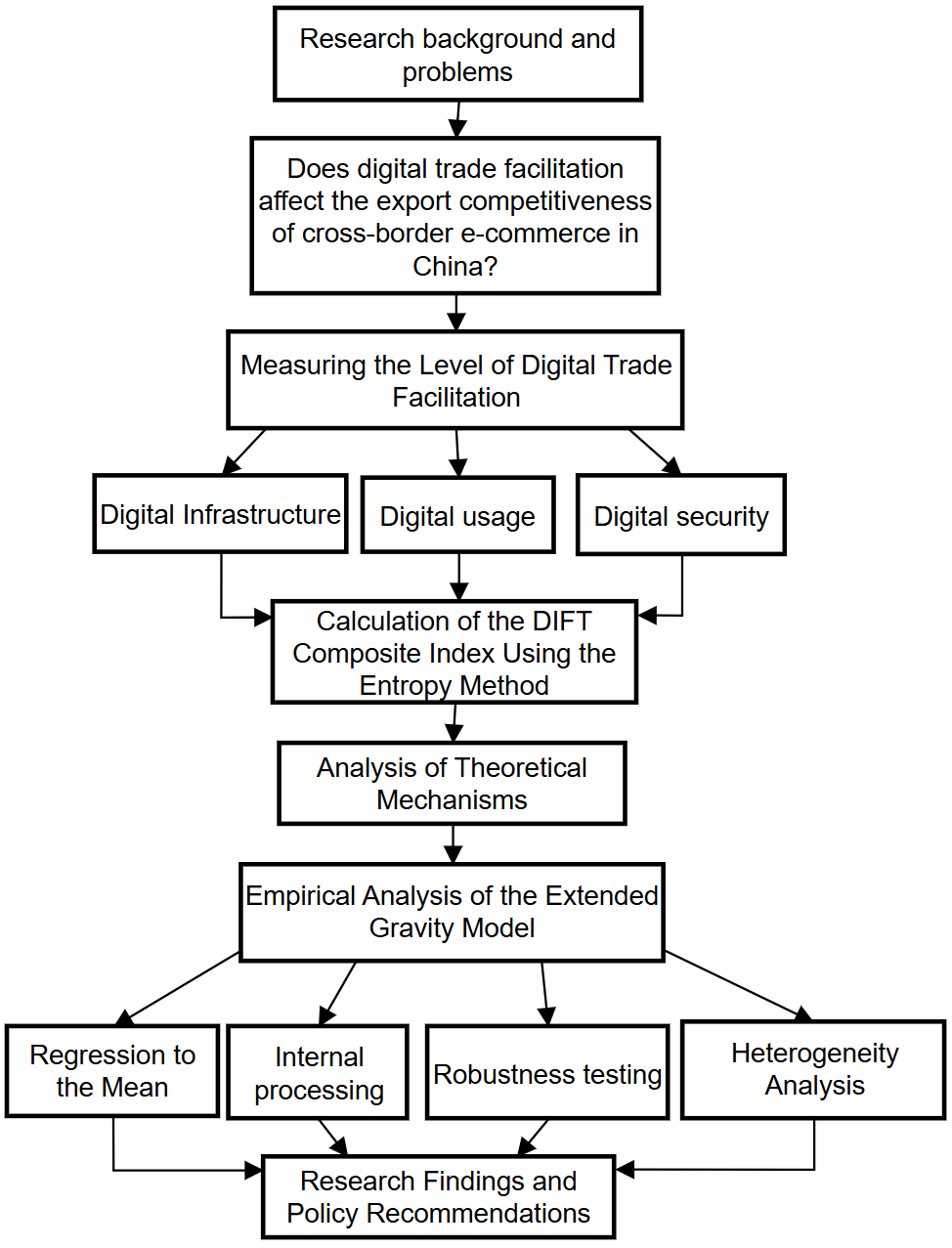
Research flowchart
- [1] B. Shepherd and J. S. Wilson, “Trade facilitation in ASEAN member countries: Measuring progress and assessing priorities,” J. Asian Econ., Vol.20, No.4, pp. 367-383, 2009. https://doi.org/10.1016/j.asieco.2009.03.001
- [2] Y. Duval, T. Wang, C. Utoktham, and A. Kravchenko, “Next-generation trade facilitation for Asian integration: Cross-border paperless trade,” Asian Econ. Integr., Vol.1, No.6, pp. 11-31, 2019. https://doi.org/10.1177/2631684618821473
- [3] M. Ismail and M. F. Ruslan, “Digitalisation, data governance, and cross-border commerce: New directions for international business theory,” Int. J. Res. Innov. Soc. Sci., Vol.9, No.11, pp. 3123-3132, 2025. https://doi.org/10.47772/IJRISS.2025.91100248
- [4] X. Li and S. Wei, “International trend of digital trade facilitation and China’s practice,” Economist, Vol.2022, No.8, pp. 77-85, 2022 (in Chinese). https://doi.org/10.16158/j.cnki.51-1312/f.2022.08.004
- [5] J. S. Wilson, C. L. Mann, and T. Otsuki, “Trade facilitation and economic development: A new approach to quantifying the impact,” World Bank Econ. Rev., Vol.17, No.3, pp. 367-389, 2003. https://doi.org/10.1093/wber/lhg027
- [6] Y. Zhang and L. Ma, “Digital trade facilitation and rising in the global value chain of the manufacturing industry: From the perspective of analyzing the adjustment of the intermediate input structure,” Mod. Finance Econ. (J. Tianjin Univ. Finance Econ.), Vol.44, No.12, pp. 35-51, 2024. https://doi.org/10.19559/j.cnki.12-1387.2024.12.003
- [7] Y. Zhou, “Digital trade and digital trade facilitation: Concept clearance and rules correlation,” J. Chengdu Univ. Technol. (Soc. Sci.), Vol.32, No.6, pp. 71-83, 2024 (in Chinese). https://doi.org/10.3969/j.issn.1672-0539.2024.06.007
- [8] N. W. Ismail, “Digital trade facilitation and bilateral trade in selected Asian countries,” Stud. Econ. Finance, Vol.38, No.2, pp. 257-271, 2021. https://doi.org/10.1108/SEF-10-2019-0406
- [9] Y. Cao, Z. Deng, and J. Wen, “The impact of digital trade facilitation on global value chain upgrading: Empirical evidence from belt and road countries,” East China Econ. Manag., Vol.38, No.6, pp. 56-65, 2024 (in Chinese). https://doi.org/10.19629/j.cnki.34-1014/f.231212008
- [10] Y. Li and Z. Wang, “Digital trade facilitation and GVC restructuring: Implications for manufacturing upgrading in developing countries,” Finance Res. Lett., Vol.86, Part B, Article No.108413, 2025. https://doi.org/10.1016/j.frl.2025.108413
- [11] P. Yu and F. Zheng, “Digital trade facilitation policies and export product quality upgrading: An empirical test based on cross-country panel data of ‘single windows’,” Stat. Res., Vol.42, No.5, pp. 47-61, 2025 (in Chinese). https://doi.org/10.19343/j.cnki.11-1302/c.2025.05.004
- [12] X. Wang and Z. Ding, “Research on the impact of trade facilitation on high-quality development of foreign trade—Based on the analysis of industrial upgrading,” China Bus. Mark., Vol.38, No.11, pp. 51-66, 2024 (in Chinese). https://doi.org/10.14089/j.cnki.cn11-3664/f.2024.11.005
- [13] M. Shuaibu and S. O. Mamman, “Trade facilitation and economic growth in ECOWAS member states: Does government size matter?,” J. Ind. Compet. Trade, Vol.25, No.1, Article No.13, 2025. https://doi.org/10.1007/s10842-025-00445-w
- [14] S. Wang and Y. Zhu, “An inquiry into the effect of trade facilitation on China’s digital product exports to countries along the ‘belt and road’,” Int. Rev. Econ. Finance, Vol.93, Part B, pp. 1246-1259, 2024. https://doi.org/10.1016/J.IREF.2024.04.041
- [15] F. Zhang, L. Wang, L. Wei, and Z. Zou, “The impact of industrial spatial agglomeration on the quality of export products under trade facilitation reform: Evidence from China,” Rev. World Econ., Vol.161, No.4, pp. 1599-1636, 2025. https://doi.org/10.1007/s10290-025-00597-1
- [16] C. Li and H. Shen, “Does trade facilitation contribute to export product quality upgrading in China?,” World Econ., Vol.48, No.3, pp. 460-499, 2025. https://doi.org/10.1111/twec.13649
- [17] Y. Wang, Y. Wang, and S. H. Lee, “The effect of cross-border e-commerce on China’s international trade: An empirical study based on transaction cost analysis,” Sustainability, Vol.9, No.11, Article No.2028, 2017. https://doi.org/10.3390/su9112028
- [18] K. Ning, X. Chen, and Y. Xiao, “Cross-border e-commerce, foreign investment and export trade resilience,” Finance Res. Lett., Vol.82, Article No.107595, 2025. https://doi.org/10.1016/j.frl.2025.107595
- [19] C. Feng, Z. Shi, C. Ma, and Y. Tian, “Cross-border e-commerce promoting the high-quality development of China’s sporting goods export trade under the ‘belt and road’ initiative,” Sports Cult. Guide, Vol.25, No.4, pp. 89-96, 2025 (in Chinese).
- [20] G. Han and F. Li, “Digital economy of trading partner countries, outward investment, and cross-border E-commerce exports,” Finance Res. Lett., Vol.85, Part B, Article No.108034, 2025. https://doi.org/10.1016/j.frl.2025.108034
- [21] K. Shi, “Analysis of the relationship between digital economic development, the dual-mode approach to cross-border E-commerce, and cross-border E-commerce export trade,” J. Commer. Econ., Vol.2025, No.15, pp. 150-153, 2025 (in Chinese).
- [22] H. Dong, S. Chen, S. Su, W. Zhu, and Y. Yang, “Research on cross-border E-commerce development strategies in the context of the belt and road Initiative: Guided by digital finance development,” J. Commer. Econ., Vol.2025, No.17, pp. 135-138, 2025 (in Chinese).
- [23] Y. Liang, L. Guo, J. Li, S. Zhang, and X. Fei, “The impact of trade facilitation on cross-border e-commerce transactions: Analysis based on the marine and land cross-border logistical practices between China and countries along the ‘Belt and Road’,” Water, Vol.13, No.24, Article No.3567, 2021. https://doi.org/10.3390/w13243567
- [24] Y. Liang, “The impact of trade facilitation on cross-border e-commerce exports of China based on the gravity model,” Int. J. Bus. Econ. Aff., Vol.5, No.4, pp. 138-155, 2020.
- [25] P. Guo, H. Z. Hamzah, and L. Chin, “Has trade facilitation of the ‘Belt and Road’ countries promoted China’s cross-border E-commerce exports?,” World Econ., Vol.48, No.2, pp. 238-266, 2025. https://doi.org/10.1111/twec.13646
- [26] A. H. Rafi et al., “Digital trade agreements and their effect on e-commerce expansion in emerging markets,” World J. Adv. Res. Rev., Vol.12, No.2, pp. 712-721, 2021. https://doi.org/10.30574/wjarr.2021.12.2.0575
- [27] Y. Li and Z. Wang, “Digital trade facilitation and GVC restructuring: Implications for manufacturing upgrading in developing countries,” Finance Res. Lett., Vol.86, Part B, Article No.108413, 2025. https://doi.org/10.1016/J.FRL.2025.108413
- [28] R. H. Coase, “The nature of the firm,” Economica, Vol.4, No.16, pp. 386-405, 1937. https://doi.org/10.1111/j.1468-0335.1937.tb00002.x
- [29] O. E. Williamson, “The economic institutions of capitalism. Firms, markets, relational contracting,” C. Boersch and R. Elschen (Eds.), “Das Summa Summarum des Management: Die 25 wichtigsten Werke für Strategie, Führung und Veränderung,” Gabler Verlag, pp. 61-75, 2007. https://doi.org/10.1007/978-3-8349-9320-5_6
- [30] Y. Liu, “Research on the impact of trade facilitation on China’s cross-border E-commerce imports and exports under RCEP framework,” Master’s thesis, Chongqing Technology and Business University, 2023 (in Chinese). https://doi.org/10.27713/d.cnki.gcqgs.2023.000385
- [31] S. Zhu, “The impact of trade facilitation in partner countries on China’s cross-border e-commerce export scale,” Master’s thesis, Jiangxi University of Finance and Economics, 2023 (in Chinese). https://doi.org/10.27175/d.cnki.gjxcu.2023.000515
- [32] J. Guo and P. Luo, “Does the internet promote total factor productivity in China?,” Manag. World, Vol.2016, No.10, pp. 34-49, 2016 (in Chinese). https://doi.org/10.19744/j.cnki.11-1235/f.2016.10.003
- [33] Z. Zhang and T. Chen, “Research on the impact of digital trade in RCEP countries on China’s cross-border e-commerce exports,” Prices Mon., Vol.2025, No.10, pp. 84-94, 2025 (in Chinese). https://doi.org/10.14076/j.issn.1006-2025.2025.10.09
- [34] N. Nunn and N. Qian, “US food aid and civil conflict,” Am. Econ. Rev., Vol.104, No.6, pp. 1630-1666, 2014. https://doi.org/10.1257/aer.104.6.1630
- [35] T. Zhao, Z. Zhang, and S. Liang, “Digital economy, entrepreneurship, and high-quality economic development: Empirical evidence from urban China,” Manag. World, Vol.36, No.10, pp. 65-76, 2020 (in Chinese). https://doi.org/10.19744/j.cnki.11-1235/f.2020.0154
This article is published under a Creative Commons Attribution-NoDerivatives 4.0 Internationa License.