
Research Paper:
Impact of Digital Economy Development on Employment Mechanisms: Perspectives from Industrial Structure and Human Capital
Dan Tang*,†, Liucen Lai**, and Jingjing Li**
*Research Center for Quantitative Economics, Huaqiao University
No.668 Jimei Avenue, Jimei District, Xiamen, Fujian 361021, China
†Corresponding author
**Institute of Quantitative Economics and Statistics, Huaqiao University
No.668 Jimei Avenue, Jimei District, Xiamen, Fujian 361021, China

The rapid development of the digital economy (DE) has exerted a profound influence on employment dynamics. Building upon a framework that captures the level of digital economic development, this study examines the effects of the DE on both the quantity and structure of employment. The analysis further explores the mechanisms underlying the influence of DE on employment outcomes from the perspectives of industrial structure and human capital. Results indicate that the DE exhibits both a “creation effect” and a “substitution effect” on total employment, with the creation effect playing the dominant role. As industrial structures advance and rationalize, and human capital structures improve, the promotional effect of DE on total employment will gradually increase. These developments expand job opportunities for highly skilled workers, promote a transition in employment structure from medium-low to high-skill occupations, and exert an “employment polarization” effect across the skill-level structure within the workforce of China. Therefore, this study proposes policy recommendations to accelerate the development of the DE, expand emerging employment opportunities, enhance the digital competencies of the labor force, and emphasize improving their digital literacy.
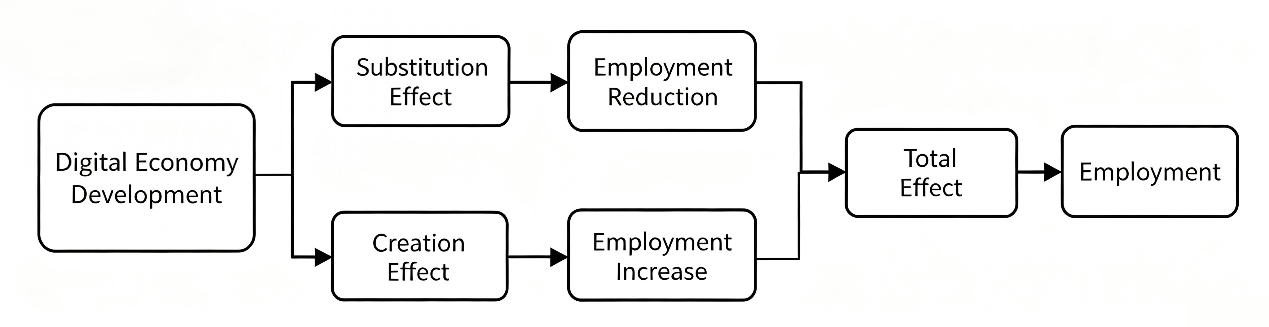
Theoretical mechanism of digital economy development on employment
1. Introduction
In 2022, the digital economy (DE) of China reached 50.2 trillion Yuan, representing a nominal year-on-year growth rate of 10.3% and accounting for 41.5% of the national GDP. The DE has profoundly transformed production, distribution, exchange, and consumption patterns; furthermore, it has emerged as a key driver for global economic growth and a central arena of strategic competition among countries. Deep integration between the DE and real economy continues to intensify, resulting in diverse new business models, including platform and sharing economies. These developments inject strong momentum into high-quality economic development and exerts comprehensive, profound, and systemic effects on job markets. Employment, the most fundamental component of social welfare, remains a central priority in national governance. The development of the DE has produced a complex landscape wherein employment growth coexists with job displacement, and the optimization of employment structure coexists with the intensification of skill mismatches. This trend creates new avenues for achieving relatively full employment while simultaneously introducing new challenges related to employment equity and quality improvement. Notably, digital transformation drives the differentiation of employment groups and transforms labor models, substantially influencing the allocation of labor and capital rights, and further highlighting the complexity and significance of employment-related issues.
Current research widely recognizes the dual impact of the DE on employment, characterized by both “creation effects” and “substitution effects.” However, no consensus has been reached regarding the dominance of these effects, their channel transmissions; or their overall net impact. A broadly shared view suggests that the DE does not directly affect total employment; instead, it exerts an indirect influence on both employment quantity and structure by reshaping underlying economic systems. Among these, industrial structural transformation and human capital upgrading constitute the two primary transmission channels. DE alters labor allocation across industries by driving industrial intellectualization, servitization, and integration. Simultaneously, it imposes new skill requirements on workers, triggering the upgradation and accumulation of human capital. Consequently, analyses confined to the macro-level impact of DE on employment remain insufficient. A comprehensive analysis of the intrinsic transmission mechanisms, particularly from the core perspectives of industrial structure and human capital, is imperative.
Therefore, this study addresses the central research question: How does DE development influence total employment and employment structure through the key channels of industrial structure upgrading and human capital enhancement? In addition, what transmission pathways and operational mechanisms govern these effects? Research on these questions presents significant theoretical and practical implications for China in implementing more precise employment promotion policies, advancing education-industry coordination, and achieving fuller and higher-quality employment in the DE era. Contemporary studies on the DE and employment primarily focuses on constructing measures of DE development and analyzing the impact of DE on employment. The concept of the DE continues to evolve 1,2; however, its measurement methods and constituent elements remain inconsistent. Internationally, metrics such as network readiness, ICT indices, and the DE and Society Index are widely employed to assess the DE. Domestically, approaches primarily involve estimating the value added of the overall DE scale 3,4, in conjunction with the development of scientific and systematic indicator frameworks for assessment 5,6. The DE primarily influences the job market via technological innovation, which functions as a dual-force mechanism that simultaneously generates disruptive 7 and creative effects 8. Advances in digital technologies have spurred the emergence of new business models and job roles while weakening the employment-promoting effects in traditional sectors. This trend not only alters employment quantities but also significantly affects employment quality. Li 9 observed that technological progress generally overall suppresses employment, although alternating suppression and creation effects occur during specific periods. The impact of the DE on employment is deeply rooted in the core characteristics of technological progress. This relationship can challenge existing job opportunities and also create new employment pathways, thereby determining the relationship between the DE and employment quality to some extent.
Industrial structure upgrading significantly expands the employment scale by promoting output growth, optimizing internal structures, and enhancing positions within global value chains, thereby exerting positive impact on the labor market 10. Driven by the dual processes of industrial digitization and digital industrialization, the DE has catalyzed a profound industrial transformation. From a digital industrialization perspective, electronic information technologies have permeated across socioeconomic domains, supported by next-generation information infrastructure, including big data, the Internet of Things, and 5G networks, thereby enabling broad digital transformation. Leveraging the massive internet user base and market scale of China, major platform enterprises such as Alibaba and Tencent have rapidly expanded, propelling the continuous emergence of new business models and formats based on digital platforms. This transformation, centered on digital technology, has disrupted traditional industry structures, injected new momentum into the labor market, and created numerous employment opportunities. From an industrial digitization perspective, the widespread application of next-generation information technologies such as artificial intelligence and big data has driven profound restructuring and shifts in production models across all sectors, thereby revitalizing traditional industries. This process optimizes production efficiency and simultaneously expands vast domains for employment and entrepreneurship, creating more opportunities for workers while promoting economic development and diversification in the job market.
Contemporary studies indicate that industrial upgrading is a key determinant of changes in regional employment structure 11. Digital technology platforms across industries have facilitated the development of ecosystem-based services, strengthened resource and information integration, and enhanced sharing capabilities, thereby effectively improving enterprise performance within value chains. Changes in the employment structure reflect shifts in the distribution of workers across different types and levels within the primary, secondary, and tertiary sectors. This redistribution illustrates the profound impact of economic development and technological progress on labor market structures and employment opportunities, revealing how digital transformation reshapes industrial layouts and labor allocation. According to the Clark–Petty theorem, labor migrates with the trend of industrial upgrading, with the employment absorption capacity of the primary sector being only 10% that of the tertiary sector. Within the secondary sector, the widespread application of industrial automation and intelligent technologies has accelerated the replacement of low-skill and labor-intensive jobs with machines 12. By contrast, the tertiary sector, particularly in transportation and e-commerce platforms, has generated new occupations, and significantly expanded employment absorption capacity, providing fresh opportunities for low-skilled workers displaced by automation. Collectively, technological progress propels both the upgrading of employment structures and reallocation of labor toward the tertiary sector, demonstrating the profound impact of technological innovation on the advanced restructuring of labor markets.
Investing in human capital can effectively expand the labor supply, thereby continuously promoting regional employment growth. Human capital encompasses education, training, and healthcare, serving as a core resource for socioeconomic development and progress. The DE has facilitated the accumulation of regional human capital in multiple dimensions, consequently increasing employment opportunities. First, regarding education and vocational training, Li and Zhou 13 note that advances in digital communication technologies, big data applications, and digital platforms have significantly accelerated the dissemination and sharing of knowledge and information, opening broader avenues for accessing advanced technologies and expertise. The development of the DE has driven innovation and transformation in educational concepts, methodologies, and formats, enabling higher education institutions to more effectively cultivate digital talent aligned with practical demands. Moreover, it has broken the temporal and spatial constraints of traditional vocational education, offering more diversified training methods that effectively reduce training costs and risks, thereby enhancing the value of workers’ human capital. Simultaneously, research by Zhang et al. 14 indicates that the DE has also driven investment in health-related human capital. By providing convenient access to health knowledge and medical services, it enhances individuals’ labor capacity and influences their employment opportunities. In the DE era, labor markets increasingly favor hiring educated and trained workers. This trend heightens unemployment risks for low-skilled groups while simultaneously motivating them to acquire digital skills and knowledge to adapt to evolving job demands, thereby promoting the accumulation of personal human capital. Ultimately, the DE era’s labor market preference for educated and trained workers increases unemployment risks for low-skilled populations. Nevertheless, this phenomenon motivates them to acquire digital skills and knowledge to meet evolving job demands, thereby fostering the accumulation of personal human capital. Through this mechanism, the DE not only elevates workers’ skill levels but also stimulates employment growth, demonstrating an employment growth dynamic that integrates technological advancement with human capital accumulation.
This paper constructs a measurement system for digital economic development levels, analyzes the mechanisms through which digital economic development impacts employment, employs the entropy method to measure provincial digital economic development levels, and empirically examines the effects of digital economic development levels on employment scale and structure. It further conducts empirical analysis from the perspectives of industrial structure transformation and human capital to explore how digital economic development influences employment. Finally, based on the research conclusions, it proposes reasonable policy recommendations.
2. Development of Indicators and Models
2.1. Development of DE Level
The DE spans three major sectors, including individuals, enterprises, and other inter-connected levels, forming a broad and highly complex integrated economic system. The report of the 20th CPC National Congress emphasized accelerating the implementation of the “Digital China” strategy, expediting the development of the DE, and promoting the deep integration of the DE with the real economy. Following the principles of scientific rigor, systematic design, and operational feasibility, this study constructs a regional digital economic development level system based on four categories of indicators: digital infrastructure development, digital industrialization, industrial digitalization, and the innovation environment supporting digital economic development, as shown in Table 1. Compared with frameworks developed by institutions such as the China Academy of Information and Communications Technology and the Tencent Research Institute, the digital economic development measurement system proposed in this study offers distinct advantages. These advantages are grounded in the core principles of the DE, which ensure stability throughout the sample period. The entropy weight method is employed to assess the digital economic development level of each province.
| Objective | Primary indicators | Secondary indicators |
| DE development level | Digital infrastructure development | 1.1 Length of long-distance optical cable lines |
| 1.2 Internet access interface density | ||
| 1.3 Proportion of mobile internet users | ||
| 1.4 Talent reserve scale | ||
| Digital industrialization development | 2.1 Output of industrial digital technologies | |
| 2.2 Software business revenue | ||
| 2.3 Degree of digital transformation | ||
| Industrial digitalization development | 3.1 E-commerce-related output | |
| 3.2 Enterprise information system development | ||
| 3.3 Digital financial inclusion index | ||
| DE innovation environment | 4.1 DE innovation and entrepreneurship index | |
| 4.2 Economic science and technology innovation status | ||
| 4.3 Innovation patent status |
This study employs the entropy weight method to determine indicator weights, enabling objective weight allocation for indicators and significantly reducing the influence of subjective judgment on indicator evaluation. Compared with alternative weight determination methods, the entropy weight method is not constrained by the volume or composition of the indicator data, making it applicable to all scenarios that require weight determination. Furthermore, this method fully extracts information embedded in raw data and can be combined with other weighting approaches to enhance evaluation accuracy and reliability. By analyzing time-series data from 31 provinces, municipalities, and autonomous regions in China over the period 2013–2020, we estimated DE development indicators of each province. The empirical data sources include the China Statistical Yearbook and China Labor Statistical Yearbook.
2.2. Model Construction and Indicator Selection
This study adopts a two-way fixed-effects model to comprehensively examine the macro-level impact of the DE on total employment, employment structure, and employment quality. This approach enhances the understanding of the influence of the DE on employment and broadens the research perspective. It provides a comprehensive analytical framework for understanding the employment-promoting effects of the DE and its role in shaping changes in the structure and quality of labor markets. Based on the theoretical analysis and research hypotheses, this study first evaluates the impact of the DE on total employment. Drawing on Cong and Yu 15, this study assumes that technological progress is a function of digital progress in accordance with the Cobb–Douglas production function, and uses the development of DE to represent digital technological progress. The baseline empirical model is specified as follows:
Based on this specification, the overall employment model is further defined as
In Eq. (1), \(i\) and \(t\) denote provinces and periods, respectively. \(u_t\) and \(\lambda_i\) represent the year and provincial fixed effects, respectively, and \(\varepsilon_{\textit{it}}\) denotes the residual term. \(\textit{EMP}_{\textit{it}}\) denotes total regional employment, \(\textit{DIG}_{\textit{it}}\) represents the level of regional digital economic development, and \(X_{\textit{it}}\) represents the set of control variables influencing employment. These controls comprise regional economic development levels 16, regional human capital, foreign direct investment, trade openness, regional infrastructure, and urbanization level. The data sources include the China Statistical Yearbook and the China Labor Statistical Yearbook.
| Variables | Corresponding education level |
| \(\textit{LOW}_{\textit{it}}\) | Elementary school and below |
| \(\textit{MID}_{\textit{it}}\) | Junior high school, high school |
| \(\textit{HIGH}1_{\textit{it}}\) | Associate’s or bachelor’s degree |
| \(\textit{HIGH}2_{\textit{it}}\) | Graduate school and above |
This study further examines the impact of the DE on employment structure by measuring the proportions of high-, medium-, and low-skilled workers. Skill levels were classified according to educational attainment, as shown in Table 2. Although skills can be distinguished by occupational characteristics, Berman et al. 17 found no significant differences between the conclusions derived from the two classification methods. Given data availability, the present study uses educational attainment as a proxy for skill level to examine the impact of the DE on the distribution of workers across tiers with different skills. The following model was employed to investigate the effects of digital economic development on the employment structure:
In Eqs. (3)–(6), \(i\) and \(t\) denote provinces and time periods, respectively. \(u_t\) and \(\lambda_i\) represent the fixed effects for the year and province, respectively, and \(\varepsilon_{\textit{it}}\) denotes the residual term. \(\textit{LOW}_{\textit{it}}\), \(\textit{MID}_{\textit{it}}\), \(\textit{HIGH}1_{\textit{it}}\), and \(\textit{HIGH}2_{\textit{it}}\) denote the proportions of high-, medium-, and low-skilled workers, respectively. \(\textit{DIG}_{\textit{it}}\) represents regional digital economic development level, and \(X_{\textit{it}}\) denotes a set of control variables.
This study incorporates multiple control variables influencing employment in the model construction:
-
(1)
Regional economic level (ECO). The regional marketization index was selected to measure regional economic development using data sourced from the China Marketization Index Database.
-
(2)
Trade openness (OPEN). The ratio of total imports and exports to GDP was used to analyze the impact of international technology and labor flows on employment changes. Data were sourced from the China Trade and Foreign Economic Statistics Yearbook and the China Statistical Yearbook.
-
(3)
Urbanization level (UAR). The proportion of the urban population was used to measure the urbanization levels. Data were sourced from the China Statistical Yearbook.
-
(4)
Human capital level (HC). The average years of education per capita at each province were used to measure regional human capital using data sourced from the China Education Statistical Yearbook and the China Statistical Yearbook.
-
(5)
Infrastructure development (INF). Infrastructure development was measured using the logarithm of per capita postal and telecommunications service volume in each province, calculated as the logarithm of the ratio of total service volume to year-end resident population. Data were sourced from the National Bureau of Statistics.
-
(6)
Foreign direct investment (INVEST). Foreign direct investment is measured as the proportion of FDI to regional GDP using data sourced from the National Bureau of Statistics.
Descriptive statistical analysis was conducted on all indicators used in this empirical study, and the results are presented in Table 3.
| Variables | Mean | SD | Max | Min |
| DIG | 2.869 | 0.938 | 5.797 | 1.619 |
| DIG_CPA | 0.61 | 0.06 | 0.889 | 0.522 |
| EMP | 570.319 | 421.392 | 2085.3 | 31 |
| LOW | 21.125 | 12.233 | 71.2 | 2.1 |
| MID | 69.016 | 10.592 | 83.175 | 22.3 |
| HIGH1 | 8.887 | 5.615 | 33.5 | 2.6 |
| HIGH2 | 0.97 | 1.535 | 10.3 | 0 |
| UAR | 0.594 | 0.125 | 0.896 | 0.24 |
| HC | 9.14 | 1.132 | 12.782 | 4.222 |
| INF | 0.382 | 0.349 | 1.484 | 0.076 |
| INVEST | 0.019 | 0.017 | 0.121 | 0 |
| OPEN | 0.253 | 0.261 | 1.257 | 0.008 |
| ECO | 7.924 | 2.106 | 12.107 | \(-\)0.16 |
| OLS | 6.742 | 0.284 | 7.657 | 6.235 |
| TL | 0.212 | 0.196 | 1.043 | 0.008 |
| HCD | 0.118 | 0.114 | 0.778 | 0.026 |
| Variables | Estimated coefficient | \(t\)-value |
| DIG | 0.114\(^{***}\) | (2.955) |
| UAR | 0.119\(^{**}\) | (2.334) |
| HC | 0.0978\(^{***}\) | (3.120) |
| INF | 0.0879 | (1.639) |
| INVEST | 1.782\(^{***}\) | (5.252) |
| OPEN | \(-\)0.349\(^{***}\) | (\(-\)3.341) |
| ECO | \(-\)0.00230 | (\(-\)0.143) |
| Constant | \(-\)0.839\(^{**}\) | (\(-\)2.409) |
Note: \(t\)-values in parentheses; ***: \(p <0.01\),**: \(p <0.05\), *: \(p <0.1\).
2.3. Model Estimation and Robustness Testing
Model (2) evaluates the impact of the DE on total employment. Table 4 presents the model estimation results.
The results indicate that the development level of the DE exerts a significant positive promotional effect on the overall employment scale of China. The job creation effect generated by digital economic development outweighs its direct substitution effect, resulting in an overall positive promotional effect. Consequently, DE increases employment opportunities and elevates the overall employment levels within the economy and society.
The results presented in Table 5 indicate that the development of the DE exerts a positive influence on the proportion of both high- and low-skilled labor, while producing a negative effect on the share of medium-skilled workers. Specifically, a 0.1 increase in the DE level increases the proportion of workers with postgraduate degrees, undergraduate and associate degrees, and primary education or below by 0.329%, 0.173%, and 0.174%, respectively. Conversely, the shares of workers with junior high and senior high school graduates decrease by 0.371%. Notably, the development of the consumer internet has spawned numerous new employment forms, creating additional job opportunities for low-skilled workers. Overall, the development of the DE significantly increases demand for highly skilled labor while reducing reliance on medium-to-low skilled workers, driving the employment structure of China toward a shift from medium-to-low to high-skill roles. This trend indicates that although the DE promotes employment structure optimization, it also generates an “employment polarization” effect on the skill level structure of the labor market, exacerbating the polarization of skill demand.
| Variables | LOW | MID | HIGH1 | HIGH2 |
| DIG | 0.174\(^{**}\) | \(-\)0.371\(^{***}\) | 0.173\(^{*}\) | 0.329\(^{***}\) |
| (2.378) | (\(-\)3.264) | (1.851) | (3.121) | |
| UAR | \(-\)0.232\(^{*}\) | 0.186 | 0.341\(^{*}\) | \(-\)0.332 |
| (\(-\)1.782) | (1.043) | (1.891) | (\(-\)1.220) | |
| HC | \(-\)0.0710 | \(-\)0.00795 | 0.151 | 0.213 |
| (\(-\)1.021) | (\(-\)0.0739) | (1.223) | (1.637) | |
| INF | \(-\)0.0387 | \(-\)0.0504 | 0.114\(^{***}\) | 0.140\(^{***}\) |
| (\(-\)1.270) | (\(-\)1.374) | (3.421) | (3.267) | |
| INVEST | \(-\)0.00821 | 0.0567 | \(-\)0.0799\(^{*}\) | \(-\)0.0511 |
| (\(-\)0.197) | (1.183) | (\(-\)1.718) | (\(-\)1.335) | |
| OPEN | 0.385\(^{**}\) | 0.497 | \(-\)1.328\(^{**}\) | \(-\)0.873 |
| (2.129) | (1.331) | (\(-\)2.368) | (\(-\)0.905) | |
| ECO | 0.0464\(^{*}\) | \(-\)0.0536 | \(-\)0.0179 | 0.0193 |
| (1.745) | (\(-\)1.399) | (\(-\)0.408) | (0.341) | |
| Constant | \(-\)0.540 | 1.774 | \(-\)1.611 | \(-\)2.855 |
| (\(-\)0.753) | (1.424) | (\(-\)1.058) | (\(-\)1.692) |
Note: \(t\)-values in parentheses; ***: \(p <0.01\),**: \(p <0.05\), *: \(p <0.1\).
Robustness tests were conducted to evaluate the reliability of research findings (Table 6). These tests primarily examine the impact of changing conditions, such as indicator selection and model evaluation methods, on the research conclusions. This study aims to verify the explanatory power of the selected indicators and rationality of the evaluation methods to ensure the stability and consistency of the conclusions under different conditions. The consistency between modified and baseline results indicate the scientific validity and reliability of the research findings. To verify the robustness of the benchmark regression, we substituted explanatory variables for testing.
This study employs the entropy weight method to calculate the DE development index. This evaluation approach may introduce variable measurement errors, potentially imparting a degree of randomness to the research findings. To demonstrate the robustness of the conclusions, we draw upon Zhao et al.’s 18 use of principal component analysis (PCA) to recalculate the DE development level as a substitute for the core explanatory variables. Based on the eigenvalues and variance contribution rates of each principal component, the composite function is derived as follows:
| Variables | EMP | LOW | MID | HIGH1 | HIGH2 |
| DIG_PCA | 0.115\(^{**}\) | 0.0377 | \(-\)0.368\(^{***}\) | 0.164\(^{*}\) | 0.542\(^{***}\) |
| (2.235) | (0.417) | (\(-\)3.668) | (1.901) | (5.784) | |
| UAR | 0.154 | \(-\)0.142 | 0.384\(^{**}\) | 1.114\(^{***}\) | \(-\)1.440\(^{***}\) |
| (1.375) | (\(-\)0.850) | (2.078) | (5.624) | (\(-\)2.799) | |
| HC | 0.0637\(^{*}\) | \(-\)0.0540 | 0.0714 | \(-\)0.0158 | 0.142\(^{*}\) |
| (1.951) | (\(-\)0.816) | (0.886) | (\(-\)0.133) | (1.747) | |
| INF | 0.0147 | \(-\)0.0908\(^{*}\) | 0.171\(^{***}\) | \(-\)0.0475 | \(-\)0.276\(^{*}\) |
| (0.234) | (\(-\)1.764) | (3.221) | (\(-\)0.789) | (\(-\)1.950) | |
| INVEST | 0.0395\(^{**}\) | \(-\)0.0192 | 0.00946 | \(-\)0.0610 | 0.0117 |
| (2.188) | (\(-\)0.531) | (0.233) | (\(-\)1.134) | (0.428) | |
| OPEN | \(-\)0.259\(^{**}\) | 0.902\(^{***}\) | 0.0996 | \(-\)0.846 | 0.893 |
| (\(-\)2.127) | (3.745) | (0.427) | (\(-\)1.522) | (1.156) | |
| ECO | 0.00355 | 0.0576\(^{*}\) | \(-\)0.0483\(^{*}\) | \(-\)0.0260 | 0.0574 |
| (0.231) | (2.006) | (\(-\)1.771) | (\(-\)0.546) | (1.068) | |
| Constant | \(-\)0.0521 | \(-\)0.488 | 0.119 | 0.183 | \(-\)2.714\(^{**}\) |
| (\(-\)0.148) | (\(-\)0.657) | (0.129) | (0.139) | (\(-\)2.507) |
Note: \(t\)-values in parentheses ; ***: \(p <0.01\),**: \(p <0.05\), *: \(p <0.1\).
In Eq. (7), \(F\) represents the composite score, whereas \(F_1\) and \(F_2\) denote the scores of the first and second principal components, respectively. Based on the composite function, panel data for the DE development index (DIG_PCA) are constructed.
Substitution of the variables into the aggregate employment model yielded magnitude and sign of the regression coefficients consistent with the benchmark regression results, indicating the robustness of the benchmark regression. The positive “creation effect” on employment offset the “direct destruction” effect, producing a net positive impact on employment. After variable substitution in the employment structure model, the coefficients and signs of the core explanatory variables remained consistent with the preliminary regression results, validating the robustness of the benchmark regression model. The results indicate that the development of DE significantly increases the demand for highly skilled labor while reducing reliance on medium-to-low-skilled labor. This drives the employment structure of China toward a shift from medium-to-low- to high-skilled labor, simultaneously confirming the existence of an “employment polarization” effect.
3. Mechanism Testing Analysis
3.1. Industrial Structure as a Mechanism Variable
The upgrading and rationalization of the industrial structure represents the key pathway through which digital economic development impacts overall employment, reflecting an industrial structure effect. Upgrading industrial structures captures improvements in the quality and efficiency of the entire industrial system. This process involves not only the adjustment of the proportion of primary, secondary, and tertiary industries in the national economy but also enhancements in inter-industrial collaboration and coordination. To comprehensively capture the essence of industrial structure upgrading, this study adopts two indicators following the approach of Cai and Xu 19. The first indicator is upgrading the industrial structure. The rapid development of DE has stimulated the emergence of new digital industries, including high-tech sectors, live streaming, and e-commerce. These developments have not promoted industrial transformation and simultaneously influenced the evolution of the labor employment structure. These emerging industries have introduced new job opportunities into the labor market, promoting diversification and upskilling in employment structures. However, traditional industries undergoing digital transformation are gradually advancing toward higher levels of development and quality. This shift drives labor demand toward skill restructuring, reducing the need for low-to-medium skill positions and increasing the reliance on highly skilled labor. This dual dynamic highlights the pivotal role of the DE in advancing industrial upgrading and improving employment quality, while underscoring the importance of enhancing labor skills and adaptability in the digital era. This study constructs an industrial structure upgrading index (OIS) following the methodology of Fu 20 to reflect the degree of industrial structure optimization. The second indicator is industrial structure rationalization. The rationalization of industrial structure refers to the process of improving the overall economic efficiency and competitiveness via complementary and coordinated development across industries, achieved by adjusting and optimizing of their composition and proportion during a specific period. This process not only involves the rational allocation of proportions among primary, secondary, and tertiary industries but also includes structural adjustments within each industry across sub-sectors, in conjunction with the optimization of technological structures, product portfolios, organizational frameworks, and other sectors. Following the methodology of Gan and Zheng 21, this study constructs an industrial structure rationalization index (TL) to measure the quality of industrial clustering. This indicator is measured using the Tier index.
Based on the above analytical framework and drawing on the research methodology of Jiang 22, the following model is established to further examine the mechanism through which digital economic development influences employment in China via industrial structure transformation:
Here, \(\textit{OIS}_{it}\) and \(\textit{TL}_{it}\) represent the OIS and TL respectively; \(\textit{DIG}_{it}\) denotes the regional level of digital economic development; and \(X_{it}\) denotes a set of control variables.
The instrumental variables for the industrial structure effect comprise the OIS and TL. The OIS precisely maps the impact of digital economic development on employment structure upgrading by emphasizing the secondary and tertiary industries, demonstrating its use as a theoretically grounded and empirically valid measure of industrial structure upgrading. The OIS is calculated using the cosine method 20, using the following steps:
-
Step 1:
Construct a set of three-dimensional \(X_0=(x_{1,0},x_{2,0},x_{3,0})\) vectors, where \(x_{1,0}\), \(x_{2,0}\), and \(x_{3,0}\) represent the respective shares of primary, secondary, and tertiary industry value added in GDP.
-
Step 2:
Calculate the angles \(\theta_1\), \(\theta_2\), \(\theta_3\), and between each vector \(X_0\) and the unit vectors \(X_1=(1,0,0)\), \(X_2=(0,1,0)\), and \(X_3=(0,0,1)\), respectively, using the following equations:
\begin{equation} \label{eq:10} \theta_j=\arccos\left(\dfrac{x_0 x_j}{\left\Vert x_0\right\Vert\times \left\Vert x_j\right\Vert}\right), \quad j=1,2,3. \tag{10} \end{equation} -
Step 3:
Calculate the industrial upgrading index using the following expression:
\begin{equation} \label{eq:11} \textit{OLS}=\sum_{k=1}^3 \sum_{j=1}^k \theta_j. \tag{11} \end{equation}
A higher industrial upgrading index value indicates a higher level of industrial upgrading and higher-quality industrial structure transformation.
Additionally, we selects the TL as the mechanism variable. From an inter-industry perspective, it reflects the overall optimization and quality of the industrial structure, facilitating a deeper understanding of the rationalization degree of the industrial structure and its underlying mechanism of influencing economic development. This indicator was measured using the Theil index, calculated as follows:
The index \(Y_i\) represents the industrial output value of industry \(i\), \(L_i\) represents the employment in sector \(i\), and \(n\) represents the number of industrial sectors. The values of the inverse indicator TZ closer to 0 indicate a more rational industrial structure, whereas higher TZ values indicate less rational industrial structure.
3.2. Human Capital as a Mechanistic Variable
Human capital constitutes a key channel through which the DE influences employment quality. The DE promotes the accumulation of regional human capital across multiple sectors, thereby expanding the employment scale and improving job quality. The development of digital communication technologies, big data applications, and digital platforms has significantly accelerated the dissemination of knowledge and information, broadened access to advanced technologies, and positively impacted the job market. The core components of human capital include education, vocational training, and healthcare. Driven by the DE, these domains have achieved substantial development at the regional level. Specifically, by enhancing educational quality, increasing investment in skills training, and optimizing health conditions, the DE has effectively enhanced labor supply, thereby providing robust support for regional employment growth. This process not only highlights the positive impact of the DE on human capital accumulation but also underscores its crucial role in driving regional employment expansion. Furthermore, the widespread application of new technologies provides new solutions to the challenges introduced by the decline of the demographic dividend, thereby serving as a new driver for economic transformation and upgrading. These findings reveal the profound impact of digital technologies on education and employment, providing crucial insights into talent development and employment policies in the DE era. Therefore, this study employs human capital dividends (HCD) to measure the human capital structure in China and examines the mechanism through which digital economic development influences employment via human capital. The following model is constructed for empirical analysis:
Drawing on the methodology for constructing human capital dividend variables by Yu and Cong 23, and integrating the classification of employment skill structures discussed earlier, this study adopts the ratio of highly skilled to low-skilled labor as a representative variable for human capital dividends. This ratio reflects the relative quantitative relationship between the labor forces at different skill levels and is calculated as follows:
| Variables | OIS | TL | HCD |
| DIG | 0.209\(^{***}\) | \(-\)0.492\(^{*}\) | 0.207\(^{**}\) |
| (2.875) | (\(-\)1.745) | (2.231) | |
| Control_ | YES | YES | YES |
Note: \(t\)-values in parentheses ; ***: \(p <0.01\),**: \(p <0.05\), *: \(p <0.1\).
3.3. Mechanism Regression Results Analyze
Empirical tests were conducted to examine whether the development of the DE influences employment fluctuations through a rationalized industrial structure, high-level industrial layout, and human capital dividends. Estimation results are presented in Table 7.
The results presented in Table 7 show that DE development of the DE exerted a significant positive effect on industrial structure upgraded. As DE advanced, the level of industrial structure upgradation was substantially enhanced. Specifically, for each one-unit increase in the DE development level, the industrial structure upgrading level increased by 0.209 units, demonstrating that DE development effectively promoted the optimization and transformation of the industrial structure from the primary sector to the secondary and tertiary sectors. Moreover, the expansion of DE broadens the scope and scale of the tertiary sector in addition to driving greater service orientation within the industrial structure, thereby providing robust support for advancing industrial upgrading to higher levels. Therefore, when using the OIS as a measure of industrial quality and efficiency improvement, the development of the DE significantly propelled the industrial restructuring in China. The level of digital economic development exerts a significant negative effect on industrial structure rationalization. The industrial structure rationalization index is an inverse indicator, where a lower index value (closer to 0) indicates enhanced inter-industrial coordination and a more rational industrial structure, whereas a higher index value indicates a less rational one, which suggests that the development of the DE has a significantly positive impact on improving the rationality of the industrial structure. Specifically, a one-unit increase in the DE development index decreases the TL by 0.492 units, indicating that digital economic advancement helps optimize and enhance the quality of coordination and integration among industries.
Digital economic development exerts a significantly positive effect on human capital dividends. As a positive indicator, an increase in the human capital dividend index reflects a trend toward the rationalization of the human capital structure, revealing that DE maturity plays a crucial role in optimizing human resource allocation and enhancing human capital quality. Therefore, DE promotes the accumulation of human capital via multiple channels. Drawing on the methodology of Jiang 22, it is evident that digital economic development influences both the quantity and structure of employment through the upgrading and rationalization of the industrial structure as well as the human capital dividend.
4. Conclusions and Policy Recommendations
This study examines the impact of the DE development of China, the employment structure, particularly in terms of industrial, sectoral, and skill distribution. The analysis indicates that DE significantly drives the transfer of the labor force to the service industry and high-end sectors by promoting digital industrialization, advancing the digital transformation of traditional industries and strengthening the development of digital infrastructure. This process creates employment opportunities for highly skilled workers. This transformation not only highlights the pivotal role of DE in shaping modern employment models but also underscores its importance in upgrading the skills of the labor market and promoting industrial development. However, the development of DE has significantly increased the demand for highly skilled labor while reducing the demand for medium- and low-skilled workers. This dynamics has accelerated the transition to a high-skill employment structure in China, which indicates that the DE exerts an “employment polarization” effect on the skill composition of the labor force. The primary mechanisms through which the DE influences regional employment structures include human capital accumulation and industrial structure upgrading. Based on the aforementioned research findings, this study proposes the following recommendations.
Accelerate the development of DE to expand employment opportunities. Therefore, it is necessary to expand the scope of the digital industry continuously and explore new channels for job creation. Priority should be given to advancing key technology industries, such as the Internet, 5G, IoT, big data, cloud computing, and artificial intelligence. The development of these industries not only creates abundant employment opportunities but also drives industrial development through innovation, thus positioning the digital sector as a leading force in economic growth. Strengthen the cultivation of platform enterprises, relax the market access criteria for digital platform enterprises, stimulate the vitality of the private economy, and enhance employment absorption capacity. Promote the development of emerging business models such as e-commerce, the sharing economy, and online education to expand the demand for information consumption, foster the emergence of new jobs, and provide more employment opportunities.
Focus on improving workforce digital literacy by deepening educational reforms, strengthening digital talent education, and adopting innovative methods for talent cultivation and training. Specific strategies include the following. First, accelerating the development of new disciplines and majors related to DE, expanding the scale of digital talent cultivation, and conducting systematic training for DE educators to build a comprehensive digital talent cultivation system covering all stages, from basic to vocational and higher education. Second, cultivate talent possessing “high-end, specialized, and scarce” capabilities aligned with global technological advancements and industrial demands. Development of advanced talent development platforms, introduction of new engineering majors in core digital technology fields, and dynamic adjustment programs in response to industry shifts support the formation of top-tier workforce capable of solving real-world problems and driving sectoral innovation. Finally, advance the digital transformation of education and training. Strengthened collaboration with digital technology enterprises facilitates the joint development of training courses suitable for online learning. The transition from traditional classroom instruction to online learning environments enhances personalized and flexible educational services. Widespread dissemination of high-quality educational resources help workers effectively update and deepen their knowledge and skills.
Acknowledgments
Fujian Province Innovation Strategy Research Project (Grant Number: 2025R0042); Fujian Provincial Social Science Planning Project (Grant Number: FJ2025B028).
- [1] B. Kim, A. Barua, and A. B. Whinston, “Virtual field experiments for a DE: A new research methodology for exploring an information economy,” Decision Support Systems, Vol.32, No.3, pp. 215-231, 2002. https://doi.org/10.1016/S0167-9236(01)00094-X
- [2] W. J. Jing and B. W. Sun, “DE promotes high-quality economic development: A theoretical analysis framework,” Economist, Vol.2, pp. 66-73, 2019.
- [3] T. X. Kang, “Research on the measurement of the scale of China’s DE,” Contemporary Finance & Economics, Vol.3, pp. 118-121, 2008.
- [4] X. Xu and M. Zhang, “Research on the scale measurement of China’s DE—Based on the perspective of international comparison,” China Ind. Econ., Vol.5, pp. 23-41, 2020.
- [5] X. L. Zhang and Y. X. Jiao, “Research on the development index of China’s DE and its preliminary application,” Zhejiang Social Sciences, Vol.4, pp. 32-40+157, 2017.
- [6] C. J. Yang and Z. X. Li, “Development level, regional differences and distribution dynamic evolution of China’s digital economy,” Statistics and Decision, Vol.39, No.5, pp. 5-10, 2023.
- [7] D. Autor, “The polarization of job opportunities in the US labor market: Implications for employment and earnings,” Center for American Progress and The Hamilton Project, Vol.6, pp. 11-19, 2010.
- [8] Z. Y. He and X. G. Song, “The mechanism and enlightenment of DE promoting employment: Thinking after the coronavirus epidemic,” Economist, Vol.5, No.5, pp. 58-68, 2020.
- [9] Z. M. Li, “Challenges and reflections on the impact of technological progress on employment in the era of the new industrial revolution,” Jiangxi Social Sciences, Vol.38, No.11, pp. 78-85, 2018.
- [10] H. C. Tian and M. X. Shi, “Research on the impact of manufacturing industrial upgrading on the employment quantity in China,” Economic Review, Vol.5, pp. 68-78, 2013.
- [11] W. G. Yang and B. Z. Wu, “The impact of platform economy on employment structure,” Chinese J. of Population Science, Vol.4, pp. 2-16+126, 2022.
- [12] W. Wang, “Does industrial intelligence promote high-quality employment in the DE era,” Economist, Vol.4, pp. 89-98, 2020.
- [13] M. N. Li and Y. B. Zhou, “Research on human capital structure effect of DE development,” Res. Econ. Manag., Vol.43, pp. 23-38, 2022.
- [14] H. S. Zhang, S. Y. Zhang, and C. Z. Wang, “The impact of human capital on high-quality economic development – A dual perspective of education and health capital,” Statistical J., Vol.3, No.2, pp. 16-30, 2022.
- [15] Y. Cong and B. Y. Yu, “The influence of DE on the efficiency of Chinese labor force resource allocation,” The Theory and Practice of Finance and Economics, Vol.41, No.2, pp. 108-114, 2020.
- [16] G. Fan, X. L. Wang, and G. R. Ma, “The contribution of China’s marketization process to economic growth,” Economic Research J., Vol.46, No.9, pp. 4-16, 2011.
- [17] E. Berman, J. Bound, and Z. Griliches, “Changes in the demand for skilled labor within U.S. manufacturing: Evidence from the annual survey of manufacturers,” The Quarterly J. of Economics, Vol.109, No.2, pp. 367-397, 1994. https://doi.org/10.2307/2118467
- [18] T. Zhao, Z. Zhang, and S. K. Liang, “Digital economy, entrepreneurial activity and high‑quality development: Empirical evidence from Chinese cities,” Management World, Vol.36, No.10, pp. 65‑76, 2020.
- [19] H. Y. Cai and Y. Z. Xu, “Does trade openness affect the upgrading of China’s industrial structure,” J. Quant. Tech. Econ., Vol.34, pp. 3-22, 2017.
- [20] L. H. Fu, “An empirical study on the relationship between industrial structure advancement and economic growth in China,” Statistical Research, Vol.27, No.8, pp. 79-81, 2010.
- [21] C. H. Gan and R. G. Zheng, “Research on the evolution of regional economic disparities and its industrial decomposition in China,” China Industrial Economics, Vol.6, pp. 25-34, 2010.
- [22] T. Jiang, “Mediating and moderating effects in empirical causal inference studies,” China Industrial Economics, Vol.5, pp. 100‑120, 2022.
- [23] B. Y. Yu and Y. Cong, “DE, human capital dividend and advanced industrial structure,” The Theory and Practice of Finance and Economics, Vol.42, No.3, pp. 124-131, 2021.
This article is published under a Creative Commons Attribution-NoDerivatives 4.0 Internationa License.