
Research Paper:
Minimum Wages and Labor Shares: Evidence from China Employer–Employee Survey
Qiang Xu and Xindong Zhao†
Institute of Quantitative Economics and Statistics, Huaqiao University
No.668 Jimei Avenue, Xiamen, Fujian 361021, China
†Corresponding author

While the labor income share has continued to decline globally, China has witnessed a notable rebound since 2010. This study investigates whether minimum-wage policy contributes to this reversal, using firm–worker matched data from the 2018 China Employer–Employee Survey. The analysis shows that minimum-wage increases raise the labor income share among firms below the productivity frontier, with effects confirmed by instrumental variable estimation. Heterogeneity analysis further indicates that the distributive impact is stronger in labor-intensive, low-automation, and large firms, as well as in high-skill industries and developed cities. These findings highlight the productivity-dependent nature of minimum-wage effects and provide new micro-level evidence for understanding China’s distinctive labor income dynamics.
1. Introduction
Over the past decades, a striking stylized fact has emerged in the global economy: the labor income share has persistently declined across most advanced and emerging countries. From the United States to Europe and Asia, the distributive position of labor has weakened under the combined pressures of technological change, globalization, and market concentration 1,2,3. However, China is a puzzling exception. As shown in Fig. 1, after a decade of decline during the 2000s, the labor income share began to rise again after 2010, despite the country’s deep integration into global value chains and its rapid technological upgrades. Why did China diverge from global patterns?
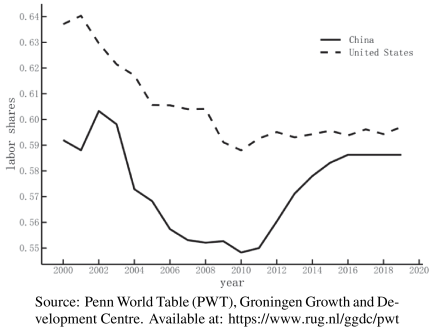
Fig. 1. Comparative trends in labor share between China and the United States.
A key institutional factor is the country’s evolving labor protection policies, particularly the minimum-wage system. Unlike advanced economies, where statutory minimum wages often bind only a small fraction of the workforce, China’s minimum-wage adjustments since the 2010s have been frequent, geographically differentiated, and closely tied to local labor market pressures. This raises a central question: To what extent have minimum-wage policies contributed to the rebound of China’s labor income share and under what conditions are these effects amplified or diminished?
Existing research offers mixed expectations. Higher minimum wages should strengthen the earnings of low-paid workers, compress wage inequality, and elevate the labor share 4,5. However, the effectiveness of these policies may be limited in high-productivity firms that already pay wage premiums 6 or may even backfire in technologically advanced firms that substitute labor with automation 7. These competing mechanisms suggest that the impact of minimum wages may not be uniform but rather shaped by a productivity frontier, where policy effectiveness operates in the mid-to-low productivity range but attenuates or reverses at the frontier.
This study provides new evidence for this debate by leveraging the 2018 China Employer–Employee Survey (CEES), a nationally representative matched dataset that links firm characteristics with worker outcomes. The CEES allows us to go beyond aggregate or provincial-level studies by observing how minimum-wage adjustments affect the within-firm labor income share, conditional on firm productivity. Our results reveal a clear productivity-frontier effect: minimum-wage hikes significantly raise the labor share in firms below the 90th percentile of productivity, but this effect weakens or turns negative among frontier firms. The magnitude of this effect varies systematically across ownership types, industrial structures, automation levels, and urban contexts.
This study contributes to the literature in three ways. First, it adds a micro-level perspective to the international debate on the declining labor share, providing evidence from China’s institutional context, where the trend has reversed. Second, it extends the literature on minimum wages by uncovering their productivity-dependent nature, highlighting that policy effectiveness is contingent on firm-level technological and organizational capacity rather than being uniform across the economy. Third, it enriches empirical research on labor protection in China by leveraging CEES data, which enables a more precise measurement of the distributional consequences of minimum-wage regulations within firms.
The remainder of this paper is organized as follows. Section 2 outlines the theoretical framework. Section 3 introduces the data and the empirical strategy. Section 4 presents the baseline results and the heterogeneity analyses. Section 5 concludes the paper and discusses the policy implications.
2. Literature Review and Theoretical Analysis
2.1. Minimum Wage and Wage Effects
The minimum wage is one of the most prominent labor protection institutions, and a vast body of literature has examined its economic consequences. The first strand of literature focuses on wage effects, which can be broadly categorized into wage-floor and wage-spillover effects.
Regarding the wage-floor effect, the evidence is generally consistent: minimum-wage increases directly boost the earnings of low-wage workers. For instance, Bossler and Schank 8, using German data, show that the introduction of the minimum wage generated substantial wage gains for incumbent workers, thereby enhancing overall labor income. Similarly, Cengiz et al. 4, applying a machine-learning approach to construct a treatment group covering approximately 75% of minimum-wage workers, document a significant rise in average wages among treated workers. These studies confirm the protective role of the minimum wage at the lower tail of the wage distribution.
In addition to this direct impact, scholars have identified wage-spillover effects. Ashenfelter and Jurajda 9, examining wage and price data from McDonald’s outlets in the United States, observe that increases in the minimum wage not only raised wages but also generated premiums exceeding the mandated minimum. Forsythe 5 further reveal that such spillovers are mediated by firms’ occupational restructuring and internal redistribution, leading to wage hikes for workers above the minimum-wage threshold.
Nevertheless, the direction and magnitude of the wage-level effects remain contested. Some studies argue that, while the wagefloor effect is evident, it may be offset by labor productivity responses. For example, Wan and Wei 10 contend that minimum-wage regulation produces both wage and productivity effects; however, because the wage effect is relatively modest, the overall consequence could be a decline in the labor income share.
2.2. Minimum Wage and Employment Effects
The second line of research emphasizes the employment effects of the minimum wage. Classical models predict that raising the wage floor reduces firms’ demand for labor, generating a negative employment effect. Empirical evidence supports this view. For instance, Bossler and Schank 8 observe that minimum-wage increases constrained the expansion of certain low-skilled jobs.
However, recent studies offer a more nuanced picture. Giupponi et al. 11, exploiting geographic variation in wage levels, show that the impact of minimum-wage increases on overall employment is statistically insignificant, suggesting that disemployment effects may be weaker than previously assumed. Moreover, the literature highlights potential external employment effects. Glasner 12 estimates that the rise in minimum wages during the 2010s—coinciding with the growth of online gig platforms—is associated with the expansion of nonemployer establishments in sectors such as transportation and warehousing. This indicates that minimum wages may reshape employment within firms and across labor-market segments.
Collectively, the evidence on employment effects remains inconclusive; some studies document negative effects, while others suggest negligible or even positive outcomes through external reallocation. However, relatively less attention has been devoted to understanding how these employment responses feed into firms’ labor income shares—a gap that motivates further inquiry.
2.3. Minimum Wage and the Labor Income Share
While the impacts of minimum wages on employment and earnings have been widely examined, their implications for the labor income share remain theoretically ambiguous. The labor income share reflects the distribution of value added between labor and capital and is therefore jointly determined by wage-setting institutions, market structure, and firms’ technological responses.
From a partial-equilibrium perspective, an increase in the statutory minimum wage raises the lower bound of the wage distribution, directly increasing labor compensation for affected workers. Considering output constant, this mechanical effect tends to increase the labor share in value added. In particular, in settings with monopsonistic labor markets or limited worker bargaining power, minimum-wage regulation may compress wage dispersion and redistribute surplus.
However, once firms are allowed to adjust along multiple margins, this effect becomes less straightforward. In standard production models with constant elasticity of substitution (CES) technology, an increase in the relative price of labor induces capital–labor substitution when the elasticity of substitution exceeds unity. Firms may respond by increasing capital intensity, reorganizing production processes, adopting automation technologies, or reallocating tasks to higher-skilled workers. These adjustments alter the marginal productivity conditions that determine factor payments and may offset the initial increase in labor compensation.
Beyond substitution, firms can adjust according to their scale margin. Higher labor costs may reduce output, compress markups, or trigger firm exits, particularly among financially constrained and low-margin producers. In such cases, the aggregate labor income share may decline when capital income is more resilient or when surviving firms are more capital-intensive.
As emphasized by Han et al. 13, exogenous increases in minimum wages may accelerate labor-saving technological adoption and induce market reallocation. Under this dynamic adjustment process, short-term gains in wage income may be offset by medium- or long-term structural responses. These mechanisms imply that the effect of the minimum wage on the labor income share is not uniform but instead depends critically on firms’ production technology, market power, and adjustment capacity.
This theoretical ambiguity motivates the need for a framework that explicitly incorporates firm heterogeneity, particularly productivity differences, in the analysis.
2.4. Theoretical Analysis: Productivity Frontiers and Distributional Effects
To reconcile the potentially opposing effects described above, we introduce firm productivity as a central conditioning variable. The key proposition of this study is that the impact of minimum-wage increases on the labor income share depends on a firm’s position relative to the productivity frontier.
In heterogeneous-firm models, productivity determines both the cost structure and adjustment capacity. Firms operating far below the frontier typically exhibit lower capital intensity, thinner profit margins, and a greater scope for efficiency improvement. For such firms, wages are more likely to cluster near the statutory minimum. When the minimum wage increases, the direct wage effect dominates, labor compensation rises mechanically, and firms may partially absorb the shock through modest price adjustments, internal efficiency gains, or reductions in non-essential expenditures. Because their baseline capital intensity is relatively low, the scope for immediate capital–labor substitution may be limited. As a result, the labor income share tends to increase.
By contrast, firms operating near the productivity frontier are typically characterized by higher capital intensity, more advanced technology, and tighter optimization around the production frontier. For these firms, productivity gains through internal reallocation are more constrained, as they are already operating close to technological best practices. When confronted with higher labor costs, their optimal response is more likely to involve capital-deepening, automation, or labor-saving innovation. In the CES framework, the higher the productivity level, the more responsive the factor proportions may become to relative price changes, especially when adjustment costs are lower for frontier firms.
Moreover, frontier firms often possess stronger financial capacity and better access to credit markets, enabling them to invest in labor-saving technologies. Consequently, the substitution margin becomes more pronounced, potentially reducing labor demand or compressing the labor share in value added. In extreme cases, even if average wages increase, a reduction in employment or an increase in capital income may dominate, leading to stagnation or a decline in the labor income share.
This reasoning implies the existence of a productivity-boundary effect: below the boundary, the direct wage effect outweighs the substitution and scale effects, raising the labor income share. However, near or above the boundary, substitution and technological responses dominate, attenuating or even reversing the positive distributional impact.
Importantly, the productivity-boundary is not a structural constant but an empirical threshold that reflects the distribution of firms within a given economy. Its identification allows us to move beyond average treatment effects and uncover the heterogeneous distributional consequences of minimum-wage policy.
2.5. Proposition
Building on this theoretical reasoning, the study advances the following proposition:
Proposition: When firms operate below the productivity frontier, an increase in the minimum wage leads to a rise in the labor income share.
This proposition provides an analytical foundation for the empirical strategy developed and presented in the next section, in which we introduce the identification framework, data, and measurement of key variables.
3. Research Design and Data Sources
3.1. Model Specification
Building on the preceding theoretical framework, the empirical model is specified as follows:
Here, \(\textit{LS}_{\textit{jt}}\) denotes the labor income share of firm \(j\) in year \(t\). \(\textit{TFP}_{\textit{jt}}\) represents firm productivity, and \(\textit{Minwage}_{\textit{jt}}\) is the statutory minimum wage in the city where the firm is located. \(I(\textit{TFP}_{\textit{jt}}{<}z_{ll})\) is an indicator function that equals one when firm productivity falls below the specified threshold \(z_{ll}\) and zero otherwise. \(X_{\textit{jt}}\) is a vector of control variables and \(\varepsilon_{\textit{jt}}\) is a random-disturbance term. The coefficient of primary interest is \(\beta\). This captures the effect of the statutory minimum wage on the labor income share within the relevant productivity interval. A positive estimate of \(\beta\) implies that, holding other factors constant, an increase in the minimum wage raises the labor income share for firms below the productivity threshold. Conversely, a negative \(\beta\) would indicate that higher minimum wages reduce the labor income share in this range.
3.2. Data
The empirical analysis draws on data from the 2018 CEES. CEES was jointly conducted by the Chinese Academy of Social Sciences, Wuhan University, the Hong Kong University of Science and Technology, and Stanford University. The survey uses a two-stage sampling strategy. First, a stratified sample of manufacturing firms was drawn from the national economic census. Second, within the sampled firms, employees were randomly selected from the official employee rosters.
The survey comprises two distinct questionnaires: a firm questionnaire and an employee questionnaire. The firm questionnaire collects information on firm characteristics, top management, organizational practices, production and operations, quality control, human capital, accounting, and financing. The employee questionnaire covers demographic information, compensation and benefits, insurance and social security, job satisfaction and attitudes, and personality traits.
In this study, the CEES provides several key variables. From the firm-level data, we extract indicators such as total wages, bonuses, welfare expenditures, workforce composition, number of separations, labor relations, and financial outcomes. From the employee-level data, we obtain information on monthly income, income composition, type of labor contract, and years of schooling.
In China, minimum-wage standards are set at the prefecture-level but are typically implemented in multiple tiers within each city, reflecting differences in local economic conditions across districts and county-level jurisdictions. Accordingly, we collected the officially announced minimum-wage schedules for each sampled prefecture-level city and identified the applicable wage tier corresponding to the specific administrative location of each firm. Firms were then directly matched to the minimum-wage standard in their respective districts or counties within a prefecture-level city. No averaging or aggregation was performed across jurisdictions.
3.3. Variable Construction and Definitions
3.3.1. Labor Income Share
The labor income share of a firm is defined as the ratio of labor compensation to the total firm output. Previous studies have employed various proxies for the numerator. Some use total employee compensation payable 10, while others adopt the sum of wages and bonuses 14 or the sum of wages and welfare expenditures 15. The specific choice typically depends on data availability.
To ensure a comprehensive measure of labor costs that reflects modern patterns of social security coverage, this study uses a detailed cost breakdown from the 2018 CEES firm questionnaire. Accordingly, we construct labor compensation as the sum of wages, bonuses, the five mandatory social insurances (pension, medical, unemployment, work-injury, and maternity), housing provident fund contributions, occupational annuities, and private medical insurance.
For the denominator, total firm output, the literature remains divided. One stream—the “gross-revenue approach”—directly uses operating revenue as the measure of output 16,17,18. However, because operating revenue includes the value of intermediate inputs, this method may systematically underestimate the labor share. Moreover, the heterogeneity in intermediate-input intensity across industries undermines cross-industry comparability. To address this issue, another stream has adopted a value-added approach, typically following Bai et al. 19. In this method, value added is calculated using the factor–cost approach, that is, the sum of labor compensation, operating profits, and fixed asset depreciation 14,15,20.
Adopting this latter approach and leveraging the advantages of the CEES dataset, we define the labor income share as:
3.3.2. Firm Productivity
Firm productivity plays a central role in the theoretical analysis. We use total factor productivity (TFP) as a proxy. Following Levinsohn and Petrin 21, we employ a semiparametric-estimation method (LP method) adapted for Chinese firm data by Li and Zhou 22. Output, labor, and capital inputs are measured by operating revenue, total employment, and net fixed assets, respectively. Intermediate inputs are measured as the sum of material costs, energy expenses, and manufacturing overheads.
The estimation is implemented using the prodest Stata package developed by Rovigatti and Mollisi 23. We control for firm and year fixed effects to absorb unobservable heterogeneity at the firm and time levels. To ensure robustness, we apply a bootstrap procedure with 200 replications and use the mean of the bootstrapped residuals as an estimate of firm-level TFP.
3.3.3. Control Variables
To reduce omitted-variable bias, we include a rich set of controls. Firm-level characteristics follow Jiang et al. 24, Qian and Shi 18, and Xiao et al. 20. These include firm age (log of the number of years from establishment), leverage ratio (total liabilities over total assets), capital-output ratio (net fixed assets over main business income), capital intensity (total assets over operating revenue), and shareholding concentration (the largest shareholder’s shareholding percentage). We also incorporate top-executive characteristics, following Wei et al. 14. These include the highest level of education, years of work experience, and political status (whether the executive is a member of the Communist Party, a delegate to the People’s Congress, or a member of the CPPCC). These final three indicators are represented as binary variables.
3.4. Descriptive Statistics
Table 1 presents the descriptive statistics for the main variables. The mean labor income share is 0.57 and is broadly consistent with the national labor share in China, which fluctuated between 0.548 and 0.606 from 1992 to 2019. This close alignment suggests that our measurement strategy is robust. The standard deviation is 0.21, indicating significant heterogeneity in the labor share across firms. The average statutory minimum wage is 15.28 yuan per hour, with a standard deviation of 1.70. This reflects both regional and sectoral variations in wage standards, which is consistent with China’s decentralized minimum-wage setting process. The mean TFP is 5.15, with a standard deviation of 1.36. The distribution shows a maximum of 17.24 and a minimum of \(-\)1.85, suggesting the presence of both highly productive firms and firms with negative productivity, possibly reflecting severe inefficiencies or financial distress. This pattern is consistent with the recent findings of Shen and Chen 25, who also document the coexistence of high-performing and struggling firms in the Chinese manufacturing sector.
| Variable | Symbol | Obs. | Mean | S.D. | Min | Max |
| Labor income share | LS | 5733 | 0.57 | 0.21 | 0.00 | 1.00 |
| Minimum wage standard | Minwage | 5733 | 15.28 | 1.70 | 11.00 | 20.30 |
| Productivity | TFP | 5733 | 5.15 | 1.36 | \(-\)1.85 | 17.24 |
| Firm age | firmage | 5730 | 11.88 | 8.81 | 1.00 | 80.00 |
| Leverage | lev | 5705 | 0.53 | 0.40 | \(-\)0.27 | 5.00 |
| Capital–output ratio | ky | 5733 | 4.05 | 101.83 | \(-\)0.05 | 3477.36 |
| Capital intensity | ci | 5733 | 4.50 | 95.97 | 0.00 | 4271.79 |
| Largest shareholder ownership [%] | largestshare | 5733 | 75.67 | 20.11 | 0.00 | 100.00 |
| CEO tenure [years] | workage | 5733 | 28.04 | 9.73 | 1.00 | 59.00 |
| CEO education level | edu | 5733 | 5.70 | 1.41 | 1 | 9 |
| CEO is CCP member (dummy) | party | 5733 | 0.36 | 0.48 | 0 | 1 |
| CEO is NPC deputy (dummy) | repre | 5733 | 0.16 | 0.36 | 0 | 1 |
| CEO is CPPCC member (dummy) | mNCCPP | 5733 | 0.12 | 0.33 | 0 | 1 |
Source: Authors’ calculation based on 2018 CEES survey data.
The control variables also fall within expected ranges. For example, the average firm age is approximately 12 years, the leverage ratio is around 0.53, and the largest shareholder holds 76% of shares on average, reflecting a relatively concentrated ownership structure. The top-executive characteristics show that the average work experience is 28 years, the mean education level is 5.7 (corresponding roughly to college-level education), and approximately one-third of the top executives are Communist Party members. The proportions of executives serving as People’s Congress representatives (16%) or CPPCC members (12%) are relatively small yet non-negligible, highlighting potential channels of political connections affecting firm behavior. Collectively, these statistics confirm that the CEES data provide a representative and internally consistent sample. The substantial heterogeneity in firm-level labor share, productivity, and governance characteristics provides fertile grounds for testing the theoretical proposition developed in Section 2.
4. Results
4.1. Baseline Estimation Results
Table 2 presents the baseline regression results for the effect of the statutory minimum wage standard on the firm-level labor income share. Column (1) presents the specification with the minimum wage only, and Column (2) additionally includes firm- and manager-level controls. The results reveal a clear productivity-targeting effect of the minimum wage. Considering other factors constant, in firms with productivity below the 90th percentile, a 1% increase in the minimum wage raises the labor income share by 0.0136 percentage points, significant at the 1% level. To illustrate, if the statutory hourly minimum wage in a city increases from 15 to 16.5 yuan—a 10% increase—the average labor income share in local firms rises by approximately 0.136 percentage points. The choice of the 90th percentile as the productivity threshold is data-driven. In particular, we conduct a sequence of estimations by progressively varying the cutoff from the 1st to the 99th percentile of the productivity distribution. The results indicate that the estimated minimum-wage effect becomes most statistically significant and economically stable when the threshold is set at the 90th percentile. Below this cutoff, the coefficient remains positive and robust, whereas beyond it, the magnitude declines and statistical significance weakens. These patterns support the identification of the 90th percentile as a meaningful productivity frontier rather than an arbitrary choice. This finding is consistent with our theoretical Proposition 3, indicating that raising the minimum wage significantly improves the relative position of labor in value distribution. The result also corroborates the evidence given by Cengiz et al. 4 and Forsythe 5, who show that minimum-wage increases enhance the labor share not only through direct wage effects for low-wage workers but also through wage spillover effects for higher-wage employees.
| (1) | (2) | |
| \(\ln \mathit{Minwage}*I (\mathit{TFP} <90)\) | 0.0136\(^{\ast\ast\ast}\) | 0.0134\(^{\ast\ast\ast}\) |
| (0.0037) | (0.0038) | |
| firmage | \(-\)0.0023\(^{\ast\ast\ast}\) | |
| (0.0005) | ||
| lev | 0.0108 | |
| (0.0072) | ||
| ky | \(-\)0.0000 | |
| (0.0000) | ||
| ci | \(-\)0.0000 | |
| (0.0001) | ||
| workage | 0.0007 | |
| (0.0005) | ||
| party | \(-\)0.0178\(^{\ast}\) | |
| (0.0101) | ||
| repre | \(-\)0.0308\(^{\ast\ast}\) | |
| (0.0137) | ||
| mNCCPP | 0.0046 | |
| (0.0136) | ||
| largestshare | \(-\)0.0001 | |
| (0.0002) | ||
| edu | 0.0039 | |
| (0.0033) | ||
| Constant | 0.5373\(^{\ast\ast\ast}\) | 0.5348\(^{\ast\ast\ast}\) |
| (0.0106) | (0.0325) | |
| Obs. | 5733 | 5702 |
| Adj. \(R^2\) | 0.0138 | 0.0159 |
Notes: (1) Dependent variable is the labor income share. (2) Robust standard errors are in parentheses. (3) \(^{*}\), \(^{**}\), and \(^{***}\) indicate significance at the 10%, 5%, and 1% levels, respectively. This table presents the baseline OLS estimates of the impact of minimum-wage policies on firms’ labor income share.
However, our findings contrast with those of Wan and Wei 10, who argue that the wage-rate effect of the minimum wage is too small to offset the rising laborcost burden, ultimately depressing the labor share. This discrepancy can be explained by the productivity-boundary effect. For firms above the 90th percentile of the productivity distribution, the positive effect of higher minimum wages on the labor share diminishes substantially and may even turn negative. Two mechanisms underlie this pattern. (1) Wagepremium rigidity. High-productivity firms tend to offer substantial wage premiums 6. Their pay levels are already well above the minimum wage, making statutory adjustments less binding and less capable of altering existing wage structures. (2) Capital–labor substitution. High-productivity firms are better able to deepen capital and automation 7. When facing rising labor costs, they are more likely to substitute low-skilled labor with machines, thereby reducing labor’s share of value creation.
This boundary effect explains why our results diverge from those of Wan and Wei 10. If a study sample contains a higher proportion of highly productive firms, the capitalsubstitution effect may dominate, leading to an overall decline in the labor share. Essentially, changes in the labor income share reflect a dynamic interplay between firms’ technological choices and institutional constraints. The emergence of a threshold effect at the productivity boundary provides micro-level evidence that the minimum wage operates in a targeted rather than a universal manner.
4.2. Robustness Checks
4.2.1. Addressing Endogeneity
Although the baseline results suggest heterogeneous effects of minimum-wage adjustments on the labor income share, potential endogeneity concerns may bias the parameter estimates. Two issues are particularly relevant. First, reverse causality: changes in the labor share may induce firms to adjust employment policies, for example, by modifying dismissal practices or altering their labor structure. Second, omitted variables: factors such as regional economic development or informal institutional environments may simultaneously affect both local minimum-wage standards and income distribution outcomes. To mitigate these concerns, we employ an instrumental-variable (IV) strategy.
Following the principles of relevance and exogeneity, we use the average minimum-wage standard of other firms in the same industry and province as the instrument. This choice is justified on two grounds. (i) Relevance: geographic proximity and industrial similarity ensure that the instrument is highly correlated with the endogenous variable because firms in the same industry-region cluster share common policy enforcement, labor-market features, and technological choices. (ii) Exogeneity: the average minimum-wage standard of neighboring firms affects the target firm’s minimum wage only through regional industry channels but has no direct link to the firm’s own labor income share.
Table 3 presents the results of the two-stage least-squares (2SLS) estimation. In the first stage, the instrument demonstrates strong predictive power; the Cragg–Donald F-statistic is 19,920.74, far above the conventional threshold of 10, which rules out weak-instrument concerns. The under-identification test also rejects the null hypothesis (\(p<0.01\)), thus confirming that the model is identifiable. In the second stage, the estimated effect of the minimum wage remains positive and significant. The coefficient increases to 0.029, which is significant at the 1% level. Because the model involves a single endogenous regressor and a single instrument, it is exactly identified; thus, an over-identification test (Hansen J-statistic) cannot be performed. Importantly, the IV estimate is larger than the baseline OLS coefficient, suggesting that a failure to account for endogeneity leads to a systematic underestimation of the policy’s true effect.
Further examination highlights that the IV results reinforce the productivity-boundary effect. A coefficient of 0.029 indicates that the distributive effect of the minimum wage is not only immediate but also cumulative. Once regional enforcement intensity and firm-level compliance dynamics are considered, the policy impact appears to exhibit a “snowball effect,” amplifying the labor share over time.
| (1) | |
| IV_\(\ln \mathit{Minwage}*I (\mathit{TFP} <90)\) | 0.029\(^{\ast\ast\ast}\) |
| (0.004) | |
| Controls | Yes |
| Constant | 0.467\(^{\ast\ast\ast}\) |
| (0.021) | |
| Obs. | 5702 |
| Adj. \(R^2\) | 0.025 |
| Weak instrument test: F-stat. | 19920.739 |
| KP LM statistic | 735.441 |
| KP LM \(p\)-value | 0.000 |
| Hansen J \(p\)-value |
Notes: (1) Dependent variable is the labor income share. (2) Robust standard errors are in parentheses. (3) \(^{*}\), \(^{**}\), and \(^{***}\) indicate significance at the 10%, 5%, and 1% levels, respectively. This table reports the 2SLS estimates, addressing potential endogeneity of policy variables.
4.2.2. Alternative Measurement of the Labor Income Share
To further verify the robustness of our findings, we adopt an alternative measure of the labor income share. In the baseline specification, firm output is the sum of labor compensation, operating profits, and depreciation (Eq. (2)). However, because tax structures may influence distributional outcomes, we extend the denominator to include the net production tax. Thus, the revised output measure is equal to labor compensation plus operating profits, depreciation, and net production taxes.
The re-estimated results confirm the robustness of our main findings. The minimum wage continues to exert a positive and significant effect on the labor income share, with coefficient magnitudes deviating by less than 5% from the baseline estimates. This consistency indicates that accounting for tax-related distortions does not alter the substantive conclusions. By incorporating net production taxes, we rule out the confounding influence of fiscal structures, thereby strengthening the credibility of the baseline results.
4.3. Heterogeneity Analysis
To further explore the heterogeneous effects of minimum-wage adjustments on the labor income share, we divide the sample across several firm- and region-level dimensions. The results are presented in Tables 4 and 5.
| (1) | (2) | (3) | (4) | (5) | (6) | |
| Domestic | Foreign | Capital-intensive | Labor-intensive | Low automation | High automation | |
| \(\ln\mathit{minwage}*I(\mathit{TFP} <90)\) | 0.0138\(^{\ast\ast\ast}\) | 0.0124\(^{\ast\ast}\) | 0.0057 | 0.0374\(^{\ast\ast\ast}\) | 0.0258\(^{\ast\ast\ast}\) | 0.0078\(^{\ast}\) |
| (0.0049) | (0.0054) | (0.0043) | (0.0096) | (0.0098) | (0.0040) | |
| Controls | Yes | Yes | Yes | Yes | Yes | Yes |
| Constant | 0.5296\(^{\ast\ast \ast}\) | 0.5657\(^{\ast\ast\ast}\) | 0.4800\(^{\ast\ast\ast}\) | 0.5418\(^{\ast\ast\ast}\) | 0.5397\(^{\ast\ast\ast}\) | 0.4804\(^{\ast\ast\ast}\) |
| (0.0368) | (0.0804) | (0.0657) | (0.0619) | (0.0528) | (0.0448) | |
| Obs. | 4613 | 1015 | 1900 | 1870 | 2692 | 2684 |
| Adj. \(R^2\) | 0.0129 | 0.0494 | 0.0196 | 0.0477 | 0.0218 | 0.0135 |
Notes: (1) Dependent variable is the labor income share. (2) Robust standard errors are in parentheses. (3) \(^{*}\), \(^{**}\), and \(^{***}\) indicate significance at the 10%, 5%, and 1% levels, respectively. This table examines the heterogeneous effects of minimum-wage policies on labor income share across ownership, capital intensity, and automation levels.
| (1) | (2) | (3) | (4) | (5) | (6) | |
| Small firms | Large firms | Low-skill industries | High-skill industries | Ordinary cities | Developed cities | |
| \(\ln\mathit{minwage}*I(\mathit{TFP} <90)\) | \(-\)0.0013 | 0.0125\(^{\ast\ast\ast}\) | 0.0089\(^{\ast}\) | 0.0180\(^{\ast\ast\ast}\) | 0.0062 | 0.0219\(^{\ast\ast\ast}\) |
| (0.0100) | (0.0042) | (0.0046) | (0.0056) | (0.0039) | (0.0064) | |
| Controls | Yes | Yes | Yes | Yes | Yes | Yes |
| Constant | 0.6324\(^{\ast\ast\ast}\) | 0.4498\(^{\ast\ast\ast}\) | 0.5512\(^{\ast\ast\ast}\) | 0.5226\(^{\ast\ast\ast}\) | 0.5259\(^{\ast\ast\ast}\) | 0.5725\(^{\ast\ast\ast}\) |
| (0.0527) | (0.0470) | (0.0458) | (0.0464) | (0.0395) | (0.0538) | |
| Obs. | 2600 | 2739 | 2967 | 2600 | 3778 | 1915 |
| Adj. \(R^2\) | 0.0019 | 0.0189 | 0.0119 | 0.0291 | 0.0152 | 0.0295 |
Notes: (1) Dependent variable is the labor income share. (2) Robust standard errors are in parentheses. (3) \(^{*}\), \(^{**}\), and \(^{***}\) indicate significance at the 10%, 5%, and 1% levels, respectively. This table explores heterogeneity across firm size, industry-level skill intensity, and regional development, providing further evidence on distributional effects.
4.3.1. Ownership and Factor Intensity
Columns (1) and (2) of Table 4 present a comparison of domestic and foreign-invested enterprises. The estimated coefficients indicate that both groups exhibit significantly positive responses to minimum-wage increases, although the effect is slightly stronger for domestic firms (0.0138) than for foreign firms (0.0124). This pattern may reflect differences in wage-setting institutions; foreign-invested enterprises often operate with relatively standardized pay scales and higher average wages, which reduces the marginal effect of binding minimum-wage adjustments. In contrast, domestic enterprises, particularly private enterprises, rely more heavily on minimum-wage benchmarks, thus displaying greater sensitivity.
Columns (3) and (4) show the differences between capital- and labor-intensive firms. The results are striking: while the effect for capital-intensive firms is small and statistically insignificant, labor-intensive firms exhibit a large and highly significant coefficient (0.0374). This divergence underscores the distributional role of the minimum wage in sectors where labor costs constitute a substantial share of total expenses. In labor-intensive firms, raising the minimum wage directly lifts the wage floor and compresses wage inequality, thereby increasing the overall labor share. In contrast, in capital-intensive firms, abundant capital substitution weakens the pass-through from minimum-wage adjustments to the labor income share.
Columns (5) and (6) focus on automation. In low-automation firms, the minimum wage significantly increases the labor income share (0.0258), whereas in highly automated firms, the effect is much smaller (0.0078) and only marginally significant. This finding is consistent with the literature on technological substitution 7, suggesting that automation provides firms with a buffer against rising labor costs, thereby diluting the distributive impact of minimum-wage policies.
4.3.2. Firm Size, Skill Intensity, and Regional Development
Table 5 further disaggregates the analysis. Columns (1) and (2) reveal a sharp size-based asymmetry. Small firms do not exhibit a significant response, while large firms show a robust and positive effect (0.0125). This may be explained by compliance dynamics: small firms often operate at the margin of enforcement and are more likely to circumvent regulations through informal employment or evasion, while larger firms—being more visible to regulators—face stronger enforcement and thus display more substantial minimum-wage adjustments.
Columns (3) and (4) split industries by skill intensity. The results indicate that both low- and high-skill industries benefit from higher minimum wages; however, the effect is stronger for high-skill industries (0.0180 versus 0.0089). One possible explanation is that minimum-wage hikes in high-skill industries trigger spillover effects on non-minimum-wage workers, amplifying the labor share gains beyond the lowest-paid group 4.
Finally, Columns (5) and (6) highlight the differences across regions. In less-developed cities, the effect is positive but statistically insignificant, whereas in more-developed cities, the coefficient is larger (0.0219) and highly significant. This finding suggests that the distributional impact of the minimum wage is more pronounced in regions with stronger enforcement capacity and more formalized labor markets. The absence of a significant effect in less-developed regions likely reflects weaker enforcement and a higher prevalence of informal employment, which dilutes the policy’s effectiveness.
Overall, these heterogeneity analyses confirm that the distributive effects of minimum-wage adjustments are not uniform across firms and regions. Instead, they depend critically on ownership structure, production technology, firm size, skill intensity, and regional development levels. This evidence highlights the importance of contextualizing the minimum-wage policy; while the policy tends to raise the labor income share overall, its effectiveness is contingent upon the institutional and structural characteristics that shape firms’ compliance behavior and technological responses.
5. Conclusion and Discussion
This study investigates the distributive consequences of minimum-wage regulations in China by combining a theoretical framework of firms’ intertemporal choices with micro-level evidence from the 2018 CEES survey. We focus on the effect of minimum-wage adjustments on the labor income share within firms and explore the role of productivity thresholds and heterogeneous firm characteristics in shaping these effects.
The main findings are summarized as follows. First, minimum-wage policies exhibit pronounced productivity-boundary effects. For firms below the 90th percentile of TFP, increases in the minimum wage significantly increase the labor income share, confirming the theoretical prediction that wage floors improve the relative bargaining position of labor in low- and mid-productivity enterprises. However, once productivity surpasses this boundary, the positive effect weakens and may even become negative. Although the estimates for frontier firms are identified less precisely, the pattern is consistent with wage rigidity at the upper end of the distribution and a greater propensity for capital substitution toward capital-intensive production technologies.
Second, heterogeneity across ownership, technology, and market environments amplifies policy differences. Domestic and labor-intensive firms respond more strongly to minimum-wage adjustments than foreign-invested and capital-intensive firms, whereas the effect is markedly attenuated in highly automated enterprises. Similarly, larger firms and those located in more-developed cities exhibit stronger responses, consistent with greater regulatory enforcement and a lower prevalence of informal employment. Moreover, the distributive impact is more pronounced in high-skill industries, where spillover effects on non-minimum-wage workers amplify the labor share gains. Overall, these patterns highlight that the minimum wage is not a uniform policy tool; its distributive power depends critically on the structural and institutional contexts in which firms operate.
Third, robustness checks—including instrumental-variable estimations and alternative measures of the labor income share—confirm that the positive effects of minimum-wage increases are not driven by endogeneity or measurement artifacts. In contrast, the IV estimates suggest that ignoring endogeneity may underestimate the true long-run distributive effect, which likely accumulates through compliance dynamics and regional enforcement over time.
Our findings have several important implications for future research and policy design. From a policy perspective, minimum-wage regulations remain an effective instrument for strengthening labor’s position in the distribution of value-added, but their impact is conditional. Policies that are too uniform risk uneven outcomes. In labor-intensive, low-productivity firms, minimum-wage hikes can meaningfully raise the labor share, whereas in high-productivity, highly automated firms, the distributive leverage of such policies is naturally constrained. This suggests that a targeted and differentiated approach—combining minimum-wage adjustments with complementary labor protection measures—may be more effective in promoting inclusive growth.
Finally, this study has some limitations. The analysis relies on cross-sectional CEES data, which restricts our ability to capture the dynamic evolution of firms’ responses to minimum-wage shocks. Future research could leverage longitudinal data or quasi-experiments policy designs to examine how digitalization, automation, and institutional enforcement shape the temporal persistence of minimum-wage effects. Moreover, extending the analysis to the interactions between minimum wages and other labor protection instruments—such as social insurance contributions or collective bargaining frameworks—would provide a more comprehensive understanding of how institutional design shapes labor share in the era of structural transformation.
In conclusion, while the global trend has been one of declining labor shares, the Chinese experience demonstrates that institutional interventions—particularly the minimum wage—can partially reverse this trajectory. However, as suggested by the data, such interventions appear to operate within identifiable productivity and institutional boundaries. Recognizing and adapting to these boundaries is essential for designing effective labor policies that balance efficiency and equity in a rapidly evolving economic landscape.
Acknowledgments
This study was supported by the Major Project of the 2024 Fujian Provincial Social Science Research Base: “Research on Redistribution Policies for Narrowing the Income Gap” (Project No.FJ2024JDZ037).
- [1] D. Autor, D. Dorn, L. F. Katz, C. Patterson, and J. V. Reenen, “The fall of the labor share and the rise of superstar firms,” The Quarterly J. of Economics, Vol.135, No.2, pp. 645-709, 2020. https://doi.org/10.1093/qje/qjaa004
- [2] F. Guvenen, R. J. Mataloni, Jr., D. G. Rassier, and K. J. Ruhl, “Offshore profit shifting and aggregate measurement: Balance of payments, foreign investment, productivity, and the labor share,” American Economic Review, Vol.112, No.6, pp. 1848-1884, 2022. https://doi.org/10.1257/aer.20190285
- [3] M. Koch and I. Manuylov, “Measuring the technological bias of robot adoption and its implications for the aggregate labor share,” Research Policy, Vol.52, No.9, Article No.104848, 2023. https://doi.org/10.1016/j.respol.2023.104848
- [4] D. Cengiz, A. Dube, A. Lindner, and D. Zentler-Munro, “Seeing beyond the trees: Using machine learning to estimate the impact of minimum wages on labor market outcomes,” J. of Labor Economics, Vol.40, No.S1, pp. S203-S247, 2022. https://doi.org/10.1086/718497
- [5] E. Forsythe, “The effect of minimum wage policies on the wage and occupational structure of establishments,” J. of Labor Economics, Vol.41, No.S1, pp. S291-S324, 2023. https://doi.org/10.1086/726820
- [6] L. F. Katz, L. H. Summers, R. E. Hall, C. L. Schultze, and R. H. Topel, “Industry rents: Evidence and implications,” Brookings Papers on Economic Activity: Microeconomics, Vol.1989, Article No.209, 1989. https://doi.org/10.2307/2534722
- [7] D. Acemoglu and P. Restrepo, “Automation and new tasks: How technology displaces and reinstates labor,” J. of Economic Perspectives, Vol.33, No.2, pp. 3-30, 2019. https://doi.org/10.1257/jep.33.2.3
- [8] M. Bossler and T. Schank, “Wage inequality in Germany after the minimum wage introduction,” J. of Labor Economics, Vol.41, No.3, pp. 813-857, 2023. https://doi.org/10.1086/720391
- [9] O. Ashenfelter and Š. Jurajda, “Minimum wages, wages, and price pass-through: The case of McDonald’s restaurants,” J. of Labor Economics, Vol.40, No.S1, pp. S179-S201, 2022. https://doi.org/10.1086/718190
- [10] J. Wan and X. Wei, “The impact of minimum wage regulation on the share of labor income in enterprises: Theoretical analysis and microscopic evidence,” J. of Finance and Economics, Vol.46, No.7, pp. 64-78, 2020 (in Chinese). https://doi.org/10.16538/j.cnki.jfe.2020.07.005
- [11] G. Giupponi, R. Joyce, A. Lindner, T. Waters, T. Wernham, and X. Xu, “The employment and distributional impacts of nationwide minimum wage changes,” J. of Labor Economics, Vol.42, No.S1, pp. S293-S333, 2024. https://doi.org/10.1086/728471
- [12] B. Glasner, “The minimum wage, self-employment, and the online gig economy,” J. of Labor Economics, Vol.41, No.1, pp. 103-127, 2023. https://doi.org/10.1086/719690
- [13] L. Han, F. Tong, and C. Liu, “Realization of the synchronous growth of labor productivity and labor remuneration under the goal of common prosperity: Market-oriented reform or labor protection?,” J. of Finance and Economics, Vol.49, No.01, pp. 4-18, 2023 (in Chinese). https://doi.org/10.16538/j.cnki.jfe.20220615.201
- [14] X. Wei, Z. Dong, and J. Huang, “Does labor union improve labor share? Theoretical analysis and evidence from private firms in China,” Economic Research J., Vol.48, No.8, pp. 16-28, 2013 (in Chinese).
- [15] P. Du, R. Liu, and S. Zhang, “Factor cost and labor income share: Evidence from minimum wage and import tariff,” J. of World Economy, Vol.45, No.2, pp. 85-110, 2022 (in Chinese). https://doi.org/10.19985/j.cnki.cassjwe.2022.02.008
- [16] X. Wang and Y. Huang, “Foreign direct investment and labor share in the listed companies: Looting a burning house or icing on the cake,” China’s Industrial Economics, No.4, pp. 135-154, 2017 (in Chinese). https://doi.org/10.19581/j.cnki.ciejournal.2017.04.008
- [17] X. Shi, W. Gao, Y. Lu, and M. Li, “Efficient resource allocation and labor income share: Evidence from the split-share structure reform,” Economic Research J., Vol.54, No.12, pp. 21-37, 2019 (in Chinese).
- [18] X. Qian and X. Shi, “Does enhanced employment protection increase labor share? Evidence from the Labor Contract Law enactment in China,” China Economic Quarterly, Vol.24, No.1, pp. 286-302, 2024 (in Chinese). https://doi.org/10.13821/j.cnki.ceq.2024.01.18
- [19] C. Bai, Z. Qian, and K. Wu, “Determinants of factor shares in China’s industrial sector,” Economic Research J., No.8, pp. 16-28, 2008 (in Chinese).
- [20] T. Xiao, Q. Dong, M. Zhang et al., “Competition policy and enterprise labor income share: Evidence from the quasi-natural experiment of the Anti-Monopoly Law implementation,” China’s Industrial Economics, No.4, pp. 117-135, 2023 (in Chinese). https://doi.org/10.3969/j.issn.1006-480X.2023.04.007
- [21] J. Levinsohn and A. Petrin, “Estimating production functions using inputs to control for unobservables,” The Review of Economic Studies, Vol.70, No.2, pp. 317-341, 2003. https://doi.org/10.1111/1467-937x.00246
- [22] J. Li and H. Zhou, “Artificial intelligence, capital-skill complementarity and enterprise total factor productivity,” Economic Review, No.1, pp. 20-36, 2025 (in Chinese). https://doi.org/10.19361/j.er.2025.01.02
- [23] G. Rovigatti and V. Mollisi, “Theory and practice of total-factor productivity estimation: The control function approach using Stata,” The Stata Journal: Promoting communications on statistics and Stata, Vol.18, No.3, pp. 618-662, 2018. https://doi.org/10.1177/1536867x1801800307
- [24] X. Jiang, L. Zhao, and C. Yuan, “Market fair competition and enterprise labor income share: Evidence from the implementation of the Anti-Monopoly Law,” Economic Theory and Business Management, Vol.43, No.3, pp. 69-81, 2023 (in Chinese).
- [25] G. Shen and B. Chen, “Total factor productivity of Chinese manufacturing firms: New findings based on new data and new method,” China Economic Quarterly, Vol.24, No.4, pp. 1048-1065, 2024 (in Chinese). https://doi.org/10.13821/j.cnki.ceq.2024.04.02
This article is published under a Creative Commons Attribution-NoDerivatives 4.0 Internationa License.