
Research Paper:
Multi-Scale Fusion Fuzzy Method for Accurate and Interpretable Prediction of Photovoltaic Power Generation
Yixuan Yu, Chenlu Tian, Wei Peng
 , Yi Yan, and Chengdong Li†
Shandong Provincial Key Laboratory of Smart Buildings and Energy Efficiency, School of Information and Electrical Engineering, Shandong Jianzhu University
No.1000 Fengming Road, Licheng District, Jinan 250101, China
†Corresponding author

Photovoltaic (PV) power systems can provide clean, carbon-free energy and have become an important pathway for achieving carbon neutrality goals. Accurate prediction of PV power output is crucial for the rational scheduling and allocation of solar power resources. To further enhance the prediction accuracy at some local regions, especially around the peak or bottom points, this paper proposes a novel fusion fuzzy model for PV power forecasting. This model begins with the development of a distributed function-weighted fuzzy method (DFWFM), which effectively simplifies the structure of traditional fuzzy systems and significantly reduces the number of fuzzy rules. And an iterative regularized least squares method is developed for tuning the parameters of the DFWFM. Furthermore, a data-driven multi-scale fusion model (DMFM) is proposed to alleviate local prediction errors by training additional local models with data from high-error regions. The construction processes for such a multi-scale fusion model are also provided. Finally, detailed experiments are conducted, comparing the DFWFM-DMFM with five other prediction models. Experimental and comparative results demonstrate that this strategy substantially enhances the prediction accuracy in specific local areas, thereby improving the overall performance of the forecasting model.
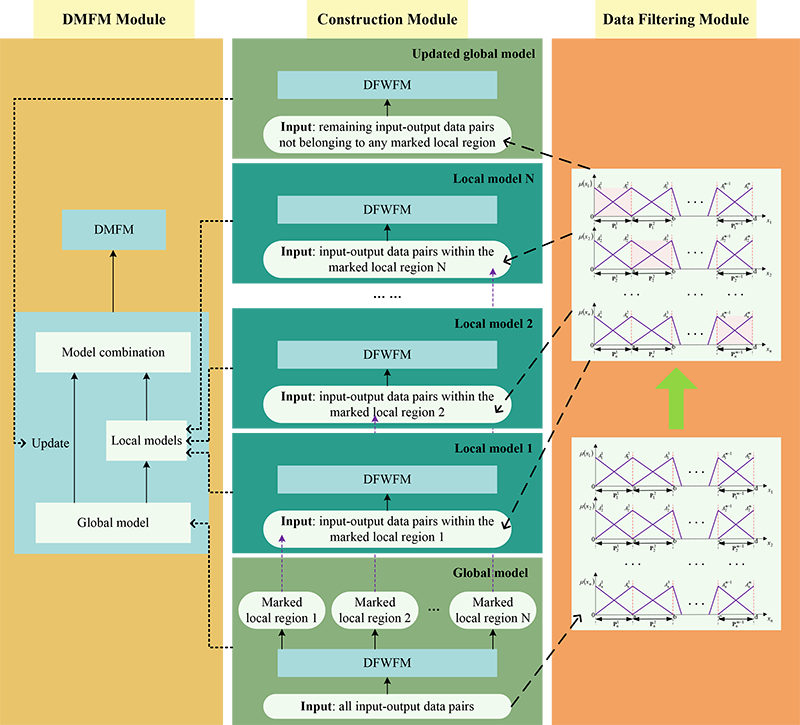
Learning flowchart of the proposed DMFM
- [1] Z. Wang, Y. Wang, S. Cao, S. Fan, Y. Zhang, and Y. Liu, “A robust spatial-temporal prediction model for photovoltaic power generation based on deep learning,” Computers and Electrical Engineering, Vol.110, Article No.108784, 2023. https://doi.org/10.1016/j.compeleceng.2023.108784
- [2] D. Liu and K. Sun, “Random forest solar power forecast based on classification optimization,” Energy, Vol.187, Article No.115940, 2019.
- [3] Y. Li, P. Janik, and H. Schwarz, “Prediction and aggregation of regional PV and wind generation based on neural computation and real measurements,” Sustainable Energy Technologies and Assessments, Vol.57, Article No.103314, 2023. https://doi.org/10.1016/j.seta.2023.103314
- [4] H. Gao, S. Qiu, J. Fang, N. Ma, J. Wang, K. Cheng, H. Wang, Y. Zhu, D. Hu, H. Liu, and J. Wang, “Short-Term Prediction of PV Power Based on Combined Modal Decomposition and NARX-LSTM-LightGBM,” Sustainability, Vol.15, Issue 10, Article No.8266, 2023. https://doi.org/10.3390/su15108266
- [5] Q. Dai, X. Huo, Y. Hao, and R. Yu, “Spatio-temporal prediction for distributed PV generation system based on deep learning neural network model,” Frontiers in Energy Research, Vol.11, Article No.1204032, 2023. https://doi.org/10.3389/fenrg.2023.1204032
- [6] Y. Jiang, K. Fu, W. Huang, J. Zhang, X. Li, and S. Liu, “Ultra-short-term PV power prediction based on Informer with multi-head probability sparse self-attentiveness mechanism,” Frontiers in Energy Research, Vol.11, Article No.1301828, 2023. https://doi.org/10.3389/fenrg.2023.1301828
- [7] H. Song, N. Al Khafaf, A. Kamoona, S. S. Sajjadi, A. M. Amani, M. Jalili, X. Yu, and P. McTaggart, “Multitasking recurrent neural network for photovoltaic power generation prediction,” Energy Reports, Vol.9, Supplement 3, pp. 369-376, 2023. https://doi.org/10.1016/j.egyr.2023.01.008
- [8] H. Zhang, J. Shi, and C. Zhang, “A hybrid ensembled double-input-fuzzy-modules based precise prediction of PV power generation,” Energy Reports, Vol.8, Supplement 4, pp. 1610-1621, 2022. https://doi.org/10.1016/j.egyr.2022.02.298
- [9] P. Malik and S. S. Chandel, “A new integrated single-diode solar cell model for photovoltaic power prediction with experimental validation under real outdoor conditions,” Int. J. of Energy Research, Vol.45, No.1, pp. 759-771, 2021. https://doi.org/10.1002/er.5881
- [10] M. Kumar, P. Malik, R. Chandel, and S. S. Chandel, “Development of a novel solar PV module model for reliable power prediction under real outdoor conditions,” Renewable Energy, Vol.217, Article No.119224, 2023. https://doi.org/10.1016/j.renene.2023.119224
- [11] Y. Chaibi, A. Allouhi, M. Malvoni, M. Salhi, and R. Saadani, “Solar irradiance and temperature influence on the photovoltaic cell equivalent-circuit models,” Solar Energy, Vol.188, pp. 1102-1110, 2019. https://doi.org/10.1016/j.solener.2019.07.005
- [12] T. Villemin, O. Farges, G. Parent, and R. Claverie, “Monte Carlo prediction of the energy performance of a photovoltaic panel using detailed meteorological input data,” Int. J. of Thermal Sciences, Vol.195, Article No.108672, 2024. https://doi.org/10.1016/j.ijthermalsci.2023.108672
- [13] C. Li, C. Zhou, W. Peng, Y. Lv, and X. Luo, “Accurate prediction of short-term photovoltaic power generation via a novel double-input-rule-modules stacked deep fuzzy method,” Energy, Vol.212, Article No.118700, 2020. https://doi.org/10.1016/j.energy.2020.118700
- [14] Y. Chu, B. Urquhart, S. M. I. Gohari, H. T. C. Pedro, J. Kleissl, and C. F. M. Coimbra, “Short-term reforecasting of power output from a 48 MWe solar PV plant,” Solar Energy, Vol.112, pp. 68-77, 2015. https://doi.org/10.1016/j.solener.2014.11.017
- [15] J. Zhang, Z. Tan, and Y. Wei, “An adaptive hybrid model for day-ahead photovoltaic output power prediction,” J. of Cleaner Production, Vol.244, Article No.118858, 2020. https://doi.org/10.1016/j.jclepro.2019.118858
- [16] M. Trigo-González, F. J. Batlles, J. Alonso-Montesinos, P. Ferrada, J. Del Sagrado, M. Martínez-Durbán, M. Cortés, C. Portillo, and A. Marzo, “Hourly PV production estimation by means of an exportable multiple linear regression model,” Renewable Energy, Vol.135, pp. 303-312, 2019. https://doi.org/10.1016/j.renene.2018.12.014
- [17] Y. Li, Y. Su, and L. Shu, “An ARMAX model for forecasting the power output of a grid connected photovoltaic system,” Renewable Energy, Vol.66, pp. 78-89, 2014. https://doi.org/10.1016/j.renene.2013.11.067
- [18] E. Kim, M. S. Akhtar, and O.-B. Yang, “Designing solar power generation output forecasting methods using time series algorithms,” Electric Power Systems Research, Vol.216, Article No.109073, 2023. https://doi.org/10.1016/j.epsr.2022.109073
- [19] M. Bouzerdoum and A. Mellit, “Performance prediction of a grid-connected photovoltaic plant,” 2017 5th Int. Conf. on Electrical Engineering-Boumerdes (ICEE-B), 2017. https://doi.org/10.1109/ICEE-B.2017.8192059
- [20] M. Lotfi, M. Javadi, G. J. Osório, C. Monteiro, and J. P. Catalão, “A Novel Ensemble Algorithm for Solar Power Forecasting Based on Kernel Density Estimation,” Energies, Vol.13, Issue 1, Article No.216, 2020. https://doi.org/10.3390/en13010216
- [21] C. Li, M. Tang, G. Zhang, R. Wang, and C. Tian, “A Hybrid Short-Term Building Electrical Load Forecasting Model Combining the Periodic Pattern, Fuzzy System, and Wavelet Transform,” Int. J. of Fuzzy Systems, Vol.22, pp. 156-171, 2020. https://doi.org/10.1007/s40815-019-00783-y
- [22] T. Lu, Q. Ai, W.-J. Lee, Z. Wang, and H. He, “An Aggregated Decision Tree-Based Learner for Renewable Integration Prediction,” 2018 IEEE Industry Applications Society Annual Meeting (IAS), 2018. https://doi.org/10.1109/IAS.2018.8544544
- [23] C. Brester, V. Kallio-Myers, A. V. Lindfors, M. Kolehmainen, and H. Niska, “Evaluating neural network models in site-specific solar PV forecasting using numerical weather prediction data and weather observations,” Renewable Energy, Vol.207, pp. 266-274, 2023. https://doi.org/10.1016/j.renene.2023.02.130
- [24] L. Wang, Y. Liu, T. Li, X. Xie, and C. Chang, “The Short-Term Forecasting of Asymmetry Photovoltaic Power Based on the Feature Extraction of PV Power and SVM Algorithm,” Symmetry, Vol.12, Issue 11, Article No.1777, 2020. https://doi.org/10.3390/sym12111777
- [25] M. S. Hossain and H. Mahmood, “Short-Term Photovoltaic Power Forecasting Using an LSTM Neural Network and Synthetic Weather Forecast,” IEEE Access, Vol.8, pp. 172524-172533, 2020. https://doi.org/10.1109/ACCESS.2020.3024901
- [26] P. Li, K. Zhou, X. Lu, and S. Yang, “A hybrid deep learning model for short-term PV power forecasting,” Applied Energy, Vol.259, Article No.114216, 2020. https://doi.org/10.1016/j.apenergy.2019.114216
- [27] D. Lee and K. Kim, “PV power prediction in a peak zone using recurrent neural networks in the absence of future meteorological information,” Renewable Energy, Vol.173, pp. 1098-1110, 2021. https://doi.org/10.1016/j.renene.2020.12.021
- [28] R. Nelega, D. I. Greu, E. Jecan, V. Rednic, C. Zamfirescu, E. Puschita, and R. V. F. Turcu, “Prediction of Power Generation of a Photovoltaic Power Plant Based on Neural Networks,” IEEE Access, Vol.11, pp. 20713-20724, 2023. https://doi.org/10.1109/ACCESS.2023.3249484
- [29] F. Wang, Z. Xuan, Z. Zhen, K. Li, T. Wang, and M. Shi, “A day-ahead PV power forecasting method based on LSTM-RNN model and time correlation modification under partial daily pattern prediction framework,” Energy Conversion and Management, Vol.212, Article No.112766, 2020. https://doi.org/10.1016/j.enconman.2020.112766
- [30] Y. Jiang, L. Zheng, and X. Ding, “Ultra-short-term prediction of photovoltaic output based on an LSTM-ARMA combined model driven by EEMD,” J. of Renewable and Sustainable Energy, Vol.13, Issue 4, Article No.046103, 2021. https://doi.org/10.1063/5.0056980
- [31] J. Zhang, Z. Liu, and T. Chen, “Interval prediction of ultra-short-term photovoltaic power based on a hybrid model,” Electric Power Systems Research, Vol.216, Article No.109035, 2023. https://doi.org/10.1016/j.epsr.2022.109035
- [32] M. Tovar, M. Robles, and F. Rashid, “PV Power Prediction, Using CNN-LSTM Hybrid Neural Network Model. Case of Study: Temixco-Morelos, México,” Energies, Vol.13, Issue 24, Article No.6512, 2020. https://doi.org/10.3390/en13246512
- [33] Q. Dai, X. Huo, Y. Hao, and R. Yu, “Spatio-temporal prediction for distributed PV generation system based on deep learning neural network model,” Frontiers in Energy Research, Vol.11, Article No.1204032, 2023. https://doi.org/10.3389/fenrg.2023.1204032
- [34] L. A. Zadeh, “Fuzzy sets,” Information and Control, Vol.8, Issue 3, pp. 338-353, 1965. https://doi.org/10.1016/S0019-9958(65)90241-X
- [35] C. Li, J. Gao, J. Yi, and G. Zhang, “Analysis and Design of Functionally Weighted Single-Input-Rule-Modules Connected Fuzzy Inference Systems,” IEEE Trans. on Fuzzy Systems, Vol.26, Issue 1, pp. 56-71, 2016. https://doi.org/10.1109/TFUZZ.2016.2637369
- [36] M. Fujita and Y. Kanzawa, “Three Fuzzy c c-Shapes Clustering Algorithms for Series Data,” J. Adv. Comput. Intell. Intell. Inform., Vol.27, No.5, pp. 976-985, 2023. https://doi.org/10.20965/jaciii.2023.p0976
- [37] H. A. Calinao Jr., R. C. Gustilo, E. P. Dadios, and R. S. Concepcion II, “Enhancing Fault Detection and Classification in Grid-Tied Solar Energy Systems Using Radial Basis Function and Fuzzy Logic-Controlled Data Switch,” J. Adv. Comput. Intell. Intell. Inform., Vol.28, No.1, pp. 41-48, 2024. https://doi.org/10.20965/jaciii.2024.p0041
- [38] K. Liao, X. Li, C. Mu, and D. Wang, “Short-term photovoltaic power prediction based on T-S fuzzy neural network,” 2018 33rd Youth Academic Annual Conf. of Chinese Association of Automation (YAC), pp. 620-624, 2018. https://doi.org/10.1109/YAC.2018.8406448
- [39] C.-R. Chen, F. B. Ouedraogo, Y.-M. Chang, D. A. Larasati, and S.-W. Tan, “Hour-Ahead Photovoltaic Output Forecasting Using Wavelet-ANFIS,” Mathematics, Vol.9, Issue 19, Article No.2438, 2021. https://doi.org/10.3390/math9192438
- [40] M. Monfared, M. Fazeli, R. Lewis, and J. Searle, “Fuzzy Predictor With Additive Learning for Very Short-Term PV Power Generation,” IEEE Access, Vol.7, pp. 91183-91192, 2019. https://doi.org/10.1109/ACCESS.2019.2927804
- [41] N. Li, L. Li, F. Huang, X. Liu, and S. Wang, “Photovoltaic power prediction method for zero energy consumption buildings based on multi-feature fuzzy clustering and MAOA-ESN,” J. of Building Engineering, Vol.75, Article No.106922, 2023. https://doi.org/10.1016/j.jobe.2023.106922
- [42] J. Kim, G. Kim, W. Son, and G. Byeon, “Photovoltaic Output Prediction using Monotonic Fuzzy System,” 2018 IEEE 7th World Conf. on Photovoltaic Energy Conversion (WCPEC), pp. 2320-2324, 2018. https://doi.org/10.1109/PVSC.2018.8547625
- [43] D. M. Teferra, L. M. H. Ngoo, and G. N. Nyakoe, “Fuzzy-based prediction of solar PV and wind power generation for microgrid modeling using particle swarm optimization,” Heliyon, Vol.9, Issue 1, Article No.e12802, 2023. https://doi.org/10.1016/j.heliyon.2023.e12802
- [44] D. Wu and J. M. Mendel, “Patch learning,” IEEE Trans. on Fuzzy Systems, Vol.28, Issue 9, pp. 1996-2008, 2020. https://doi.org/10.1109/TFUZZ.2019.2930022
- [45] J.-S. R. Jang, “ANFIS: Adaptive-network-based fuzzy inference system,” IEEE Trans. on Systems, Man, and Cybernetics, Vol.23, Issue 3, pp. 665-685, 1993. https://doi.org/10.1109/21.256541
- [46] J. J. Buckley and Y. Hayashi, “Fuzzy neural networks: A survey,” Fuzzy Sets and Systems, Vol.66, Issue 1, pp. 1-13, 1994. https://doi.org/10.1016/0165-0114(94)90297-6
- [47] H. Drucker, C. J. C. Burges, L. Kaufman, A. Smola, and V. Vapnik, “Support vector regression machines advances,” Proc. of the 10th Int. Conf. on Neural Information Processing Systems (NIPS’96), pp. 155-161, 1996.
- [48] D. E. Rumelhart, G. E. Hinton, and R. J. Williams, “Learning representations by back-propagating errors,” Nature, Vol.323, No.6088, pp. 533-536, 1986. https://doi.org/10.1038/323533a0
- [49] R. Dey and F. M. Salem, “Gate-variants of gated recurrent unit (GRU) neural networks,” 2017 IEEE 60th Int. Midwest Symp. on Circuits and Systems (MWSCAS), pp. 1597-1600, 2017. https://doi.org/10.1109/MWSCAS.2017.8053243
- [50] S. Silwal, C. Mullican, Y.-A. Chen, A. Ghosh, J. Dilliott, and J. Kleissl, “Open-source multi-year power generation, consumption, and storage data in a microgrid,” J. of Renewable and Sustainable Energy, Vol.13, Issue 2, Article No.025301, 2021. https://doi.org/10.1063/5.0038650
This article is published under a Creative Commons Attribution-NoDerivatives 4.0 Internationa License.