
Research Paper:
Analyzing the Network Structure of Indigenous Teachers’ Professional Development and Co-Production Behaviors: An Application of Epistemic Network Analysis
Hsiao-Chi Juan†

Department of Education, National Taichung University of Education
No.140 Minsheng Road, West District, Taichung 40306, Taiwan
†Corresponding author

This study aims to overcome the limitations of one-mode social network analysis by incorporating advanced two-mode network feature analysis and using clearer visualization tools for two-mode network analysis. The research applies network analysis in the relatively uncommon field of policy, particularly in educational policy governance, and explores research questions related to indigenous education by analyzing the trends of indigenous teachers participating in professional development activities. The methodology included a questionnaire survey using the network scale and co-production behavior scale. Data was collected from 85 indigenous teachers across three rural counties. The conclusion shows that local cultural elders have a significant impact on the professional development of indigenous teachers, and teachers with different levels of co-production have different preferences for professional development behaviors.
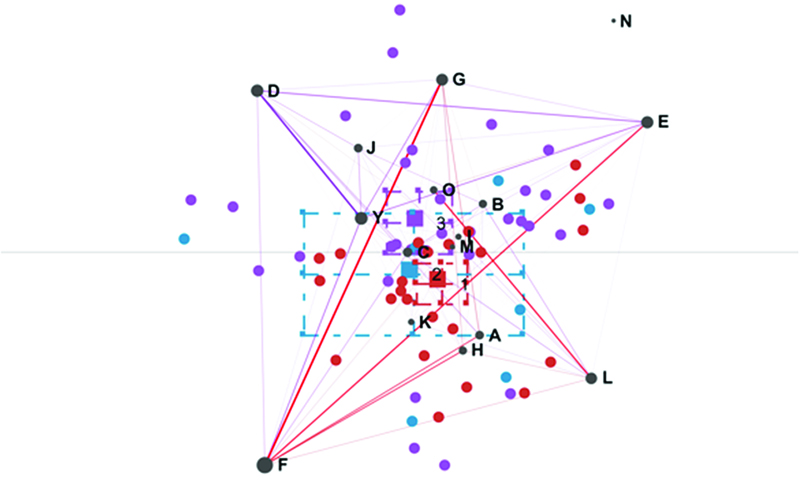
ENA projection of teacher networks
- [1] Y. Tan, Z. Swiecki, A. R. Ruis, and D. W. Shaffer, “Epistemic network analysis and ordered network analysis in learning analytics,” M. Saqr and S. López-Pernas (Eds), “Learning analytics methods and tutorials: A practical guide using R,” Springer Nature Switzerland, pp. 569-636, 2024. https://doi.org/10.1007/978-3-031-54464-4_18
- [2] V. Rolim, R. Ferreira, R. D. Lins, and D. Găsević, “A network-based analytic approach to uncovering the relationship between social and cognitive presences in communities of inquiry,” The Internet and Higher Education, Vol.42, pp. 53-65, 2019. https://doi.org/10.1016/j.iheduc.2019.05.001
- [3] J. W. Reid, J. Parrish, S. B. Syed, and B. Couch, “Finding the connections: A scoping review of epistemic network analysis in science education,” J. of Science Education and Technology, Vol.34, pp. 937-955, 2024. https://doi.org/10.1007/s10956-024-10193-x
- [4] N. Pantić et al., “Making sense of teacher agency for change with social and epistemic network analysis,” J. of Educational Change, Vol.23, pp. 145-177, 2022. https://doi.org/10.1007/s10833-021-09413-7
- [5] C. McMullin, “Individual, group, and collective co-production: The role of public value conceptions in shaping co-production practices,” Administration & Society, Vol.55, No.2, pp. 239-263, 2023. https://doi.org/10.1177/00953997221131790
- [6] T. Bovaird and E. Loeffler, “From engagement to co-production: The contribution of users and communities to outcomes and public value,” Voluntas: Int. J. of Voluntary and Nonprofit Organizations, Vol.23, pp. 1119-1138, 2012. https://doi.org/10.1007/s11266-012-9309-6
- [7] V. Pestoff, “Collective action and the sustainability of co-production,” Public Management Review, Vol.16, No.3, pp. 383-401, 2014. https://doi.org/10.1080/14719037.2013.841460
- [8] R. Hill et al., “Working with indigenous, local and scientific knowledge in assessments of nature and nature’s linkages with people,” Current Opinion in Environmental Sustainability, Vol.43, pp. 8-20, 2020. https://doi.org/10.1016/j.cosust.2019.12.006
- [9] L. Acar, T. Steen, and B. Verschuere, “Public values? A systematic literature review into the outcomes of public service co-creation,” Public Management Review, Vol.27, No.5, pp. 1357-1389, 2025. https://doi.org/10.1080/14719037.2023.2288248
- [10] N. Haug, “Actor roles in co-production—Introducing intermediaries: Findings from a systematic literature review,” Public Administration, Vol.102, No.3, pp. 1069-1094, 2024. https://doi.org/10.1111/padm.12965
- [11] D. W. Shaffer, W. Collier, and A. R. Ruis, “A tutorial on epistemic network analysis: Analyzing the structure of connections in cognitive, social, and interaction data,” J. of Learning Analytics, Vol.3, No.3, pp. 9-45, 2016. https://doi.org/10.18608/jla.2016.33.3
- [12] Y. Ogai, Y. Matsumura, Y. Hoshino, T. Yasuda, and K. Ohkura, “Centralized business-to-business networks in the Japanese textile and apparel industry: Using network analysis and an agent-based model,” J. Robot. Mechatron., Vol.31, No.4, pp. 546-557, 2019. https://doi.org/10.20965/jrm.2019.p0546
- [13] R. Elmoazen, M. Saqr, M. Tedre, and L. Hirsto, “A systematic literature review of empirical research on epistemic network analysis in education,” IEEE Access, Vol.10, pp. 17330-17348, 2022. https://doi.org/10.1109/ACCESS.2022.3149812
- [14] D. W. Shaffer et al., “Epistemic network analysis: A prototype for 21st-century assessment of learning,” Int. J. of Learning and Media, Vol.1, No.2, pp. 33-53, 2009. https://doi.org/10.1162/ijlm.2009.0013
- [15] D. Bowman et al., “The mathematical foundations of epistemic network analysis,” A. R. Ruis and S. B. Lee (Eds.), “Advances in Quantitative Ethnography,” pp. 91-105, Springer, 2021. https://doi.org/10.1007/978-3-030-67788-6_7
- [16] S. Zhang et al., “Understanding student teachers’ collaborative problem solving: Insights from an epistemic network analysis (ENA),” Computers & Education, Vol.183, Article No.104485, 2022. https://doi.org/10.1016/j.compedu.2022.104485
- [17] P. Fawcett and C. Daugbjerg, “Explaining governance outcomes: Epistemology, network governance and policy network analysis,” Political Studies Review, Vol.10, No.2, pp. 195-207, 2012. https://doi.org/10.1111/j.1478-9302.2012.00257.x
- [18] A. L. Siebert-Evenstone et al., “In search of conversational grain size: Modeling semantic structure using moving stanza windows,” J. of Learning Analytics, Vol.4, No.3, pp. 123-139, 2017. https://doi.org/10.18608/jla.2017.43.7
- [19] T. Greany and R. Higham, “Hierarchy, markets and networks: Analysing the ’self-improving school-led system’ agenda in England and the implications for schools,” UCL Institute of Education Press, 2018.
- [20] G. Thompson, “Between hierarchies and markets: The logic and limits of network forms of organization,” Oxford University Press, 2003. https://doi.org/10.1093/acprof:oso/9780198775270.001.0001
- [21] M. Tavakol and R. Dennick, “Making sense of Cronbach’s alpha,” Int. J. of Medical Education, Vol.2, pp. 53-55, 2011. https://doi.org/10.5116/ijme.4dfb.8dfd
- [22] K. Kurkela, S. Maijala, S. Tuurnas, and H. Jalonen, “Citizen agency in value co-creation processes—A literature review,” Int. J. of Public Sector Management, 2025. https://doi.org/10.1108/IJPSM-06-2024-0203
- [23] A. Uster, “Governmental implementation of information and communication technology at the local level: Digital co-production during a crisis,” Australian J. of Public Administration, Vol.84, No.1, pp. 69-101, 2025. https://doi.org/10.1111/1467-8500.12657
- [24] C. McMullin, “The case against co-production as a silver bullet: Why and when citizens should not be involved in public service delivery,” Public Management and Governance Review, Vol.1, No.1, 2024. https://doi.org/10.60733/PMGR.2024.04
This article is published under a Creative Commons Attribution-NoDerivatives 4.0 Internationa License.