
Research Paper:
Fabrication of Triply Periodic Minimal Surfaces by Wire and Arc-Directed Energy Deposition Based on Thin-Wall Manufacturing Strategy with Overhang in Direction of Surface Extension
Yusuke Funabashi
 , Takeyuki Abe†
, and Jun’ichi Kaneko
, Takeyuki Abe†
, and Jun’ichi Kaneko
Graduate School of Science and Engineering, Saitama University
255 Shimo-Okubo, Sakura-ku, Saitama, Saitama 338-8570, Japan
†Corresponding author

Triply periodic minimal surfaces (TPMSs) exhibit excellent mechanical properties. However, their complex geometries impose significant limitations on their fabrication processes. In this study, we fabricate TPMSs using wire and arc-directed energy deposition (DED-Arc) for the first time to leverage its large-scale manufacturing and low production costs. DED-Arc is generally associated with challenges such as distortion caused by high heat input and challenges in fabricating complex geometries. Moreover, TPMS structures feature curved surfaces that include a characteristic overhang in the surface extension direction, i.e., where the width of thin walls increases with height. When fabricating such overhangs, the deposited layers are generally insufficiently tall at the ends of each deposition path. Hence, we propose a novel fabrication strategy incorporating spot deposition, in which localized deposition and cooling are applied repeatedly at the end of each deposition path. Additionally, we devise a method to determine the optimal number of spot depositions based on the overhang angle in the surface extension direction to compensate for the insufficient layer height. Subsequently, we fabricate single- and 27-cell TPMS structures—including Schwarz primitive geometries—using the proposed strategy to evaluate its effectiveness. We evaluate the accuracy of the fabrication process based on X-ray computed tomography measurements, the results of which confirm high geometric fidelity. These findings demonstrate the feasibility of TPMSs fabrication using DED-Arc.
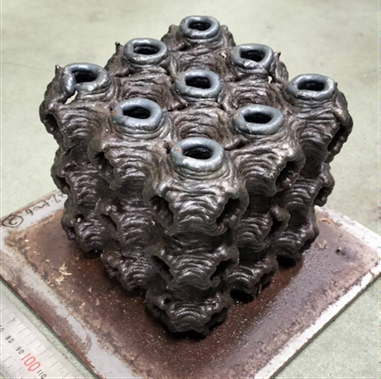
Schwrz primitive TPMS structure fabricated by DED-Arc
- [1] H. Yin, X. Zheng, G. Wen, C. Zhang, and Z. Wu, “Design optimization of a novel bio-inspired 3D porous structure for crashworthiness,” Compos. Struct., Vol.255, Article No.112897, 2021. https://doi.org/10.1016/j.compstruct.2020.112897
- [2] M. Zhao, D. Z. Zhang, F. Liu, Z. Li, Z. Ma, and Z. Ren, “Mechanical and energy absorption characteristics of additively manufactured functionally graded sheet lattice structures with minimal surfaces,” Int. J. Mech. Sci., Vol.167, Article No.105262, 2020. https://doi.org/10.1016/j.ijmecsci.2019.105262
- [3] A. R. de Oliveira, A. A. Mendes Filho, M. Masoumi, and E. G. del Conte, “Compression and energy absorption of maraging steel primitive scaffolds produced by powder bed fusion,” Int. J. Adv. Manuf. Technol., Vol.116, pp. 1271-1283, 2021. https://doi.org/10.1007/s00170-021-07514-4
- [4] K. Dutkowski, M. Kruzel, and K. Rokosz, “Review of the state-of-the-art uses of minimal surfaces in heat transfer,” Energies, Vol.15, Issue 21, Article No.7994, 2022. https://doi.org/10.3390/en15217994
- [5] R. Attarzadeh, M. Rovira, and C. Duwig, “Design analysis of the ‘Schwartz D’ based heat exchanger: A numerical study,” Int. J. Heat Mass Transf., Vol.177, Article No.121415, 2021. https://doi.org/10.1016/j.ijheatmasstransfer.2021.121415
- [6] Z. Dong and X. Zhao, “Application of TPMS structure in bone regeneration,” Eng. Regen., Vol.2, pp. 154-162, 2021. https://doi.org/10.1016/j.engreg.2021.09.004
- [7] A. Tikhonov, P. Evdokimov, E. Klimashina, S. Tikhonova, E. Karpushkin, I. Scherbackov, V. Dubrov, and V. Putlayev, “Stereolithographic fabrication of three-dimensional permeable scaffolds from CaP/PEGDA hydrogel biocomposites for use as bone grafts,” J. Mech. Behav. Biomed. Mater., Vol.110, Article No.103922, 2020. https://doi.org/10.1016/j.jmbbm.2020.103922
- [8] J. G. Werner, G. G. Rodríguez-Calero, H. D. Abruña, and U. Wiesner, “Block copolymer derived 3D interpenetrating multifunctional gyroidal nanohybrids for electrical energy storage,” Energy Environ. Sci., Vol.11, pp. 1261-1270, 2018. https://doi.org/10.1039/c7ee03571c
- [9] H.-Y. Lei, J.-R. Li, Q.-H. Wang, Z.-J. Xu, W. Zhou, C.-L. Yu, and T.-Q. Zheng, “Feasibility of preparing additive manufactured porous stainless steel felts with mathematical micro pore structure as novel catalyst support for hydrogen production via methanol steam reforming,” Int. J. Hydrog. Energy, Vol.44, Issue 45, pp. 24782-24791, 2019. https://doi.org/10.1016/j.ijhydene.2019.07.187
- [10] Y. Feng, X. Guo, K. Huang, H. Elsayed, G. Franchin, H. Gong, and P. Colombo, “Enhanced electromagnetic microwave absorption of SiOC ceramics targeting the integration of structure and function,” J. Eur. Ceram. Soc., Vol.41, Issue 13, pp. 6393-6405, 2021. https://doi.org/10.1016/j.jeurceramsoc.2021.06.007
- [11] W. D. Abueidda, M. Elhebeary, C. S. Shiang, S. Pang, R. K. Abu Al-Rub, and I. M. Jasiuk, “Mechanical properties of 3D printed polymeric gyroid cellular structures: Experimental and finite element study,” Mater. Des., Vol.165, Article No.107597, 2019. https://doi.org/10.1016/j.matdes.2019.107597
- [12] S. Yu, J. Sun, and J. Bai, “Investigation of functionally graded TPMS structures fabricated by additive manufacturing,” Mater. Des., Vol.182, Article No.108021, 2019. https://doi.org/10.1016/j.matdes.2019.108021
- [13] N. Qiu, J. Zhang, F. Yuan, Z. Jin, Y. Zhang, and J. Fang, “Mechanical performance of triply periodic minimal surface structures with a novel hybrid gradient fabricated by selective laser melting,” Eng. Struct., Vol.263, Article No.114377, 2022. https://doi.org/10.1016/j.engstruct.2022.114377
- [14] X. Zhang, X. Xie, Y. Li, B. Li, S. Yan, and P. Wen, “Mechanical behavior of Al-Si10-Mg P-TPMS structure fabricated by selective laser melting and a unified mathematical model with geometrical parameter,” Materials, Vol.16, No.2, Article No.468, 2023. https://doi.org/10.3390/ma16020468
- [15] N. Qiu, Y. Wan, Y. Shen, and J. Fang, “Experimental and numerical studies on mechanical properties of TPMS structures,” Int. J. Mech. Sci., Vol.261, Article No.108657, 2024. https://doi.org/10.1016/j.ijmecsci.2023.108657
- [16] J. Feng, J. Fu, X. Yao, and Y. He, “Triply periodic minimal surface (TPMS) porous structures: From multi-scale design, precise additive manufacturing to multidisciplinary applications,” Int. J. Extreme Manuf., Vol.4, No.2, Article No.022001, 2022. https://doi.org/10.1088/2631-7990/ac5be6
- [17] D. G. Ahn, “Directed energy deposition (DED) process: State of the art,” Int. J. Precis. Eng. Manuf.-Green Technol., Vol.8, No.2, pp. 703-742, 2021. https://doi.org/10.1007/s40684-020-00302-7
- [18] A. Nishiyama, S. Kayashima, N. Sumi, T. Hashimoto, T. Abe, and J. Kaneko, “Process planning with removal of melting penetration and temper colors in 5-axis hybrid additive and subtractive manufacturing,” Int. J. Automation Technol., Vol.17, No.4, pp. 356-368, 2023. https://doi.org/10.20965/ijat.2023.p0356
- [19] T. Cordkaew, J. Kaneko, and T. Abe, “Analysis of the relationship between process parameters and microhardness for the finishing process by wire arc additive manufacturing combined with the FSB tool of austenitic stainless steel 316L,” Int. J. Automation Technol., Vol.18, No.5, pp. 688-701, 2024. https://doi.org/10.20965/ijat.2024.p0688
- [20] T. Abe and H. Sasahara, “Residual stress and deformation after finishing of a shell structure fabricated by direct metal lamination using arc discharge,” Int. J. Automation Technol., Vol.6, No.5, pp. 611-617, 2012. https://doi.org/10.20965/ijat.2012.p0611
- [21] J. Ye, P. Kyvelou, F. Gilardi, H. Lu, M. Gilbert, and L. Gardner, “An end-to-end framework for the additive manufacture of optimized tubular structures,” IEEE Access, Vol.9, pp. 165476-165489, 2021. https://doi.org/10.1109/access.2021.3132797
- [22] J. Marcotte, S. Mishra, and J. T. Wen, “Robotic wire arc additive manufacturing with variable height layers,” arXiv:2412.04536, 2024. https://doi.org/10.48550/arXiv.2412.04536
- [23] T. Kamioka, S. Ishikawa, and H. Sasahara, “Fabrication of elbow pipe by direct metal lamination using arc discharge while maintaining the molten pool in a horizontal position,” Int. J. Automation Technol., Vol.4, No.5, pp. 422-431, 2010. https://doi.org/10.20965/ijat.2010.p0422
- [24] T. Feucht, B. Waldschmitt, J. Lange, and M. Erven, “Additive manufacturing of a bridge in situ,” Steel Constr., Vol.15, Issue 2, pp. 100-110, 2022. https://doi.org/10.1002/stco.202100045
- [25] T. Abe and H. Sasahara, “Development of the shell structures fabrication CAM system for direct metal lamination using arc discharge: Lamination height error compensation by torch feed speed control,” Int. J. Precis. Eng. Manuf., Vol.16, pp. 171-176, 2015. https://doi.org/10.1007/s12541-015-0022-4
- [26] P. Kazanas, P. Deherkar, P. Almeida, H. Lockett, and S. Williams, “Fabrication of geometrical features using wire and arc additive manufacture,” Proc. Inst. Mech. Eng., Part B: J. Eng. Manuf., Vol.226, No.6, pp. 1042-1051, 2012. https://doi.org/10.1177/0954405412437126
- [27] V. Laghi, M. Palermo, L. Tonelli, G. Gasparini, V. Girelli, L. Ceschini, and T. Trombetti, “Mechanical response of dot-by-dot wire-and-arc additively manufactured 304L stainless steel bars under tensile loading,” Constr. Build. Mater., Vol.318, Article No.125925, 2022. https://doi.org/10.1016/j.conbuildmat.2021.125925
This article is published under a Creative Commons Attribution-NoDerivatives 4.0 Internationa License.