
Research Paper:
Efficient Method to Create 3D Models Based on Center Lines and Cross-Sectional Geometries from Point Cloud of an Entire Steel Truss Bridge
Nao Hidaka†, Daisuke Uchiyama, and Ei Watanabe
Nagoya Institute of Technology
Gokiso-cho, Showa-ku, Nagoya, Aichi 466-8555, Japan
†Corresponding author

For efficient maintenance of existing bridges, quantitative evaluation of residual load capacity using numerical analysis with FE models is widely adopted. Among various FE models, the fiber-based model, composed of center lines and cross-sectional geometries, is particularly effective for analyzing entire bridges. However, as-built drawings are often unavailable, and bridge conditions inevitably change over time, necessitating modeling methods that do not rely on design drawings. Point cloud data, capable of capturing as-is 3D geometry, have therefore attracted increasing attention. The authors have previously developed a method to semi-automatically construct fiber-based models from point clouds of entire steel truss bridges. However, a mismatch remains between the dimensional reproducibility required for load-bearing capacity analysis and the limitations imposed by measurement equipment and site conditions. While millimeter-level accuracy is required, measurement conditions are often constrained, resulting in incomplete or low-quality data. To address this issue, this study proposes an extended method incorporating deep learning. A measurement simulation tool is introduced to generate training data that reflect realistic laser scanner conditions, improving member recognition accuracy even in regions with poor measurement quality. Furthermore, deep learning enables the estimation of flange and web dimensions as well as plate thickness. As a result, the proposed method improves dimensional reproducibility and represents a step forward in capturing the overall structural configuration of entire bridges.
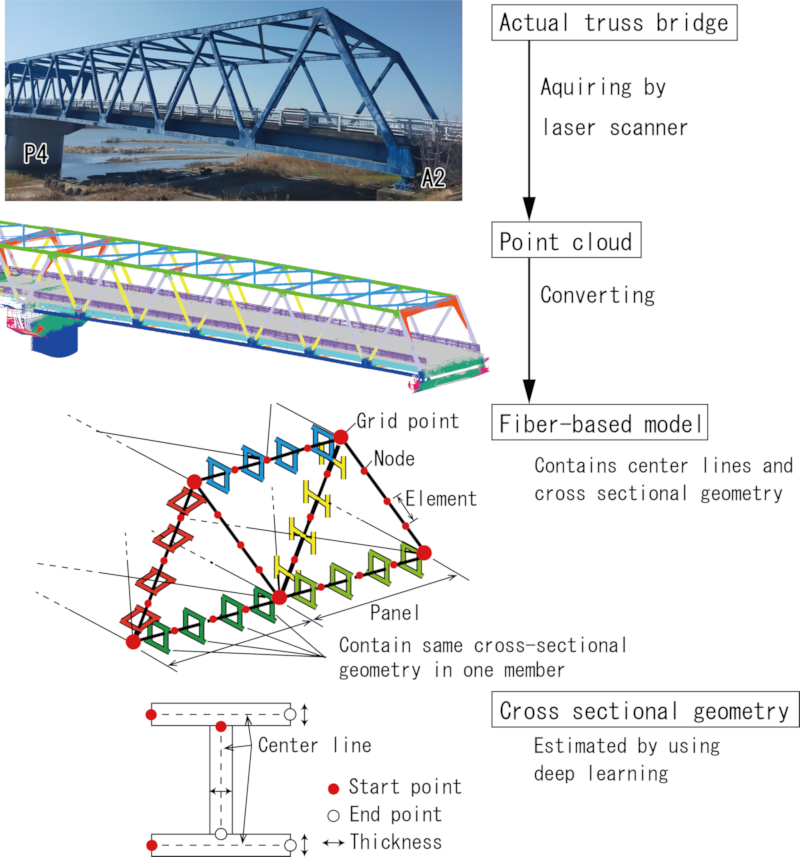
Creating a fiber-based model from point cloud
- [1] M. E. Mabsout, K. M. Tarhini, G. R. Frederick, and C. Tayar, “Finite-element analysis of steel girder highway bridges,” J. of Bridge Engineering, Vol.2, No.3, pp. 83-87, 1997. https://doi.org/10.1061/(ASCE)1084-0702(1997)2:3(83)
- [2] T. Nakamizo and M. Nishio, “Shell model reconstruction of thin-walled structures from point clouds for finite element modelling of existing steel bridges,” Sensors, Vol.25, No.13, Article No.4167, 2025. https://doi.org/10.3390/s25134167
- [3] K. Komuro, Y. Miyamori, M. Yoshida, T. Kadota, and T. Saito, “Construction of a point cloud FE model for a real structure with local damage and evaluation of its element shape,” Proc. of IABSE Symp. 2025, pp. 2925-2933, 2025. https://doi.org/10.2749/tokyo.2025.2925
- [4] N. Hidaka, N. Hashimoto, T. Nonaka, M. Obata, K. Magoshi, and E. Watanabe, “Construction of a practical finite element model from point cloud data for an existing steel truss bridge,” Proc. of the 23th Int. Conf. on Construction Applications of Virtual Reality (CONVR 2023), pp. 1155-1166, 2023. https://doi.org/10.36253/979-12-215-0289-3.114
- [5] N. Hidaka, N. Hashimoto, E. Watanabe, and D. Uchiyama, “Developing a deep learning-based method to segment bridge members by using 2D cross sectional point clouds,” Proc. of 13th Int. Conf. on Structural Health Monitoring of Intelligent Infrastructure (SHMII-13), pp. 550-557, 2025. https://doi.org/10.3217/978-3-99161-057-1-083
- [6] L. Winiwarter, A. M. Esmorís Pena, M. Yermo García, J. Martínez Sánche, M. Searle, H. Weiser, K. Anders, B. Höfle, and D. Kempf, “HELIOS++ (v2.1.0),” Zenodo, 2025. https://doi.org/10.5281/zenodo.16780208
- [7] N. Hidaka, T. Michikawa, A. Motamedi, N. Yabuki, and T. Fukuda, “Polygonization of point cloud of tunnels using lofting operation,” Int. J. Automation Technol., Vol.12, No.3, pp. 356-368, 2018. https://doi.org/10.20965/ijat.2018.p0356
- [8] M. A. Fischler and R. C. Bolles, “Random sample consensus: A paradigm for model fitting with applications to image analysis and automated cartography,” Communications of the ACM, Vol.24, No.6, pp. 381-395, 1981. https://doi.org/10.1145/358669.35869
- [9] D. H. Ballard, and C. M. Brown, “Region growing,” Computer Vision, Prentice Hall, pp. 149-165, 1982.
- [10] C. R. Qi, L. Yi, H. Su, and L. J. Guibas, “PointNet++: Deep hierarchical feature learning on point sets in a metric space,” Proc. of the 31st Int. Conf. on Neural Information Processing Systems, pp. 5105-5114, 2017.
- [11] R. B. Rusu and S. Cousins, “3D is here: Point cloud library (PCL),” 2011 IEEE Int. Conf. on Robotics and Automation (ICRA), 2011. https://doi.org/10.1109/ICRA.2011.5980567
This article is published under a Creative Commons Attribution-NoDerivatives 4.0 Internationa License.