
Research Paper:
SGRO: Semantic–Geometric Consistency Loop-Closure Detection and Robust Observation-Factor Modeling for Multi-Robot Distributed Object-Level Semantic SLAM
Chengwei Yang, Zhibin Yang, and Zhi Zheng†

School of Computer Science and Cyber Security, Fujian Normal University
No.18 Wulongjiang Middle Avenue, Shangjie Town, Minhou County, Fuzhou, Fujian 350117, China
†Corresponding author

Distributed multi-robot teams exploring and mapping unknown environments rely on onboard localization and observations, together with information shared within the team. Reliable cross-robot loop-closure detection, robot-pose estimation, and object-state estimation are essential. This study proposes SGRO, a method for loop-closure detection and robust observation-factor modeling in distributed multi-robot object-level semantic simultaneous localization and mapping. SGRO uses the object-level semantic map as a common intermediate representation. Its front end combines semantic and geometric constraints to improve cross-robot loop-closure robustness. Its back end models observation factors for different geometric object types to strengthen the joint optimization of object maps and robot trajectories. Cross-robot loop-closure constraints and object-level semantic mapping are integrated into a unified distributed estimation framework. Experiments show that SGRO improves pose estimation and object-level map stability, with lower position error, yaw error, and map inconsistency.
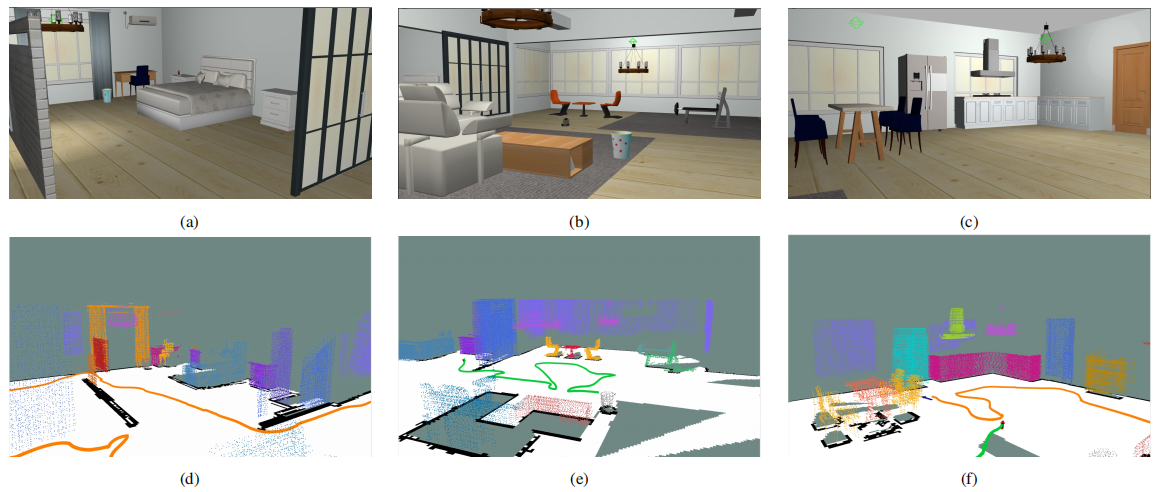
Regional views and corresponding point-cloud clustering results by SGRO
- [1] M. W. M. G. Dissanayake, P. Newman, S. Clark et al., “A solution to the simultaneous localization and map building (SLAM) problem,” IEEE Trans. Robotics Autom., Vol.17, No.3, pp. 229-241, 2001. https://doi.org/10.1109/70.938381
- [2] T. Bailey and H. Durrant-Whyte, “Simultaneous localization and mapping (SLAM): Part II,” IEEE Robotics Autom. Mag., Vol.13, No.3, pp. 108-117, 2006. https://doi.org/10.1109/MRA.2006.1678144
- [3] C. Cadena, L. Carlone, H. Carrillo et al., “Past, present, and future of simultaneous localization and mapping: Toward the robust-perception age,” IEEE Trans. Robotics, Vol.32, No.6, pp. 1309-1332, 2016. https://doi.org/10.1109/TRO.2016.2624754
- [4] S. B. Williams, G. Dissanayake, and H. Durrant-Whyte, “Towards multi-vehicle simultaneous localisation and mapping,” Proc. 2002 IEEE Int. Conf. on Robotics and Automation, pp. 2743-2748, 2002. https://doi.org/10.1109/ROBOT.2002.1013647
- [5] P.-Y. Lajoie, B. Ramtoula, F. Wu et al., “Towards collaborative simultaneous localization and mapping: A survey of the current research landscape,” Field Robotics, Vol.2, pp. 971-1000, 2022. https://doi.org/10.55417/fr.2022032
- [6] S. Hoshino and K. Uchida, “Interactive motion planning for mobile robot navigation in dynamic environments,” J. Adv. Comput. Intell. Intell. Informatics, Vol.21, pp. 667-674, 2017. https://doi.org/10.20965/jaciii.2017.p0667
- [7] X. Zhang, Y. Liu, L. Wang et al., “A curiosity-based autonomous navigation algorithm for maze robot,” J. Adv. Comput. Intell. Intell. Informatics, Vol.26, No.6, pp. 893-904, 2022. https://doi.org/10.20965/jaciii.2022.p0893
- [8] S. X. Yang and M. Meng, “An efficient neural network model for path planning of car-like robots in dynamic environment,” J. Adv. Comput. Intell. Intell. Informatics, Vol.4, No.3, pp. 220-229, 2000. https://doi.org/10.20965/jaciii.2000.p0220
- [9] J. Wang, K. Hirota, X. Wu, Y. Dai, and Z. Jia, “Hybrid bidirectional rapidly exploring random tree path planning algorithm with reinforcement learning,” J. Adv. Comput. Intell. Intell. Inform., Vol.25, No.1, pp. 121-129, 2021. https://doi.org/10.20965/jaciii.2021.p0121
- [10] R. P. Rangkuti, V. Dewanto, Aprinaldi et al., “Utilizing google images for training classifiers in CRF-based semantic segmentation,” J. Adv. Comput. Intell. Intell. Informatics, Vol.20, pp. 455-461, 2016. https://doi.org/10.20965/jaciii.2016.p0455
- [11] R. Mur-Artal, J. M. M. Montiel, and J. D. Tardós, “ORB-SLAM: A versatile and accurate monocular SLAM system,” IEEE Trans. Robotics, Vol.31, No.5, pp. 1147-1163, 2015. https://doi.org/10.1109/TRO.2015.2463671
- [12] R. Mur-Artal and J. D. Tardós, “ORB-SLAM2: An open-source system for monocular, stereo, and RGB-D cameras,” IEEE Trans. Robotics, Vol.33, No.5, pp. 1255-1262, 2017. https://doi.org/10.1109/TRO.2017.2705103
- [13] C. Campos, R. Elvira, J. J. Gómez Rodríguez et al., “ORB-SLAM3: An accurate open-source library for visual, visual-inertial, and multi-map SLAM,” IEEE Trans. Robotics, Vol.37, No.6, pp. 1874-1890, 2021. https://doi.org/10.1109/TRO.2021.3075644
- [14] T. Qin, P. Li, and S. Shen, “VINS-Mono: A robust and versatile monocular visual-inertial state estimator,” IEEE Trans. Robotics, Vol.34, No.4, pp. 1004-1020, 2018. https://doi.org/10.1109/TRO.2018.2853729
- [15] A. Rosinol, M. Abate, Y. Chang et al., “Kimera: An open-source library for real-time metric-semantic localization and mapping,” 2020 IEEE Int. Conf. on Robotics and Automation (ICRA), pp. 1689-1696, 2020. https://doi.org/10.1109/ICRA40945.2020.9196885
- [16] J. McCormac, R. Clark, M. Bloesch et al., “Fusion++: Volumetric object-level SLAM,” 2018 Int. Conf. on 3D Vision (3DV), pp. 32-41, 2018. https://doi.org/10.1109/3DV.2018.00015
- [17] L. Nicholson, M. Milford, and N. Sünderhauf, “QuadricSLAM: Dual quadrics from object detections as landmarks in object-oriented SLAM,” IEEE Robotics Autom. Lett., Vol.4, No.1, pp. 1-8, 2019. https://doi.org/10.1109/LRA.2018.2866205
- [18] S. Yang and S. Scherer, “CubeSLAM: Monocular 3-D object SLAM,” IEEE Trans. Robotics, Vol.35, No.4, pp. 925-938, 2019. https://doi.org/10.1109/TRO.2019.2909168
- [19] S. L. Bowman, K. Daniilidis, and G. J. Pappas, “Robust object-level semantic visual SLAM using semantic keypoints,” Field Robotics, Vol.2, pp. 513-524, 2022. https://doi.org/10.55417/fr.2022018
- [20] Y. Tian, Y. Chang, F. Herrera Arias et al., “Kimera-Multi: Robust, distributed, dense metric-semantic SLAM for multi-robot systems,” IEEE Trans. Robotics, Vol.38, No.4, pp. 2022-2038, 2022. https://doi.org/10.1109/TRO.2021.3137751
- [21] Y. Zhang, M. Hsiao, J. Dong et al., “MR-iSAM2: Incremental smoothing and mapping with multi-root Bayes tree for multi-robot SLAM,” 2021 IEEE/RSJ Int. Conf. on Intelligent Robots and Systems (IROS), pp. 8671-8678, 2021. https://doi.org/10.1109/IROS51168.2021.9636687
- [22] X. Liu, A. Prabhu, F. Cladera et al., “Active metric-semantic mapping by multiple aerial robots,” 2023 IEEE Int. Conf. on Robotics and Automation (ICRA), pp. 3282-3288, 2023. https://doi.org/10.1109/ICRA48891.2023.10161564
- [23] P.-Y. Lajoie and G. Beltrame, “Swarm-SLAM: Sparse decentralized collaborative simultaneous localization and mapping framework for multi-robot systems,” arXiv:2301.06230, 2023. https://doi.org/10.48550/arXiv.2301.06230
- [24] P. C. Lusk, K. Fathian, and J. P. How, “CLIPPER: A graph-theoretic framework for robust data association,” arXiv:2011.10202, 2020. https://doi.org/10.48550/arXiv.2011.10202
- [25] M. Kaess, A. Ranganathan, and F. Dellaert, “iSAM: Incremental smoothing and mapping,” IEEE Trans. Robotics, Vol.24, No.6, pp. 1365-1378, 2008. https://doi.org/10.1109/TRO.2008.2006706
- [26] M. Kaess, H. Johannsson, R. Roberts et al., “iSAM2: Incremental smoothing and mapping using the Bayes tree,” Int. J. Robotics Research, Vol.31, No.2, pp. 216-235, 2012. https://doi.org/10.1177/0278364911430419
- [27] F. Dellaert and M. Kaess, “Factor graphs for robot perception,” Found. Trends Robotics, Vol.6, Nos.1-2, pp. 1-139, 2017. https://doi.org/10.1561/2300000043
- [28] L. Schmid, J. Delmerico, J. L. Schönberger et al., “Panoptic multi-TSDFs: A flexible representation for online multi-resolution volumetric mapping and long-term dynamic scene consistency,” 2022 Int. Conf. on Robotics and Automation (ICRA), pp. 8018-8024, 2022. https://doi.org/10.1109/ICRA46639.2022.9811877
- [29] K. Sirohi, D. Büscher, and W. Burgard, “uPLAM: Robust panoptic localization and mapping leveraging perception uncertainties,” IEEE Robotics Autom. Lett., Vol.9, No.8, pp. 7174-7181, 2024. https://doi.org/10.1109/LRA.2024.3419648
- [30] A. Adkins, T. Chen, and J. Biswas, “ObVi-SLAM: Long-term object-visual SLAM,” IEEE Robotics Autom. Lett., Vol.9, No.3, pp. 2909-2916, 2024. https://doi.org/10.1109/LRA.2024.3363534
- [31] Y. Wu, Y. Zhang, D. Zhu et al., “An object SLAM framework for association, mapping, and high-level tasks,” IEEE Trans. on Robotics, Vol.39, No.4, pp. 2912-2932, 2023. https://doi.org/10.1109/TRO.2023.3273180
- [32] G. Grisetti, R. Kümmerle, C. Stachniss et al., “A tutorial on graph-based SLAM,” IEEE Intell. Transportation Systems Mag., Vol.2, No.4, pp. 31-43, 2010. https://doi.org/10.1109/MITS.2010.939925
- [33] M. Cummins and P. Newman, “FAB-MAP: Probabilistic localization and mapping in the space of appearance,” Int. J. Robotics Research, Vol.27, No.6, pp. 647-665, 2008. https://doi.org/10.1177/0278364908090961
- [34] D. Gálvez-López and J. D. Tardós, “Bags of binary words for fast place recognition in image sequences,” IEEE Trans. Robotics, Vol.28, No.5, pp. 1188-1197, 2012. https://doi.org/10.1109/TRO.2012.2197158
- [35] R. Arandjelović, P. Gronat, A. Torii et al., “NetVLAD: CNN architecture for weakly supervised place recognition,” 2016 IEEE Conf. on Computer Vision and Pattern Recognition (CVPR), pp. 5297-5307, 2016. https://doi.org/10.1109/CVPR.2016.572
- [36] G. Kim and A. Kim, “Scan context: Egocentric spatial descriptor for place recognition within 3D point cloud map,” 2018 IEEE/RSJ Int. Conf. on Intelligent Robots and Systems (IROS), pp. 4802-4809, 2018. https://doi.org/10.1109/IROS.2018.8593953
- [37] R. Dubé, A. Cramariuc, D. Dugas et al., “SegMap: Segment-based mapping and localization using data-driven descriptors,” Int. J. Robotics Research, Vol.39, Nos.2-3, pp. 339-355, 2020. https://doi.org/10.1177/0278364919863090
- [38] X. Liu, J. Lei, A. Prabhu et al., “SlideSLAM: Sparse, lightweight, decentralized metric-semantic SLAM for multirobot navigation,” IEEE Trans. Robotics, Vol.41, pp. 6529-6548, 2025. https://doi.org/10.1109/TRO.2025.3629786
- [39] R. Zhang, H. M. Bong, and G. Beltrame, “Active semantic mapping and pose graph spectral analysis for robot exploration,” 2024 IEEE/RSJ Int. Conf. on Intelligent Robots and Systems (IROS), pp. 13787-13794, 2024. https://doi.org/10.1109/IROS58592.2024.10802821
- [40] A. Asgharivaskasi, F. Girke, and N. Atanasov, “Riemannian optimization for active mapping with robot teams,” IEEE Trans. on Robotics, Vol.41, pp. 1077-1097, 2025. https://doi.org/10.1109/TRO.2025.3526295
- [41] R. A. Dwyer, “A faster divide-and-conquer algorithm for constructing delaunay triangulations,” Algorithmica, Vol.2, No.1-4, pp. 137-151, 1987. https://doi.org/10.1007/BF01840356
- [42] M. Yaseen, “What is YOLOv8: An in-depth exploration of the internal features of the next-generation object detector,” arXiv:2408.15857, 2024. https://doi.org/10.48550/arXiv.2408.15857
This article is published under a Creative Commons Attribution-NoDerivatives 4.0 Internationa License.