
Research Paper:
Run Prevention vs. Run Creation: A Dynamic Panel Analysis of Performance Persistence in Major League Baseball
Chao-Chin Liu*
 , Che-Jen Chuang**
, Xuan-Min Zhu*
, and Yung-Chuan Tsai***,†
*School of Physical Education, Fujian Polytechnic Normal University
No.1 Campus New Village, Longjiang Street, Fuqing, Fujian 350300, China
**Department of Food & Beverage Management, Lee-Ming Institute of Technology
No.22 Section 3, Tailin Road, Taishan District, New Taipei 24305, Taiwan
***Department of Sport and Leisure Management, Meiho University
No.23 Pingguang Road, Neipu Township, Pingtung County 912, Taiwan
†Corresponding author

This study investigates how core Major League Baseball team indicators—offensive output, run suppression, defensive performance, and prior-season competitive records—correlate with seasonal winning rates. Based on 2015–2024 panel data of all 30 league teams, this research employs two-way fixed-effects models with lagged winning percentage variables. Empirical results show that runs scored per game, on-base plus slugging percentage, and fielding percentage positively predict win rates, whereas earned run average, runs allowed per game, and per-game errors present negative associations. The significant positive lagged coefficient verifies sustained team competitive performance over time. All identified statistical associations are conditional rather than causal, as key game metrics and winning records are simultaneously generated from regular-season contests. Besides, runs allowed per game cannot fully isolate pure pitching performance, and raw regression coefficients are insufficient to rank the importance of different competitive factors. This paper constructs an integrated team-season analytical framework for sports empirical research; however, its numerical results and practical guiding value require further systematic validation to guarantee robustness.
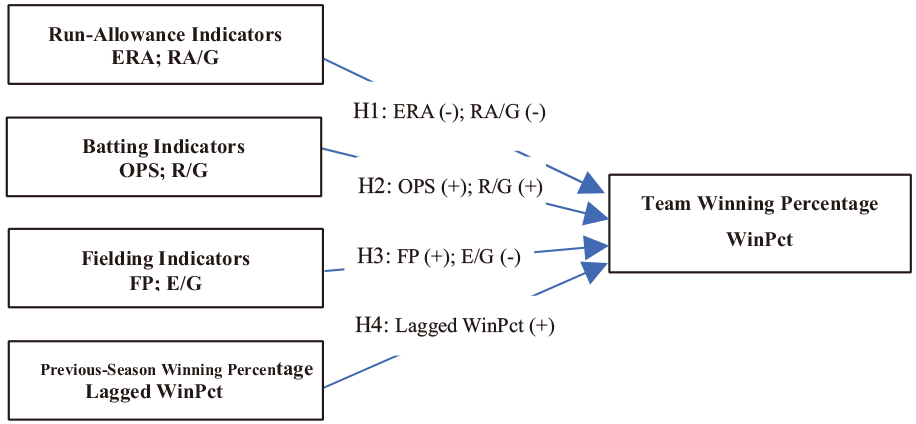
MLB performance persistence framework
- [1] G. W. Scully, “Pay and performance in Major League Baseball,” The American Economic Review, Vol.64, No.6, pp. 915-930, 1974.
- [2] B. James, “Bill James’ Baseball Abstract,” Ballantine Books, 1985.
- [3] T. M. Tango, M. Lichtman, and A. Dolphin, “The book: Playing the percentages in baseball,” Potomac Books, 2007.
- [4] M. Lewis, “Moneyball: The art of winning an unfair game,” W. W. Norton & Company, 2003.
- [5] B. S. Baumer and A. Zimbalist, “The sabermetric revolution: Assessing the growth of analytics in baseball,” University of Pennsylvania Press, 2014.
- [6] J. Albert and B. S. Baumer, “Analyzing baseball data with R (2nd ed.),” FL: Chapman & Hall/CRC, 2018.
- [7] S. Szymanski, “The economic design of sporting contests,” J. of Economic Literature, Vol.41, No.4, pp. 1137-1187, 2003. https://doi.org/10.1257/002205103771800004
- [8] J. M. Wooldridge, “Econometric analysis of cross section and panel data (2nd ed.),” The MIT Press, 2010.
- [9] B. H. Baltagi, “Econometric analysis of panel data (6th ed.),” Springer, 2021.
- [10] J. Lee and Y. H. Lee, “Development of a Win Production Function and Evaluation of Cross-Sectional Dependence,” J. of Sports Economics, Vol.22, No.4, pp. 412-431, 2021. https://doi.org/10.1177/1527002520983438
- [11] D. W. Rockerbie, “Team Production and Factor Substitution in Major League Baseball,” Int. J. of Empirical Economics, Vol.04, No.03, Article No.2550006, 2025. https://doi.org/10.1142/S2810943025500064
- [12] J. Cairney, S. Townsend, D. M. Y. Brown, J. D. Graham, V. Richard, and M. Y. W. Kwan, “The golden ratio in baseball: the influence of historical eras on winning percentages in major league baseball,” Frontiers in Sports and Active Living, Vol.5, 2023. https://doi.org/10.3389/fspor.2023.1273327
- [13] J. Barney, “Firm resources and sustained competitive advantage,” J. of Management, Vol.17, No.1, pp. 99-120, 1991. https://doi.org/10.1177/014920639101700108
- [14] S. Nickell, “Biases in dynamic models with fixed effects,” Econometrica, Vol.49, No.6, pp. 1417-1426, 1981. https://doi.org/10.2307/1911408
- [15] M. Arellano and S. Bond, “Some tests of specification for panel data: Monte Carlo evidence and an application to employment equations,” The Review of Economic Studies, Vol.58, No.2, pp. 277-297, 1991. https://doi.org/10.2307/2297968
- [16] R. Blundell and S. Bond, “Initial conditions and moment restrictions in dynamic panel data models,” J. of Econometrics, Vol.87, No.1, pp. 115-143, 1998. https://doi.org/10.1016/S0304-4076(98)00009-8
- [17] M. Arellano and O. Bover, “Another look at the instrumental variable estimation of error-components models,” J. of Econometrics, Vol.68, No.1, pp. 29-51, 1995. https://doi.org/10.1016/0304-4076(94)01642-D
- [18] J. F. Hair, W. C. Black, B. J. Babin, and R. E. Anderson, “Multivariate data analysis (7th ed.),” Pearson, 2010.
- [19] S. Rottenberg, “The baseball players’ labor market,” J. of Political Economy, Vol.64, No.3, pp. 242-258, 1956. https://doi.org/10.1086/257790
- [20] A. C. Cameron and D. L. Miller, “A practitioner’s guide to cluster-robust inference,” J. of Human Resources, Vol.50, No.2, pp. 317-372, 2015. https://doi.org/10.3368/jhr.50.2.317
This article is published under a Creative Commons Attribution-NoDerivatives 4.0 Internationa License.