
Research Paper:
Analysis of Social Media Discourse Surrounding Inbound Tourism Using BERTopic
Yoshiyuki Matsumoto

Department of Data Science, Shimonoseki City University
2-1-1 Daigaku-cho, Shimonoseki, Yamaguchi 751-8510, Japan

In recent years, the number of foreign tourists visiting Japan has increased rapidly, and tourism has come to play an increasingly important role in the national economy. At the same time, various issues associated with overtourism—such as overcrowding at tourist destinations, problems related to visitor behavior and manners, friction with local residents, and rising prices—have become more evident. Public opinions and sentiments regarding these issues are extensively expressed on social media platforms, providing a valuable source of information for the formulation of tourism policies and regional development strategies. However, to systematically extract meaningful insights from large-scale and unstructured textual data, applying advanced natural language processing techniques is indispensable. In this study, tweets related to foreign tourists were collected from X (formerly Twitter), preprocessed through procedures such as morphological analysis, and analyzed using BERTopic. BERTopic is a topic modeling approach that combines contextualized embeddings generated by BERT with clustering techniques. Compared with conventional probabilistic topic models such as latent Dirichlet allocation, BERTopic extracts semantically coherent topics by capturing contextual meaning rather than relying solely on word co-occurrence frequencies. In particular, it has been reported to outperform other methods in the analysis of short texts, such as social media posts. This study aims to clarify social perceptions and emerging issues related to foreign tourists by examining the characteristics and distributions of the extracted topics. The results of the analysis revealed that inbound tourism demand in Japan involves not only positive aspects but also negative issues. The current state of inbound tourism is considered to place a certain burden on Japanese society. Although inbound tourism provides economic benefits, the findings suggest that there is growing concern about the deterioration of quality of life and disruption of social order associated with the rapid increase in inbound tourism.
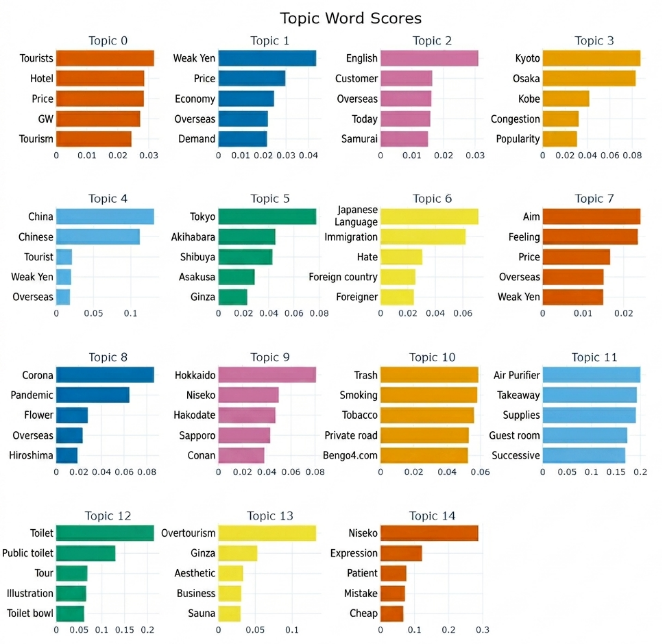
Analysis of social media using BERTopic
- [1] Y. Matsumoto, “Tourism Information analysis of SNS data using text mining,” J. Adv. Comput. Intell. Intell. Inform., Vol.29, No.4, pp. 829-837, 2025. https://doi.org/10.20965/jaciii.2025.p0829
- [2] Y. Matsumoto, “Analysis of inbound tourism demand using social media,” ICIC Express Letters, Part B: Applications, Vol.17, No.4, pp. 355-364, 2026. https://doi.org/10.24507/icicelb.17.04.355
- [3] N. Z. Dina, “Tourist sentiment analysis on TripAdvisor using textmining: A case study using hotels in Ubud, Bali,” African J. of Hospitality, Tourism and Leisure, Vol.9, No.2, pp. 1-10, 2020.
- [4] F. Visentin and D. Bertocchi, “Venice: An analysis of tourism excesses in an overtourism icon,” C. Milano, J. M. Cheer, and M. Novelli (Eds.), “Overtourism: excesses, discontents and measures in travel and tourism,” CABI International, pp. 18-38, 2019. https://doi.org/10.1079/9781786399823.0018
- [5] M.-d.-M. Alonso-Almeida, F. Borrajo-Millan, and L. Yi, “Are Social Media Data Pushing Overtourism? The Case of Barcelona and Chinese Tourists,” Sustainability, Vol.11, No.12, Article No.3356, 2019. https://doi.org/10.3390/su11123356
- [6] R. D. Siano and R. R. Canale, “Controversial effects of tourism on economic growth: A spatial analysis on Italian provincial data,” Land Use Policy, Vol.117, Article No.106081, 2022. https://doi.org/10.1016/j.landusepol.2022.106081
- [7] N. Türker, C. M. Koçoğlu, and Ö. Saraç, “Effect of Overtourism on Residents’ Quality of Life in World Heritage Cities,” J. of New Tourism Trends (JOINNTT), Vol.5, No.1, 2024. https://doi.org/10.58768/joinntt.1436906
- [8] K. Hussain, M. M. D. Alam, A. Malik, A. Tarhini, and M. K. A. Balushi, “From likes to luggage: The role of social media content in attracting tourists,” Heliyon, Vol.10, No.19, Article No.e38914, 2024. https://doi.org/10.1016/j.heliyon.2024.e38914
- [9] D. M. Blei, A. Y. Ng, and M. I. Jordan, “Latent dirichlet allocation,” The J. of Machine Learning Research, Vol.3, pp. 993-1022, 2003.
- [10] T. Ali, B. Omar, and K. Soulaimane, “Analyzing tourism reviews using an LDA topic-based sentiment analysis approach,” MethodsX, Vol.9, Article No.101894, 2022. https://doi.org/10.1016/j.mex.2022.101894
- [11] R. Leung and I. Handler, “Unveiling tourist typology: Using online reviews and LDA to understand motivations for visiting Kyoto’s prominent temples,” Int. J. of Tourism Cities, Vol.11, No.2, pp. 242-259, 2025. https://doi.org/10.1108/IJTC-01-2024-0014
- [12] J. Devlin, M.-W. Chang, K. Lee, and K. Toutanova, “BERT: Pre-training of Deep Bidirectional Transformers for Language Understanding,” North American Chapter of the Association for Computational Linguistics, pp. 4171-4186, 2019. https://doi.org/10.18653/v1/n19-1423
- [13] M. Grootendorst, “BERTopic: Neural topic modeling with a class-based TF-IDF procedure,” arXiv preprint, arXiv:2203.05794, 2022. https://doi.org/10.48550/arXiv.2203.05794
- [14] P. McCann, “fugashi, a Tool for Tokenizing Japanese in Python,” Proc. of Second Workshop for NLP Open Source Software (NLP-OSS), pp. 44-51, 2020. https://doi.org/10.18653/v1/2020.nlposs-1.7
- [15] M. Otani and S. Matsuda, “Application of topic models to medical text data,” Review of Japan Society of Health Support Science, Vol.5, pp. 29-35, 2020 (in Japanese). https://doi.org/10.14964/hssanj.5.29
- [16] S. Tsukioka, T. Yoshikawa, and T. Furuhashi, “A study on evaluation analysis for products using topic model,” Proc. of 31st Fuzzy System Symp., pp. 655-660, 2015 (in Japanese). https://doi.org/10.14864/fss.31.0_655
- [17] R. Egger and J. Yu, “A topic modeling comparison between LDA, NMF, Top2Vec, and BERTopic to Demystify Twitter Posts,” Frontiers in Sociology, Sec. Sociological Theory, Vol.7, Article No.886498, 2022. https://doi.org/10.3389/fsoc.2022.886498
- [18] W. Wahyuni, T. P. Lestari, M. Apriliana, and R. Gumelta, “Implementation of BERTopic for Topic Modeling Analysis of the Free Nutritious Meal Program Based on YouTube Comments,” J. of Applied Informatics and Computing, Vol.9, No.4, pp. 1964-1971, 2025. https://doi.org/10.30871/jaic.v9i4.9754
- [19] O. El-Gayar, M. Al-Ramahi, A. Wahbeh, T. Nasralah, and A. Elnoshokaty, “A Comparative Analysis of the Interpretability of LDA and LLM for Topic Modeling: The Case of Healthcare Apps,” Proc. of Americas Conf. on Information Systems 2024 Proc., No.22, 2024.
- [20] sonoisa/sentence-bert-base-ja-mean-tokens-v2. https://huggingface.co/sonoisa/sentence-bert-base-ja-mean-tokens-v2 [Accessed March 1, 2026]
- [21] J. Chang, J. Boyd-Graber, S. Gerrish, C. Wang, and D. M. Blei, “Reading tea leaves: how humans interpret topic models,” Proc. of the 23rd Int. Conf. on Neural Information Processing Systems (NIPS’09), pp. 288-296, 2009.
- [22] M. Röder, A. Both, and A. Hinneburg, “Exploring the Space of Topic Coherence Measures,” Proc. of the Eighth ACM Int. Conf. on Web Search and Data Mining (WSDM ’15), pp. 399-408, 2015. https://doi.org/10.1145/2684822.2685324
- [23] koheiduck/bert-japanese-finetuned-sentiment. https://huggingface.co/koheiduck/bert-japanese-finetuned-sentiment [Accessed May 1, 2026]
This article is published under a Creative Commons Attribution-NoDerivatives 4.0 Internationa License.