
Research Paper:
Tsallis Entropy-Regularized Yang-Type Fuzzy c-Directions
Yuchi Kanzawa
 and Haruki Kinoshita
Shibaura Institute of Technology
3-7-5 Toyosu, Koto-ku, Tokyo 135-8548, Japan

This study proposes Tsallis entropy-regularized Yang-type fuzzy c-directions (TYFCD), which is a fuzzy clustering algorithm designed for spherical data on a unit hypersphere, in which directional information plays a central role. The proposed method is based on the von Mises–Fisher (vMF) distribution and extends the conventional Yang-type fuzzy c-directions (YFCD) by introducing Tsallis entropy regularization into its objective function. This formulation provides additional fuzzification control while retaining YFCD as a special case, thereby generalizing the original framework. The influence of the fuzzification parameters on the fuzzy classification function and the resulting decision boundary was analyzed using a low-dimensional artificial dataset. Extensive experiments on high-dimensional artificial datasets demonstrated that TYFCD exhibits significantly improved robustness compared with existing methods, particularly with low-concentration parameters and severely imbalanced cluster size ratios, where conventional approaches often suffer from numerical instability. Furthermore, experiments on 12 real datasets confirmed that YFCD performs poorly on datasets with extremely high-dimensional settings, whereas TYFCD often achieves higher clustering accuracy than a mixture of vMF distributions and a limiting variant of TYFCD. These results indicate that Tsallis entropy regularization effectively enhances the flexibility and stability of fuzzy clustering for spherical data.
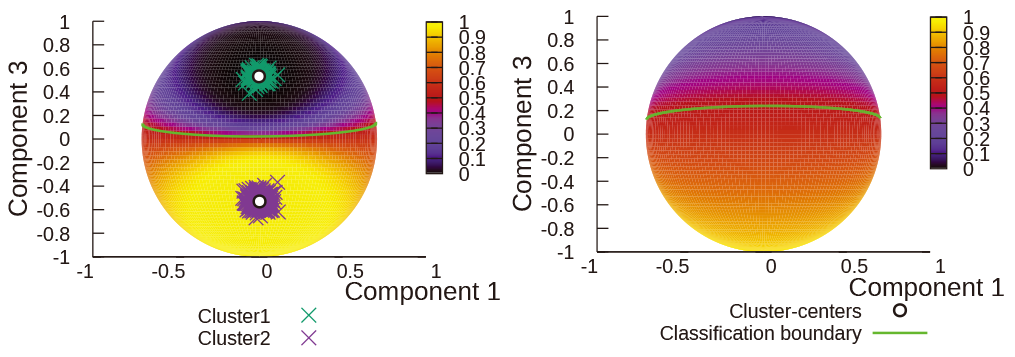
Fuzzy classification function of TYFCD
- [1] J. C. Bezdek, “Pattern Recognition with Fuzzy Objective Function Algorithms,” Plenum Press, 1981. https://doi.org/10.1007/978-1-4757-0450-1
- [2] M. Ménard, V. Courboulay, and P.-A. Dardignac, “Possibilistic and probabilistic fuzzy clustering: Unification within the framework of the non-extensive thermostatistics,” Pattern Recognition, Vol.36, No.6, pp. 1325-1342, 2003. https://doi.org/10.1016/S0031-3203(02)00049-3
- [3] M.-S. Yang, S.-J. Chang-Chien, W.-L. Hung, “An unsupervised clustering algorithm for data on the unit hypersphere,” Applied Soft Computing, Vol.42, pp. 290-313, 2016. https://doi.org/10.1016/j.asoc.2015.12.037
- [4] H. Ichihashi, K. Honda, and N. Tani, “Gaussian Mixture PDF Approximation and Fuzzy c-Means Clustering with Entropy Regularization,” Proc. 4th Asian Fuzzy System Symp., pp. 217-221, 2000.
- [5] C. Tsallis, “Possible Generalization of Boltzmann-Gibbs Statistics,” J. Statist. Phys., Vol.52, Nos.1/2, pp. 479-487, 1988. https://doi.org/10.1007/BF01016429
- [6] I. S. Dhillon and S. Sra, “Modeling Data using Directional Distributions,” Technical Report TR-03-06, Department of Computer Sciences, The University of Texas at Austin, 2003.
- [7] S. Sra, “A Short Note on Parameter Approximation for von Mises–Fisher Distributions: And a Fast Implementation of Is(x),” Computational Statistics, Vol.27, No.1, pp. 177-190, 2012. https://doi.org/10.1007/s00180-011-0232-x
- [8] S. Miyamoto, H. Ichihashi, and K. Honda, “Algorithms for Fuzzy Clustering,” Springer, 2008. https://doi.org/10.1007/978-3-540-78737-2
- [9] LINQS Dataset. https://linqs.org/datasets/ [Accessed February 10, 2017]
- [10] G. Karypis, Karypis Lab, CLUTO - Software for Clustering High Dimensional Datasets. https://karypis.github.io/glaros/software/cluto/overview.html [Accessed February 8, 2017]
- [11] TREC: Text REtrieval Conf. Relevance Judgments. https://trec.nist.gov/data/qrels_eng/index.html [Accessed February 10, 2017]
- [12] W. Hersh, C. Buckley, T. J. Leone, and D. Hickam, “OHSUMED: an interactive retrieval evaluation and new large test collection for research,” Proc. of SIGIR94, pp. 192-201, 1994. https://doi.org/10.1007/978-1-4471-2099-5_20
- [13] D. Boley, M. Gini, R. Gross, E. H. Han, K. Hastings, G. Karypis, V. Kumar, B. Mobasher, and J. Moore, “Partitioning-based clustering for web document categorization,” Decision Support Systems, Vol.27, No.3, pp. 329-341, 1999. https://doi.org/10.1016/S0167-9236(99)00055-X
- [14] D. D. Lewis, “Reuters-21578 text categorization test collection distribution 1.0.” http://www.daviddlewis.com/resources/testcollections/reuters21578/ [Accessed December 1, 2025]
- [15] K. Hornik and B. Grün, “movMF: An R Package for Fitting Mixtures of von Mises-Fisher Distributions,” J. of Statistical Software, Vol.58, No.10, pp. 1-31, 2014. https://doi.org/10.18637/jss.v058.i10
- [16] L. Hubert and P. Arabie, “Comparing Partitions,” J. of Classification, Vol.2, pp. 193-218, 1985. https://doi.org/10.1007/BF01908075
- [17] I. S. Dhillon and D. S. Modha, “Concept Decompositions for Large Sparse Text Data Using Clustering,” Machine Learning, Vol.42, No.1, pp. 143-175, 2001. https://doi.org/10.1023/A:1007612920971
This article is published under a Creative Commons Attribution-NoDerivatives 4.0 Internationa License.