
Research Paper:
Emotional Expression and Purchase Intention in RED Beauty-Related Comments: An Exploratory Comment-Based Analysis
Lu Jiang*
 and Yukio Kodono**,†
*School of Project Design, Miyagi University
1-1 Gakuen, Taiwa-cho, Kurokawa-gun, Miyagi 981-3298, Japan
**Kindai University
3-4-1 Kowakae, Higashiosaka, Osaka 577-8502, Japan
†Corresponding author

This study explores how emotional expression and purchase intention are reflected in beauty-related user comments on RED, a major Chinese social media and e-commerce platform. Using 4,371 beauty-related comments, this study applies sentiment analysis, bidirectional encoder representations from transformers (BERT)-based validation, linguistic feature detection, and qualitative coding to examine comment-level consumer expressions. The results show that the overall sentiment was positively inclined but heterogeneous. Sentiment intensity alone did not significantly predict purchase intention. Instead, specific linguistic features, such as emotional adverbs, repeated characters, and information-seeking expressions, played a more important role in indicating consumer interest. In addition, different beauty-related content themes were associated with different response patterns. Comments under “must-buy” posts showed stronger purchase-intention signals, while skincare-related comments showed more information-oriented responses. These findings suggest that purchase intention in RED beauty-related comments is often expressed through subtle linguistic cues rather than strong emotional polarity. This study contributes to social media marketing research by showing the limitations of sentiment-based approaches and the value of comment-level linguistic analysis. The findings also provide practical implications for marketers seeking to identify consumer interest in online communities.
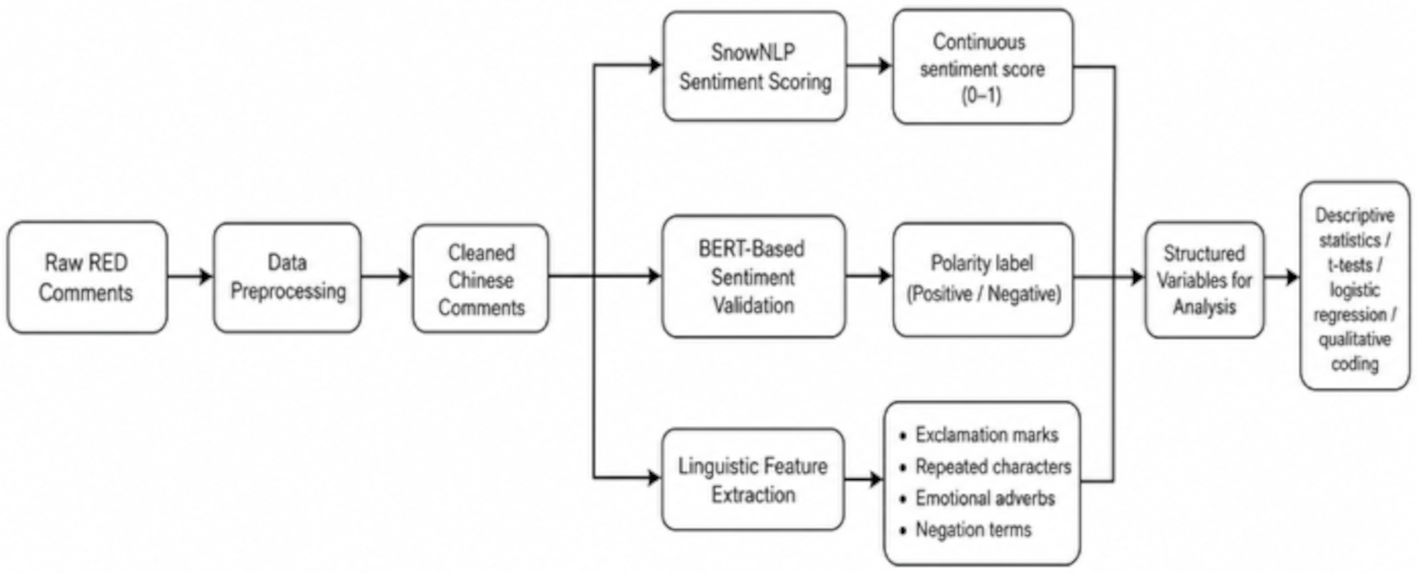
Workflow of RED comment analysis
- [1] C. M. K. Cheung and D. R. Thadani, “The impact of electronic word-of-mouth communication: A literature analysis and integrative model,” Decis. Support Syst., Vol.54, No.1, pp. 461-470, 2012. https://doi.org/10.1016/j.dss.2012.06.008
- [2] A. M. Kaplan and M. Haenlein, “Users of the world, unite! The challenges and opportunities of Social Media,” Bus. Horiz., Vol.53, No.1, pp. 59-68, 2010. https://doi.org/10.1016/j.bushor.2009.09.003
- [3] L. V. Casaló, C. Flavián, and S. Ibáñez-Sánchez, “Influencers on Instagram: Antecedents and consequences of opinion leadership,” J. Bus. Res., Vol.117, pp. 510-519, 2020. https://doi.org/10.1016/j.jbusres.2018.07.005
- [4] F. Fan, K. Chan, Y. Wang, Y. Li, and M. Prieler, “How influencers’ social media posts have an influence on audience engagement among young consumers,” Young Consum., Vol.24, No.4, pp. 427-444, 2023. https://doi.org/10.1108/YC-08-2022-1588
- [5] A. Babić Rosario, F. Sotgiu, K. de Valck, and T. H. A. Bijmolt, “The effect of electronic word-of-mouth on sales: A meta-analytic review of platform, product, and metric factors,” J. Mark. Res., Vol.53, No.3, pp. 297-318, 2016. https://doi.org/10.1509/jmr.14.0380
- [6] C. T. Bui, T. T. A. Ngo, H. K. L. Chau, and N. P. N. Tran, “How perceived eWOM in visual form influences online purchase intention on social media: A research based on the SOR theory,” PLoS One, Vol.20, No.7, Article No.e0328093, 2025. https://doi.org/10.1371/journal.pone.0328093
- [7] T. T. Le, D. N. Phan, T. T. T. Ngo, and N. T. Le, “Website quality’s impact on Gen Z’s eWOM behavior and online purchase intentions: The mediating role of trust in online shopping,” Asia Pac. J. Mark. Logist., Vol.38, No.8, pp. 2350-2370, 2026. https://doi.org/10.1108/APJML-03-2025-0567
- [8] Y. Sun and T. P. Ly, “The influence of word-of-web on customers’ purchasing process: The case of Xiaohongshu,” J. China Tour. Res., Vol.19, No.2, pp. 221-244, 2023. https://doi.org/10.1080/19388160.2022.2057378
- [9] B. Lin and B. Shen, “Study of consumers’ purchase intentions on community e-commerce platform with the SOR model: A case study of China’s Xiaohongshu app,” Behav. Sci., Vol.13, No.2, Article No.103, 2023. https://doi.org/10.3390/bs13020103
- [10] S. Kwakye, A. Ertugan, and L. Tashtoush, “Navigating purchase intentions: The influence of reviewers’ comments moderated by risk and trust,” Behav. Sci., Vol.14, No.7, Article No.552, 2024. https://doi.org/10.3390/bs14070552
- [11] W. He, S. Zha, and L. Li, “Social media competitive analysis and text mining: A case study in the pizza industry,” Int. J. Inf. Manag., Vol.33, No.3, pp. 464-472, 2013. https://doi.org/10.1016/j.ijinfomgt.2013.01.001
- [12] Z. Dong and Q. Dong, “HowNet and the computation of meaning,” World Scientific, 2006. https://doi.org/10.1142/5935
- [13] B. Liu, “Sentiment analysis and opinion mining,” Morgan & Claypool Publishers, 2012. https://doi.org/10.2200/S00416ED1V01Y201204HLT016
- [14] J. A. Chevalier and D. Mayzlin, “The effect of word of mouth on sales: Online book reviews,” J. Mark. Res., Vol.43, No.3, pp. 345-354, 2006. https://doi.org/10.1509/jmkr.43.3.345
- [15] I. Erkan and C. Evans, “The influence of eWOM in social media on consumers’ purchase intentions: An extended approach to information adoption,” Comput. Hum. Behav., Vol.61, pp. 47-55, 2016. https://doi.org/10.1016/j.chb.2016.03.003
- [16] E. Djafarova and T. Bowes, “‘Instagram made me buy it’: Generation Z impulse purchases in fashion industry,” J. Retail. Consum. Serv., Vol.59, Article No.102345, 2021. https://doi.org/10.1016/j.jretconser.2020.102345
- [17] N. Hajli, “Social commerce constructs and consumer’s intention to buy,” Int. J. Inf. Manag., Vol.35, No.2, pp. 183-191, 2015. https://doi.org/10.1016/j.ijinfomgt.2014.12.005
- [18] L. Xiong, V. Cho, K. M. Y. Law, and L. Lam, “A study of KOL effectiveness on brand image of skincare products,” Enterp. Inf. Syst., Vol.15, No.10, pp. 1483-1500, 2021. https://doi.org/10.1080/17517575.2021.1924864
This article is published under a Creative Commons Attribution-NoDerivatives 4.0 Internationa License.