
Research Paper:
Ship Propulsion Performance Estimation from Limited Hull Form Images Using Self-Supervised Pretraining with Decoder-Side Masking
Taian Kigawa*, Tomoki Hamagami*,†, Ichiro Amaya**
 , and Naoya Okamoto**
*Yokohama National University
79-1 Tokiwadai, Hodogaya-ku, Yokohama, Kanagawa 240-8501, Japan
†Corresponding author
**Japan Marine United Corporation
1-3 Kumozu-kokan-cho, Tsu, Mie 514-0398, Japan

Efficient estimation of ship propulsion performance from hull form geometry is essential for data-driven ship design. However, limited hull data due to confidentiality and manufacturing constraints hinder stable training of deep learning models. To address this challenge, we propose a self-supervised pretraining framework, salience-based adaptive decoder-side masking (SBADM), for estimating performance from a limited number of hull-form images. SBADM integrates two techniques: decoder-side masking, which preserves complete geometric information during encoding, and salience-based adaptive masking (SBAM), which dynamically adjusts masking ratios and regions based on token salience. These mechanisms enable effective pretraining even with small sample sizes. Experiments using 299 hull geometries provided by Japan Marine United Corporation show that SBADM improves estimation accuracy, particularly for the form factor (1+K) and the highly sensitive thrust deduction factor (1-t), confirming its effectiveness in enhancing feature representation and prediction robustness.
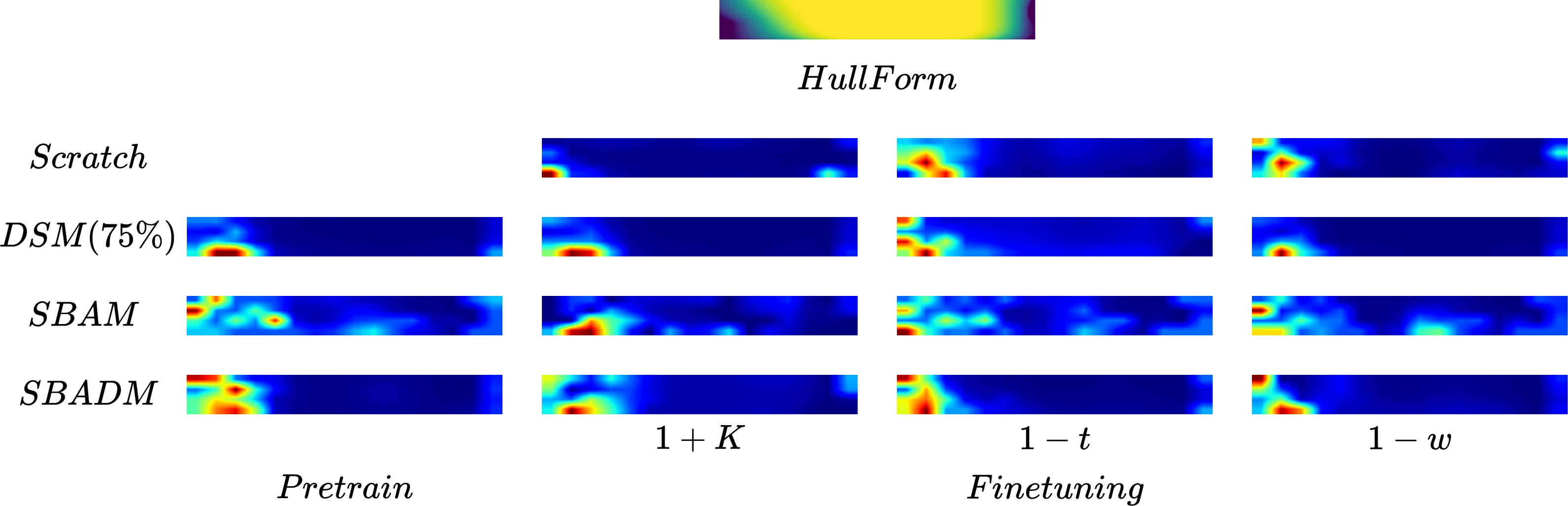
Attention focus on ship stern by SBADM
- [1] J. M. Walker, A. Coraddu, and L. Oneto, “Data-driven models for yacht hull resistance optimization: Exploring geometric parameters beyond the boundaries of the Delft Systematic Yacht Hull Series,” IEEE Access, Vol.12, pp. 76102-76120, 2024. https://doi.org/10.1109/ACCESS.2024.3404495
- [2] Y. Ao, Y. Li, J. Gong, and S. Li, “An artificial intelligence-aided design (AIAD) of ship hull structures,” J. of Ocean Engineering and Science, Vol.8, No.1, pp. 15-32, 2023. https://doi.org/10.1016/j.joes.2021.11.003
- [3] Y.-C. Kim, K.-S. Kim, S. Yeon, Y.-Y. Lee, G.-D. Kim, and M. Kim, “Power prediction method for ships using data regression models,” J. of Marine Science and Engineering, Vol.11, No.10, Article No.1961, 2023. https://doi.org/10.3390/jmse11101961
- [4] L. T. Trinh, T. Hamagami, and N. Okamoto, “3D ship hull design direct optimization using generative adversarial network,” J. Adv. Comput. Intell. Intell. Inform., Vol.28, No.3, pp. 693-703, 2024. https://doi.org/10.20965/jaciii.2024.p0693
- [5] T. Chen, S. Kornblith, M. Norouzi, and G. Hinton, “A simple framework for contrastive learning of visual representations,” arXiv:2002.05709, 2020. https://arxiv.org/abs/2002.05709
- [6] K. He, H. Fan, Y. Wu, S. Xie, and R. Girshick, “Momentum contrast for unsupervised visual representation learning,” arXiv:1911.05722, 2020. https://arxiv.org/abs/1911.05722
- [7] K. He, X. Chen, S. Xie, Y. Li, P. Dollár, and R. Girshick, “Masked autoencoders are scalable vision learners,” arXiv:2111.06377, 2021. https://arxiv.org/abs/2111.06377
- [8] Z. Xie, Z. Zhang, Y. Cao, Y. Lin, J. Bao, Z. Yao, Q. Dai, and H. Hu, “SimMIM: A simple framework for masked image modeling,” arXiv:2111.09886, 2022. https://arxiv.org/abs/2111.09886
- [9] A. Dosovitskiy, L. Beyer, A. Kolesnikov, D. Weissenborn, X. Zhai, T. Unterthiner, M. Dehghani, M. Minderer, G. Heigold, S. Gelly, J. Uszkoreit, and N. Houlsby, “An image is worth 16×16 words: Transformers for image recognition at scale,” arXiv:2010.11929, 2021. https://arxiv.org/abs/2010.11929
- [10] H. Choi, H. Park, K. M. Yi, S. Cha, and D. Min, “Salience-based adaptive masking: Revisiting token dynamics for enhanced pre-training,” arXiv:2404.08327, 2024. https://arxiv.org/abs/2404.08327
This article is published under a Creative Commons Attribution-NoDerivatives 4.0 Internationa License.