
Research Paper:
Multilingual Emotion Profiling of Large Language Models Through Literary Texts and Persona Conditioning
Naruki Shirahama*1,†
 , Yuma Yoshimoto*2, Naofumi Nakaya*3
, and Satoshi Watanabe*4
*1Shimonoseki City University
2-1-1 Daigaku-cho, Shimonoseki, Yamaguchi 751-8510, Japan
†Corresponding author
*2National Institute of Technology (KOSEN), Kitakyushu College
5-20-1 Shii, Kokuraminami, Kitakyushu, Fukuoka 802-0985, Japan
*3Juntendo University
3-6-1 Hinode, Urayasu, Chiba 279-0013, Japan
*4Shizuoka Institute of Science and Technology
2200-2 Toyosawa, Fukuroi, Shizuoka 437-0032, Japan

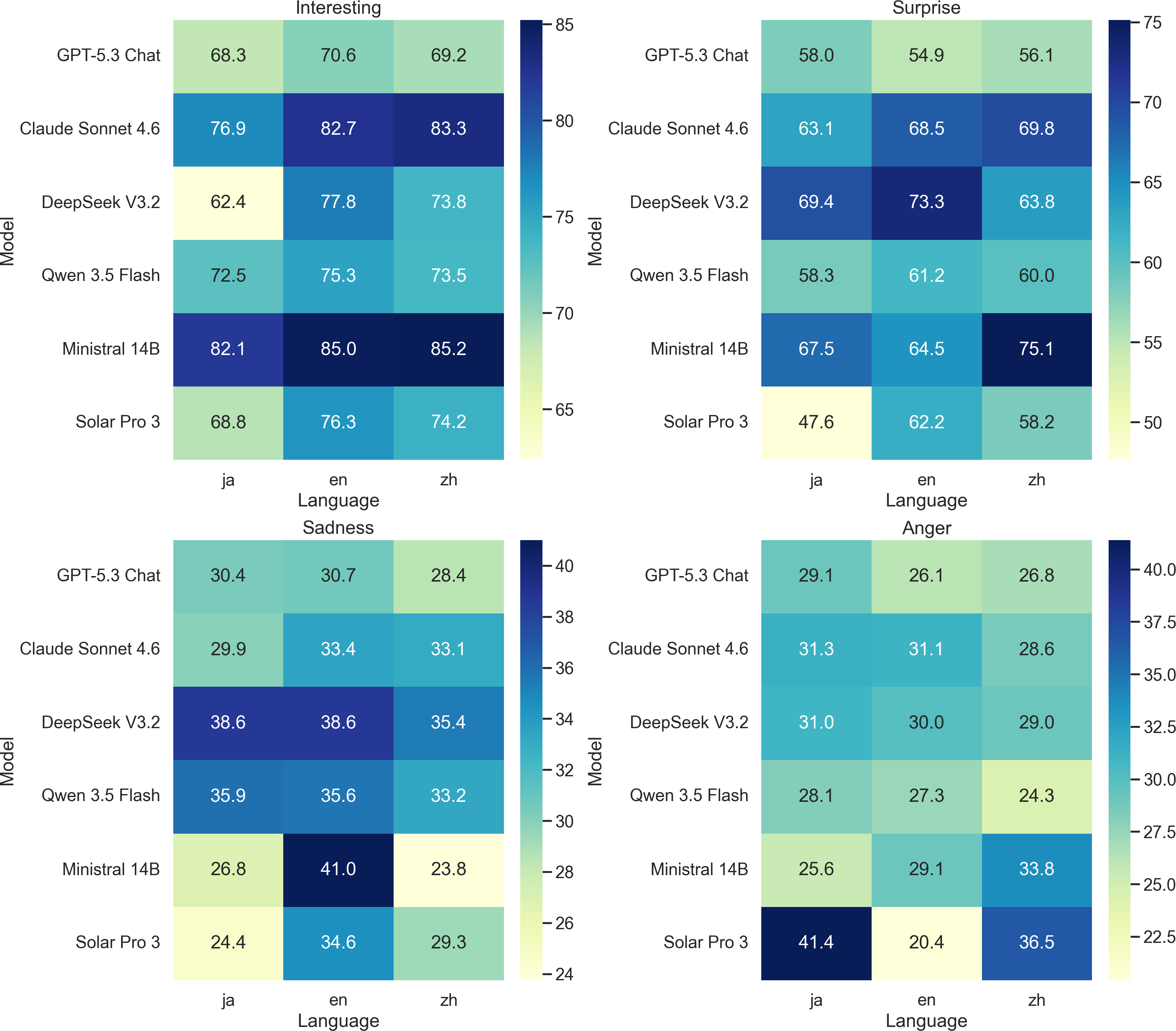
This paper examines whether multilingual prompt-and-text conditions materially alter large language model (LLM) emotion evaluation rather than merely rephrasing the same task. Using OpenRouter as a unified inference layer, we evaluated six contemporary LLMs under three full-language conditions (Japanese, English, and Traditional Chinese), three literary texts, four personas, and three repeated API calls per condition. Each completion rated four emotional dimensions — Interesting, Surprise, Sadness, and Anger — and provided a brief rationale. The design comprised 648 planned evaluations (6 models × 3 languages × 3 texts × 4 personas × 3 trials). The final combined dataset contained 648 valid records, comprising 631 original records and 17 replacement records obtained under a repair amendment registered after the main run and before the patch run. Descriptive summaries and preregistered ordinary least squares analyses with HC3 robust standard errors showed that text content was a major driver of scores, especially for Sadness and Anger. Simultaneously, model-language interactions were significant for all four emotions, indicating that the effect of the language condition varied substantially across models. English yielded the highest mean Interesting, Surprise, and Sadness scores, whereas Japanese yielded the highest mean Anger score. However, these aggregate patterns mask the strong model-specific contrasts. The findings show that multilingual literary evaluation is shaped by both the text itself and the model processing of its translation. This study contributes a multilingual literary emotion benchmark, a preregistered and repair-aware evaluation pipeline, and evidence that multilingual conditions are substantive experimental factors for LLM emotion profiling.
Multilingual LLM emotion profiles
- [1] N. Shirahama, N. Nakaya, and S. Watanabe, “Characterizing ‘emotional individuality’ in 36 LLMs: Persona and Japanese text conditioning,” S.-C. Chu, T.-C. Lu, J.-S. Pan, G. A. Tsihrintzis, and T.-W. Sung (Eds.), “Advances in Intelligent Information Hiding and Multimedia Signal Processing (IIHMSP 2025),” pp. 287-298, Springer, 2026. https://doi.org/10.1007/978-3-032-22588-7_27
- [2] S. Havaldar, S. Rai, B. Singhal, L. Liu, S. C. Guntuku, and L. Ungar, “Multilingual language models are not multicultural: A case study in emotion,” Proc. of the 13th Workshop on Computational Approaches to Subjectivity, Sentiment, and Social Media Analysis, pp. 202-214, 2023. https://doi.org/10.18653/v1/2023.wassa-1.19
- [3] T. D. Belay, A. H. Ahmed, A. Grissom II, I. Ameer, G. Sidorov, O. Kolesnikova, and S. M. Yimam, “CULEMO: Cultural lenses on emotion – Benchmarking LLMs for cross-cultural emotion understanding,” Proc. of the 63rd Annual Meeting of the Association for Computational Linguistics (Volume 1: Long Papers), pp. 18894-18909, 2025. https://doi.org/10.18653/v1/2025.acl-long.925
- [4] W. Lee, Y. Sim, H. Kim, and H. Kim, “Multilingual, not multicultural: Uncovering the cultural empathy gap in LLMs through a comparative empathetic dialogue benchmark,” Proc. of the 14th Int. Joint Conf. on Natural Language Processing and the 4th Conf. of the Asia-Pacific Chapter of the Association for Computational Linguistics, pp. 791-809, 2025. https://doi.org/10.18653/v1/2025.ijcnlp-long.44
- [5] Y. Chen and Y. Xiao, “Recent advancement of emotion cognition in large language models,” arXiv:2409.13354, 2024. https://doi.org/10.48550/arXiv.2409.13354
- [6] Y. Chen, S. Yan, S. Liu, Y. Li, and Y. Xiao, “EmotionQueen: A benchmark for evaluating empathy of large language models,” Findings of the Association for Computational Linguistics: ACL 2024, pp. 2149-2176, 2024. https://doi.org/10.18653/v1/2024.findings-acl.128
- [7] J.-T. Huang, M. Lam, E. Li, S. Ren, W. Wang, W. Jiao, Z. Tu, and M. Lyu, “Apathetic or empathetic? evaluating LLMs’ emotional alignments with humans,” Advances in Neural Information Processing Systems 37, pp. 97053-97087, 2024. https://doi.org/10.52202/079017-3077
- [8] S. J. Paech, “EQ-Bench: An emotional intelligence benchmark for large language models,” arXiv:2312.06281, 2024. https://doi.org/10.48550/arXiv.2312.06281
- [9] E. Jeon, M. Lee, S. Kim, J. Kim, W. Cho, T.-E. Kam, and S. Lee, ““Going to a trap house” conveys more fear than “Going to a mall”: Benchmarking emotion context sensitivity for LLMs,” Findings of the Association for Computational Linguistics: EMNLP 2025, pp. 14848-14869, 2025. https://doi.org/10.18653/v1/2025.findings-emnlp.802
- [10] S. Wu, Y. Zhu, W. Hsu, M.-L. Lee, and Y. Deng, “From personas to talks: Revisiting the impact of personas on LLM-synthesized emotional support conversations,” Proc. of the 2025 Conf. on Empirical Methods in Natural Language Processing, pp. 5439-5453, 2025. https://doi.org/10.18653/v1/2025.emnlp-main.277
- [11] Y. Jun and H. Lee, “Exploring persona sentiment sensitivity in personalized dialogue generation,” Proc. of the 63rd Annual Meeting of the Association for Computational Linguistics (Volume 1: Long Papers), pp. 18384-18402, 2025. https://doi.org/10.18653/v1/2025.acl-long.900
- [12] E. Kim and R. Klinger, “A survey on sentiment and emotion analysis for computational literary studies,” Zeitschrift für digitale Geisteswissenschaften, 2019. https://doi.org/10.17175/2019_008
- [13] E. Öhman and R. Rossi, “Affect as a proxy for literary mood,” J. of Data Mining and Digital Humanities, Vol.NLP4DH, 2023. https://doi.org/10.46298/jdmdh.11164
- [14] F. M. Plaza-del-Arco, A. A. Cercas Curry, A. Cercas Curry, and D. Hovy, “Emotion analysis in NLP: Trends, gaps and roadmap for future directions,” Joint Int. Conf. on Computational Linguistics, Language Resources and Evaluation, pp. 5696-5710, 2024. https://doi.org/10.63317/3kradf7tw6gm
- [15] L. P. Hung and S. Alias, “Beyond sentiment analysis: A review of recent trends in text based sentiment analysis and emotion detection,” J. Adv. Comput. Intell. Intell. Inform., Vol.27, No.1, pp. 84-95, 2023. https://doi.org/10.20965/jaciii.2023.p0084
- [16] N. Lin, “A CNN-BiGRU-GNN model for sentiment analysis of complex English texts,” J. Adv. Comput. Intell. Intell. Inform., Vol.30, No.1, pp. 144-155, 2026. https://doi.org/10.20965/jaciii.2026.p0144
- [17] G. C. Yeo and K. Jaidka, “Beyond context to cognitive appraisal: Emotion reasoning as a theory of mind benchmark for large language models,” Findings of the Association for Computational Linguistics: ACL 2025, pp. 26517-26525, 2025. https://doi.org/10.18653/v1/2025.findings-acl.1359
- [18] J. Huang, W. Jiao, M. H. Lam, E. J. Li, W. Wang, and M. Lyu, “On the reliability of psychological scales on large language models,” Proc. of the 2024 Conf. on Empirical Methods in Natural Language Processing, pp. 6152-6173, 2024. https://doi.org/10.18653/v1/2024.emnlp-main.354
- [19] Y. Tokutake and K. Okamoto, “Can large language models assess serendipity in recommender systems?,” J. Adv. Comput. Intell. Intell. Inform., Vol.28, No.6, pp. 1263-1272, 2024. https://doi.org/10.20965/jaciii.2024.p1263
- [20] S. H. Muhammad, N. Ousidhoum, I. Abdulmumin, S. M. Yimam, J. P. Wahle, T. L. Ruas, M. Beloucif, C. De Kock, T. D. Belay, I. S. Ahmad, N. Surange, D. Teodorescu, D. I. Adelani, A. F. Aji, F. D. M. Ali, V. Araujo, A. A. Ayele, O. Ignat, A. Panchenko, Y. Zhou, and S. Mohammad, “SemEval-2025 task 11: Bridging the gap in text-based emotion detection,” Proc. of the 19th Int. Workshop on Semantic Evaluation (SemEval-2025), pp. 2558-2569, 2025.
- [21] K. Takahashi, T. Oka, and M. Komachi, “Effectiveness of pre-trained language models for the Japanese Winograd schema challenge,” J. Adv. Comput. Intell. Intell. Inform., Vol.27, No.3, pp. 511-521, 2023. https://doi.org/10.20965/jaciii.2023.p0511
- [22] N. Shirahama, N. Nakaya, S. Watanabe, K. Moriya, K. Matsumoto, and K. Koshi, “Assessing emotional intelligence in AI: Visual analogue scale vs. Likert scale in short story comprehension,” J. of the Institute of Industrial Applications Engineers, Vol.13, No.1, pp. 21-31, 2025. https://doi.org/10.12792/jiiae.13.21
- [23] N. Shirahama, N. Nakaya, and S. Watanabe, “Development of an experimental platform for evaluating LLM emotion understanding,” ICIC Express Letters, Vol.20, No.2, pp. 191-198, 2026. https://doi.org/10.24507/icicel.20.02.191
- [24] N. Shirahama, N. Nakaya, and S. Watanabe, “Temperature-controlled response reliability in large language models: A quantitative analysis of 36 models for emotion understanding tasks,” The 12th Int. Conf. on Intelligent Systems and Image Processing 2025, pp. 78-84, 2025. https://doi.org/10.12792/icisip2025.016
- [25] Z. Lian, H. Chen, L. Chen, H. Sun, L. Sun, Y. Ren, Z. Cheng, B. Liu, R. Liu, X. Peng, J. Yi, and J. Tao, “AffectGPT: A new dataset, model, and benchmark for emotion understanding with multimodal large language models,” Proc. of the 42nd Int. Conf. on Machine Learning, pp. 36993-37014, 2025.
- [26] H. Zhao, L. Li, S. Chen, S. Kong, J. Wang, K. Huang, T. Gu, Y. Wang, J. Wang, D. Liang, Z. Li, Y. Teng, Y. Xiao, and Y. Wang, “ESC-Eval: Evaluating emotion support conversations in large language models,” Proc. of the 2024 Conf. on Empirical Methods in Natural Language Processing, pp. 15785-15810, 2024. https://doi.org/10.18653/v1/2024.emnlp-main.883
- [27] Y. Zhou, Z. Zhang, J. Cao, J. Jia, Y. Jiang, F. Wen, X. Liu, X. Min, and G. Zhai, “MEMO-Bench: A multiple benchmark for text-to-image and multimodal large language models on human emotion analysis,” arXiv:2411.11235, 2024. https://doi.org/10.48550/arXiv.2411.11235
This article is published under a Creative Commons Attribution-NoDerivatives 4.0 Internationa License.