
Research Paper:
Multilingual Emotion Profiling of Large Language Models Through Literary Texts and Persona Conditioning
Naruki Shirahama*1,†
 , Yuma Yoshimoto*2, Naofumi Nakaya*3
, and Satoshi Watanabe*4
*1Shimonoseki City University
2-1-1 Daigaku-cho, Shimonoseki, Yamaguchi 751-8510, Japan
†Corresponding author
*2National Institute of Technology (KOSEN), Kitakyushu College
5-20-1 Shii, Kokuraminami, Kitakyushu, Fukuoka 802-0985, Japan
*3Juntendo University
3-6-1 Hinode, Urayasu, Chiba 279-0013, Japan
*4Shizuoka Institute of Science and Technology
2200-2 Toyosawa, Fukuroi, Shizuoka 437-0032, Japan

This paper examines whether multilingual prompt-and-text conditions materially alter large language model (LLM) emotion evaluation rather than merely rephrasing the same task. Using OpenRouter as a unified inference layer, we evaluated six contemporary LLMs under three full-language conditions (Japanese, English, and Traditional Chinese), three literary texts, four personas, and three repeated API calls per condition. Each completion rated four emotional dimensions — Interesting, Surprise, Sadness, and Anger — and provided a brief rationale. The design comprised 648 planned evaluations (6 models × 3 languages × 3 texts × 4 personas × 3 trials). The final combined dataset contained 648 valid records, comprising 631 original records and 17 replacement records obtained under a repair amendment registered after the main run and before the patch run. Descriptive summaries and preregistered ordinary least squares analyses with HC3 robust standard errors showed that text content was a major driver of scores, especially for Sadness and Anger. Simultaneously, model-language interactions were significant for all four emotions, indicating that the effect of the language condition varied substantially across models. English yielded the highest mean Interesting, Surprise, and Sadness scores, whereas Japanese yielded the highest mean Anger score. However, these aggregate patterns mask the strong model-specific contrasts. The findings show that multilingual literary evaluation is shaped by both the text itself and the model processing of its translation. This study contributes a multilingual literary emotion benchmark, a preregistered and repair-aware evaluation pipeline, and evidence that multilingual conditions are substantive experimental factors for LLM emotion profiling.
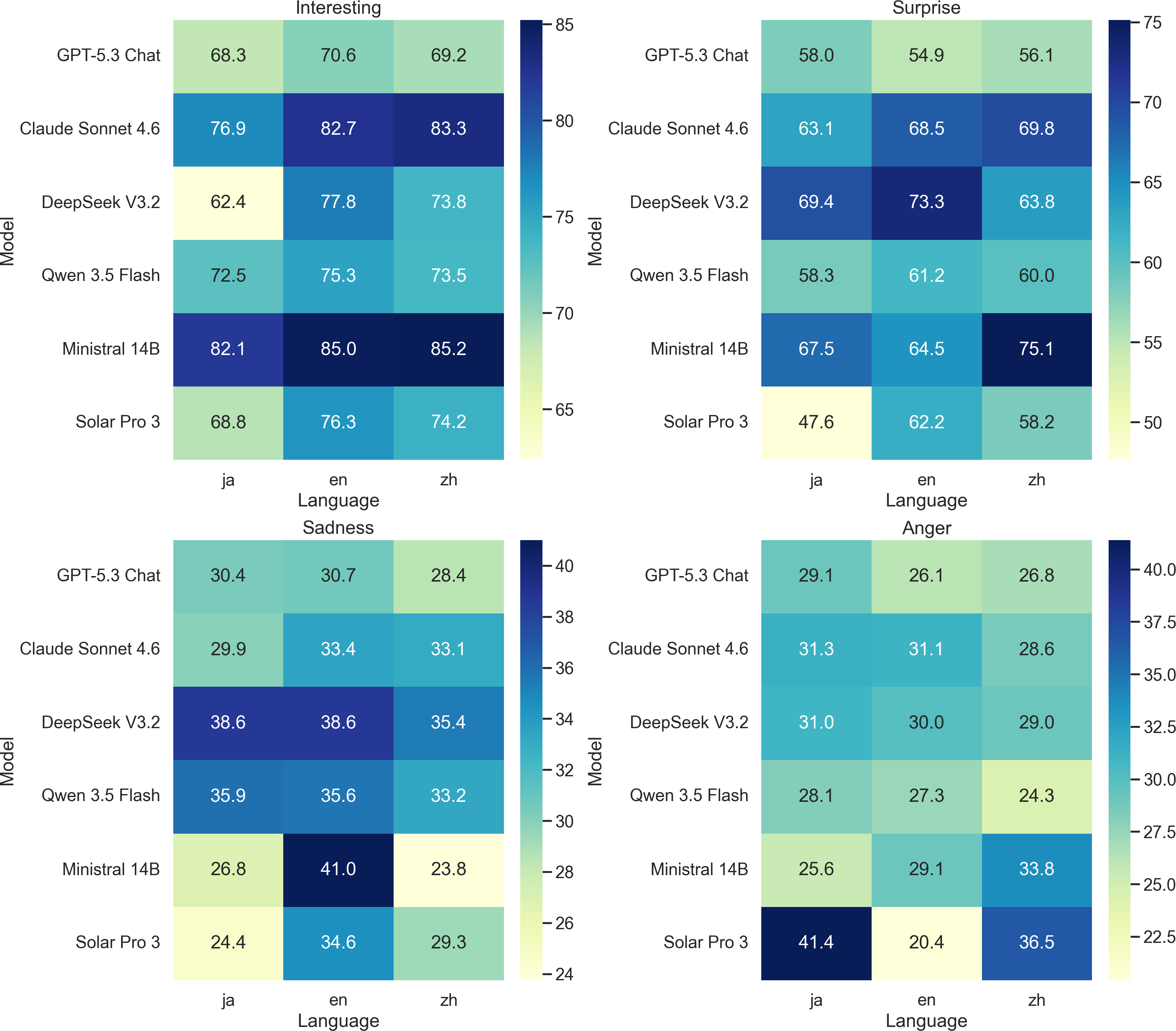
Multilingual LLM emotion profiles
1. Introduction
Large language models (LLMs) are increasingly used in settings where emotional interpretation is important, including dialogue systems, educational support, health-related communication, and literary analysis. In such applications, the model must not only generate fluent language but also react to affective nuances in a stable and interpretable way. Despite the rapid progress in general-purpose LLM capabilities, cross-model differences in emotional judgment remain insufficiently characterized.
Our earlier conference paper examined the emotional evaluations of Japanese literary texts under persona conditioning and established a Japanese-only baseline for comparing model- and persona-dependent emotion profiles 1. The present journal version extends this predecessor to a matched multilingual design, rebuilds inference and logging through OpenRouter, and adds preregistration, together with a repair-aware reproducibility workflow.
This extension is motivated by a simple but underexplored question: When literary content is translated and the prompt language changes accordingly, do LLM emotion profiles remain stable, or do they shift in model-specific ways? Multilingual emotional interpretation is known to be culturally and linguistically sensitive 2,3,4, and recent studies on LLM emotion cognition and empathy benchmarking suggest that current systems still exhibit uneven emotional competence 5,6,7,8,9. In parallel, persona conditioning has been shown to alter dialogue behavior and emotional stances 10,11. These strands suggest that the language condition, persona condition, and model identity should be treated jointly rather than in isolation from one another.
Accordingly, this study addresses the following research questions.
-
RQ1:
Does the full language condition (Japanese, English, Traditional Chinese) significantly affect LLM emotion scores?
-
RQ2:
Do six current LLMs exhibit systematically different emotional evaluation profiles?
-
RQ3:
Do text and persona conditions modulate the language effect?
-
RQ4:
How large is trial-to-trial variability, and does it differ across models?
The main contribution of this study is not a claim about national origin as a causal explanation but a reproducible comparison of six concrete models under matched multilingual conditions. More specifically, this study contributes (i) a multilingual literary emotion benchmark that switches the full input bundle across three languages, (ii) a preregistered and repair-aware evaluation pipeline with complete raw logging, and (iii) empirical evidence that model-language interactions significantly reshape emotion profiles, alongside substantial text effects, especially for Sadness and Anger. These findings imply that translation conditions cannot be treated as minor implementation details in multilingual LLM evaluations.
3. Research Questions and Hypotheses
The registration fixed four research questions and five directional expectations before the main six-model run. These hypotheses were not treated as post-hoc interpretations but as the analytical frame used to organize the results reported below.
-
H1:
Text content will be the strongest determinant of emotion scores across models and languages.
-
H2:
Language condition will show dimension-specific effects, with larger shifts for Surprise, Sadness, and Anger than for Interesting.
-
H3:
Persona conditioning will have a measurable but smaller effect than text and model identity.
-
H4:
Trial-to-trial variability will differ by model, indicating different levels of response stability.
-
H5:
Country-level grouping may be descriptively useful, but model-level differences will be more interpretable than country-level averages because country representation is sparse and uneven.
4. Method
4.1. Experimental Setup
The experiment evaluated six current LLMs using the OpenRouter Chat Completions API with a unified request structure and a single execution engine. This setup follows the broader methodological line of our standardized emotion-understanding platform, which addresses provider heterogeneity, prompt management, batch execution, and result normalization across multiple LLM families 23. In the present study, OpenRouter served as a simplified unified inference layer for a narrower six-model comparison under matched multilingual conditions. The model set included GPT-5.3 Chat and Claude Sonnet 4.6 from the United States; DeepSeek V3.2 and Qwen 3.5 Flash from China; Ministral 14B from France; and Solar Pro 3 from South Korea. Country labels were used only as descriptive metadata, not as inferential categories.
Three short literary texts were used: “The Pocket Watch” and “The Money and the Pistol” by Kyusaku Yumeno, and “The Tattered Ostrich” by Kotaro Takamura. For each text, the model was instructed to rate four emotions — Interesting, Surprise, Sadness, and Anger — on a 0–100 scale and provide a short rationale for each rating. The four personas were defined as follows: College Freshman, “a young, open-minded first-year college student” with base temperature 0.7; Literary Scholar, “a logical, analytically minded literary scholar” with base temperature 0.4; The Emotive Poet, “a sensitive, deeply feeling poet” with base temperature 0.9; and The Emotionless Robot, “a mechanical, logic-driven robot” with base temperature 0.1. The Japanese and Traditional Chinese prompts used semantically matched persona names and descriptions. Text-specific temperature modifiers were set to 0.0; therefore, the effective temperature was equal to the persona base temperature in this study. The design specified three trials for every model-language-text-persona cell, yielding \(6 \times 3 \times 3 \times 4 \times 3 = 648\) planned evaluations.
The language condition in this study was a full-input condition. The user instruction, persona wording, title, author, and text body were all switched among Japanese, English, and Traditional Chinese. Therefore, the experiment tested not only a change in the prompt language but also a change in the full linguistic representation of the literary stimulus.
The actual prompt contained a persona instruction, literary text, score definitions, and a strict output template. A shortened English excerpt is shown below; the Japanese and Traditional Chinese versions follow the same structure in their respective languages:
You are “{PERSONA_NAME}.” As {PERSONA_DESC}, you will evaluate a literary text that was originally written in Japanese. Read the following text and rate the four emotions on a scale of 0 to 100 (integers only), then briefly explain why you chose that number.
===RESPONSE_START===
Q1.Interesting|||score|||reason
Q2.Surprise|||score|||reason
Q3.Sadness|||score|||reason
Q4.Anger|||score|||reason
===RESPONSE_END===
In this structure, Qn denotes the emotion item number, score denotes the integer rating from 0 to 100, and reason denotes a one- to three-sentence explanation of the score. The triple delimiter ||| separates these three fields for deterministic parsing. All raw requests, timestamps, responses, token usage, and parsing results were recorded. This emphasis on strict formatting and parseability is consistent with our recent reliability study, which showed that structured-response reliability and controllability vary substantially across models and can be monitored through missing data behavior 24. Because some models occasionally violated the formatting template despite returning semantically valid answers, a repair amendment registered after the main run and before the patch run introduced a limited-repair protocol. The original main run produced 648 successful API responses, but 17 responses did not satisfy the parser format requirement because of missing start or end markers, markdown emphasis around scores, absent markers despite four recognizable Q1–Q4 entries, or single-line concatenation of several items. The amendment specified that only these 17 failed job keys would be rerun into a separate patch directory, that the original main run would remain unchanged, and that the official dataset would be created by merging the original and patch records by job key while preferring patch records only for the failed keys. The combined dataset preserved a record_source field and contained 631 main-run records and 17 patch-run records. The protocol yielded a final combined dataset of 648 valid call records.
4.2. Preregistered Analysis Plan
The preregistration fixed the following ordinary least squares (OLS) model for each emotion.
The interaction terms were included because a simpler additive model would not answer the main research question. RQ1 asks whether language matters, while RQ3 asks whether language effects are moderated by text and persona, and the central empirical concern is whether language shifts are model-specific rather than uniform across systems. Therefore, the preregistered model included model-language, language-text, and language-persona interactions. Higher-order interactions were not included because the design was intended to preserve interpretability and avoid overfitting a dataset of 648 valid records with many sparse interaction cells.
We estimated the models using HC3 robust standard errors. Omnibus term significance was evaluated using robust Wald tests, and effect sizes were reported as partial \(\eta^2\) based on Type II ANOVA sums of squares on the same design. When the model-language interaction was significant for a given emotion, we conducted within-model post-hoc language contrasts (‘,’ ‘ja-zh,’ ‘en-zh’) with Holm correction.
In addition to inferential analysis, we produced descriptive summaries by language, model, text, and persona, together with trial variability summaries based on within-cell standard deviations and ranges. The main analytical unit was one API call in the wide-format dataset, and the long-format dataset was used for emotion-specific aggregation and for plotting.
5. Results
5.1. Data Quality
The final combined dataset satisfied the preregistered quality criteria. The main run produced 648 successful API responses, of which 17 did not meet the parser format requirements. After replacement of those 17 records through the limited-repair protocol, the final dataset contained 648 parseable records: 631 from the main run and 17 from the patch run. Each model–language cell contained 36 valid observations.
5.2. Descriptive Patterns
At the aggregate level, the English condition produced the highest mean scores for Interesting (77.94), Surprise (64.12), and Sadness (35.65), whereas the Japanese condition produced the highest mean score for Anger (31.07). The Chinese condition remained close to English for Interesting (76.53) and Surprise (63.82), but stayed close to Japanese for Sadness (30.54 versus 31.01). These language-level averages provide a useful summary but do not reveal whether the same pattern holds for every model.
The text effects were immediately apparent. Text 2 yielded the highest Interesting and Surprise scores across all three languages, whereas Text 3 consistently produced the highest Sadness and Anger scores. For example, Text 3 in English reached a Sadness mean of 77.54, and Text 3 in Chinese reached an Anger mean of 68.50. Text 1 remained relatively low in the negative dimensions in all three languages. These descriptive patterns motivate the inferential question of whether the text remains dominant once model identity, persona, and language conditions are considered jointly.
5.3. Inferential Results
5.3.1. Text and Model Effects
| Text | Lang | Interesting | Surprise | Sadness | Anger |
| t1 | en | 73.85 | 54.35 | 17.74 | 7.35 |
| t1 | ja | 73.94 | 50.06 | 11.36 | 7.93 |
| t1 | zh | 75.26 | 49.97 | 13.90 | 7.06 |
| t2 | en | 82.54 | 77.36 | 11.67 | 13.69 |
| t2 | ja | 81.11 | 76.53 | 11.22 | 19.50 |
| t2 | zh | 82.08 | 80.51 | 9.42 | 13.90 |
| t3 | en | 77.44 | 60.64 | 77.54 | 60.99 |
| t3 | ja | 60.43 | 55.43 | 70.44 | 65.79 |
| t3 | zh | 72.25 | 60.97 | 68.29 | 68.50 |
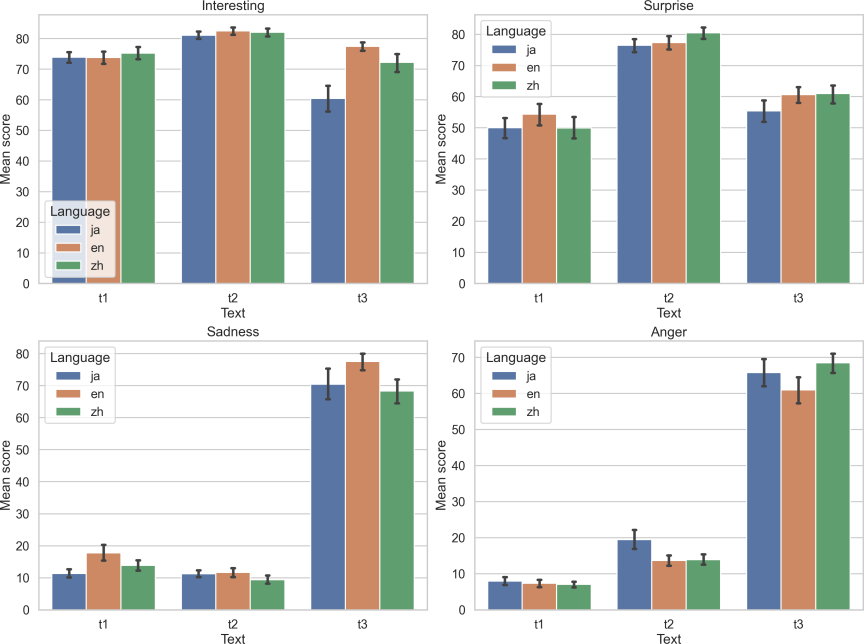
Fig. 1. Text-by-language bar charts for the four emotion dimensions. Error bars show 95% confidence intervals.
The preregistered OLS analyses showed that text content had the largest partial \(\eta^2\) for Surprise, Sadness, and Anger, whereas model identity had the largest partial \(\eta^2\) for Interesting (0.3301 for model identity versus 0.2980 for text). For Sadness and Anger, the text term reached partial \(\eta^2\) values of 0.8901 and 0.8827, respectively. Thus, H1 was partially supported. Surprise also showed a very large text effect (partial \(\eta^2 = 0.5615\)). Table 1 and Fig. 1 show this structure clearly.
5.3.2. Model-Language Interactions
The preregistered model-language interaction was significant for all four emotions (Table 2), showing that translation condition did not affect every model in the same way. The heatmap in Fig. 2 makes this clear at a glance. DeepSeek V3.2 showed a strong Japanese-English contrast on Interesting (difference \(=-15.42\)), Solar Pro 3 showed a very large Japanese-English contrast on Anger (difference \(=20.97\)), and Ministral 14B showed a large English-Chinese contrast on Sadness (difference \(=17.25\)). These contrasts illustrate that the emotional profile changes in model-specific ways when the full language condition is switched.
5.3.3. Persona Effects and Trial Variability
Persona effects were smaller than text effects but remained non-negligible, especially for Sadness. The Emotive Poet persona produced the highest Sadness average in English (41.65), while the Emotionless Robot persona showed the lowest Interesting mean in Japanese (68.44). These persona-conditioned differences were smaller than the text effects; for Sadness, however, the persona effect was comparable to the model and model-language effects.
| Emotion | F | \(p\) | Partial \(\eta^2\) |
| Interesting | 3.3544 | 0.0003 | 0.0662 |
| Surprise | 6.5928 | \(<\)0.0001 | 0.1059 |
| Sadness | 5.6102 | \(<\)0.0001 | 0.0770 |
| Anger | 4.6743 | \(<\)0.0001 | 0.1395 |
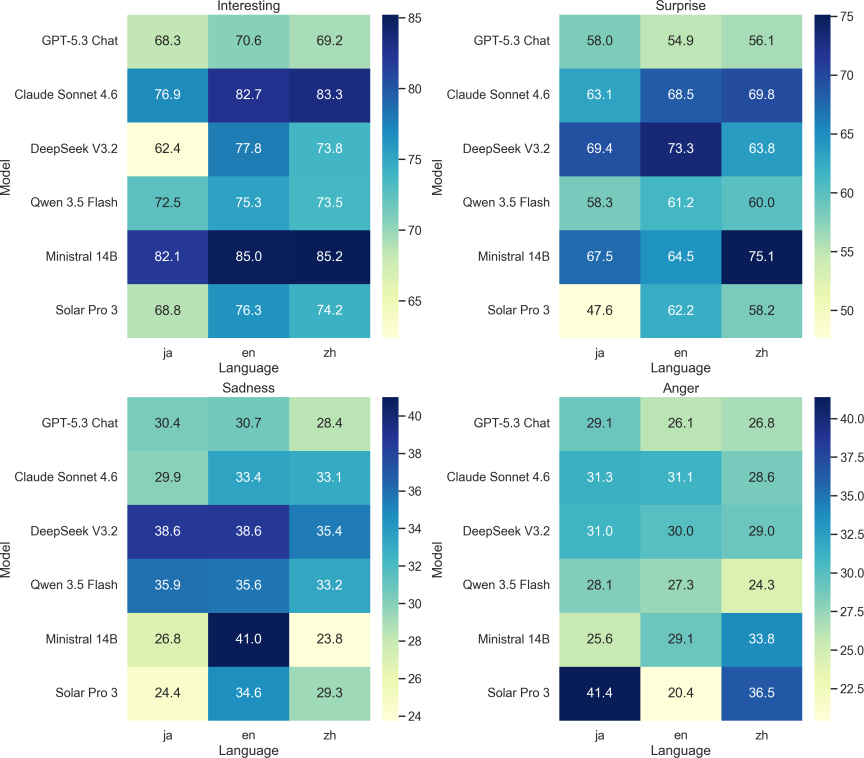
Fig. 2. Model by language heatmaps for the four emotion dimensions.
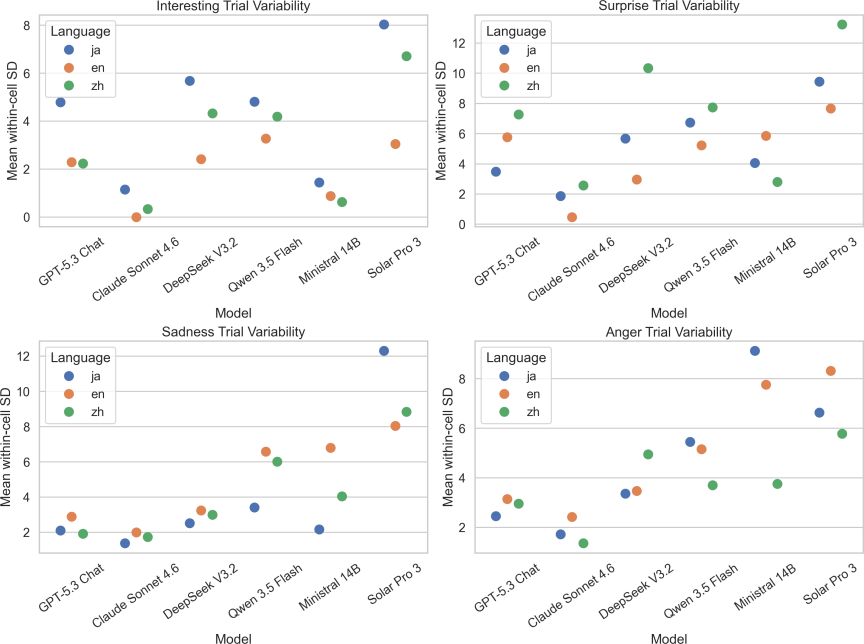
Fig. 3. Mean within-cell trial variability by model and language.
Descriptive trial-variability summaries suggested model- and language-level differences. On average, Solar Pro 3 exhibited the largest within-cell standard deviation across conditions, as shown in Fig. 3. Given the three-call design, this pattern should be treated as an initial stability diagnostic rather than a confirmatory test. It nevertheless indicates that multilingual emotion profiling should consider response stability in addition to mean scores.
Taken together, the inferential results showed that text content had the largest partial \(\eta^2\) for Surprise, Sadness, and Anger, whereas model identity had the largest partial \(\eta^2\) for Interesting. Language condition also reshaped emotional profiles in model-specific ways. Accordingly, multilingual benchmarking should treat language not as a nuisance factor but as a substantive experimental condition.
6. Discussion
The discussion is organized around preregistered questions and hypotheses. For RQ1, the results indicate that language effects depend on model identity. However, the directional ordering predicted by H2 was not consistently supported. English increased Interesting, Surprise, and Sadness on average, whereas Japanese produced the highest Anger mean score. More importantly, these aggregate tendencies were unstable across the models. This is why the main contribution of this study is the finding that multilingual conditions act as substantive experimental factors rather than as superficial wrappers around a fixed task. Relative to the Japanese-only 36-model benchmark reported in our earlier conference study 1, this study shifts the analytical emphasis from vendor-group differences to model-specific language interactions under matched translated stimuli.
For RQ2, model identity mattered. H1 was partially supported: text content had the largest partial \(\eta^2\) for Surprise, Sadness, and Anger, whereas model identity had the largest partial \(\eta^2\) for Interesting. The large text effects for Sadness, Anger, and Surprise indicate that the models responded to the broad affective properties of the literary works rather than merely to the prompt style. This result is consistent with prior work in the computational literature 12,13, while extending it to a controlled LLM comparison setting with translated inputs.
For RQ3, language–text interactions were significant for all four dimensions, whereas language–persona interactions did not reach statistical significance. This does not establish the absence of language–persona interactions. Regarding H3, persona-associated effects were smaller than text effects, but for Sadness the persona effect was comparable to the model and model-language effects. Thus, H3 was not uniformly supported across dimensions. The observed differences between persona conditions are consistent with prior persona-prompting research 10,11, although persona and temperature effects cannot be separated in this design. In the present study, persona was a controlled experimental factor; its main effect should be distinguished from moderation of language effects.
For RQ4 and H4, repeated trials provided a preliminary diagnosis of stability differences across the models. Solar Pro 3 showed the largest within-cell variability, indicating that multilingual emotion profiling should not be judged solely based on mean scores. This concern with response stability is also consistent with our temperature control study, which found large model-dependent differences in structured response reliability and controllability across emotion-understanding tasks 24. Stability is important because an apparently strong emotional tendency may be less trustworthy if it is accompanied by a high trial-to-trial fluctuation.
These results are also consistent with recent LLM emotion benchmarks 6,7,8,9,17. These studies show that current LLMs can display uneven emotional competence, but they typically do not frame the task as a multilingual literary evaluation with matched, translated inputs. Our findings extend this line of work by showing that multilinguality changes not only the difficulty of the task but also the shape of the emotional profile itself. In parallel, the result resonates with the cross-cultural and multilingual concerns raised by prior multilingual work 2,3,4: language-specific representation affects what the model appears to feel.
H5 was only supported in a cautious descriptive sense. Country grouping may help readers orient themselves to the model set, but the scientifically defensible interpretation remains model-level rather than country-level because the grouping is sparse and unbalanced. Therefore, we treat the country as contextual metadata, not as a basis for causal or comparative national claims.
7. Limitations
Several limitations should be noted when interpreting these findings. First, the study used only three literary texts; therefore, the benchmark captures a narrow slice of literary affect rather than the full range of narrative, poetic, and stylistic variation. Second, the design includes only three language conditions and relies on translated text versions; therefore, the results should not be conflated with the performance of originally authored multilingual corpora. The observed language effects may partly reflect how context, metaphor, rhythm, and evaluative nuances were expressed in the translation. We did not fit an additional model that separates translation-specific wording from the language condition because the preregistered factor intentionally treated instruction language, persona wording, title, author name, and text body as one full-language condition. Future work should explicitly separate these factors, for example, by comparing Japanese source texts with multilingual output requirements against translated source texts with a fixed Japanese output requirement. Third, the country grouping of the six models is descriptive rather than inferential because France and South Korea are represented by only one model each, whereas the United States and China are represented by two models each. Accordingly, the country names in this study are the United States, China, France, and South Korea, and should not be interpreted as balanced national samples. Fourth, H4 should be interpreted cautiously because three repeated calls per condition are insufficient for a strong statistical test of trial-to-trial stability. The variability results are best read as an initial diagnostic analysis that motivates larger, repeated-trial designs. Fifth, the present analysis focused on scalar emotion ratings and did not examine rationale quality in depth. Because each persona was assigned a different temperature, the observed persona-associated effects cannot be separated from temperature effects in this design. Therefore, future work should expand the text set, compare translated and originally authored multilingual materials, analyze explanation quality more directly, and test whether the same interaction patterns appear in multimodal or conversational emotion tasks 25,26,27.
8. Conclusion
This study presents a reproducible multilingual benchmark for LLM emotion evaluation using literary texts, personas, and an OpenRouter-based unified execution framework. Across the six models and three full-language conditions, text content had the largest partial \(\eta^2\) for Surprise, Sadness, and Anger, whereas model identity had the largest partial \(\eta^2\) for Interesting. Model-language interactions were significant for all four emotional dimensions. The central implication is that multilingual prompts and text conditions are part of the phenomenon being measured, not merely packaging details around the same underlying task.
More broadly, this study shows that multilingual literary emotion evaluation can serve as a useful probe for LLM sensitivity, stability, and cross-language variation. We expect this framework to support future work on multilingual emotion benchmarking, rationale analysis, and human-centered evaluations of LLM affective behavior.
Data and Code Availability
The prompt templates, model-language-text-persona job table, redacted public raw response logs, parser outputs, 17 repair job keys, merged wide-format and long-format datasets, analysis scripts, and preregistration files are available in the public GitHub repository at https://github.com/nshrhm/llm-emotion-attribution-multilingual. The Japanese source texts were public domain materials, and the English and Traditional Chinese versions used in this study were machine translated by the authors for experimental reproducibility.
Acknowledgments
This work was partially supported by JSPS Grants-in-Aid for Scientific Research (JSPS KAKENHI), Grant Numbers 26K14983 and 24K13350.
- [1] N. Shirahama, N. Nakaya, and S. Watanabe, “Characterizing ‘emotional individuality’ in 36 LLMs: Persona and Japanese text conditioning,” S.-C. Chu, T.-C. Lu, J.-S. Pan, G. A. Tsihrintzis, and T.-W. Sung (Eds.), “Advances in Intelligent Information Hiding and Multimedia Signal Processing (IIHMSP 2025),” pp. 287-298, Springer, 2026. https://doi.org/10.1007/978-3-032-22588-7_27
- [2] S. Havaldar, S. Rai, B. Singhal, L. Liu, S. C. Guntuku, and L. Ungar, “Multilingual language models are not multicultural: A case study in emotion,” Proc. of the 13th Workshop on Computational Approaches to Subjectivity, Sentiment, and Social Media Analysis, pp. 202-214, 2023. https://doi.org/10.18653/v1/2023.wassa-1.19
- [3] T. D. Belay, A. H. Ahmed, A. Grissom II, I. Ameer, G. Sidorov, O. Kolesnikova, and S. M. Yimam, “CULEMO: Cultural lenses on emotion – Benchmarking LLMs for cross-cultural emotion understanding,” Proc. of the 63rd Annual Meeting of the Association for Computational Linguistics (Volume 1: Long Papers), pp. 18894-18909, 2025. https://doi.org/10.18653/v1/2025.acl-long.925
- [4] W. Lee, Y. Sim, H. Kim, and H. Kim, “Multilingual, not multicultural: Uncovering the cultural empathy gap in LLMs through a comparative empathetic dialogue benchmark,” Proc. of the 14th Int. Joint Conf. on Natural Language Processing and the 4th Conf. of the Asia-Pacific Chapter of the Association for Computational Linguistics, pp. 791-809, 2025. https://doi.org/10.18653/v1/2025.ijcnlp-long.44
- [5] Y. Chen and Y. Xiao, “Recent advancement of emotion cognition in large language models,” arXiv:2409.13354, 2024. https://doi.org/10.48550/arXiv.2409.13354
- [6] Y. Chen, S. Yan, S. Liu, Y. Li, and Y. Xiao, “EmotionQueen: A benchmark for evaluating empathy of large language models,” Findings of the Association for Computational Linguistics: ACL 2024, pp. 2149-2176, 2024. https://doi.org/10.18653/v1/2024.findings-acl.128
- [7] J.-T. Huang, M. Lam, E. Li, S. Ren, W. Wang, W. Jiao, Z. Tu, and M. Lyu, “Apathetic or empathetic? evaluating LLMs’ emotional alignments with humans,” Advances in Neural Information Processing Systems 37, pp. 97053-97087, 2024. https://doi.org/10.52202/079017-3077
- [8] S. J. Paech, “EQ-Bench: An emotional intelligence benchmark for large language models,” arXiv:2312.06281, 2024. https://doi.org/10.48550/arXiv.2312.06281
- [9] E. Jeon, M. Lee, S. Kim, J. Kim, W. Cho, T.-E. Kam, and S. Lee, ““Going to a trap house” conveys more fear than “Going to a mall”: Benchmarking emotion context sensitivity for LLMs,” Findings of the Association for Computational Linguistics: EMNLP 2025, pp. 14848-14869, 2025. https://doi.org/10.18653/v1/2025.findings-emnlp.802
- [10] S. Wu, Y. Zhu, W. Hsu, M.-L. Lee, and Y. Deng, “From personas to talks: Revisiting the impact of personas on LLM-synthesized emotional support conversations,” Proc. of the 2025 Conf. on Empirical Methods in Natural Language Processing, pp. 5439-5453, 2025. https://doi.org/10.18653/v1/2025.emnlp-main.277
- [11] Y. Jun and H. Lee, “Exploring persona sentiment sensitivity in personalized dialogue generation,” Proc. of the 63rd Annual Meeting of the Association for Computational Linguistics (Volume 1: Long Papers), pp. 18384-18402, 2025. https://doi.org/10.18653/v1/2025.acl-long.900
- [12] E. Kim and R. Klinger, “A survey on sentiment and emotion analysis for computational literary studies,” Zeitschrift für digitale Geisteswissenschaften, 2019. https://doi.org/10.17175/2019_008
- [13] E. Öhman and R. Rossi, “Affect as a proxy for literary mood,” J. of Data Mining and Digital Humanities, Vol.NLP4DH, 2023. https://doi.org/10.46298/jdmdh.11164
- [14] F. M. Plaza-del-Arco, A. A. Cercas Curry, A. Cercas Curry, and D. Hovy, “Emotion analysis in NLP: Trends, gaps and roadmap for future directions,” Joint Int. Conf. on Computational Linguistics, Language Resources and Evaluation, pp. 5696-5710, 2024. https://doi.org/10.63317/3kradf7tw6gm
- [15] L. P. Hung and S. Alias, “Beyond sentiment analysis: A review of recent trends in text based sentiment analysis and emotion detection,” J. Adv. Comput. Intell. Intell. Inform., Vol.27, No.1, pp. 84-95, 2023. https://doi.org/10.20965/jaciii.2023.p0084
- [16] N. Lin, “A CNN-BiGRU-GNN model for sentiment analysis of complex English texts,” J. Adv. Comput. Intell. Intell. Inform., Vol.30, No.1, pp. 144-155, 2026. https://doi.org/10.20965/jaciii.2026.p0144
- [17] G. C. Yeo and K. Jaidka, “Beyond context to cognitive appraisal: Emotion reasoning as a theory of mind benchmark for large language models,” Findings of the Association for Computational Linguistics: ACL 2025, pp. 26517-26525, 2025. https://doi.org/10.18653/v1/2025.findings-acl.1359
- [18] J. Huang, W. Jiao, M. H. Lam, E. J. Li, W. Wang, and M. Lyu, “On the reliability of psychological scales on large language models,” Proc. of the 2024 Conf. on Empirical Methods in Natural Language Processing, pp. 6152-6173, 2024. https://doi.org/10.18653/v1/2024.emnlp-main.354
- [19] Y. Tokutake and K. Okamoto, “Can large language models assess serendipity in recommender systems?,” J. Adv. Comput. Intell. Intell. Inform., Vol.28, No.6, pp. 1263-1272, 2024. https://doi.org/10.20965/jaciii.2024.p1263
- [20] S. H. Muhammad, N. Ousidhoum, I. Abdulmumin, S. M. Yimam, J. P. Wahle, T. L. Ruas, M. Beloucif, C. De Kock, T. D. Belay, I. S. Ahmad, N. Surange, D. Teodorescu, D. I. Adelani, A. F. Aji, F. D. M. Ali, V. Araujo, A. A. Ayele, O. Ignat, A. Panchenko, Y. Zhou, and S. Mohammad, “SemEval-2025 task 11: Bridging the gap in text-based emotion detection,” Proc. of the 19th Int. Workshop on Semantic Evaluation (SemEval-2025), pp. 2558-2569, 2025.
- [21] K. Takahashi, T. Oka, and M. Komachi, “Effectiveness of pre-trained language models for the Japanese Winograd schema challenge,” J. Adv. Comput. Intell. Intell. Inform., Vol.27, No.3, pp. 511-521, 2023. https://doi.org/10.20965/jaciii.2023.p0511
- [22] N. Shirahama, N. Nakaya, S. Watanabe, K. Moriya, K. Matsumoto, and K. Koshi, “Assessing emotional intelligence in AI: Visual analogue scale vs. Likert scale in short story comprehension,” J. of the Institute of Industrial Applications Engineers, Vol.13, No.1, pp. 21-31, 2025. https://doi.org/10.12792/jiiae.13.21
- [23] N. Shirahama, N. Nakaya, and S. Watanabe, “Development of an experimental platform for evaluating LLM emotion understanding,” ICIC Express Letters, Vol.20, No.2, pp. 191-198, 2026. https://doi.org/10.24507/icicel.20.02.191
- [24] N. Shirahama, N. Nakaya, and S. Watanabe, “Temperature-controlled response reliability in large language models: A quantitative analysis of 36 models for emotion understanding tasks,” The 12th Int. Conf. on Intelligent Systems and Image Processing 2025, pp. 78-84, 2025. https://doi.org/10.12792/icisip2025.016
- [25] Z. Lian, H. Chen, L. Chen, H. Sun, L. Sun, Y. Ren, Z. Cheng, B. Liu, R. Liu, X. Peng, J. Yi, and J. Tao, “AffectGPT: A new dataset, model, and benchmark for emotion understanding with multimodal large language models,” Proc. of the 42nd Int. Conf. on Machine Learning, pp. 36993-37014, 2025.
- [26] H. Zhao, L. Li, S. Chen, S. Kong, J. Wang, K. Huang, T. Gu, Y. Wang, J. Wang, D. Liang, Z. Li, Y. Teng, Y. Xiao, and Y. Wang, “ESC-Eval: Evaluating emotion support conversations in large language models,” Proc. of the 2024 Conf. on Empirical Methods in Natural Language Processing, pp. 15785-15810, 2024. https://doi.org/10.18653/v1/2024.emnlp-main.883
- [27] Y. Zhou, Z. Zhang, J. Cao, J. Jia, Y. Jiang, F. Wen, X. Liu, X. Min, and G. Zhai, “MEMO-Bench: A multiple benchmark for text-to-image and multimodal large language models on human emotion analysis,” arXiv:2411.11235, 2024. https://doi.org/10.48550/arXiv.2411.11235
This article is published under a Creative Commons Attribution-NoDerivatives 4.0 Internationa License.