
Research Paper:
Boosting Cross-Domain Remaining Useful Life Prediction for Unknown Target Domain Based on Feature Decoupling
Hanchen Nan† and Chenhan Yuan
CCTEG Xi’an Research Institute (Group) Co., Ltd.
No.82, Jinye 1st Road, High-tech Industrial Development Zone, Xi’an, Shaanxi 710077, China
†Corresponding author

Remaining useful life (RUL) prediction is an important technology used to ensure safe operation of industrial equipment, which reduces maintenance costs. However, methods based on deep learning often struggle to maintain accuracy under unknown working conditions owing to the scarcity of target domain data and significant domain shifts between source and target domains. This paper proposes a novel cross-domain RUL prediction for unknown target domains based on feature decoupling, which decouples features into domain-dependent and domain-independent features. The generalizability of the model to the unknown target domain is enhanced by domain-independent features, and the performance of cross-domain RUL prediction is improved. Extensive experiments are carried out on IEEE PHM 2012 and XJTU-SY bearing datasets, and the results show that the proposed method outperformed other methods by a large margin.
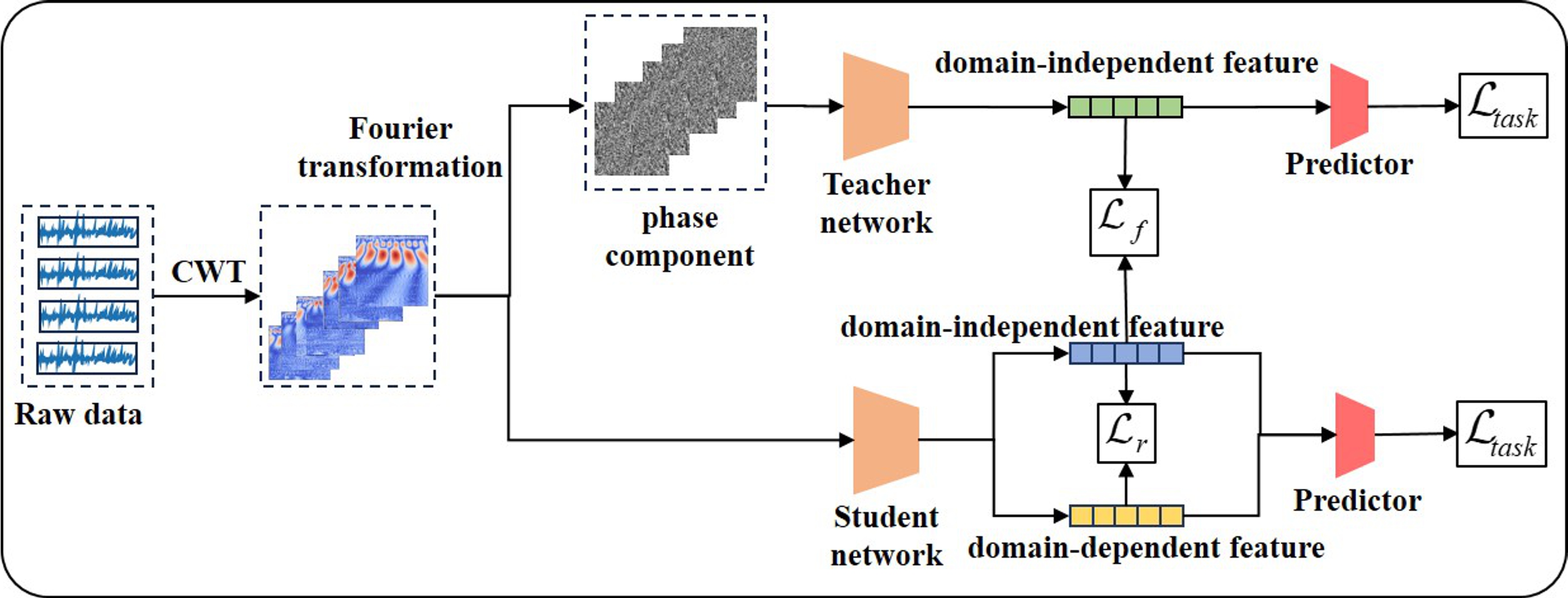
Schematic diagram of our method
- [1] B. Zhang, N. Li, J. Huang, T. Arakawa, K. Ishii, and R. Yashima, “Remaining useful life prediction for tools based on monitoring data and stochastic degradation model,” J. Adv. Comput. Intell. Intell. Inform., Vol.29, No.3, pp. 668-676, 2025. https://doi.org/10.20965/jaciii.2025.p0668
- [2] J. Zhao, D. He, Z. Jin, X. Zhang, and J. Zhou, “A new method for bearing remaining useful life prediction based on dynamic wavelet and physical information constraints,” Expert Systems with Applications, Vol.296, Article No.129023, 2026. https://doi.org/10.1016/j.eswa.2025.129023
- [3] J. Han, Y. Kwon, and H. Yoon, “Mamba-attention: A self-supervised framework for efficient remaining useful life prediction,” Reliability Engineering and System Safety, Vol.265, Article No.111492, 2026. https://doi.org/10.1016/j.ress.2025.111492
- [4] S. O. Khairunnisa, Z. Chen, and M. Komachi, “Improving domain-specific ner in the indonesian language through domain transfer and data augmentation,” J. Adv. Comput. Intell. Intell. Inform., Vol.28, No.6, pp. 1299-1312, 2024. https://doi.org/10.20965/jaciii.2024.p1299
- [5] H. Shao, D. Jing, N. Xia, Z. Tang, and D. Zhong, “Universal domain adaptation in intelligent fault diagnosis via simulating unseen classes,” IEEE Trans. on Automation Science and Engineering, Vol.22, pp. 9178-9189, 2025. https://doi.org/10.1109/tase.2024.3502426
- [6] T. Hu, Z. Mo, and Z. Zhang, “Neural ode powered model for bearing remaining useful life predictions with intra- and inter-domain shifts,” Advanced Engineering Informatics, Vol.64, Article No.103077, 2025. https://doi.org/10.1016/j.aei.2024.103077
- [7] I. Barry and M. Hafsi, “Advanced multi-model prediction of aircraft engine remaining useful life with random sampling-based class balancing and voting-based features selection,” Engineering Applications of Artificial Intelligence, Vol.156, Article No.111201, 2025. https://doi.org/10.1016/j.engappai.2025.111201
- [8] A. R. A. Besari, F. Ardilla, A. A. Saputra, Kurnianingsih, T. Obo, and N. Kubota, “Egocentric behavior analysis based on object relationship extraction with graph transfer learning for cognitive rehabilitation support,” J. Adv. Comput. Intell. Intell. Inform., Vol.29, No.1, pp. 12-22, 2025. https://doi.org/10.20965/jaciii.2025.p0012
- [9] X. Lei, H. Shao, Z. Tang, S. Xu, and D. Zhong, “Cross-domain remaining useful life prediction under unseen condition via mixed data and domain generalization,” Measurement, Vol.244, Article No.116451, 2025. https://doi.org/10.1016/j.measurement.2024.116451
- [10] J. Shang, D. Xu, M. Li, H. Qiu, C. Jiang, and L. Gao, “Remaining useful life prediction of rotating equipment under multiple operating conditions via multi-source adversarial distillation domain adaptation,” Reliability Engineering and System Safety, Vol.256, Article No.110769, 2025. https://doi.org/10.1016/j.ress.2024.110769
- [11] Z. Yang, Y. Wang, Y. Yang, N. Li, and C. Zhang, “Remaining useful life prediction approach for aviation bearings based on multigenerator generative adversarial network and cbam,” IEEE Trans. on Instrumentation and Measurement, Vol.74, pp. 1-9, 2025. https://doi.org/10.1109/tim.2025.3545177
- [12] J. Du, L. Song, X. Gui, J. Zhang, L. Guo, and X. Li, “Remaining useful life prediction under variable operating conditions via multisource adversarial domain adaptation networks,” Applied Soft Computing, Vol.161, Article No.111717, 2024. https://doi.org/10.1016/j.asoc.2024.111717
- [13] T. Pan, J. Chen, and Z. Liu, “A meta-weighted network equipped with uncertainty estimations for remaining useful life prediction of turbopump bearings,” Expert Systems with Applications, Vol.252, Article No.124161, 2024. https://doi.org/10.1016/j.eswa.2024.124161
- [14] Z. Shang, T. Pang, C. Pan, L. Yao, and Z. Wang, “Meta-adversarial transfer learning based on a dual-channel transformer network for aircraft engine remaining useful life prediction,” Engineering Applications of Artificial Intelligence, Vol.160, Article No.111852, 2025. https://doi.org/10.1016/j.engappai.2025.111852
- [15] R. Mo, H. Zhou, H. Yin, and X. Si, “A survey on few-shot learning for remaining useful life prediction,” Reliability Engineering and System Safety, Vol.257, Article No.110850, 2025. https://doi.org/10.1016/j.ress.2025.110850
- [16] J. Yang, D. Sun, L. Wang, W. Zhang, and X. Wang, “DPMA: Self-supervised dual-path meta alignment network for remaining useful life prediction with limited data and unknown working conditions,” IEEE Trans. on Instrumentation and Measurement, Vol.74, pp. 1-11, 2025. https://doi.org/10.1109/tim.2025.3595222
- [17] J. Zhou, J. Yang, S. Xiang, and Y. Qin, “Remaining useful life prediction methodologies with health indicator dependence for rotating machinery: A comprehensive review,” IEEE Trans. on Instrumentation and Measurement, Vol.74, pp. 1-19, 2025. https://doi.org/10.1109/tim.2025.3556919
- [18] Y. Wang, M. Wu, X. Li, L. Xie, and Z. Chen, “A survey on graph neural networks for remaining useful life prediction: Methodologies, evaluation and future trends,” Mechanical Systems and Signal Processing, Vol.229, Article No.112449, 2025. https://doi.org/10.1016/j.ymssp.2025.112449
- [19] D. He, J. Zhao, Z. Jin, C. Huang, C. Yi, and J. Wu, “DCAGGCN: A novel method for remaining useful life prediction of bearings,” Reliability Engineering and System Safety, Vol.260, Article No.110978, 2025. https://doi.org/10.1016/j.ress.2025.110978
- [20] J. Qi, Z. Chen, Y. Kong, W. Qin, and Y. Qin, “Attention-guided graph isomorphism learning: A multi-task framework for fault diagnosis and remaining useful life prediction,” Reliability Engineering and System Safety, Vol.263, Article No.111209, 2025. https://doi.org/10.1016/j.ress.2025.111209
- [21] Z. Zhang, W. Song, Q. Wu, W. Sun, Q. Li, and L. Jia, “A novel local enhanced channel self-attention based on transformer for industrial remaining useful life prediction,” Engineering Applications of Artificial Intelligence, Vol.141, Article No.109815, 2025. https://doi.org/10.1016/j.engappai.2024.109815
- [22] M. Gandhudi and G. R. Gangadharan, “Dynamic quantum annealing optimized quantum neural networks for remaining useful lifetime prediction,” Engineering Applications of Artificial Intelligence, Vol.167, Article No.113856, 2026. https://doi.org/10.1016/j.engappai.2026.113856
- [23] I. Nejjar, F. Geissmann, M. Zhao, C. Taal, and O. Fink, “Domain adaptation via alignment of operation profile for remaining useful lifetime prediction,” Reliability Engineering and System Safety, Vol.242, Article No.109718, 2024. https://doi.org/10.1016/j.ress.2023.109718
- [24] J. Yang and X. Wang, “Meta-learning with deep flow kernel network for few shot cross-domain remaining useful life prediction,” Reliability Engineering and System Safety, Vol.244, Article No.109928, 2024. https://doi.org/10.1016/j.ress.2024.109928
- [25] T. Liu, Y. Li, Z. Hu, C. Fu, and G. Song, “Deep transfer learning based on cross-domain subsequence alignment and feature contribution interpretation for remaining useful life prediction,” Reliability Engineering and System Safety, Vol.273, Article No.112370, 2026. https://doi.org/10.1016/j.ress.2026.112370
- [26] H. Tian, J. Mi, S. Tong, and Y.-F. Li, “Uncertainty-weighted with gradient-based to re-weight domain generalization for remaining useful life prediction of rotating machinery under unseen conditions,” Reliability Engineering and System Safety, Vol.267, Article No.111810, 2026. https://doi.org/10.1016/j.ress.2025.111810
- [27] X. Zhang, Z. Li, and J. Wang, “Joint domain-adaptive transformer model for bearing remaining useful life prediction across different domains,” Engineering Applications of Artificial Intelligence, Vol.159, Article No.111615, 2025. https://doi.org/10.1016/j.engappai.2025.111615
- [28] Y. Li, Z. Zhou, C. Sun, J. Peng, X. Liu, and R. Yan, “Domain invariant and consistent ordinal representation learning for remaining useful life prediction of bearings,” IEEE Trans. on Industrial Informatics, Vol.20, No.12, pp. 14489-14498, 2024. https://doi.org/10.1109/tii.2024.3454772
- [29] W. Lu, J. Wang, H. Li, Y. Chen, and X. Xie, “Domain-invariant feature exploration for domain generalization,” Trans. Mach. Learn. Res., Vol.2022, pp. 1-20, 2022.
- [30] Q. Xu, R. Zhang, Y. Zhang, Y. Wang, and Q. Tian, “A fourier-based framework for domain generalization,” 2021 IEEE/CVF Conf. on Computer Vision and Pattern Recognition (CVPR), pp. 14378-14387, 2021. https://doi.org/10.1109/cvpr46437.2021.01415
- [31] H. Shao, D. Zhong, and X. Du, “Deep distillation hashing for unconstrained palmprint recognition,” IEEE Trans. on Instrumentation and Measurement, Vol.70, pp. 1-13, 2021. https://doi.org/10.1109/tim.2021.3053991
- [32] H. He, Z. Zhu, Z. Li, and Y. Dan, “Deep convolutional neural networks based on knowledge distillation for offline handwritten chinese character recognition,” J. Adv. Comput. Intell. Intell. Inform., Vol.28, No.2, pp. 231-238, 2024. https://doi.org/10.20965/jaciii.2024.p0231
- [33] M. Yan, Y. Xiong, and J. She, “Gcn-transformer autoencoder with knowledge distillation for unsupervised video anomaly detection,” J. Adv. Comput. Intell. Intell. Inform., Vol.29, No.3, pp. 659-667, 2025. https://doi.org/10.20965/jaciii.2025.p0659
- [34] P. Nectoux, R. Gouriveau, K. Medjaher, E. Ramasso, and C. Varnier, “Pronostia: An experimental platform for bearings accelerated degradation tests,” IEEE Int. Conf. on Prognostics and Health Management, pp. 1-8, 2012.
- [35] B. Wang, Y. Lei, N. Li, and N. Li, “A hybrid prognostics approach for estimating remaining useful life of rolling element bearings,” IEEE Trans. on Reliability, Vol.69, No.1, pp. 401-412, 2020. https://doi.org/10.1109/tr.2018.2882682
- [36] L. Martiri, G. Meli, L. Pasquarelli, D. Azzalini, L. Cristaldi, and F. Amigoni, “Domain adversarial neural networks for remaining useful life estimation of lithium-ion batteries,” 2024 IEEE Int. Conf. on Metrology for eXtended Reality, Artificial Intelligence and Neural Engineering (MetroXRAINE), pp. 640-645, 2024. https://doi.org/10.1109/metroxraine62247.2024.10795952
- [37] M. Xu, J. Zhang, B. Ni, T. Li, C. Wang, Q. Tian, and W. Zhang, “Adversarial domain adaptation with domain mixup,” Proc. of the 34th AAAI Conf. on Artificial Intelligence (AAAI 2020), pp. 6502-6509, 2020. https://doi.org/10.1609/aaai.v34i04.6123
- [38] T. Hu, Z. Mo, and Z. Zhang, “Multitask pointwise mutual information learning for bearing remaining useful life cross-domain imbalanced regression,” IEEE Internet of Things J., Vol.12, No.15, pp. 30415-30425, 2025. https://doi.org/10.1109/jiot.2025.3569977
- [39] S. Tong, Y. Han, X. Zhang, H. Tian, X. Li, and Q. Huang, “Uncertainty-weighted domain generalization for remaining useful life prediction of rolling bearings under unseen conditions,” IEEE Sensors J., Vol.24, No.7, pp. 10933-10943, 2024. https://doi.org/10.1109/jsen.2024.3366689
- [40] X. Liu, Y. Lei, N. Li, B. Yang, K. Feng, and Y. Shu, “Domain weighted distribution adaptation network: A novel remaining useful life prediction framework for machinery targeting time-varying operation conditions,” Advanced Engineering Informatics, Vol.68, Article No.103794, 2025. https://doi.org/10.1016/j.aei.2025.103794
- [41] Y. Zhang, X. Liu, and J. Ma, “Health assessment and rul prediction of aeroengine under multiple working conditions,” Lecture Notes in Electrical Engineering, pp. 2951-2963, 2023. https://doi.org/10.1007/978-981-19-6613-2_286
- [42] S. Sagawa, P. W. Koh, T. B. Hashimoto, and P. Liang, “Distributionally robust neural networks,” 8th Int. Conf. on Learning Representations ICLR, pp. 1-19, 2020.
- [43] Z. Huang, H. Wang, E. P. Xing, and D. Huang, “Self-challenging improves cross-domain generalization,” A. Vedaldi, H. Bischof, T. Brox, and J. Frahm (Eds.), “Lecture Notes in Computer Science,” pp. 124-140, Springer, 2020. https://doi.org/10.1007/978-3-030-58536-5_8
This article is published under a Creative Commons Attribution-NoDerivatives 4.0 Internationa License.