
Research Paper:
Evaluating the Circular Economy Performance of Construction and Demolition Waste Management in Taiwan: A DEA and Malmquist Index Approach
Yu-Wei Lee†
 and Yuh-Ming Lee
Institute of Natural Resource Management, National Taipei University
No.151 University Road, Sanxia District, New Taipei City 237303, Taiwan
†Corresponding author

Construction and demolition waste (CDW) is a major industrial waste stream in Taiwan. Conventional indicators such as recycling rates and treated volumes describe throughput, without directly measuring how efficiently regional systems transform resource inputs into reusable products while limiting residual waste. This study evaluates regional CDW circular-economy performance using an input-oriented data envelopment analysis (DEA) framework and the Malmquist productivity index. The original database covered 19 geographic units for 2023–2025; excluding observations with all-zero outputs, the static DEA dataset contained 53 county-year observations for 18 counties and cities. A common pooled frontier was estimated using three inputs (CDW received, licensed treatment/reuse capacity, and estimated treatment cost) and three outputs (treated/reused CDW, recycled product output, and a reciprocal transformation of residual waste). For 2023–2025, the mean Charnes-Cooper-Rhodes (CCR) efficiencies were 0.509, 0.455, and 0.461 and mean Banker-Charnes-Cooper (BCC) efficiencies 0.639, 0.598, and 0.573, respectively. Input correlations were moderate (r≤0.578). Slack analysis identified frequent treated-/reused-output shortfalls and input excesses. While the Malmquist results reveal heterogeneous regional pathways, four zero or non-finite transitions, for Kaohsiung City and Taitung County, were treated as non-interpretable numerical cases rather than as substantive productivity declines. Because the processing and output statistics include non-CDW materials and carryover inventories, scores are interpreted as relative system-level operational benchmarks. These findings support scale matching, stronger waste-to-product conversion, and region-specific management interventions. Recycled product quantity is interpreted as an operational valorization indicator rather than as a complete measure of circularity, because product quality, substitution potential, and market acceptance remain important.
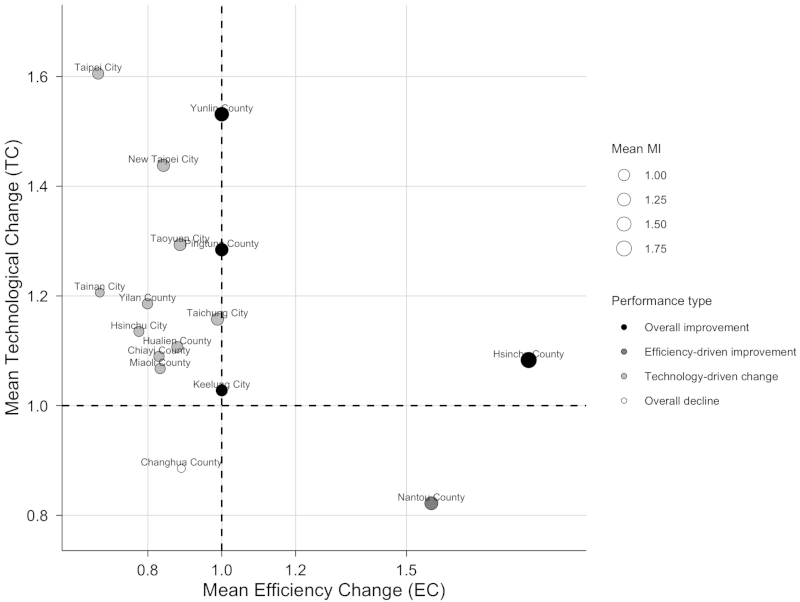
Regional circular economy performance
- [1] N. Elshaboury, A. Al-Sakkaf, E. M. Abdelkader, and G. Alfalah, “Construction and demolition waste management research: A science mapping analysis,” Int. J. Environ. Res. Public Health, Vol.19, No.8, Article No.4496, 2022. https://doi.org/10.3390/ijerph19084496
- [2] European Commission, Directorate-General for Internal Market, Industry, Entrepreneurship and SMEs, A. Oberender et al., “EU construction & demolition waste management protocol including guidelines for pre-demolition and pre-renovation audits of construction works—Updated edition 2024,” Publications Office of the European Union, 2024. https://doi.org/10.2873/77980
- [3] I. Papamichael, I. Voukkali, P. Loizia, and A. A. Zorpas, “Construction and demolition waste framework of circular economy: A mini review,” Waste Manag. Res., Vol.41, No.12, pp. 1728-1740, 2023. https://doi.org/10.1177/0734242X231190804
- [4] C. K. Purchase et al., “Circular economy of construction and demolition waste: A literature review on lessons, challenges, and benefits,” Materials, Vol.15, No.1, Article No.76, 2022. https://doi.org/10.3390/ma15010076
- [5] L. A. López Ruiz, X. Roca Ramón, and S. Gassó Domingo, “The circular economy in the construction and demolition waste sector – A review and an integrative model approach,” J. Clean. Prod., Vol.248, Article No.119238, 2020. https://doi.org/10.1016/j.jclepro.2019.119238
- [6] E. Iacovidou, J. N. Hahladakis, and P. Purnell, “A systems thinking approach to understanding the challenges of achieving the circular economy,” Environ. Sci. Pollut. Res., Vol.28, No.19, pp. 24785-24806, 2021. https://doi.org/10.1007/s11356-020-11725-9
- [7] A. Charnes, W. W. Cooper, and E. Rhodes, “Measuring the efficiency of decision making units,” Eur. J. Oper. Res., Vol.2, No.6, pp. 429-444, 1978. https://doi.org/10.1016/0377-2217(78)90138-8
- [8] R. D. Banker, A. Charnes, and W. W. Cooper, “Some models for estimating technical and scale inefficiencies in data envelopment analysis,” Manag. Sci., Vol.30, No.9, pp. 1078-1092, 1984. https://doi.org/10.1287/mnsc.30.9.1078
- [9] I. Marjanović, J. J. Stanković, J. Östh, M. Marković, and M. Stanojević, “Insight into territorial efficiency of circular economy through data envelopment analysis,” Front. Environ. Sci., Vol.13, Article No.1494184, 2025. https://doi.org/10.3389/fenvs.2025.1494184
- [10] N. Rogge and S. De Jaeger, “Measuring and explaining the cost efficiency of municipal solid waste collection and processing services,” Omega, Vol.41, No.4, pp. 653-664, 2013. https://doi.org/10.1016/j.omega.2012.09.006
- [11] P. Llanquileo-Melgarejo and M. Molinos-Senante, “Evaluation of economies of scale in eco-efficiency of municipal waste management: An empirical approach for Chile,” Environ. Sci. Pollut. Res., Vol.28, No.22, pp. 28337-28348, 2021. https://doi.org/10.1007/s11356-021-12529-1
- [12] G. Halkos and K. N. Petrou, “Assessing 28 EU member states’ environmental efficiency in national waste generation with DEA,” J. Clean. Prod., Vol.208, pp. 509-521, 2019. https://doi.org/10.1016/j.jclepro.2018.10.145
- [13] C.-W. Huang, Y.-H. Chiu, W.-T. Fang, and N. Shen, “Assessing the performance of Taiwan’s environmental protection system with a non-radial network DEA approach,” Energy Policy, Vol.74, pp. 547-556, 2014. https://doi.org/10.1016/j.enpol.2014.06.023
- [14] R. Färe, S. Grosskopf, M. Norris, and Z. Zhang, “Productivity growth, technical progress, and efficiency change in industrialized countries,” Am. Econ. Rev., Vol.84, No.1, pp. 66-83, 1994.
- [15] R. G. Dyson et al., “Pitfalls and protocols in DEA,” Eur. J. Oper. Res., Vol.132, No.2, pp. 245-259, 2001. https://doi.org/10.1016/S0377-2217(00)00149-1
- [16] P. Llanquileo-Melgarejo and M. Molinos-Senante, “The impact of recycling on the productivity of Municipal Solid Waste: A comparison of the Malmquist and Malmquist-Luenberger Productivity Indexes,” Int. J. Sustain. Eng., Vol.16, No.1, pp. 236-247, 2023. https://doi.org/10.1080/19397038.2023.2256382
- [17] G. E. Halkos and P.-S. C. Aslanidis, “Monitoring sustainable waste management in OECD countries: A Malmquist productivity approach,” Waste Manag., Vol.190, pp. 623-631, 2024. https://doi.org/10.1016/j.wasman.2024.10.035
- [18] W. W. Cooper, L. M. Seiford, and K. Tone, “Data Envelopment Analysis: A Comprehensive Text with Models, Applications, References and DEA-Solver Software,” 2nd edition, Springer, 2007. https://doi.org/10.1007/978-0-387-45283-8
- [19] Ministry of Environment, Taiwan, “Industrial waste report and management information system—Annual statistics,” 2026. https://waste.moenv.gov.tw/RWD/Statistics/?page=Year1 [Accessed April 21, 2026]
- [20] L. Simar and P. W. Wilson, “Estimation and inference in two-stage, semi-parametric models of production processes,” J. Econom., Vol.136, No.1, pp. 31-64, 2007. https://doi.org/10.1016/j.jeconom.2005.07.009
- [21] L. Simar and P. W. Wilson, “Two-stage DEA: Caveat emptor,” J. Prod. Anal., Vol.36, No.2, pp. 205-218, 2011. https://doi.org/10.1007/s11123-011-0230-6
- [22] R. D. Banker and R. Natarajan, “Evaluating contextual variables affecting productivity using data envelopment analysis,” Oper. Res., Vol.56, No.1, pp. 48-58, 2008. https://doi.org/10.1287/opre.1070.0460
This article is published under a Creative Commons Attribution-NoDerivatives 4.0 Internationa License.