
Research Paper:
Gated Hybrid Network Using CRNN and RNN Models for Time-Series Forecasting and Case Studies
Takayuki Kataoka*1,†
 , Tomonari Yomono*2, Sho Yamamoto*3
, and Takashi Nishi*4
*1Kindai University
1 Takaya Umenobe, Higashihiroshima, Hiroshima 739-2116, Japan
†Corresponding author
*2Dai Nippon Printing Co., Ltd.
Tokyo, Japan
*3Kindai University
Higashiosaka, Japan
*4Mazda Motor Corporation
Fuchu-cho, Japan

Time-series forecasting is a critical challenge in industrial applications such as inventory management and energy planning. This paper proposes a gated hybrid network for time-series forecasting that combines feature vectors obtained from convolutional recurrent neural network (CRNN) and recurrent neural network (RNN) branches. Unlike conventional CRNN models, the proposed model feeds the original time-series sequence in parallel to both CRNN and independent RNN branches, enabling each branch to extract complementary temporal features. A squeeze-and-excitation-inspired gating mechanism then adaptively weights and integrates the two feature vectors. Experiments were conducted using six real-world datasets, including automotive sales, electricity consumption, and solar energy data. The proposed model achieved lower mean relative squared error and relative absolute error values averaged across four forecasting periods than autoregressive (AR), autoregressive integrated moving average (ARIMA), Holt–Winters, gated recurrent unit (GRU), and long short-term memory (LSTM) baseline models on most of the datasets, while also demonstrating superior prediction stability. These results suggest that the proposed architecture is suitable for practical industrial forecasting tasks.
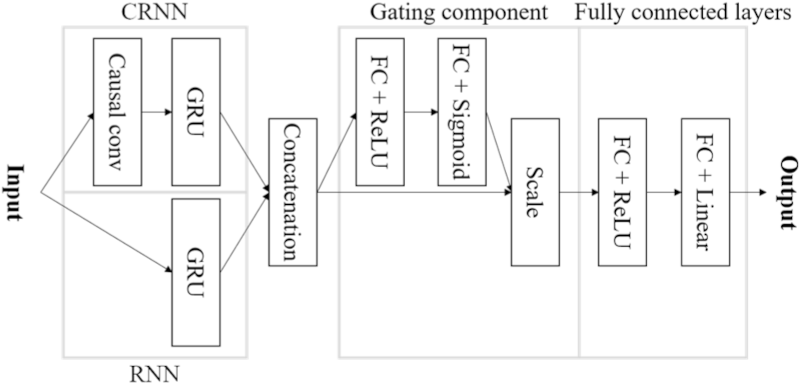
Schematic of the proposed model
- [1] G. E. Box and D. A. Pierce, “Distribution of residual autocorrelations in autoregressive-integrated moving average time series models,” J. Am. Stat. Assoc., Vol.65, No.332, pp. 1509-1526, 1970. https://doi.org/10.1080/01621459.1970.10481180
- [2] G. Zhang, B. E. Patuwo, and M. Y. Hu, “Forecasting with artificial neural networks: The state of the art,” Int. J. Forecast., Vol.14, No.1, pp. 35-62, 1998. https://doi.org/10.1016/S0169-2070(97)00044-7
- [3] S. Hochreiter and J. Schmidhuber, “Long short-term memory,” Neural Comput., Vol.9, No.8, pp. 1735-1780, 1997. https://doi.org/10.1162/neco.1997.9.8.1735
- [4] K. Cho, B. van Merriënboer, D. Bahdanau, and Y. Bengio, “On the properties of neural machine translation: Encoder-decoder approaches,” arXiv:1409.1259, 2014. https://doi.org/10.48550/arXiv.1409.1259
- [5] Y. Wu et al., “Google’s neural machine translation system: Bridging the gap between human and machine translation,” arXiv:1609.08144, 2016. https://doi.org/10.48550/arXiv.1609.08144
- [6] W. Xiong et al., “The Microsoft 2017 conversational speech recognition system,” IEEE Int. Conf. Acoust. Speech Signal Process. (ICASSP), pp. 5934-5938, 2018. https://doi.org/10.1109/ICASSP.2018.8461870
- [7] A. Abdallah, M. Kasem, M. A. Hamada, and S. Sdeek, “Automated question-answer medical model based on deep learning technology,” Proc. 6th Int. Conf. Eng. MIS, Article No.13, 2020. https://doi.org/10.1145/3410352.3410744
- [8] T. Y. Kim and S. B. Cho, “Predicting residential energy consumption using CNN-LSTM neural networks,” Energy, Vol.182, pp. 72-81, 2019. https://doi.org/10.1016/j.energy.2019.05.230
- [9] J. Dong and S. Liang, “Hybrid CNN-LSTM-GNN neural network for A-share stock prediction,” Entropy, Vol.27, No.8, Article No.881, 2025. https://doi.org/10.3390/e27080881
- [10] A. van den Oord et al., “WaveNet: A generative model for raw audio,” Proc. 9th ISCA Workshop Speech Synth. (SSW 9), p. 125, 2016.
- [11] Z. Zhang and Y. Dong, “Temperature forecasting via convolutional recurrent neural networks based on time-series data,” Complexity, Vol.2020, Article No.3536572, 2020. https://doi.org/10.1155/2020/3536572
- [12] M. Alhussein, K. Aurangzeb, and S. I. Haider, “Hybrid CNN-LSTM model for short-term individual household load forecasting,” IEEE Access, Vol.8, pp. 180544-180557, 2020. https://doi.org/10.1109/ACCESS.2020.3028281
- [13] A. Agga, A. Abbou, Y. El Houm, and M. Labbadi, “Short-term load forecasting based on CNN and LSTM deep neural networks,” IFAC-PapersOnLine, Vol.55, No.12, pp. 777-781, 2022. https://doi.org/10.1016/j.ifacol.2022.07.407
- [14] I. E. Livieris, E. Pintelas, and P. Pintelas, “A CNN–LSTM model for gold price time-series forecasting,” Neural Comput. Appl., Vol.32, pp. 17351-17360, 2020. https://doi.org/10.1007/s00521-020-04867-x
- [15] A. Lazcano, P. J. Herrera, and M. Monge, “A combined model based on recurrent neural networks and graph convolutional networks for financial time series forecasting,” Mathematics, Vol.11, No.1, Article No.224, 2023. https://doi.org/10.3390/math11010224
- [16] E. Çakır, G. Parascandolo, T. Heittola, H. Huttunen, and T. Virtanen, “Convolutional recurrent neural networks for polyphonic sound event detection,” IEEE/ACM Trans. Audio Speech Lang. Process., Vol.25, No.6, pp. 1291-1303, 2017. https://doi.org/10.1109/TASLP.2017.2690575
- [17] Y. Li, R. Yu, C. Shahabi, and Y. Liu, “Diffusion convolutional recurrent neural network: data-driven traffic forecasting,” Proc. Int. Conf. Learn. Represent. (ICLR), 2018.
- [18] R. K. Srivastava, K. Greff, and J. Schmidhuber, “Training very deep networks,” Adv. Neural Inf. Process. Syst. 28, 2015.
- [19] J. Hu, L. Shen, and G. Sun, “Squeeze-and-excitation networks,” Proc. IEEE Conf. Comput. Vis. Pattern Recognit. (CVPR), pp. 7132-7141, 2018. https://doi.org/10.1109/CVPR.2018.00745
- [20] N. Sugimura, N. Q. Thinh, S. Kohama, Y. Fukui, and K. Iwamura, “A study on demand forecasting of wholesale markets of lettuces for production planning in plant factories,” Int. J. Automation Technol., Vol.16, No.2, pp. 218-229, 2022. https://doi.org/10.20965/ijat.2022.p0218
- [21] R. Yonemoto and H. Suwa, “Task scheduling of material-handling manipulator for enhancing energy efficiency in flow-type FMS,” Int. J. Automation Technol., Vol.14, No.6, pp. 943-950, 2020. https://doi.org/10.20965/ijat.2020.p0943
- [22] K. Shimomoto, M. Nakamura, and T. Samukawa, “Energy consumption-oriented process design based on specific energy-consumption model,” Int. J. Automation Technol., Vol.20, No.1, pp. 24-37, 2026. https://doi.org/10.20965/ijat.2026.p0024
- [23] V. Nair and G. E. Hinton, “Rectified linear units improve restricted Boltzmann machines,” Proc. 27th Int. Conf. Mach. Learn. (ICML), 2010.
- [24] J. Chung, C. Gulcehre, K. Cho, and Y. Bengio, “Empirical evaluation of gated recurrent neural networks on sequence modeling,” arXiv:1412.3555, 2014. https://doi.org/10.48550/arXiv.1412.3555
- [25] O. Russakovsky et al., “ImageNet large-scale visual recognition challenge,” Int. J. Comput. Vis., Vol.115, pp. 211-252, 2015. https://doi.org/10.1007/s11263-015-0816-y
- [26] K. Simonyan and A. Zisserman, “Very deep convolutional networks for large-scale image recognition,” arXiv:1409.1556, 2014. https://doi.org/10.48550/arXiv.1409.1556
- [27] C. Szegedy et al., “Going deeper with convolutions,” Proc. IEEE Conf. Comput. Vis. Pattern Recognit. (CVPR), 2015. https://doi.org/10.1109/CVPR.2015.7298594
- [28] K. He, X. Zhang, S. Ren, and J. Sun, “Deep residual learning for image recognition,” Proc. IEEE Conf. Comput. Vis. Pattern Recognit. (CVPR), pp. 770-778, 2016. https://doi.org/10.1109/CVPR.2016.90
- [29] D. Dua and C. Graff, UCI Machine Learning Repository. http://archive.ics.uci.edu/ml [Accessed March 24, 2026]
- [30] Y. Zhang, “Solar power data for integration studies,” National Renewable Energy Laboratory. https://www.nrel.gov/grid/solar-power-data.html [Accessed March 24, 2026].
- [31] D. P. Kingma and J. Ba, “Adam: A method for stochastic optimization,” arXiv:1412.6980, 2014. https://doi.org/10.48550/arXiv.1412.6980
This article is published under a Creative Commons Attribution-NoDerivatives 4.0 Internationa License.