
Research Paper:
Reused over Refurbished: Exploring Smartphone Life Extension in Thailand’s Informal Market
Kwanmanas Meethavorn*
 , Chanathip Pharino**
, and Aksornchan Chaianong***,†
*Department of Environmental Science, Chulalongkorn University
254 Phaya Thai Road, Wang Mai Subdistrict, Pathum Wan District, Bangkok 10330, Thailand
**Department of Environmental Engineering, Chulalongkorn University
Bangkok, Thailand
***Sustainability Transition Policy Group, Friedrich-Alexander-Universität Erlangen-Nürnberg
Nürnberg, Germany
†Corresponding author

The rapid turnover of smartphones has created a growing electric waste challenge globally, particularly in emerging economies where formal recycling infrastructure remains limited. Circular economy strategies, such as reuse and refurbishment, offer potential pathways to extend smartphone lifespans, yet consumer preferences and market structures strongly shape their adoption. This study explores the dynamics of smartphone life extension in Thailand’s informal economy, focusing on Bangkok’s second-hand smartphone market. Data were collected through structured interviews with 110 kiosk operators in Bangkok, complemented by stakeholder insights from recyclers and used-phone providers. Descriptive and inferential statistical analyses were conducted to examine business pathways, purchasing behavior, and factors influencing smartphone life extension. The findings demonstrated that reuse, rather than refurbishment, constitutes the dominant life-extension pathway. Most kiosks preferred smartphones that could be resold with minimal repair, while warranty provision emerged as the strongest enabling factor supporting consumer trust. Inferential analyses showed that prolonged smartphone circulation was significantly associated with product value, reflected in brand and price, whereas external condition and technical functionality were not significantly associated with smartphone age. Government support was perceived as limited, indicating that the market currently operates largely through decentralized commercial relationships rather than formal policy intervention. Thus, the study demonstrates that informal markets can serve as effective mechanisms for extending product lifespans and suggests that circular economy transitions in middle-income economies depend not only on refurbishment infrastructure but also on market organization, consumer trust, and product value.
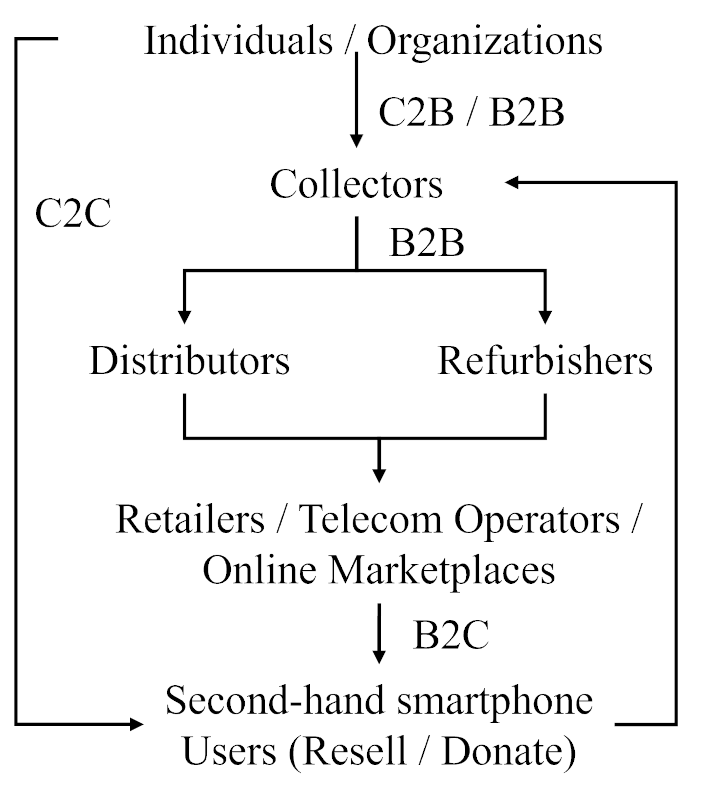
Second-hand smartphone market pathways
- [1] C. P. Baldé, E. D’Angelo, V. Luda, O. Deubzer, and R. Kuehr, “Global transboundary e-waste flows monitor 2022,” United Nations Institute for Training and Research, 2022.
- [2] S. Çetin and J. Kirchherr, “The build back circular framework: Circular economy strategies for post-disaster reconstruction and recovery,” Circ. Econ. Sustain., Vol.5, No.3, pp. 1689-1726, 2025. https://doi.org/10.1007/s43615-024-00495-y
- [3] M. Geissdoerfer, P. Savaget, N. M. P. Bocken, and E. J. Hultink, “The circular economy – A new sustainability paradigm?,” J. Clean. Prod., Vol.143, pp. 757-768, 2017. https://doi.org/10.1016/j.jclepro.2016.12.048
- [4] J. C. T. Bieser et al., “Consumer-oriented interventions to extend smartphones’ service lifetime,” Clean. Responsible Consum., Vol.7, Article No.100074, 2022. https://doi.org/10.1016/j.clrc.2022.100074
- [5] D. A. Hazelwood and M. G. Pecht, “Life extension of electronic products: A case study of smartphones,” IEEE Access, Vol.9, pp. 144726-144739, 2021. https://doi.org/10.1109/access.2021.3121733
- [6] R. Pamminger, S. Glaser, and W. Wimmer, “Modelling of different circular end-of-use scenarios for smartphones,” Int. J. Life Cycle Assess., Vol.26, No.3, pp. 470-482, 2021. https://doi.org/10.1007/s11367-021-01869-2
- [7] W. M. H. P. Bandara and P. R. C. N. Ariyarathne, “Exploring consumer acceptance of refurbished smart phones in Sri Lankan market: Circular economy adoption,” J. Bus. Stud., Vol.11, No.2, pp. 73-89, 2024. https://doi.org/10.4038/jbs.v11i2.109
- [8] S. Holmström and H. Böhlin, “Towards a circular economy: A qualitative study on how to communicate refurbished smartphones in the Swedish market,” Umeå University, 2017.
- [9] T. Makov and D. Font Vivanco, “Does the circular economy grow the pie? The case of rebound effects from smartphone reuse,” Front. Energy Res., Vol.6, Article No.39, 2018. https://doi.org/10.3389/fenrg.2018.00039
- [10] Y.-Y. Chun et al., “What will lead Asian consumers into circular consumption? An empirical study of purchasing refurbished smartphones in Japan and Indonesia,” Sustain. Prod. Consum., Vol.33, pp. 158-167, 2022. https://doi.org/10.1016/j.spc.2022.06.015
- [11] J. C. Kerber, D. C. Fettermann, and M. Bouzon, “Effects of green and circular products’ features on consumers’ choice of remanufactured smartphones,” Bus. Strategy Environ., Vol.33, No.3, pp. 2331-2344, 2024. https://doi.org/10.1002/bse.3597
- [12] A. Klompstra, “The influence of eWOM on purchase intention for refurbished smartphones, mediated by trust and moderated by sentiment,” Master’s thesis, Radboud University, 2024.
- [13] B. S. Nzeyimana and S. M. Mariaselvam, “Behavioral drivers and e-waste valorization opportunities in HEIs: A dual-method study,” Circ. Econ. Sustain., Vol.5, No.6, pp. 5221-5246, 2025. https://doi.org/10.1007/s43615-025-00664-7
- [14] A. Singh, A. Yadav, T. T. Le, and S. Singh, “Recycling of electronic waste for circular economy goals: Systematic literature review,” Int. J. Glob. Bus. Compet., Vol.18, No.2, pp. 145-161, 2023. https://doi.org/10.1007/s42943-023-00081-3
- [15] A. K. Hagaman and A. Wutich, “How many interviews are enough to identify metathemes in multisited and cross-cultural research? Another perspective on Guest, Bunce, and Johnson’s (2006) landmark study,” Field Methods, Vol.29, No.1, pp. 23-41, 2017. https://doi.org/10.1177/1525822X16640447
- [16] L. Agostini, B. Bigliardi, S. Filippelli, and F. Galati, “Seller reputation, distribution and intention to purchase refurbished products,” J. Clean. Prod., Vol.316, Article No.128296, 2021. https://doi.org/10.1016/j.jclepro.2021.128296
- [17] D. Watson et al., “Circular business models in the mobile phone industry,” The Nordic Council of Ministers, 2017. https://doi.org/10.6027/TN2017-560
- [18] X. Chi, M. Streicher-Porte, M. Y. L. Wang, and M. A. Reuter, “Informal electronic waste recycling: A sector review with special focus on China,” Waste Manag., Vol.31, No.4, pp. 731-742, 2011. https://doi.org/10.1016/j.wasman.2010.11.006
- [19] J. Hapuli and A. Kumpulainen, “Circular economy of refurbished smartphones in the European Union: Research on drivers and barriers,” Karelia University of Applied Sciences, 2023.
- [20] H. Wieser and N. Tröger, “Exploring the inner loops of the circular economy: Replacement, repair, and reuse of mobile phones in Austria,” J. Clean. Prod., Vol.172, pp. 3042-3055, 2018. https://doi.org/10.1016/j.jclepro.2017.11.106
- [21] I. Gåvertsson, L. Milios, and C. Dalhammar, “Quality labelling for re-used ICT equipment to support consumer choice in the circular economy,” J. Consum. Policy, Vol.43, No.2, pp. 353-377, 2020. https://doi.org/10.1007/s10603-018-9397-9
- [22] A. Raihanian Mashhadi, A. Vedantam, and S. Behdad, “Investigation of consumer’s acceptance of product-service-systems: A case study of cell phone leasing,” Resour. Conserv. Recycl., Vol.143, pp. 36-44, 2019. https://doi.org/10.1016/j.resconrec.2018.12.006
This article is published under a Creative Commons Attribution-NoDerivatives 4.0 Internationa License.