
Research Paper:
Simulating Feedback System for Calibrating Parameters of Circular Consumer Incentive Models
Raul Carlsson*,†
 and Tatiana Nevzorova**
*Carlson’s FactSky
Ansgariigatan 17, , Sweden
†Corresponding author
**Business design, RISE Research Institutes of Sweden
Stockholm, Sweden

The main methodological contribution is treating consumer behaviour as an endogenous, probabilistic system component whose response to information and incentives can be parameterised and tested rather than assumed as fixed. Behavioural responses are modelled as functions of incentive type, communication frequency, timing, and decay over time. This enables systematic testing of strategies such as point-of-sale information, brand communication, recurring engagement (e.g., recurring customer reminders), second-hand market promotion, and varying levels of monetary incentives. These behavioural parameters are linked to material flows within a modular circular value chain, allowing analysis of how individual decisions scale to system-level environmental and economic outcomes. Applied to a denim case study, the model shows how changes in consumer response probabilities alter the distribution between virgin production, reuse, repair, remanufacturing, and recycling. In the illustrative denim experiment, progressively stronger intervention conditions reduce modelled virgin-material demand, 100-year global warming potential (GWP100) and cost. Overall, the findings show that circular business model performance can be sensitive to consumer participation, while the magnitude of the effect remains conditional on the behavioural and technical assumptions. The tool enables pre-implementation testing of incentive strategies, offering a novel decision-support approach for companies and policymakers seeking to align consumer behaviour with circular economy innovations. The same structure identifies which consumer-response and decay parameters require empirical calibration.
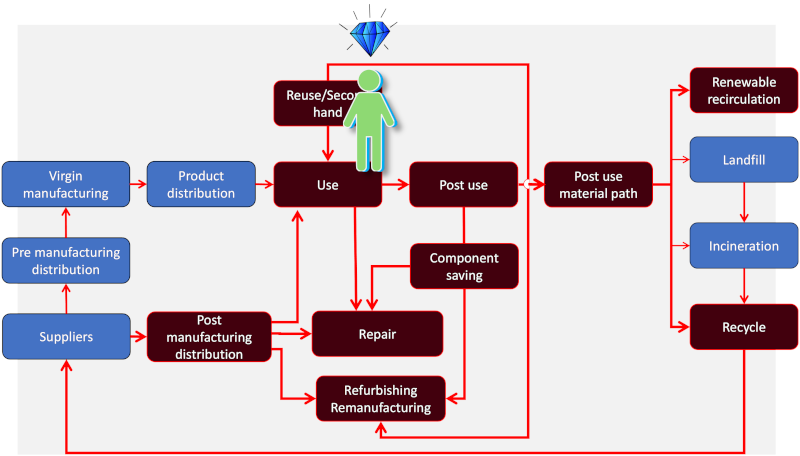
Incentivizes agents to act circular
- [1] S. Lang, G. Minnucci, M. Mueller, and M. P. Schlaile, “The role of consumers in business model innovations for a sustainable circular bioeconomy,” Sustainability, Vol.15, No.12, Article No.9573, 2023. https://doi.org/10.3390/su15129573
- [2] R. van den Berge, L. Magnier, and R. Mugge, “Sparking the repair ‘can-do’ attitude: Enhancing users’ willingness to repair through design support in fault diagnostics,” Int. J. Des., Vol.17, No.3, pp. 25-39, 2023. https://doi.org/10.57698/v17i3.02
- [3] L. Torca-Adell, P. Juan, and M. D. Bovea, “Exploring the acquisition, usage, repair, and end-of-life management practices of electrical self-care appliances: Insights from domestic and professional users,” Clean. Responsible Consum., Vol.16, Article No.100236, 2025. https://doi.org/10.1016/j.clrc.2024.100236
- [4] J. Camacho-Otero, C. Boks, and I. N. Pettersen, “Consumption in the circular economy: A literature review,” Sustainability, Vol.10, No.8, Article No.2758, 2018. https://doi.org/10.3390/su10082758
- [5] J. Kirchherr et al., “Barriers to the circular economy: Evidence from the European Union (EU),” Ecol. Econ., Vol.150, pp. 264-272, 2018. https://doi.org/10.1016/j.ecolecon.2018.04.028
- [6] R. Elzinga, D. Reike, S. O. Negro, and W. P. C. Boon, “Consumer acceptance of circular business models,” J. Clean. Prod., Vol.254, Article No.119988, 2020. https://doi.org/10.1016/j.jclepro.2020.119988
- [7] B. Corona, V. S. C. Tunn, and K. L. van den Broek, “Integrating consumer behaviour into the environmental assessment of circular packaging: A scoping review,” Int. J. Life Cycle Assess., Vol.29, No.1, pp. 430-447, 2024. https://doi.org/10.1007/s11367-023-02218-1
- [8] M. Lieder, F. M. A. Asif, and A. Rashid, “Towards circular economy implementation: An agent-based simulation approach for business model changes,” Auton. Agents Multi-Agent Syst., Vol.31, No.6, pp. 1377-1402, 2017. https://doi.org/10.1007/s10458-017-9365-9
- [9] M. Rizzati and M. Landoni, “A systematic review of agent-based modelling in the circular economy: Insights towards a general model,” Struct. Change Econ. Dyn., Vol.69, pp. 617-631, 2024. https://doi.org/10.1016/j.strueco.2024.03.013
- [10] R. Koide, H. Yamamoto, K. Nansai, and S. Murakami, “Agent-based model for assessment of multiple circular economy strategies: Quantifying product-service diffusion, circularity, and sustainability,” Resour. Conserv. Recycl., Vol.199, Article No.107216, 2023. https://doi.org/10.1016/j.resconrec.2023.107216
- [11] A. Micolier, P. Loubet, F. Taillandier, and G. Sonnemann, “To what extent can agent-based modelling enhance a life cycle assessment? Answers based on a literature review,” J. Clean. Prod., Vol.239, Article No.118123, 2019. https://doi.org/10.1016/j.jclepro.2019.118123
- [12] C. Davis, I. Nikolić, and G. P. J. Dijkema, “Integration of life cycle assessment into agent-based modeling: Toward informed decisions on evolving infrastructure systems,” J. Ind. Ecol., Vol.13, No.2, pp. 306-325, 2009. https://doi.org/10.1111/j.1530-9290.2009.00122.x
- [13] International Organization for Standardization (ISO), “Environmental management – Life cycle assessment – Principles and framework,” ISO 14040:2006, 2006. https://www.iso.org/standard/37456.html [Accessed October 20, 2026]
- [14] ISO, “Environmental management – Life cycle assessment – Requirements and guidelines,” ISO 14044:2006, 2006. https://www.iso.org/standard/38498.html [Accessed October 20, 2026]
- [15] ISO, “Circular economy – Measuring and assessing circularity performance,” ISO 59020:2024, 2024. https://www.iso.org/standard/80650.html [Accessed October 20, 2026]
- [16] R. S. Atlason, D. Giacalone, and K. Parajuly, “Product design in the circular economy: Users’ perception of end-of-life scenarios for electrical and electronic appliances,” J. Clean. Prod., Vol.168, pp. 1059-1069, 2017. https://doi.org/10.1016/j.jclepro.2017.09.082
- [17] T. G. B. Teixeira, J. F. de Medeiros, C. Kolling, J. L. D. Ribeiro, and D. Morea, “Redesign in the textile industry: Proposal of a methodology for the insertion of circular thinking in product development processes,” J. Clean. Prod., Vol.397, Article No.136588, 2023. https://doi.org/10.1016/j.jclepro.2023.136588
- [18] B. Pozo Arcos, C. Bakker, and R. Balkenende, “How user manuals support the diagnosis of common faults in household appliances: An analysis of 150 manuals,” Circ. Econ. Sustain., Vol.3, No.1, pp. 535-555, 2023. https://doi.org/10.1007/s43615-022-00195-5
- [19] S. Lawrenz et al., “Implementing the circular economy by tracing the sustainable impact,” Int. J. Environ. Res. Public Health, Vol.18, No.21, Article No.11316, 2021. https://doi.org/10.3390/ijerph182111316
- [20] A. Taron, A. Majumder, S. Bodach, and D. Agbefu, “Public-private partnerships for the circular bio-economy in the Global South: Lessons learned,” Resource Recovery and Reuse Series, No.22, International Water Management Institute, 2023. https://doi.org/10.5337/2023.205
- [21] P. K. Mallick, K. B. Salling, D. C. A. Pigosso, and T. C. McAloone, “Towards a circular economy: Development of a support tool for designing reverse logistics systems,” J. Environ. Manage., Vol.351, Article No.119819, 2023. https://doi.org/10.1016/j.jenvman.2023.119819
- [22] V. Ramani and P. De Giovanni, “Circular economy business strategies and public schemes: A game theory-based survey,” Int. Trans. Oper. Res., Vol.33, No.5, pp. 2827-2869, 2026. https://doi.org/10.1111/itor.70031
- [23] J. Walzberg, J.-M. Frayret, A. L. Eberle, A. Carpenter, and G. Heath, “Agent-based modeling and simulation for the circular economy: Lessons learned and path forward,” J. Ind. Ecol., Vol.27, No.5, pp. 1227-1238, 2023. https://doi.org/10.1111/jiec.13423
- [24] E. G. Gulserliler, J. D. Blackburn, and L. N. Van Wassenhove, “Consumer acceptance of circular business models and potential effects on economic performance: The case of washing machines,” J. Ind. Ecol., Vol.26, No.2, pp. 509-521, 2022. https://doi.org/10.1111/jiec.13202
- [25] European Parliament and Council of the European Union, “Regulation (EU) 2024/1781 establishing a framework for the setting of ecodesign requirements for sustainable products,” 2024. http://data.europa.eu/eli/reg/2024/1781/oj [Accessed October 20, 2026]
- [26] European Committee for Standardization and European Committee for Electrotechnical Standardization (CEN-CENELEC), “CEN/CLC/JTC 24 – Digital product passport – Framework and system.” https://standards.cencenelec.eu/dyn/www/f?p=205:7:0::::FSP_ORG_ID:3342699&cs=1798F43FAA14922B642266F24B912DC61 [Accessed October 20, 2026]
This article is published under a Creative Commons Attribution-NoDerivatives 4.0 Internationa License.