
Technical Paper:
Recycling Medical Intravenous Infusion Bags into Sharps Containers: Process Design and System Implementation
Shu-Mei Chien*,† and Cho-Chun Chou**
*Department of Nuclear Engineering, Pacific Engineers & Constructors, Ltd.
14F, No.333, Section 2, Dunhua South Road, Taipei 106033, Taiwan
†Corresponding author
**Green Hung Enterprise Co., Ltd.
Taichung, Taiwan

In 2024, Taiwan generated approximately 130,000 metric tons (MT) of medical waste, including about 42,000 MT of hazardous waste. Despite the implementation of circular economy initiatives, most of the medical waste is still incinerated and landfilled, thereby increasing the environmental burden through dioxin emissions and secondary pollution. Current recycling practices are aimed at converting medical plastics into secondary products but face logistical and operational challenges. This study developed a circular recycling system for medical intravenous (IV) infusion bags in Taiwan. In collaboration with two medical institutions, used IV bags were collected, sorted, cleaned, and reprocessed into recycled plastic pellets via a patented recycling-and-pelletization process. The pellets were incorporated into sharps containers, which were returned to participating hospitals, thus establishing a circular material pathway within the healthcare sector. The entire process was independently verified for traceability and regulatory compliance. The containers were assessed for recycled content, safety performance, and cradle-to-gate carbon footprint. The containers complied with ISO 14021 and ISO 23907-1 and were adopted by two hospitals in northern Taiwan. The carbon footprint was estimated as 1.852 kg CO2-eq per container, comprising 1.587 kg CO2-eq from raw-material acquisition and 0.265 kg CO2-eq from manufacturing. The economic dimension was discussed qualitatively through major cost components and potential avoided-cost mechanisms. The interpretation was limited by the unavailability of process data, financial and subsidy information, a quantitative base-case model, and a functionally equivalent virgin-plastic benchmark. The findings demonstrate practical implementation and provide a case-specific carbon-footprint baseline without establishing quantified environmental superiority or economic viability.
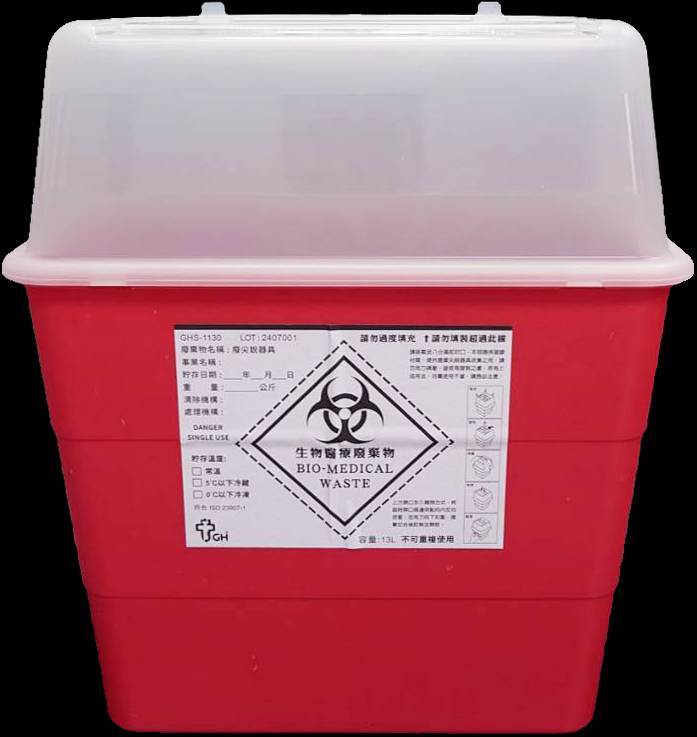
Sharps container from recycled IV bags
- [1] R. Geyer, J. R. Jambeck, and K. L. Law, “Production, use, and fate of all plastics ever made,” Sci. Adv., Vol.3, No.7, Article No.e1700782, 2017. https://doi.org/10.1126/sciadv.1700782
- [2] European Commission, “A European strategy for plastics in a circular economy,” 2018.
- [3] M. Wagner et al., “Microplastics in freshwater ecosystems: What we know and what we need to know,” Environ. Sci. Eur., Vol.26, Article No.12, 2014. https://doi.org/10.1186/s12302-014-0012-7
- [4] D. K. A. Barnes, F. Galgani, R. C. Thompson, and M. Barlaz, “Accumulation and fragmentation of plastic debris in global environments,” Phil. Trans. R. Soc. B, Vol.364, No.1526, pp. 1985-1998, 2009. https://doi.org/10.1098/rstb.2008.0205
- [5] J. C. Prata, A. L. P. Silva, T. R. Walker, A. C. Duarte, and T. Rocha-Santos, “COVID-19 pandemic repercussions on the use and management of plastics,” Environ. Sci. Technol., Vol.54, No.13, pp. 7760-7765, 2020. https://doi.org/10.1021/acs.est.0c02178
- [6] A. L. P. Silva et al., “Rethinking and optimising plastic waste management under COVID-19 pandemic: Policy solutions based on redesign and reduction of single-use plastics and personal protective equipment,” Sci. Total Environ., Vol.742, Article No.140565, 2020. https://doi.org/10.1016/j.scitotenv.2020.140565
- [7] L. Rigamonti et al., “Environmental evaluation of plastic waste management scenarios,” Resour. Conserv. Recycl., Vol.85, pp. 42-53, 2014. https://doi.org/10.1016/j.resconrec.2013.12.012
- [8] S. ElSaid and E.-H. Aghezzaf, “A progress indicator-based assessment guide for integrated municipal solid-waste management systems,” J. Mater. Cycles Waste Manag., Vol.20, No.2, pp. 850-863, 2018. https://doi.org/10.1007/s10163-017-0647-8
- [9] G. Marin, F. Nicolli, and R. Zoboli, “Catching-up in waste management. Evidence from the EU,” J. Environ. Plan. Manag., Vol.61, No.11, pp. 1861-1882, 2018. https://doi.org/10.1080/09640568.2017.1333952
- [10] Department for Environment, Food and Rural Affairs (DEFRA), “Guidance on applying the waste hierarchy,” 2011. https://assets.publishing.service.gov.uk/government/uploads/system/uploads/attachment_data/file/69403/pb13530-waste-hierarchy-guidance.pdf [Accessed March 28, 2026]
- [11] European Parliament, “Closing the loop: New circular economy package,” 2016. https://www.europarl.europa.eu/RegData/etudes/BRIE/2016/573899/EPRS_BRI(2016)573899_EN.pdf [Accessed March 28, 2026]
- [12] J. Schmidt, L. Grau, M. Auer, R. Maletz, and J. Woidasky, “Multilayer packaging in a circular economy,” Polymers, Vol.14, No.9, Article No.1825, 2022. https://doi.org/10.3390/polym14091825
- [13] H. Logan, T. F. Astrup, and A. Damgaard, “Additive inclusion in plastic life cycle assessments part I: Review of mechanical recycling studies,” J. Ind. Ecol., Vol.28, No.6, pp. 1582-1597, 2024. https://doi.org/10.1111/jiec.13542
- [14] J. N. Hahladakis, C. A. Velis, R. Weber, E. Iacovidou, and P. Purnell, “An overview of chemical additives present in plastics: Migration, release, fate and environmental impact during their use, disposal and recycling,” J. Hazard. Mater., Vol.344, pp. 179-199, 2018. https://doi.org/10.1016/j.jhazmat.2017.10.014
- [15] World Health Organization, “Safe management of wastes from health-care activities: A summary,” 2017.
- [16] R. Meys et al., “Towards a circular economy for plastic packaging wastes – The environmental potential of chemical recycling,” Resour. Conserv. Recycl., Vol.162, Article No.105010, 2020. https://doi.org/10.1016/j.resconrec.2020.105010
- [17] J. Hopewell, R. Dvorak, and E. Kosior, “Plastics recycling: Challenges and opportunities,” Phil. Trans. R. Soc. B, Vol.364, No.1526, pp. 2115-2126, 2009. https://doi.org/10.1098/rstb.2008.0311
- [18] S. M. Al-Salem, P. Lettieri, and J. Baeyens, “Recycling and recovery routes of plastic solid waste (PSW): A review,” Waste Manag., Vol.29, No.10, pp. 2625-2643, 2009. https://doi.org/10.1016/j.wasman.2009.06.004
- [19] K. Ragaert, L. Delva, and K. Van Geem, “Mechanical and chemical recycling of solid plastic waste,” Waste Manag., Vol.69, pp. 24-58, 2017. https://doi.org/10.1016/j.wasman.2017.07.044
- [20] K. Kaiser, M. Schmid, and M. Schlummer, “Recycling of polymer-based multilayer packaging: A review,” Recycling, Vol.3, No.1, Article No.1, 2018. https://doi.org/10.3390/recycling3010001
- [21] P. D. Mangalgiri, “Polymer-matrix composites for high-temperature applications,” Def. Sci. J., Vol.55, No.2, pp. 175-193, 2005. https://doi.org/10.14429/dsj.55.1980
- [22] M. Ranjbari et al., “Mapping healthcare waste management research: Past evolution, current challenges, and future perspectives towards a circular economy transition,” J. Hazard. Mater., Vol.422, Article No.126724, 2022. https://doi.org/10.1016/j.jhazmat.2021.126724
- [23] R. Hossain, A. Ghose, and V. Sahajwalla, “Circular economy of the materials in the healthcare industry: Opportunities and challenges,” Resour. Conserv. Recycl., Vol.215, Article No.108041, 2025. https://doi.org/10.1016/j.resconrec.2024.108041
- [24] Y. Cho et al., “Achieving the sustainable waste management of medical plastic packaging using a life cycle assessment approach,” Heliyon, Vol.10, No.19, Article No.e38185, 2024. https://doi.org/10.1016/j.heliyon.2024.e38185
- [25] A. Booth, M. Chowaniec, S. Goyal, S. Faulkner, and S. Shaw, “The carbon footprints of single-use and reusable medical devices: A systematic review,” BMJ Open, Vol.15, No.12, Article No.e108446, 2025. https://doi.org/10.1136/bmjopen-2025-108446
This article is published under a Creative Commons Attribution-NoDerivatives 4.0 Internationa License.