
Research Paper:
Reducing Thermoplastic Diversity— A Path to Enhanced Circularity
Mattias Lindahl*,†
 , Rajni Hatti-Kaul**
, Erik Sundin*
, and Leif Nilsson***
*Department of Management and Engineering, Linköping University
SE-581 83, Linköping, Sweden
†Corresponding author
**Center for Chemistry and Chemical Engineering, Lund University
Lund, Sweden
***Rentus AB
Finspång, Sweden

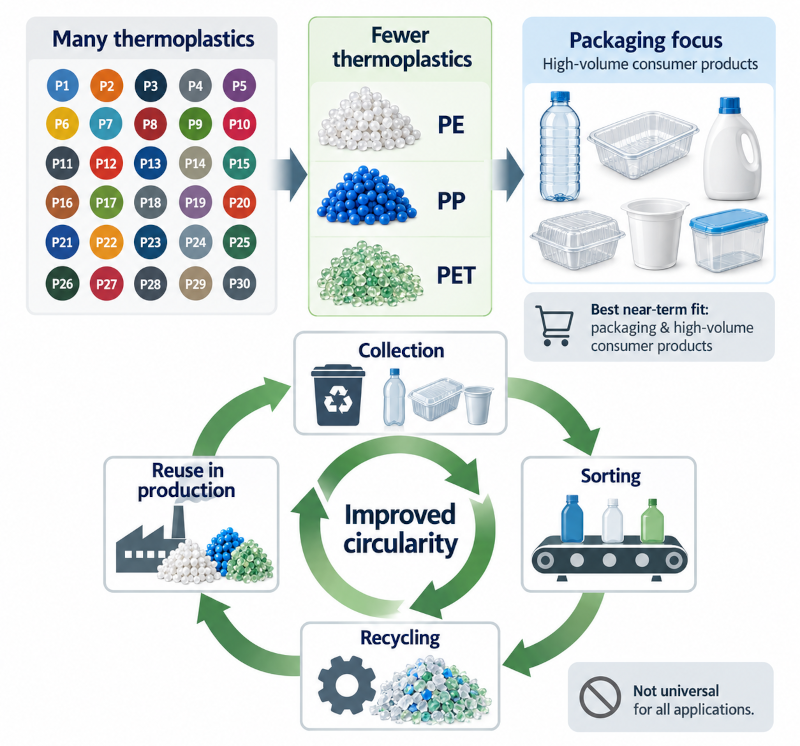
This paper shows that reducing thermoplastic diversity can improve circularity without compromising key performance. Based on 63 interviews and a stakeholder workshop across the Swedish plastics value network, it identifies highest near-term feasibility in high-volume Northern European consumer applications, especially packaging and PE, PP, and PET flows, where design, collection, and recycling can be aligned. More demanding applications remain conditional, and advanced structural composites are outside the current evidence base. Respondents link reduction not only to cleaner material flows and stronger recycling markets, but also to production and economic value: larger volumes of fewer polymers, lower inventory and changeover costs, less start-up waste, and more stable processing. These gains depend on maintaining application-specific properties. Three priorities emerge: (i) circular design; (ii) phasing out hazardous materials while prioritising recyclable polymers; and (iii) aligned regulation across the value network. The results support a staged, application-specific “fewer, better” strategy—not universal substitution.
Fewer thermoplastics, better recycling
- [1] S. Freinkel, “Plastic: A toxic love story,” HarperCollins, 2011.
- [2] D. Allen et al., “The fraud of plastic recycling—How big oil and the plastics industry deceived the public for decades and caused the plastic waste crisis,” Center for Climate Integrity, 2024.
- [3] K. Elo, J. Karlsson, K. Lydebrandt, and E. Sundin, “Automation of plastic recycling – A case study,” Proc. EcoDesign 2009, pp. 935-940, 2009.
- [4] United Nations Environment Programme, “Turning off the tap: How the world can end plastic pollution and create a circular economy,” 2023.
- [5] Ellen MacArthur Foundation, “The new plastics economy: Rethinking the future of plastics and catalysing action,” 2017.
- [6] J. R. Jambeck and I. Walker-Franklin, “The impacts of plastics’ life cycle,” One Earth, Vol.6, No.6, pp. 600-606, 2023. https://doi.org/10.1016/j.oneear.2023.05.015
- [7] European Commission, “A European strategy for plastics in a circular economy,” 2018.
- [8] United Nations Environment Programme, “Historic day in the campaign to beat plastic pollution: Nations commit to develop a legally binding agreement,” 2022. https://www.unep.org/en/news-and-stories/press-release/historic-day-campaign-beat-plastic-pollution-nations-commit-develop [Accessed February 4, 2026]
- [9] Plastics Europe, “Plastics – The fast facts 2023,” 2023.
- [10] J. Zheng and S. Suh, “Strategies to reduce the global carbon footprint of plastics,” Nat. Clim. Change, Vol.9, No.5, pp. 374-378, 2019. https://doi.org/10.1038/s41558-019-0459-z
- [11] F. Bauer et al., “Plastics and climate change—Breaking carbon lock-ins through three mitigation pathways,” One Earth, Vol.5, No.4, pp. 361-376, 2022. https://doi.org/10.1016/j.oneear.2022.03.007
- [12] Organisation for Economic Co-operation and Development (OECD), “Global plastics outlook: Policy scenarios to 2060,” 2022. https://doi.org/10.1787/aa1edf33-en
- [13] A. Fråne et al., “Kartläggning av plastflöden i Sverige 2020: Med avseende på råvara, produkter och avfall,” Naturvårdsverket, 2022 (in Swedish).
- [14] F. Meng, M. Brandão, and J. M. Cullen, “Replacing plastics with alternatives is worse for greenhouse gas emissions in most cases,” Environ. Sci. Technol., Vol.58, No.6, pp. 2716-2727, 2024. https://doi.org/10.1021/acs.est.3c05191
- [15] F. Vidal et al., “Designing a circular carbon and plastics economy for a sustainable future,” Nature, Vol.626, No.7997, pp. 45-57, 2024. https://doi.org/10.1038/s41586-023-06939-z
- [16] I. Vanderreydt et al., “Pathways to circular plastics in Europe: Good examples from countries, business and citizens,” European Environment Agency, 2023.
- [17] R. Hatti-Kaul et al., “Designing biobased recyclable polymers for plastics,” Trends Biotechnol., Vol.38, No.1, pp. 50-67, 2020. https://doi.org/10.1016/j.tibtech.2019.04.011
- [18] T. Nielsen et al., “Pathways to sustainable plastics – A discussion brief,” Lund University, 2018.
- [19] M. Lindahl et al., “Unity – Is it possible to replace all of today’s plastic variants with a smaller number?,” Avfall Sverige, 2022. https://mistrarees.se/custom/uploads/2023/02/2022-23-eng.pdf
- [20] L. Mattias, L. Ellen, HK. Rajni, and E. Sundin, “Is it possible to reduce the number of today’s thermoplastics?—An investigation of the Swedish plastic industry,” S. Fukushige, T. Nonaka, H. Kobayashi, C. Tokoro, and E. Yamasue (Eds.), “EcoDesign for Circular Value Creation: Volume II,” pp. 171-186, Springer, 2025. https://doi.org/10.1007/978-981-97-9076-0_11
- [21] OECD, “Plastic additives,” 2014. https://doi.org/10.1787/9789264221291-en
- [22] T. Nielsen and F. Bauer, “Plastics and sustainable investments – An information brief for investors,” IVL Swedish Environmental Research Institute, 2019.
- [23] A. Paletta et al., “Barriers and challenges to plastics valorisation in the context of a circular economy: Case studies from Italy,” J. Clean. Prod., Vol.241, Article No.118149, 2019. https://doi.org/10.1016/j.jclepro.2019.118149
- [24] A. A. Capetillo, “Circular economy in a plastic world: How can emerging technologies enable the transition?,” Master’s thesis, Lund University, 2021.
- [25] W.-T. Hsu, T. Domenech, and W. McDowall, “Closing the loop on plastics in Europe: The role of data, information and knowledge,” Sustain. Prod. Consum., Vol.33, pp. 942-951, 2022. https://doi.org/10.1016/j.spc.2022.08.019
- [26] A. R. Rennie, “Thermoplastics and thermosets,” G. M. Swallowe (Ed.), “Mechanical Properties and Testing of Polymers: An A–Z Reference,” pp. 248-248, Springer, 1999. https://doi.org/10.1007/978-94-015-9231-4_53
- [27] M. E. Grigore, “Methods of recycling, properties and applications of recycled thermoplastic polymers,” Recycling, Vol.2, No.4, Article No.24, 2017. https://doi.org/10.3390/recycling2040024
- [28] U. Bruder, “Värt att veta om plast,” Bruder Consulting, 2018 (in Swedish).
- [29] Y. Xie et al., “Bio-based polymeric materials synthesized from renewable resources: A mini-review,” Resour. Chem. Mater., Vol.2, No.3, pp. 223-230, 2023. https://doi.org/10.1016/j.recm.2023.05.001
- [30] S. M. Al-Salem, P. Lettieri, and J. Baeyens, “Recycling and recovery routes of plastic solid waste (PSW): A review,” Waste Manag., Vol.29, No.10, pp. 2625-2643, 2009. https://doi.org/10.1016/j.wasman.2009.06.004
- [31] J. Hopewell, R. Dvorak, and E. Kosior, “Plastics recycling: Challenges and opportunities,” Philos. Trans. R. Soc. Lond. B Biol. Sci., Vol.364, No.1526, pp. 2115-2126, 2009. https://doi.org/10.1098/rstb.2008.0311
- [32] M. Kazemi, S. Faisal Kabir, and E. H. Fini, “State of the art in recycling waste thermoplastics and thermosets and their applications in construction,” Resour. Conserv. Recycl., Vol.174, Article No.105776, 2021. https://doi.org/10.1016/j.resconrec.2021.105776
- [33] M. Tolinski, “Additives for Polyolefins: Getting the Most out of Polypropylene, Polyethylene and TPO,” Elsevier, 2015.
- [34] E. A. Coleman, “Plastics additives,” M. Kutz (Ed.), “Applied Plastics Engineering Handbook: Processing, Materials, and Applications (2nd Edition),” pp. 489-500, William Andrew Publishing, 2017. https://doi.org/10.1016/B978-0-323-39040-8.00021-3
- [35] J. N. Hahladakis et al., “An overview of chemical additives present in plastics: Migration, release, fate and environmental impact during their use, disposal and recycling,” J. Hazard. Mater., Vol.344, pp. 179-199, 2018. https://doi.org/10.1016/j.jhazmat.2017.10.014
- [36] A. D. Godwin, “Plasticizers,” M. Kutz (Ed.), “Applied Plastics Engineering Handbook: Processing and Materials,” pp. 487-501, William Andrew Publishing, 2011. https://doi.org/10.1016/C2010-0-67336-6
- [37] H. Wiesinger, Z. Wang, and S. Hellweg, “Deep dive into plastic monomers, additives, and processing aids,” Environ. Sci. Technol., Vol.55, No.13, pp. 9339-9351, 2021. https://doi.org/10.1021/acs.est.1c00976
- [38] H. A. Leslie et al., “Propelling plastics into the circular economy – Weeding out the toxics first,” Environ. Int., Vol.94, pp. 230-234, 2016. https://doi.org/10.1016/j.envint.2016.05.012
- [39] A. Turner, “Black plastics: Linear and circular economies, hazardous additives and marine pollution,” Environ. Int., Vol.117, pp. 308-318, 2018. https://doi.org/10.1016/j.envint.2018.04.036
- [40] D. Lithner, Å. Larsson, and G. Dave, “Environmental and health hazard ranking and assessment of plastic polymers based on chemical composition,” Sci. Total Environ., Vol.409, No.18, pp. 3309-3324, 2011. https://doi.org/10.1016/j.scitotenv.2011.04.038
- [41] G. Leone, R. Payet, and E. de Villamore, “Plastic’s toxic additives and the circular economy,” International Pollutants Elimination Network, 2020.
- [42] United Nations Industrial Development Organization, “Circular design of plastic products – Policy brief,” 2024.
- [43] I. A. Ignatyev, W. Thielemans, and B. Vander Beke, “Recycling of polymers: A review,” ChemSusChem, Vol.7, No.6, pp. 1579-1593, 2014. https://doi.org/10.1002/cssc.201300898
- [44] K. Le Blevennec et al., “For better not worse: Applying ecodesign principles to plastics in the circular economy,” Environmental Coalition on Standards, 2019.
- [45] European Environmental Bureau, “EU has legal duty to ban PVC – NGOs tell European Commission,” 2023. https://eeb.org/eu-has-legal-duty-to-ban-pvc-ngos-tell-european-commission/ [Accessed February 4, 2026]
- [46] European Union, “The use of PVC (poly vinyl chloride) in the context of a non-toxic environment – Final report,” 2022. https://doi.org/10.2779/375357
- [47] E. C. Quinn et al., “Mono-material product design with bio-based, circular, and biodegradable polymers,” One Earth, Vol.6, No.6, pp. 582-586, 2023. https://doi.org/10.1016/j.oneear.2023.05.019
This article is published under a Creative Commons Attribution-NoDerivatives 4.0 Internationa License.