
Research Paper:
Extracting Distinctive Motion Patterns in Nut-Tightening and Nut-Loosening Tasks Based on Joint Angle and Principal Component Analysis
Taku Hayashi*, Kei Harada*,†
 , Koki Karube*, Masao Sugi**
, Munenori Kakehi***, and Tetsuo Yamada*
*Department of Informatics, The University of Electro-Communications
1-5-1 Chofugaoka, Chofu, Tokyo 182-8585, Japan
†Corresponding author
**Department of Mechanical Engineering and Intelligent Systems, The University of Electro-Communications
Chofu, Japan
***Faculty of Symbiotic Systems Science, Fukushima University
Fukushima, Japan

To improve training for manual assembly and disassembly tasks, it is essential to characterize changes in workers’ movements with task repetition. This study analyzed repeated nut-tightening and nut-loosening tasks using optical motion capture data collected from five workers. Workload-related postures were assessed using rapid upper limb assessment (RULA), and movement coordination was examined through principal component analysis (PCA) of six joint angles. The results indicated that the RULA grand score varied little across trials and lacked sufficient sensitivity to detect subtle changes associated with task repetition. By contrast, joint-angle statistics and PCA revealed evidence of both shared and task-specific changes in movement patterns. In particular, PCA indicated a common pattern of adaptation across tasks, alongside distinct changes in coordination during nut-tightening and nut-loosening. These findings suggest that multivariate motion analysis may inform proficiency assessment and the design of task-specific training for manual assembly and disassembly work.
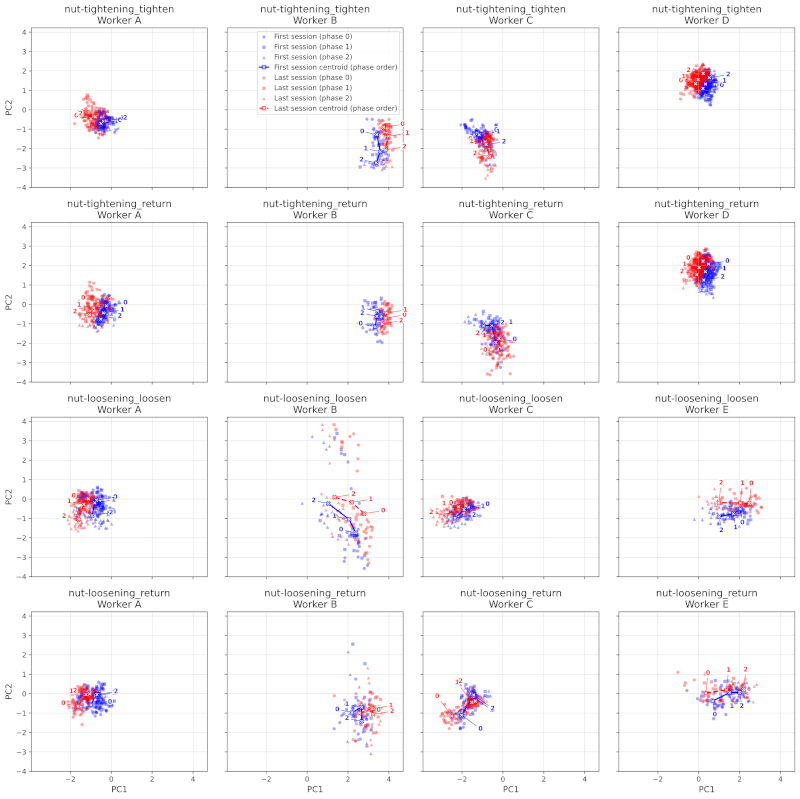
PC1 and PC2 for joint angles
- [1] Organisation for Economic Co-operation and Development, “OECD Supply Chain Resilience Review: Navigating Risks,” OECD Publishing, 2025. https://doi.org/10.1787/94e3a8ea-en
- [2] P. Stavropoulos, A. Papacharalampopoulos, K. Tzimanis, and A. Lianos, “Manufacturing resilience during the coronavirus pandemic: On the investigation manufacturing processes agility,” Eur. J. Soc. Impact Circ. Econ., Vol.1, No.3, pp. 28-57, 2020. https://doi.org/10.13135/2704-9906/5073
- [3] M. Song, M. A. Nasir, and W. B. Arfi, “Geopolitical risk implications for natural resource governance and conflict resolution,” Resour. Policy, Vol.93, Article No.105079, 2024. https://doi.org/10.1016/j.resourpol.2024.105079
- [4] A. Rejeb, K. Rejeb, J. G. Keogh, and E. Süle, “When Industry 5.0 meets the circular economy: A systematic literature review,” Circ. Econ. Sustain., Vol.5, pp. 2621-2652, 2025. https://doi.org/10.1007/s43615-025-00570-y
- [5] A. J. D. Lambert and S. M. Gupta, “Disassembly Modeling for Assembly, Maintenance, Reuse and Recycling,” CRC Press, 2005.
- [6] G. Salvendy (Ed.), “Handbook of Industrial Engineering,” 2nd Ed., John Wiley & Sons, 1992.
- [7] K. Karube, T. Yamada, and M. Sugi, “DX visualization of assembly task speed by 3D coordinate data using motion capture,” Proc. Northeast Decis. Sci. Inst. 53rd Annu. Conf., pp. 82-89, 2024.
- [8] C. Saeki, Y. Kubo, M. Suga, H. Egusa, and A. Ohta, “Development and realization of system for passing down skills and techniques on digital motion analysis,” Mazda Technical Review, Vol.38, pp. 127-132, 2021 (in Japanese). https://doi.org/10.34338/mazdagihou.38.0_127
- [9] S. Sato, H. Tanaka, and M. Yamamoto, “Multiple regressive analysis of skillful polishing operation of aircraft wings,” IEEJ Trans. Electron. Inf. Syst, Vol.137, No.7, pp. 948-956, 2017 (in Japanese). https://doi.org/10.1541/ieejeiss.137.948
- [10] R. Kawane, K. Karube, M. Sugi, T. Nakada, and T. Yamada, “Assembly movement analysis by work classification using motion capture and machine learning,” Int. J. Automation Technol., Vol.19, No.4, pp. 678-690, 2025. https://doi.org/10.20965/ijat.2025.p0678
- [11] T. Hayashi, K. Harada, K. Karube, M. Sugi, and T. Yamada, “Unveiling key movements in disassembly task through motion capture analysis and machine learning,” Asian J. Manag. Sci. Appl. (in press).
- [12] T. Hayashi, K. Harada, K. Karube, M. Kakehi, M. Sugi, and T. Yamada, “Comparison of motion study and data science methods for proficiency in disassembly task movement via motion capture,” Int. J. Adv. Manuf. Technol., Vol.146, pp. 1629-1646, 2026. https://doi.org/10.1007/s00170-025-17189-w
- [13] L. McAtamney and E. N. Corlett, “RULA: A survey method for the investigation of work-related upper limb disorders,” Appl. Ergon., Vol.24, No.2, pp. 91-99, 1993. https://doi.org/10.1016/0003-6870(93)90080-S
- [14] I. Sabino et al., “Application of wearable technology for the ergonomic risk assessment of healthcare professionals: A systematic literature review,” Int. J. Ind. Ergon., Vol.100, Article No.103570, 2024. https://doi.org/10.1016/j.ergon.2024.103570
- [15] T. Prunet, N. Absi, V. Borodin, and D. Cattaruzza, “Optimization of human-aware logistics and manufacturing systems: A survey on the human-aware models,” EURO J. Transp. Logist., Vol.13, Article No.100137, 2024. https://doi.org/10.1016/j.ejtl.2024.100137
- [16] D. A. Madani and A. Dababneh, “Rapid entire body assessment: A literature review,” Am. J. Eng. Appl. Sci., Vol.9, No.1, pp. 107-118, 2016. https://doi.org/10.3844/ajeassp.2016.107.118
- [17] B. J. Baird, M. A. Tynan, L. F. Tracy, J. T. Heaton, and J. A. Burns, “Surgeon positioning during awake laryngeal surgery: An ergonomic analysis,” Laryngoscope, Vol.131, No.12, pp. 2752-2758, 2021. https://doi.org/10.1002/lary.29717
- [18] S. Y. Nof, W. E. Wilhelm, and H. Warnecke, “Industrial Assembly,” Springer, 1997.
- [19] nac Image Technology, “MAC3D System,” (in Japanese). https://www.nacinc.jp/analysis/motion-capture/mac3d-system/ [Accessed January 26, 2026]
- [20] W. F. Senjaya, B. N. Yahya, and S. L. Lee, “Sensor-based motion tracking system evaluation for RULA in assembly task,” Sensors, Vol.22, No.22, Article No.8898, 2022. https://doi.org/10.3390/s22228898
- [21] SciPy Documentation, “scipy.signal.find_peaks – SciPy v1.x Manual.” https://docs.scipy.org/doc/scipy/reference/generated/scipy.signal.find_peaks.html [Accessed January 26, 2026]
This article is published under a Creative Commons Attribution-NoDerivatives 4.0 Internationa License.