
Paper:
Edible Mobile Robot Using Confectionery and Baked Materials
Yorito Igeta, Hidemitsu Furukawa
 , and Jun Ogawa
Graduate School of Science and Technology, Yamagata University
4-3-16 Jonan, Yonezawa, Yamagata 992-8510, Japan

Edible shape design refers to creating structures and mechanical components using food materials. This approach enables consuming otherwise unused parts instead of discarding them, thereby reducing waste and contributing to a more sustainable society. Furthermore, being food materials, they are low in toxicity, pose minimal risk in the event of accidental ingestion, and are highly biodegradable, with potential applications including the reuse of food waste. In addition, incorporating edible materials into a mobile robot allows the robot to serve as food after delivering supplies to disaster sites. Leveraging three-dimensional food printing allows customizing its taste and texture to suit individual preferences, thus creating new food experiences. Therefore, this study focuses on developing and evaluating edible mobile robots.
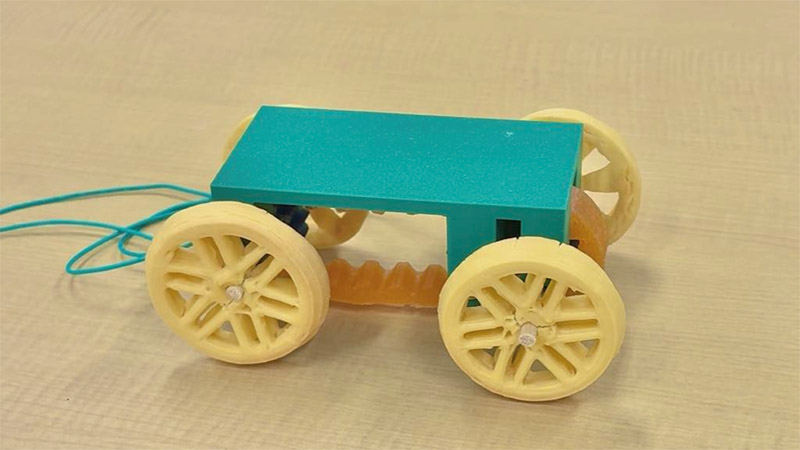
Edible mobile robot
- [1] R. Kanno, B. Kwak, M. Pankhurst, J. Shintake, and D. Floreano, “Edible soft actuators based on konjac glucomannan for underwater operation,” Adv. Intell. Syst., Vol.6, No.5, Article No.2300473, 2024. https://doi.org/10.1002/aisy.202300473
- [2] B. Kwak, J. Shintake, L. Zhang, and D. Floreano, “Towards edible drones for rescue missions: Design and flight of nutritional wings,” 2022 IEEE/RSJ Int. Conf. Intell. Robots Syst. (IROS), pp. 1802-1809, 2022. https://doi.org/10.1109/IROS47612.2022.9981956
- [3] D. Floreano et al., “Towards edible robots and robotic food,” Nat. Rev. Mater., Vol.9, No.8, pp. 589-599, 2024. https://doi.org/10.1038/s41578-024-00688-9
- [4] L. Lamanna, P. Cataldi, M. Friuli, C. Demitri, and M. Caironi, “Monitoring of drug release via intra body communication with an edible pill,” Advanced Materials Technologies, Vol.8, No.1, Article No.2200731, 2022. https://doi.org/10.1002/admt.202200731
- [5] D. Shen, M. Zhang, A. S. Mujumdar, and J. Li, “Advances and prospects for edible robots based on additive manufacturing technology,” Innov. Food Sci. Emerg. Technol., Vol.100, Article No.103896, 2025. https://doi.org/10.1016/j.ifset.2024.103896
- [6] R. Kanno et al., “Biodegradable electrohydraulic soft actuators,” Adv. Intell. Syst., Vol.5, No.9, Article No.2200239, 2023. https://doi.org/10.1002/aisy.202200239
- [7] V. F. Annese et al., “An edible bistable tilt sensor enabling autonomous operation of a partially eatable rolling robot,” Adv. Sens. Res., Vol.2, No.12, Article No.2300092, 2023. https://doi.org/10.1002/adsr.202300092
- [8] D. Rus and M. T. Tolley, “Design, fabrication and control of soft robots,” Nature, Vol.521, No.7553, pp. 467-475, 2015. https://doi.org/10.1038/nature14543
- [9] J. Trafialek, S. Kaczmarek, and W. Kolanowski, “The risk analysis of metallic foreign bodies in food products,” J. Food Qual., Vol.39, No.4, pp. 398-407, 2016. https://doi.org/10.1111%2Fjfq.12193
- [10] J. Yao, Z. Wu, P. Wang, J. Ye, and J. Wang, “Research on X-ray image fusion algorithm for food foreign object detection,” J. Nondestruct. Eval., Vol.44, No.2, Article No.63, 2025. https://doi.org/10.1007/s10921-025-01203-y
- [11] Y. Nakata et al., “Exploring the eating experience of a pneumatically-driven edible robot: Perception, taste, and texture,” PLOS One, Vol.19, No.2, Article No.e0296697, 2024. https://doi.org/10.1371/journal.pone.0296697
- [12] T. Gayler, “Towards edible interfaces: Designing interactions with food,” Proc. 19th ACM Int. Conf. Multimodal Interact., pp. 623-627, 2017. https://doi.org/10.1145/3136755.3137030
- [13] E. Van Doleweerd and M. B. Alonso, “The creation of a holistic interactive dining experience with shape-changing food materials at restaurant alchemist,” Proc. 17th Int. Conf. Tangible Embed. Embodied Interact., Article No.21, 2023. https://doi.org/10.1145/3569009.3572791
- [14] Y. Igeta, K. Fujiwara, J. Ogawa, and H. Furukawa, “Anisotropic texture control in 3D food printing through pitch adjustment and internal structural design,” Artif. Life Robot., Vol.30, No.4, pp. 786-793, 2025. https://doi.org/10.1007/s10015-025-01065-7
- [15] G. L. Goh, H. Zhang, T. H. Chong, and W, Y, Yeong, “3D printing of multilayered and multimaterial electronics: A review,” Adv. Electron. Mater., Vol.7, No.10, Article No.2100445, 2021. https://doi.org/10.1002/aelm.202100445
- [16] H. Jiang et al., “3D food printing: Main components selection by considering rheological properties,” Crit. Rev. Food Sci. Nutr., Vol.59, No.14, pp. 2335-2347, 2019. https://doi.org/10.1080/10408398.2018.1514363
- [17] J. Sun, Z. Peng, L. Yan, J. Y. H. Fuh, and G. S. Hong, “3D food printing—An innovative way of mass customization in food fabrication,” Int. J. Bioprinting, Vol.1, No.1, pp. 27-38, 2015. https://doi.org/10.18063/IJB.2015.01.006
- [18] F. Yang, M. Zhang, S. Prakash, and Y. Liu, “Physical properties of 3D printed baking dough as affected by different compositions,” Innov. Food Sci. Emerg. Technol., Vol.49, pp. 202-210, 2018. https://doi.org/10.1016/j.ifset.2018.01.001
- [19] R. Karyappa and M. Hashimoto, “Chocolate-based ink three-dimensional printing (Ci3DP),” Sci. Rep., Vol.9, No.1, Article No.14178, 2019. https://doi.org/10.1038/s41598-019-50583-5
- [20] J. I. Lipton, “Printable food: The technology and its application in human health,” Curr. Opin. Biotechnol., Vol.44, pp. 198-201, 2017. https://doi.org/10.1016/j.copbio.2016.11.015
- [21] X. Wan, Y. Shan, X. Liu, H. Wang, and J. Wang, “Simulation of biaxial wheel test and fatigue life estimation considering the influence of tire and wheel camber,” Adv. Eng. Softw., Vol.92, pp. 57-64, 2016. https://doi.org/10.1016/j.advengsoft.2015.11.005
- [22] Y. Ma, M. A. I. Schutyser, R. M. Boom, and L. Zhang, “Quantification of fracture mechanics with digital image correlation guides the infill design of 3D-printed snack bars with modulated flexural properties,” Virtual Phys. Prototyp., Vol.19, No.1, Article No.e2349679, 2024. https://doi.org/10.1080/17452759.2024.2349679
- [23] R. Maldonado-Rosas, J. L. Pérez-Castillo, E. Cuan-Urquizo, and V. Tejada-Ortigoza, “The role of controlled voids shape on the flexural properties of 3D printed food: An approach for tailoring their mechanical properties,” Virtual Phys. Prototyp., Vol.19, No.1, Article No.e2284816, 2024. https://doi.org/10.1080/17452759.2023.2284816
- [24] A. Quattrocchi et al., “Measurement of the structural behaviour of a 3D airless wheel prototype by means of optical non-contact techniques,” Acta IMEKO, Vol.11, No.3, Article No.13, 2022. https://doi.org/10.21014/acta_imeko.v11i3.1268
- [25] N. T. Ukamaka and P. A. Onwualu, “Effect of moisture content and types of structural surfaces on coefficient of friction of two Nigerian food grains: Sorghum (Sorghum bicolor) and millet (Pennisetum glaucum),” Agric. Eng. Int.: CIGR J., Vol.11, Article No.1152, 2009.
This article is published under a Creative Commons Attribution-NoDerivatives 4.0 Internationa License.