
Paper:
Target Following for a Snake-Like Robot Using Rolling Locomotion via Deep Reinforcement Learning
Tsuyoshi Kimoto
 , Akio Yamano
, Satomi Suzuki, and Takashi Iwasa
Department of Aerospace Engineering, Graduate School of Engineering, Osaka Metropolitan University
1-1 Gakuen-cho, Naka-ku, Sakai, Osaka 599-8531, Japan

The turning motion of snake-like robots based on center of gravity shift has superior energy efficiency compared to the undulatory locomotion that simultaneously drives many joints, but precise guidance control has been difficult due to its nonlinear dynamic characteristics. In this paper, we propose a control method using deep reinforcement learning for following target points in all directions in the turning motion using center of gravity shift and ground reaction forces. The target direction is defined as a normalized vector in the body coordinate system. This allows us to present target direction information to the agent that is independent of changes in self-orientation, and we show that it can acquire a policy for accurate following in all directions. The results of motion analysis confirmed that the learned policy not only skillfully utilizes the ground reaction forces at the time of contact to make dynamic trajectory corrections, but also achieves target following by flexibly switching the turning strategy according to the target direction.
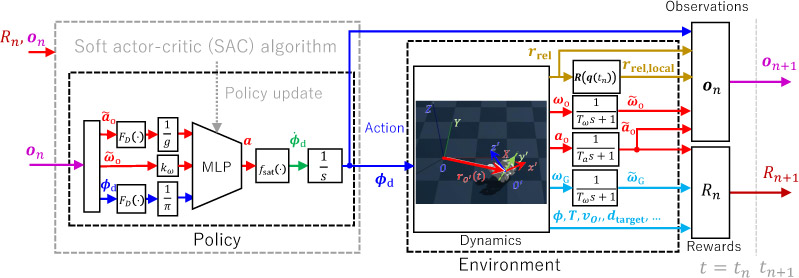
DRL framework for rolling locomotion
- [1] X. Zang, Y. Liu, Z. Lin, C. Zhang, and S. Iqbal, “Two multi-linked rescue robots: Design, construction and field tests,” J. of Advanced Mechanical Design, Systems, and Manufacturing, Vol.10, No.6, Article No.JAMDSM0089, 2016. https://doi.org/10.1299/jamdsm.2016jamdsm0089
- [2] T. Kamegawa, T. Akiyama, S. Sakai, K. Fujii, K. Une, Y. Wang, Y. Matsumura, T. Kishutani, E. Nose, Y. Yoshizaki, and A. Gofuku, “Development of a separable search-and-rescue robot composed of a mobile robot and a snake robot,” Advanced Robotics, Vol.34, No.2, pp. 132-139, 2020. https://doi.org/10.1080/01691864.2019.1691941
- [3] F. Enner, D. Rollinson, and H. Choset, “Motion estimation of snake robots in straight pipes,” 2013 IEEE Int. Conf. on Robotics and Automation, pp. 5168-5173, 2013. https://doi.org/10.1109/ICRA.2013.6631316
- [4] I. N. Ismail, A. Anuar, K. S. M. Sahari, M. Z. Baharuddin, M. Fairuz, A. Jalal, and J. M. Saad, “Development of in-pipe inspection robot: A review,” 2012 IEEE Conf. on Sustainable Utilization and Development in Engineering and Technology (STUDENT), pp. 310-315, 2012. https://doi.org/10.1109/STUDENT.2012.6408425
- [5] N. Matsumoto, M. Tanaka, M. Nakajima, M. Fujita, and K. Tadakuma, “Development of a folding arm on an articulated mobile robot for plant disaster prevention,” Advanced Robotics, Vol.34, No.2, pp. 89-103, 2020. https://doi.org/10.1080/01691864.2019.1689167
- [6] X. Hou, Y. Shi, L. Li, Y. Tian, Y. Su, T. Ding, and Z. Deng, “Revealing the Mechanical Characteristics via Kinematic Wave Model for Snake-Like Robot Executing Exploration of Lunar Craters,” IEEE Access, Vol.8, pp. 38368-38379, 2020. https://doi.org/10.1109/ACCESS.2020.2971221
- [7] T. S. Vaquero, G. Daddi, R. Thakker et al., “EELS: Autonomous snake-like robot with task and motion planning capabilities for ice world exploration,” Science Robotics, Vol.9, No.88, Article No.eadh8332, 2024. https://doi.org/10.1126/scirobotics.adh8332
- [8] M. Tesch, K. Lipkin, I. Brown, R. Hatton, A. Peck, J. Rembisz, and H. Choset, “Parameterized and Scripted Gaits for Modular Snake Robots,” Advanced Robotics, Vol.23, No.9, pp. 1131-1158, 2009. https://doi.org/10.1163/156855309X452566
- [9] T. Takemori, M. Tanaka, and F. Matsuno, “Hoop-Passing Motion for a Snake Robot to Realize Motion Transition Across Different Environments,” IEEE Trans. on Robotics, Vol.37, No.5, pp. 1696-1711, 2021. https://doi.org/10.1109/TRO.2021.3063438
- [10] T. Takemori, M. Tanaka, and F. Matsuno, “Gait design of a snake robot by connecting simple shapes,” 2016 IEEE Int. Symposium on Safety, Security, and Rescue Robotics (SSRR), pp. 189-194, 2016. https://doi.org/10.1109/SSRR.2016.7784297
- [11] M. Tesch, J. Schneider, and H. Choset, “Expensive multiobjective optimization for robotics,” 2013 IEEE Int. Conf. on Robotics and Automation, pp. 973-980, 2013. https://doi.org/10.1109/ICRA.2013.6630691
- [12] S. Hasanzadeh and A. A. Tootoonchi, “Ground adaptive and optimized locomotion of snake robot moving with a novel gait,” Autonomous Robots, Vol.28, pp. 457-470, 2010. https://doi.org/10.1007/s10514-010-9179-y
- [13] A. Crespi and A. J. Ijspeert, “Online Optimization of Swimming and Crawling in an Amphibious Snake Robot,” IEEE Trans. on Robotics, Vol.24, No.1, pp. 75-87, 2008. https://doi.org/10.1109/TRO.2008.915426
- [14] S. Jiang, A. Salagame, A. Ramezani, and L. L. S. Wong, “Snake Robot with Tactile Perception Navigates on Large-scale Challenging Terrain,” 2024 IEEE Int. Conf. on Robotics and Automation (ICRA), pp. 5090-5096, 2024. https://doi.org/10.1109/ICRA57147.2024.10611384
- [15] S. Jiang, A. Salagame, A. Ramezani, and L. L. Wong, “Hierarchical RL-Guided Large-scale Navigation of a Snake Robot,” 2024 IEEE Int. Conf. on Advanced Intelligent Mechatronics (AIM), pp. 1347-1352, 2024. https://doi.org/10.1109/AIM55361.2024.10637006
- [16] J. Naish, J. Rodriguez, J. Zhang, B. Jones, G. Daddi, A. Orekhov, R. Royce, M. Paton, H. Choset, M. Ono, and R. Thakker, “Reinforcement learning-driven parametric curve fitting for snake robot gait design,” Proc. of the 6th Annual Learning for Dynamics & Control Conf., pp. 1715-1727, 2024.
- [17] H. Kurokawa, A. Kamimura, E. Yoshida, K. Tomita, S. Murata, and S. Kokaji, “Self-reconfigurable modular robot (M-TRAN) and its motion design,” 7th Int. Conf. on Control, Automation, Robotics and Vision (ICARCV 2002) pp. 51-56, 2002. https://doi.org/10.1109/ICARCV.2002.1234789
- [18] J. Zhao, X. Cui, Y. Zhu, and S. Tang, “A new self-reconfigurable modular robotic system UBot: Multi-mode locomotion and self-reconfiguration,” 2011 IEEE Int. Conf. on Robotics and Automation, pp. 1020-1025, 2011. https://doi.org/10.1109/ICRA.2011.5980293
- [19] X. Wang, H. Jin, Y. Zhu, B. Chen, D. Bie, Y. Zhang, and J. Zhao, “Serpenoid polygonal rolling for chain-type modular robots: A study of modeling, pattern switching and application,” Robotics and Computer-Integrated Manufacturing, Vol.39, pp. 56-67, 2016. https://doi.org/10.1016/j.rcim.2015.12.003
- [20] A. Salagame, N. Bhattachan, A. Caetano et al., “How Strong a Kick Should be to Topple Northeastern’s Tumbling Robot?,” 2024 IEEE Int. Conf. on Advanced Intelligent Mechatronics (AIM), pp. 76-81, 2024. https://doi.org/10.1109/AIM55361.2024.10637166
- [21] A. Salagame, H. Noyes, E. Sihite, A. Kalantari, and A. Ramezani, “Crater Observing Bioinspired Rolling Articulator (COBRA),” Advanced Intelligent Systems, Vol.8, No.3, Article No.2500352, 2026. https://doi.org/10.1002/aisy.202500352
- [22] K. Miki, C. W. Chin, and M. Tanaka, “Snake Robot with Opposing Helix Gait for Transporting Cylindrical Objects,” IEEE Robotics and Automation Letters, Vol.11, No.2, pp. 2098-2105, 2026. https://doi.org/10.1109/LRA.2025.3645515
- [23] A. Yamano, Y. Ikeda, K. Imai, and M. Chiba, “Efficient rolling motion for snake-like robots utilizing center of gravity shift,” Mechatronics, Vol.94, Article No.103024, 2023. https://doi.org/10.1016/j.mechatronics.2023.103024
- [24] Y. Sugiyama and S. Hirai, “Crawling and Jumping by a Deformable Robot,” The Int. J. of Robotics Research, Vol.25, Nos.5-6, pp. 603-620, 2006. https://doi.org/10.1177/0278364906065386
- [25] Y. Wang, C. Wu, L. Yu, and Y. Mei, “Trajectory planning of a rolling robot of closed five-bow-shaped-bar linkage,” Robotics and Computer-Integrated Manufacturing, Vol.53, pp. 81-92, 2018. https://doi.org/10.1016/j.rcim.2018.03.004
- [26] Y. Wang, C. Wu, L. Yu, and Y. Mei, “Dynamics of a rolling robot of closed five-arc-shaped-bar linkage,” Mechanism and Machine Theory, Vol.121, pp. 75-91, 2018. https://doi.org/10.1016/j.mechmachtheory.2017.10.010
- [27] A. Yamano, T. Kimoto, and M. Chiba, “Design of Rolling Motion for Snake-like Robots using Center-of-Gravity Shift,” J. of Mechanisms and Robotics, Vol.17, No.6, Article No.061011, 2025. https://doi.org/10.1115/1.4067307
- [28] T. Kimoto, S. Suzuki, A. Yamano, and T. Iwasa, “Rolling Motion Control in a Snake Robot Using Center-of-Mass Shift and Reinforcement Learning-Based Motion Exploration,” 2025 JSME Conf. on Robotics and Mechatronics, Vol.2025, Article No.2P1-P11, 2025 (in Japanese). https://doi.org/10.1299/jsmermd.2025.2P1-P11
- [29] S. Suzuki, A. Yamano, T. Kimoto, and T. Iwasa, “Study on the Rolling Motion of a Snake-Like Robot That Transforms into a Parallel Two-Wheeled Vehicle Using Deep Reinforcement Learning,” 2025 25th Int. Conf. on Control, Automation and Systems (ICCAS), pp. 1485-1490, 2025. https://doi.org/10.23919/ICCAS66577.2025.11301120
- [30] A. Yamano, S. Suzuki, T. Kimoto, and T. Iwasa, “Deep reinforcement learning-based design with observation buffer of rolling motion for snake-like robots,” Robotics and Autonomous Systems, Vol.199, Article No.105370, 2026. https://doi.org/https://doi.org/10.1016/j.robot.2026.105370
- [31] H. C. Astley, C. Gong, J. Dai, M. Travers, M. M. Serrano, P. A. Vela, H. Choset, J. Mendelson III, D. Hu, and D. Goldman, “Modulation of orthogonal body waves enables high maneuverability in sidewinding locomotion,” PNAS, Vol.112, No.19, pp. 6200-6205, 2015. https://doi.org/10.1073/pnas.1418965112
- [32] R. Ariizumi and F. Matsuno, “Dynamic Analysis of Three Snake Robot Gaits,” IEEE Trans. on Robotics, Vol.33, No.5, pp. 1075-1087, 2017. https://doi.org/10.1109/TRO.2017.2704581
- [33] E. Kelasidi, P. Liljebäck, K. Y. Pettersen, and J. T. Gravdahl, “Experimental investigation of efficient locomotion of underwater snake robots for lateral undulation and eel-like motion patterns,” Robotics and Biomimetics, Vol.2, Article No.8, 2015. https://doi.org/10.1186/s40638-015-0029-4
- [34] A. Yamano, K. Shimizu, M. Chiba, and H. Ijima, “Fluid force identification acting on snake-like robots swimming in viscous fluids,” J. of Fluids and Structures, Vol.106, Article No.103351, 2021. https://doi.org/10.1016/j.jfluidstructs.2021.103351
- [35] K. V. Katsikopoulos and S. E. Engelbrecht, “Markov decision processes with delays and asynchronous cost collection,” IEEE Trans. on Automatic Control, Vol.48, No.4, pp. 568-574, 2003. https://doi.org/10.1109/TAC.2003.809799
- [36] J. Ikemoto and T. Ushio, “Application of Deep Reinforcement Learning to Control Problems,” The Brain & Neural Networks, Vol.26, No.4, pp. 135-144, 2019 (in Japanese). https://doi.org/10.3902/jnns.26.135
- [37] T. Haarnoja, S. Ha, A. Zhou, J. Tan, G. Tucker, and S. Levine, “Learning to Walk via Deep Reinforcement Learning,” ArXiv preprint, arXiv:1812.11103, 2018. https://doi.org/10.48550/arXiv.1812.11103
- [38] T. Haarnoja, A. Zhou, K. Hartikainen, G. Tucker, S. Ha, J. Tan, V. Kumar, H. Zhu, A. Gupta, P. Abbeel, and S. Levine, “Soft Actor-Critic Algorithms and Applications,” ArXiv preprint, arXiv:1812.05905, 2018. https://doi.org/10.48550/arXiv.1812.05905
- [39] T. Haarnoja, A. Zhou, P. Abbeel, and S. Levine, “Soft Actor-Critic: Off-Policy Maximum Entropy Deep Reinforcement Learning with a Stochastic Actor,” ArXiv preprint, arXiv:1801.01290, 2018. https://doi.org/10.48550/arXiv.1801.01290
- [40] A. Raffin, A. Hill, A. Gleave, A. Kanervisto, M. Ernestus, and N. Dormann, “Stable-Baselines3: Reliable Reinforcement Learning Implementations,” J. of Machine Learning Research, Vol.22, No.268, pp. 1-8, 2021.
- [41] G. Authors, “Genesis: A Generative and Universal Physics Engine for Robotics and Beyond,” 2024. https://github.com/Genesis-Embodied-AI/genesis-world [Accessed October 1, 2026]
This article is published under a Creative Commons Attribution-NoDerivatives 4.0 Internationa License.