
Paper:
Design and Fabrication of a Snake Robot Using Modular Pneumatic Film Actuators
Kaisei Takahashi*, Daisuke Yamaguchi**
 , Shuichi Wakimoto**
, and Takefumi Kanda**
*Graduate School of Environment, Life, Natural Science and Technology, School of Engineering, Okayama University
3-1-1 Tsushima-naka, Kita-ku, Okayama, Okayama 700-8530, Japan
**Division of Intelligent Mechanical Systems Course, Faculty of Environmental, Life, Natural Science and Technology, Okayama University
3-1-1 Tsushima-naka, Kita-ku, Okayama, Okayama 700-8530, Japan

Pipe inspection robots are being developed for environments that are difficult for humans to enter, such as nuclear power and chemical plants. However, the actuators used for robots are large and heavy, which limits the miniaturization of piping inspection robots. This paper presents an ultra-thin, lightweight film snake-type robot composed of polyimide (PI) film actuators. The proposed robot is expected to enable the easy transport of multiple units. By utilizing the heat and chemical resistance of PI, it can efficiently inspect various targets from multiple locations under harsh conditions. The robot employs a bidirectional bending differential stiffness actuator (BB-DSA). The BB-DSA has two air chambers formed by welding three non-stretchable PI films of different thicknesses. By changing the applied pneumatic pressure between the two air chambers, the actuator achieves bidirectional large bending deformation with a simple structure. A connectable actuator structure is also introduced to reduce the number of pneumatic supply tubes. This contributes to lowering the overall weight of the robot and improving its locomotion performance. The bending angle and generated force of the actuator were evaluated. In addition, a snake-type robot with a reduced number of tubes was fabricated, and its traveling speed and traction force were evaluated. The results show that the maximum traveling speed and traction force were 1.38 mm/s and 14.57 mN, respectively.
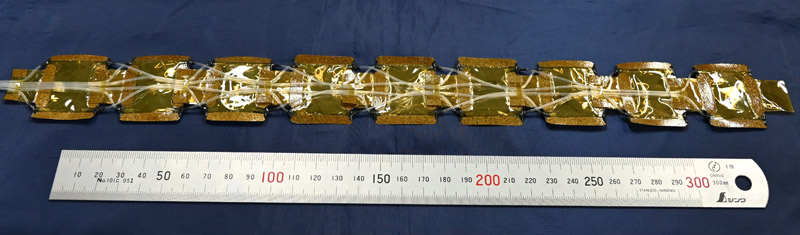
Snake-shaped robot made of PI films
- [1] H. Jang et al., “A review: Technological trends and development direction of pipeline robot systems,” J. Intell. Robot. Syst., Vol.105, No.3, Article No.59, 2022. https://doi.org/10.1007/s10846-022-01669-2
- [2] M. R. A. Md Zin, K. S. M. Sahari, J. Md Saad, A. Anuar, and A. T. Zulkarnain, “Development of a low cost small sized in-pipe robot,” Procedia Eng., Vol.41, pp. 1469-1475, 2012. https://doi.org/10.1016/j.proeng.2012.07.337
- [3] A. A. Abd Eltwab and A. Sameh, “A modular, multi-sensor crawler robot for adaptive pipeline inspection: Design and experimental validation,” Sci. Rep., Vol.16, Article No.880, 2026. https://doi.org/10.1038/s41598-025-32719-y
- [4] A. Gunatilake, L. Piyathilaka, S. Kodagoda, S. Barclay, and D. Vitanage, “Real-time 3D profiling with RGB-D mapping in pipelines using stereo camera vision and structured IR laser ring,” 14th IEEE Conf. Ind. Electron. Appl., pp. 916-921, 2019. https://doi.org/10.1109/ICIEA.2019.8834089
- [5] R. S. Elankavi, D. Dinakaran, R. M. K. Chetty, M. M. Ramya, and D. G. H. Samuel, “A review on wheeled type in-pipe inspection robot,” Int. J. Mech. Eng. Robot. Res., Vol.11, No.10, pp. 745-754, 2022. https://doi.org/10.18178/ijmerr.11.10.745-754
- [6] J. Park, D. Hyun, W.-H. Cho, T.-H. Kim, and H.-S. Yang, “Normal-force control for an in-pipe robot according to the inclination of pipelines,” IEEE Trans. Ind. Electron., Vol.58, No.12, pp. 5304-5310, 2011. https://doi.org/10.1109/TIE.2010.2095392
- [7] L. Xu, L. Zhang, J. Zhao, and K. Kim, “Cornering algorithm for a crawler in-pipe inspection robot,” Symmetry, Vol.12, No.12, Article No.2016, 2020. https://doi.org/10.3390/sym12122016
- [8] J. Park and H. Yang, “Pipeline mapping with crawler-type in-pipe robot feature,” J. Mech. Sci. Technol., Vol.37, No.10, pp. 5015-5020, 2023. https://doi.org/10.1007/s12206-023-0908-5
- [9] T. Ren, Q. Liu, Y. Li, and Y. Chen, “Design, analysis and innovation in variable radius active screw in-pipe drive mechanisms,” Int. J. Adv. Robot. Syst., Vol.14, No.3, 2017. https://doi.org/10.1177/1729881417703564
- [10] T. Li et al., “Development of an in-pipe robot with differential screw angles for curved pipes and vertical straight pipes,” J. Mech. Robot., Vol.9, No.5, Article No.051014, 2017. https://doi.org/10.1115/1.4037617
- [11] P. Li, S. Ma, C. Lyu, X. Jiang, and Y. Liu, “Energy-efficient control of a screw-drive pipe robot with consideration of actuator’s characteristics,” Robot. Biomim., Vol.3, Article No.11, 2016. https://doi.org/10.1186/s40638-016-0045-z
- [12] J. Qiao, J. Shang, and A. Goldenberg, “Development of inchworm in-pipe robot based on self-locking mechanism,” IEEE/ASME Trans. Mechatron., Vol.18, No.2, pp. 799-806, 2013. https://doi.org/10.1109/TMECH.2012.2184294
- [13] Q. Xie, S. Liu, and X. Ma, “Design of a novel inchworm in-pipe robot based on cam-linkage mechanism,” Adv. Mech. Eng., Vol.13, No.9, 2021. https://doi.org/10.1177/16878140211045193
- [14] J. Lim et al., “One pneumatic line based inchworm-like micro robot for half-inch pipe inspection,” Mechatronics, Vol.18, No.7, pp. 315-322, 2008. https://doi.org/10.1016/j.mechatronics.2008.05.007
- [15] S. Wakimoto, J. Nakajima, M. Tanaka, T. Kanda, and K. Suzumori, “A micro snake-like robot for small pipe inspection,” Proc. 2003 Int. Symp. Micromechatronics Hum. Sci., pp. 303-308, 2003. https://doi.org/10.1109/MHS.2003.1249959
- [16] F. Trebuňa, I. Virgala, M. Pástor, T. Lipták, and Ľ. Miková, “An inspection of pipe by snake robot,” Int. J. Adv. Robot. Syst., Vol.13, No.5, 2016. https://doi.org/10.1177/1729881416663668
- [17] C.-W. Huang, C.-H. Huang, Y.-H. Hung, and C.-Y. Chang, “Sensing pipes of a nuclear power mechanism using low-cost snake robot,” Adv. Mech. Eng., Vol.10, No.6, 2018. https://doi.org/10.1177/1687814018781286
- [18] I. Virgala et al., “Investigation of snake robot locomotion possibilities in a pipe,” Symmetry, Vol.12, No.6, Article No.939, 2020. https://doi.org/10.3390/sym12060939
- [19] S. A. Fjerdingen, P. Liljebäck, and A. A. Transeth, “A snake-like robot for internal inspection of complex pipe structures (PIKo),” 2009 IEEE/RSJ Int. Conf. Intell. Robots Syst., pp. 5665-5671, 2009. https://doi.org/10.1109/IROS.2009.5354751
- [20] Y. Miyake, D. Yamaguchi, S. Wakimoto, and T. Kanda, “Fabrication of bidirectionally bending rigid differential actuator using polyimide films,” Proc. JFPS Fluid Power Syst. Conf., 2023 (in Japanese).
- [21] D. Yamaguchi et al., “Concept and prototype of soft actuator for liquid nitrogen temperature environments,” J. Robot. Mechatron., Vol.32, No.5, pp. 1019-1026, 2020. https://doi.org/10.20965/jrm.2020.p1019
- [22] S. Wakimoto, K. Suzumori, M. Tanaka, and J. Nakajima, “In-pipe inspection micro robot adaptable to changes in pipe diameter,” J. Robot. Mechatron., Vol.15, No.6, pp. 609-615, 2003. https://doi.org/10.20965/jrm.2003.p0609
- [23] S. Wakimoto, K. Suzumori, and T. Kanda, “A bio-mimetic amphibious soft cord robot,” Trans. Jpn. Soc. Mech. Eng. C, Vol.72, No.714, pp. 471-477, 2006 (in Japanese). https://doi.org/10.1299/kikaic.72.471
This article is published under a Creative Commons Attribution-NoDerivatives 4.0 Internationa License.