
Paper:
In-Body Cybernetic Avatar Communication as a Multi-Scale Integrated Design Framework
Takeshi Matsumura

Wireless Systems Laboratory, Wireless Networks Research Center, Network Research Institute, National Institute of Information and Communications Technology
3-4 Hikarino-oka, Yokosuka, Kanagawa 239-0847, Japan

The sustainability of the healthcare and elderly care systems has become a critical issue because of aging population and demographic decline. In this context, cybernetic avatars (CAs) have been proposed as a means to extend human capabilities beyond physical constraints. While conventional studies have mainly focused on socio-CAs based on remote robots, increasing attention has been directed toward in-body CAs, which perform sensing, actuation, and information processing within the human body. In-body CAs exist in diverse forms ranging from the nano- to millimeter-scale, each with distinct communication requirements and design constraints. Correspondingly, various communication modalities have been investigated, including molecular communication, terahertz communication, optical communication, radio frequency communication, and coupling-based methods. However, these technologies have largely evolved in isolation with no unified design framework available for in-body CA systems. This study considered in-body communication as a design problem and investigated a taxonomy based on three axes: the scale, communication medium, and function. Using this framework, the properties and applicability of different communication modalities were systematically characterized, and design guidelines for selecting and combining them according to application requirements were derived. Furthermore, structural gaps across scales were identified, highlighting the necessity of hierarchical architectures and gateway mechanisms for integrating heterogeneous communication domains.
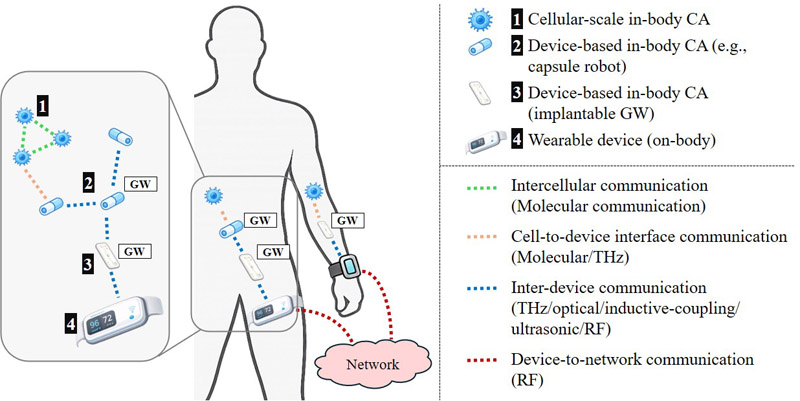
Multi-scale in-body CA communication
- [1] N. Hagita et al., “Cybernetic avatars: Teleoperation technologies from in-body monitoring to social interaction,” Science Robotics, Vol.9, No.96, Article No.eadg1842, 2024. https://doi.org/10.1126/scirobotics.adg1842
- [2] IMARC, “Internet of Nano Things market by device type, communication type, network architecture, end user, and region 2026-2034,” 2026.
- [3] D. Malak and O. B. Akan, “Molecular communication nanonetworks inside human body,” Nano Commun. Netw., Vol.3, No.1, pp. 19-35, 2012. https://doi.org/10.1016/j.nancom.2011.10.002
- [4] T. Nakano, T. Suda, Y. Okaie, M. J. Moore, and A. V. Vasilakos, “Molecular communication among biological nanomachines: A layered architecture and research issues,” IEEE Trans. Nanobioscience, Vol.13, No.3, pp. 169-197, 2014. https://doi.org/10.1109/TNB.2014.2316674
- [5] S. Zafar et al., “A systematic review of bio-cyber interface technologies and security issues for Internet of Bio-Nano Things,” IEEE Access, Vol.9, pp. 93529-93566, 2021. https://doi.org/10.1109/ACCESS.2021.3093442
- [6] Q. Cao et al., “Robotic wireless capsule endoscopy: Recent advances and upcoming technologies,” Nature Communications, Vol.15, Article No.4597, 2024. https://doi.org/10.1038/s41467-024-49019-0
- [7] X. Tian et al., “Implant-to-implant wireless networking with metamaterial textiles,” Nature Communications, Vol.14, Article No.4335, 2023. https://doi.org/10.1038/s41467-023-39850-2
- [8] Y. Sun et al., “Magnetically driven capsules with multimodal response and multifunctionality for biomedical applications,” Nature Communications, Vol.15, Article No.1839, 2024. https://doi.org/10.1038/s41467-024-46046-9
- [9] W. Zhao, Y. Zhang, and N. Wang, “Soft robotics: Research, challenges, and prospects,” J. Robot. Mechatron., Vol.33, No.1, pp. 45-68, 2021. https://doi.org/jrm.2021.p0045
- [10] I. F. Akyildiz, F. Brunetti, and C. Blázquez, “Nanonetworks: A new communication paradigm,” Computer Networks, Vol.52, No.12, pp. 2260-2279, 2008. https://doi.org/10.1016/j.comnet.2008.04.001
- [11] P. Kulakowski, K. Turbic, and L. M. Correia, “From nano-communications to body area networks: A perspective on truly personal communications,” IEEE Access, Vol.8, pp. 159839-159853, 2020. https://doi.org/10.1109/ACCESS.2020.3015825
- [12] N. Saeed, M. H. Loukil, H. Sarieddeen, T. Y. Al-Naffouri, and M.-S. Alouini, “Body-centric terahertz networks: Prospects and challenges,” IEEE Trans. on Molecular, Biological, and Multi-Scale Communications, Vol.8, No.3, pp. 138-157, 2021. https://doi.org/10.1109/TMBMC.2021.3135198
- [13] R. Zhang et al., “Modelling of the terahertz communication channel for in-vivo nano-networks in the presence of noise,” Proc. 16th Mediterranean Microwave Symposium (MMS), 2016. https://doi.org/10.1109/MMS.2016.7803812
- [14] S. Yoshida, H. Miyaguchi, and T. Nakamura, “Development of ingestible thermometer with built-in coil antenna charged by gastric acid battery and demonstration of long-time in vivo telemetry,” IEEE Access, Vol.9, pp. 102368-102377, 2021. https://doi.org/10.1109/ACCESS.2021.3098333
- [15] T. V. de Steene et al., “Optimal frequency and wireless power budget for miniature receivers in obese people,” Sensors, Vol.23, No.19, Article No.8084, 2023. https://doi.org/10.3390/s23198084
- [16] M. C. Gursoy, M. Nasiri-Kenari, and U. Mitra, “Towards high data-rate diffusive molecular communications: A review on performance enhancement strategies,” Digital Signal Processing, Vol.124, Article No.103161, 2022. https://doi.org/10.1016/j.dsp.2021.103161
- [17] S. R. Khan, S. K. Pavuluri, G. Cummins, and M. P. Y. Desmulliez, “Wireless power transfer techniques for implantable medical devices: A review,” Sensors, Vol.20, No.12, Article No.3487, 2020. https://doi.org/10.3390/s20123487
- [18] “IEEE standard for local and metropolitan area networks – Part 15.6: Wireless body area networks,” IEEE 802.15.6-2012, 2012. https://doi.org/10.1109/IEEESTD.2012.6161600
- [19] U.S. Food and Drug Administration (FDA), “Radio frequency wireless technology in medical devices; Guidance for industry and food and drug administration staff,” 2013.
- [20] J. Walk et al., “Remote powered medical implants for telemonitoring,” Proc. of the IEEE, Vol.102, No.11, pp. 1811-1832, 2014. https://doi.org/10.1109/JPROC.2014.2359517
- [21] M. S. Wegmueller, M. Oberle, N. Felber, N. Kuster, and W. Fichtner, “Signal transmission by Galvanic coupling through the human body,” IEEE Trans. Instrumentation and Measurement, Vol.59, No.4, pp. 963-969, 2010. https://doi.org/10.1109/TIM.2009.2031449
- [22] L. Galluccio, A. Lombardo, R. Raftopoulos, C. Ricci, and S. Rossitto, “Design of next generation ultrasonic-based healthcare transmission systems exploiting MAB,” Proc. 11th Annual ACM Int. Conf. on Nanoscale Computing and Communication (NANOCOM’24), pp. 78-84, 2024. https://doi.org/10.1145/3686015.3689358
- [23] W. Jiang et al., “Terahertz communications and sensing for 6G and beyond: A comprehensive review,” IEEE Communications Surveys & Tutorials, Vol.26, No.4, pp. 2326-2381, 2024. https://doi.org/10.1109/COMST.2024.3385908
- [24] T. Liu, U. Bihr, S. M. Anis, and M. Ortmanns, “Optical transcutaneous link for low power, high data rate telemetry,” 2012 Annual Int. Conf. of the IEEE Engineering in Medicine and Biology Society, 2012. https://doi.org/10.1109/EMBC.2012.6346729
- [25] M. Mimee et al., “An ingestible bacterial-electronic system to monitor gastrointestinal health,” Science, Vol.360, No.6391, pp. 915-918, 2018. https://doi.org/10.1126/science.aas9315
- [26] Code of Federal Regulations, Title 47, Part 95, “Subpart I—Medical device radio communications service (MedRadio),” eCFR, U.S. Government Publishing Office. https://www.ecfr.gov/current/title-47/chapter-I/subchapter-D/part-95/subpart-I [Accessed October 1, 2026]
- [27] U.S. FDA, “Wireless medical devices,” 2018. https://www.fda.gov/medical-devices/digital-health-center-excellence/wireless-medical-devices [Accessed October 1, 2026]
This article is published under a Creative Commons Attribution-NoDerivatives 4.0 Internationa License.