
Paper:
In-Body Cybernetic Avatar Communication as a Multi-Scale Integrated Design Framework
Takeshi Matsumura

Wireless Systems Laboratory, Wireless Networks Research Center, Network Research Institute, National Institute of Information and Communications Technology
3-4 Hikarino-oka, Yokosuka, Kanagawa 239-0847, Japan

The sustainability of the healthcare and elderly care systems has become a critical issue because of aging population and demographic decline. In this context, cybernetic avatars (CAs) have been proposed as a means to extend human capabilities beyond physical constraints. While conventional studies have mainly focused on socio-CAs based on remote robots, increasing attention has been directed toward in-body CAs, which perform sensing, actuation, and information processing within the human body. In-body CAs exist in diverse forms ranging from the nano- to millimeter-scale, each with distinct communication requirements and design constraints. Correspondingly, various communication modalities have been investigated, including molecular communication, terahertz communication, optical communication, radio frequency communication, and coupling-based methods. However, these technologies have largely evolved in isolation with no unified design framework available for in-body CA systems. This study considered in-body communication as a design problem and investigated a taxonomy based on three axes: the scale, communication medium, and function. Using this framework, the properties and applicability of different communication modalities were systematically characterized, and design guidelines for selecting and combining them according to application requirements were derived. Furthermore, structural gaps across scales were identified, highlighting the necessity of hierarchical architectures and gateway mechanisms for integrating heterogeneous communication domains.
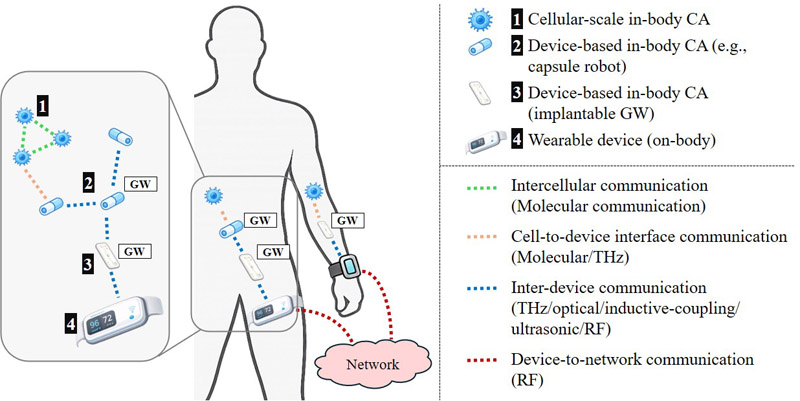
Multi-scale in-body CA communication
1. Introduction
In recent years, the sustainability of social systems, including healthcare, elderly care, and daily life support, has become a critical issue because of the aging population and demographic decline. In this context, the concept of cybernetic avatars (CAs) has been proposed, which enable human activity beyond physical and spatial constraints and provide services to users 1. CAs are expected to contribute to the realization of a society in which diverse individuals can participate in social activities regardless of time and location.
CAs have traditionally been discussed in the context of socio-CAs, in which human capabilities are extended through teleoperation robots or devices. However, the concept of CAs is not limited to such external embodiments but includes in-body CAs consisting of devices or cellular-scale agents operating inside the human body. These in-body CAs function as agents that perform sensing, actuation, and information processing within the body and can interact with external systems to enable remote monitoring, control, and information delivery.
In-body CAs can be broadly categorized into two types based on their physical realization: device- or machine-based in-body CAs, such as implantable devices and capsule robots, and cellular- or molecular-scale in-body CAs operating at the nano- or microscale. Although these agents significantly differ in scale and functionality, they share a common role in performing specific tasks within the body. Communication with external systems is essential for remote monitoring and control applications. Recent reports indicate that the healthcare sector accounts for the largest share of the in-body device market, including the Internet of Nano Things. Its share reached approximately 40% in 2023 2, highlighting the growing societal and industrial demands for such technologies.
The use of in-body CAs enables new forms of support, such as the continuous monitoring of physiological conditions in elderly individuals requiring care, and allows timely and personalized assistance. In these applications, communication between multiple in-body CAs and external systems is essential for data acquisition, information transfer, and control. Furthermore, future systems should involve cooperative operations among multiple in-body CAs that exchange information.
Communication technologies for in-body devices and cellular agents have been developed independently according to their scale and functional requirements. For instance, cellular-scale CAs rely on biochemical reactions and molecular transport as their primary means of information transfer, leading to the development of molecular communication and bio-interface technologies 3,4,5. By contrast, device- or machine-based in-body CAs encompass a wide range of form factors, from near-surface implants to ingestible capsule robots 6,7,8, each requiring different communication distances, data rates, and levels of reliability.
In addition, recent advances in soft robotics have enabled robots composed of flexible materials to operate adaptively in confined and unstructured environments where conventional rigid-body robots face significant limitations 9. Such technological progress promotes the diversification of the form and functionality of devices that can be deployed within the body, thereby expanding the design space for in-body CA systems. Therefore, future in-body CA systems are expected to consist of diverse components, including nanoscale devices and cellular CAs, which will be distributed throughout the body and cooperate through information exchange. At the device level, the wireless networking of implanted devices for distributed sensing and control has been demonstrated 7. Because these components operate at different physical scales, it is necessary to integrate multiple communication modalities, including electromagnetic communication using radio frequency (RF) and terahertz bands, along with molecular communication. These communication modalities are applicable on different scales and rely on different physical principles.
Previous studies have investigated communication mechanisms ranging from nanoscale networks to body area networks (BANs), as well as the interfaces connecting these domains. Representative examples include layered architectures for molecular communication among biological nanomachines 4, nanonetwork models focusing on communication among nanoscale entities 10, and cross-scale perspectives that connect nanoscale communication with BANs 11. Molecular communication and nanonetwork frameworks mainly address localized information exchange at the cellular or nanoscale level within specific communication paradigms, whereas BAN frameworks primarily focus on device-level communication within and around the human body. Cross-scale studies have also highlighted communication gaps and the importance of interfaces between these domains. However, these studies generally focused on particular scales, communication paradigms, or interface mechanisms, and the problem of systematically selecting and integrating heterogeneous communication modalities across different scales, media, and functions remains insufficiently explored.
Removing this gap is critical for future in-body CA systems and related sensing systems that incorporate intracellular and tissue-level sensing. In such systems, information generated at the cellular or molecular scale must not remain confined to local biochemical processes but must be transferred to larger-scale in-body devices, wearable devices, and external networks. However, information transfer at the cellular and molecular scales differs fundamentally from device-level communication in terms of the available communication media, information representation, communication range, and power constraints. Therefore, an integrated design perspective is required to select and combine communication technologies across different scales and communication domains to enable end-to-end information transmission from the intracellular environment to tissues, devices, and external networks.
To address this integrated design challenge, this paper discusses in-body communication from a system-level design perspective and presents a systematic framework for its analysis. Specifically, this paper introduces a taxonomy based on three axes—the scale, communication medium, and function—to classify in-body communication technologies and to clarify their characteristics and applicability. Although previous studies have primarily addressed particular communication paradigms, scales, or interfaces between predefined communication domains, the proposed framework places heterogeneous communication modalities within this common three-axis design space, thereby providing a common basis for selecting and integrating them across domains. Based on this framework, design implications are derived for selecting and combining communication modalities according to the application requirements. Furthermore, hierarchical structures for bridging different communication domains are examined, and design guidelines for in-body CA communication systems are proposed.
2. Multi-Scale Taxonomy of In-Body Communication
To understand in-body communication technologies systematically, it is necessary to organize them from multiple perspectives rather than relying on a single dimension. In this paper, communication is considered a design problem for in-body CAs, and a taxonomy based on three axes—the scale, communication medium, and function—is introduced to capture the inherent heterogeneity of in-body systems. The framework proposed in this section is intended to provide a system-level perspective for organizing the design space of in-body communication rather than prescribing a fixed implementation procedure. By relating the scale, communication medium, and function, the framework supports the systematic interpretation of heterogeneous communication technologies and provides a basis for considering the selection and integration of communication modalities based on the application requirements. Fig. 1 illustrates the relationships between the physical scale, in-body CA entities, and communication modalities based on the proposed taxonomy, highlighting their overlapping applicability and constraints.
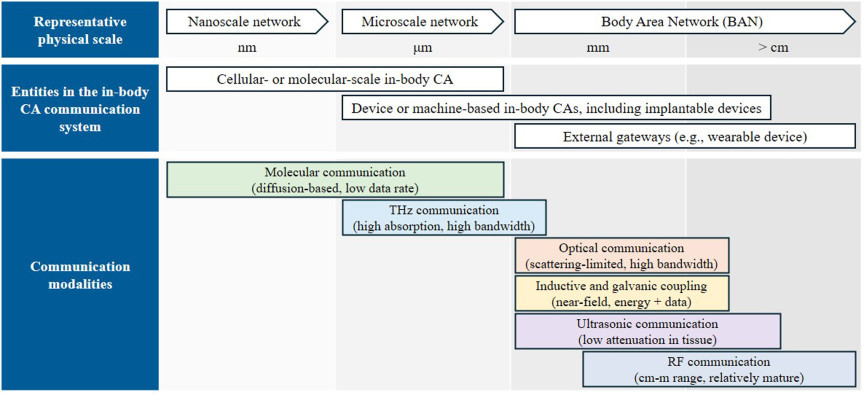
Fig. 1. Multi-scale mapping of entities and communication modalities in an in-body CA communication system, highlighting their characteristics and the need for integrated design. The horizontal position and extent of each entity and communication modality box indicate their representative ranges of applicability along the physical-scale axis shown above. The vertical alignment facilitates comparison between system entities and communication modalities applicable at similar scales.
From the viewpoint of scale, in-body communication can be broadly categorized into nano-, micro-, and millimeter-to-centimeter-scale regimes. As shown in Fig. 1, these communication modalities have overlapping applicabilities across different scales, and their feasible operation ranges are constrained by both physical and implementation factors. In particular, conventional electromagnetic communication based on antennas is inefficient at the nanoscale owing to physical size constraints. Therefore, molecular communication has been extensively investigated as a primary approach 3,4. More recently, terahertz communication has emerged as a promising alternative to nanoscale communication 12,13. In contrast, for millimeter-tocentimeter-scale devices, RF communication and inductive coupling are widely employed and have reached a relatively high level of implementation maturity 11,14,15. Generally, smaller-scale communications tend to be dominated by theoretical research, whereas larger-scale systems are more mature and ready for practical deployment.
From the viewpoint of communication media, in-body communication can be organized into several modalities, including molecular communication, electromagnetic communication (e.g., RF and terahertz), inductive coupling, ultrasonic communication, and optical communication, each associated with distinct physical mechanisms and constraints. Molecular communication offers high biocompatibility but suffers from low data rates 16, whereas terahertz communication provides high bandwidth but experiences significant attenuation in biological tissues 12,13. RF communication enables relatively long-range and reliable links, making it a practical foundation for in-body systems 6,15. Inductive coupling and wireless power transfer are particularly important because they enable simultaneous communication and energy delivery 17.
From the viewpoint of function, in-body communication is not limited to data transmission, but supports a wide range of roles, including sensing data acquisition, actuation control, inter-device coordination, and interaction with external systems. For example, wireless capsule endoscopy primarily involves data transmission from inside the body to an external receiver 6,14, whereas future in-body CA applications are expected to involve cooperative operations among multiple devices through mutual communication 7.
Based on this three-axis taxonomy and the relationships illustrated in Fig. 1, in-body communication can be regarded as a design problem requiring the selection and integration of appropriate communication modalities under multiple constraints. In particular, because feasible communication media and functions vary significantly with scale, it is difficult to realize a unified system using a single communication method. Therefore, a combination of communication modalities, tailored to different scales, is required. This scale dependency constitutes a fundamental constraint in the integrated design of in-body CA communication systems, and directly motivated the development of the hierarchical architecture presented in Section 5.
3. Communication Modalities for In-Body CAs
This section presents representative communication modalities for in-body CAs based on the taxonomy introduced in Section 2. Table 1 summarizes the characteristics of these representative communication modalities in terms of their physical scale, communication range, representative data-rate range, key advantages, and constraints. The communication and data-rate ranges listed in Table 1 should be interpreted as indicative rather than fixed performance limits because the actual values depend strongly on the implementation, communication distance, tissue conditions, device size, and available power. In addition, other quantitative factors such as attenuation and power consumption depend on different sets of operating and implementation conditions. Attenuation is influenced by factors such as the tissue type, frequency band, and communication distance, whereas the power consumption depends on the device architecture, antenna or transducer characteristics, data-rate requirements, and implementation. Therefore, rather than providing fixed numerical values for these factors, Table 1 summarizes them as design constraints reflecting communication performance, biocompatibility, and implementation feasibility combinations. For example, terahertz and optical communication methods offer high data rates but are limited by strong tissue attenuation over short distances, whereas RF and coupling-based methods are more practical for implant-to-wearable or near-field communication under severe power constraints.
|
Communication modality |
Physical scale |
Communication range |
Representative data-rate range\(^{\boldsymbol{\ast}}\) |
Key advantage | Key constraints |
|
Molecular communication |
nm–μm | 10 nm–sub-mm |
Very low (bps–kbps) |
|
|
|
THz communication |
μm–sub-mm | sub-mm–mm | Very high (Mbps–Gbps) |
|
|
|
Optical communication |
μm–mm | mm–cm |
High (Mbps–Gbps) |
|
|
|
Coupling-based communication |
mm–cm | a few cm | Low to medium (kbps–Mbps) |
|
|
|
Ultrasonic communication |
mm–cm | up to a few cm | Low to medium (kbps–Mbps) |
|
|
|
RF communication |
mm–cm | cm–m | Medium (kbps–Mbps) |
|
|
\(^*\)Data-rate values indicate representative orders of magnitude and may vary depending on the implementation, communication distance, tissue conditions, device size, and power constraints.
These modalities are categorized into three groups: (i) practical and mature communication methods such as RF and coupling-based techniques; (ii) emerging and alternative communication modalities, including terahertz and optical communication; and (iii) molecular communication for nanoscale information transfer. These classifications reflect not only the differences in communication media, but also variations in the implementation maturity, applicable scale, and functional roles within in-body CA systems. By comparing these modalities in terms of their characteristics, constraints, and applicability, their respective roles in the design of in-body CA communication systems can be clarified.
3.1. RF, Coupling-Based, and Ultrasonic Communication for BAN and In-Body-to-Off-Body Links
RF communication and coupling-based techniques represent the most mature in-body communication modalities to date and are widely employed as core technologies in BANs. As illustrated in Fig. 1, BAN environments involve multiple communication scenarios, including implant-to-implant communication, in-body-to-off-body communication, on-body device communication, and connectivity to external networks. These scenarios impose different requirements in terms of the communication distance, data rate, and power consumption, necessitating the selection of appropriate communication methods depending on the application.
RF communication utilizes conventional frequency bands, such as the sub-gigahertz and 2.4 GHz bands, as well as dedicated medical bands, such as the medical device radiocommunications service (MedRadio, 401–406 MHz), to enable communication between implanted devices and external systems, as well as between in-body devices 6,7,14. These systems typically support communication distances ranging from centimeters to meters, and provide relatively stable links. Another important feature is a well-established standardization and regulatory framework. For example, IEEE 802.15.6 defines communication standards for in- and on-body networks 18, whereas the Federal Communications Commission MedRadio regulations specify the spectrum usage for medical applications a. In addition, the U.S. Food and Drug Administration provides design guidelines addressing the interference resilience and coexistence requirements for wireless medical devices [19, b]. Furthermore, recent studies have demonstrated the feasibility of implant-to-implant communication, which enables the realization of in-body networks based on direct communication between devices 7.
In addition to RF communication, coupling-based methods play an important role in short-range communication and wireless power transfer. Representative approaches include inductive coupling, which uses magnetic fields 20, and galvanic coupling, which relies on electrical conduction through biological tissues 21. Inductive coupling is suitable for communication and power transfer between external devices and implants or among closely spaced implants, enabling simultaneous information exchange and energy delivery 17. However, it involves a trade-off between the communication distance and power transfer efficiency, and requires precise alignment. Galvanic coupling enables efficient signal transmission through conductive tissues, but typically requires electrode contact, limiting its applicability and introducing constraints related to biological safety.
Alternative physical methods, such as ultrasonic communication, have also been investigated in BAN environments 22. Ultrasound exhibits relatively low attenuation in biological tissues, enabling communication over several centimeters, and offering strong compatibility with existing medical imaging and therapeutic technologies. However, challenges remain in terms of system-level validation and integration into miniaturized devices.
Despite their maturity, these communication methods have several common challenges, including power supply constraints, limited communication ranges, safety considerations, and sensitivity to device positioning. In particular, inductive coupling faces trade-offs between communication and power transfer. Galvanic coupling is constrained by safety and electrode requirements, and RF communication is affected by propagation loss and power limitations.
Overall, RF- and coupling-based methods represent the most practical communication technologies for short- to mid-term in-body CA systems. However, their applicability is constrained by the communication range, device configuration, and operational conditions, making it necessary to carefully select and design communication methods based on the application requirements. Moreover, because these approaches are primarily applicable at the millimeter scale and above, they have inherent limitations when directly interfacing with nanoscale devices. Therefore, integrated designs combining multiple communication modalities across different scales are required.
3.2. Emerging and Alternative In-Body Communication Modalities
In recent years, new communication modalities such as terahertz and optical communication have been investigated as alternatives to short-range in-body communication. These approaches are based on physical principles that differ from those of conventional RF communications and are primarily targeted at specific scales and short-range scenarios.
Terahertz communication has been proposed as an electromagnetic communication method for nanoscale devices. For devices on the order of several micrometers, the relationship between the antenna size and wavelength makes the terahertz band suitable. This band offers an extremely wide bandwidth, enabling high-data-rate communication 12,13,23. However, in biological environments, terahertz signals experience significant attenuation owing to absorption by water molecules, which limits communication distances to the sub-millimeter or millimeter range. In addition, challenges such as propagation channel variability in dynamic environments (e.g., blood flow) and the realization of nanoscale transceivers and power sources remain unresolved. Consequently, most studies have been theoretical or simulation-based.
Optical communication, utilizing visible or near-infrared light, enables high-bandwidth data transmission 24,25. Certain wavelength ranges exhibit relatively low absorption in biological tissues. However, optical signals are strongly affected by scattering, and their line-of-sight characteristics make communication highly dependent on device alignment and positioning. These factors limit the robustness of optical links. Furthermore, constraints exist in terms of miniaturizing light sources and receivers (e.g., single-photon avalanche diodes) and providing sufficient power.
Although these communication modalities can be effective under specific conditions, establishing them as a standalone communication infrastructure for in-body CA systems remains difficult. Instead, their effective use requires careful selection and integration based on the scale and application requirements.
3.3. Molecular Communication
Molecular communication is a bio-inspired communication paradigm that utilizes the diffusion and transport of molecules to encode and transmit information 3,4. Representative mechanisms include Förster resonance energy transfer and molecular diffusion processes such as calcium signaling, both of which exhibit strong compatibility with biochemical processes inside and outside the cells. This approach is particularly promising for nanoscale communication and is well-suited for applications such as cellular-level sensing and targeted drug delivery.
The primary advantages of molecular communication are its high biocompatibility and suitability for extremely small-scale applications. However, this method has some fundamental limitations. Diffusion-based communications inherently result in extremely low data rates and long delays 16. In addition, owing to the stochastic nature of molecular propagation, previously released molecules may persist in the environment and interfere with subsequent transmissions. This phenomenon, which is commonly modeled as inter-symbol interference (ISI), significantly degrades the communication performance. Furthermore, communication characteristics strongly depend on environmental factors, such as the diffusion conditions and flow dynamics (e.g., blood flow). Communication distances are typically limited to a range of tens of nanometers to hundreds of micrometers. Interoperability with other communication modalities (e.g., electromagnetic communication) is also limited.
As discussed in the nanonetwork studies by Akyildiz et al., molecular communication represents a promising new communication paradigm; however, significant challenges remain in terms of the communication performance, controllability, and practical implementation 10. Therefore, although molecular communication is suitable for localized information exchange at the cellular and nanoscale levels, it is insufficient for long-range communication or interactions with external systems. Instead, it is expected to function as a component of broader multimodal in-body CA communication architectures.
4. Structural Gaps in Communication Design for In-Body CA Systems
The fundamental challenge facing in-body CA communication is the significant variability of the communication modalities, performance requirements, and design constraints based on the scale and application. Molecular and terahertz communication methods are considered viable candidates at the nanoscale, whereas at the millimeter scale and above, RF communication and inductive coupling are predominantly used. This difference is not merely a variation in the communication medium but reflects fundamental differences in the communication feasibility and design objectives. Specifically, nanoscale communication prioritizes localized information transfer and compatibility with biological processes, whereas larger-scale communication is governed by requirements such as the communication range, bandwidth, standard compliance, and power transfer efficiency. Consequently, direct communication across different scales is not always feasible, and discontinuities arise between communication modalities and information representations. To address this problem, gateway (GW) mechanisms are required to bridge heterogeneous communication domains across different scales. In this paper, the term GW refers to the functional role of translating and relaying information between communication modalities.
In practice, the implementation of GW mechanisms may introduce several technical challenges specific to cross-domain interfaces. For instance, the translation between biochemical information and electrical or electromagnetic signals may require appropriate mapping between different information representations and signal formats. In addition, differences in the communication latency, timescale, and update rate across communication modalities may affect the synchronization and timing consistency in cross-scale information transfer. The compatibility of interfaces and protocols across the molecular, electromagnetic, and coupling-based communication domains has not yet been fully established, which may complicate the integration of heterogeneous modalities. These issues should be considered when designing the GW functions for cross-scale in-body CA communication systems.
At the system level, the selection of communication modalities in in-body CA systems is not solely determined by the communication performance. In-body devices are subject to strict power constraints and influenced by factors such as electromagnetic attenuation in biological tissues, material limitations, biocompatibility, and encapsulation technologies. In addition, medical safety requirements, regulatory compliance, and cybersecurity considerations play critical roles in the system design. Therefore, in-body communication must be investigated not only as a channel optimization problem but also as a multi-domain optimization problem that incorporates device implementation, clinical safety, and regulatory constraints.
Considering these scale dependencies and diverse constraints, designing in-body CA communication as a uniform connectivity framework based on a single communication modality is difficult. Instead, a hierarchical and selective design approach is required, in which communication methods are chosen and combined according to the application requirements, scale, and constraints. In particular, in-body CA systems spanning a range from the nanoscale to macroscale require relay and interface mechanisms that connect heterogeneous communication modalities, as well as hierarchical structures that bridge local in-body communication and body-to-external communication. In this sense, the essence of in-body CA communication lies not in optimizing a single communication link, but in achieving an integrated design that accounts for heterogeneity across scales, media, and functions.
5. Design Implications for In-Body CA
In systems where multiple in-body CAs operate cooperatively across different physical scales and interact with external systems, end-to-end information transfer cannot generally be achieved using a single communication modality. Instead, the overall communication system should be designed as a hierarchical architecture integrating multiple communication mechanisms across different functional layers and physical media. Fig. 2 illustrates the conceptual architecture of a multilayer communication and information integration system for cooperative in-body CAs. The GW labels in Fig. 2 indicate where the information translation and relay functions are performed within the architecture.
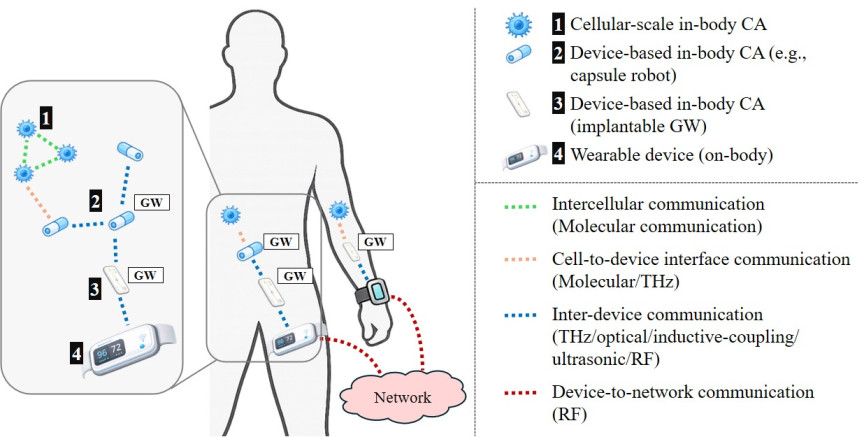
Fig. 2. Conceptual multi-layer communication architecture for cooperative in-body CA systems. The left inset shows an example flow from cellular- or molecular-scale sensors to external networks via device-based and implantable in-body CAs and wearable devices. GW mechanisms support information translation and relaying across heterogeneous communication domains, while the communication modalities shown are representative and may vary depending on the scale, application requirements, and implementation conditions.
In this architecture, in-body CAs are categorized based on their functional roles and implementation forms, rather than purely on a physical scale. Specifically, the device- or machine-based categories introduced in Section 1 are further divided into local device-based and implantable CAs, which serve as aggregation or interface nodes. In the lowest layer, cellular-scale in-body CAs operate in close proximity to biological processes and perform localized sensing and information exchange. CAs rely on communication mechanisms that are tightly coupled with biochemical interactions at the cellular level.
In the intermediate layer, device-based in-body CAs are distributed within the body and provide localized data acquisition and short-range information exchange. These devices may utilize communication mechanisms such as short-range electromagnetic communication, including terahertz-band communication, depending on their design and operational requirements. Compared to cellular-scale CAs, device-based CAs offer more structured and controllable communication capabilities, while operating within localized regions.
In the higher layers, implantable in-body CAs function as aggregates and interface nodes within the body. These implantable devices collect information from multiple lower-layer CAs, and serve as GWs for communication across heterogeneous domains. Implantable CAs can act as subcutaneous GWs that bridge in-body communication modalities with body-surface and external communication systems.
Wearable devices located on the body form the outermost interface layer of a communication system. These devices communicate with implantable CAs using electromagnetic communication methods, such as RF communication and inductive coupling, and relay information to external networks. Consequently, the overall system exhibits a layered structure in which different communication modalities are employed according to the functional role and placement of each entity.
Communication across these layers is not always directly feasible because of discontinuities in the communication media and information representation. For example, the chemically encoded information used in molecular communication is inherently incompatible with the electromagnetic signals used in RF communication. To address this issue, GW mechanisms are required to perform translations and relay information between different communication domains. In this architecture, device-based in-body CAs can serve as local cross-scale GWs between cellular- or molecular-scale sensing and device-level communication domains.
Furthermore, the communication designs of in-body CA systems strongly depend on the application requirements and operational modes. In monitoring-oriented applications, communication is primarily directed from in-body CAs to wearable devices and external systems, requiring low-power and reliable uplink transmission. By contrast, applications involving external control, actuation, or stimulation require bidirectional communication with appropriate levels of latency and reliability. At the cellular and device levels, communication is often tightly integrated with sensing and local biological processes, making it essential to define application-specific communication functions and select suitable modalities.
As an illustrative design scenario, consider an in-body CA system that integrates intracellular or tissue-level sensing with external monitoring and information processing. In such a system, information is first generated at the cellular or molecular scale using biochemical sensing processes. At these scales, molecular communication can be regarded as a suitable mechanism for localized information transfer owing to its compatibility with biological environments. Such information is generally difficult to transfer directly to larger-scale devices or external networks because the communication media, information representations, communication ranges, and power constraints differ significantly across scales.
Therefore, the generated information may need to be relayed through device-based in-body CAs that can serve as intermediate nodes for local aggregation, processing, or translation. Depending on the communication distance, device size, and implementation constraints, short-range electromagnetic communication, optical communication, coupling-based communication, and other suitable modalities can be used. Implantable in-body CAs can function as GWs that connect local communication domains to wearable devices through RF communication or coupling-based methods. Wearable devices can relay information to external networks for monitoring, analysis, or control. This example illustrates how the proposed framework can help organize the design space by considering the scale, communication medium, and function, and can clarify where heterogeneous communication modalities and GW mechanisms are required.
Although this scenario describes a simplified information flow, future in-body CA systems are expected to involve many diverse types of CAs with different scales, functions, and communication requirements. In these systems, information exchange across layers will become increasingly important. However, such integration cannot be achieved using a single communication modality. Systems that incorporate cellular-scale, device-based, implantable CAs inherently require heterogeneous communication mechanisms and coordinated cross-layer integration.
Consequently, the design of in-body CA systems requires not only the optimization of individual communication links, but also an architectural design that combines and interconnects multiple communication modalities. The essence of in-body CA systems lies not in maximizing the performance of a single communication method but in constructing a hierarchical and hybrid architecture that integrates heterogeneous communication media, functional roles, and system requirements.
The proposed framework is intended to be a general system-level representation of in-body CA communication and has several limitations. It does not prescribe specific implementation procedures or guarantee quantitative performance. In practical applications, the communication design depends on factors such as the target tissue or organ, device size, available power, safety requirements, and regulatory requirements. Therefore, detailed system design and optimization require application-specific considerations that were beyond the scope of this study. Nevertheless, the proposed framework provides a useful basis for organizing heterogeneous communication technologies and guiding the selection and integration of communication modalities and GW functions in cross-scale in-body CA systems.
6. Conclusion
This paper presented a systematic framework for understanding in-body CA communication by organizing communication technologies along three axes: the scale, communication medium, and function. Based on this framework, in-body communication was investigated as an integrated design problem, rather than as a collection of independent communication techniques. In-body communication spans a wide range of modalities, from molecular and terahertz communication at the nanoscale to RF communication and inductive coupling at the millimeter scale and above. These modalities exhibit fundamentally different constraints and applicabilities, making it difficult to construct a unified system based on a single communication method. Instead, the appropriate selection and combination of communication modalities based on the scale and application requirements are essential.
Furthermore, in-body communication design is influenced not only by the communication performance requirements, but also by factors that include the power constraints, biocompatibility, safety, and regulatory requirements. Therefore, it should be treated as a multi-domain optimization problem that integrates communication, device implementation, and clinical constraints. Additionally, discontinuities between communication modalities across different scales necessitate hierarchical structures and GW mechanisms for cross-scale information integration. These findings indicate that the essence of in-body CA communication lies not in optimizing individual communication links but in achieving an integrated design that accounts for heterogeneity across scales, media, and functions. The proposed taxonomy and design guidelines provide a foundational framework for realizing in-body CA systems, including future systems involving intracellular and tissue-level sensing. This perspective supports a shift in the design paradigm of in-body communication from link-level optimization to system-level integration, enabling end-to-end information transmission architectures that connect information generated at the cellular and molecular scales with in-body devices, wearable devices, and external networks.
Future work will include the development of concrete architectural implementations based on the proposed framework, experimental validation, and the advancement of interface technologies for seamless integration across heterogeneous communication modalities.
Acknowledgments
A portion of this research was supported by the JST Moonshot R&D Goal 1, Grant Number JPMJMS2216.
- [1] N. Hagita et al., “Cybernetic avatars: Teleoperation technologies from in-body monitoring to social interaction,” Science Robotics, Vol.9, No.96, Article No.eadg1842, 2024. https://doi.org/10.1126/scirobotics.adg1842
- [2] IMARC, “Internet of Nano Things market by device type, communication type, network architecture, end user, and region 2026-2034,” 2026.
- [3] D. Malak and O. B. Akan, “Molecular communication nanonetworks inside human body,” Nano Commun. Netw., Vol.3, No.1, pp. 19-35, 2012. https://doi.org/10.1016/j.nancom.2011.10.002
- [4] T. Nakano, T. Suda, Y. Okaie, M. J. Moore, and A. V. Vasilakos, “Molecular communication among biological nanomachines: A layered architecture and research issues,” IEEE Trans. Nanobioscience, Vol.13, No.3, pp. 169-197, 2014. https://doi.org/10.1109/TNB.2014.2316674
- [5] S. Zafar et al., “A systematic review of bio-cyber interface technologies and security issues for Internet of Bio-Nano Things,” IEEE Access, Vol.9, pp. 93529-93566, 2021. https://doi.org/10.1109/ACCESS.2021.3093442
- [6] Q. Cao et al., “Robotic wireless capsule endoscopy: Recent advances and upcoming technologies,” Nature Communications, Vol.15, Article No.4597, 2024. https://doi.org/10.1038/s41467-024-49019-0
- [7] X. Tian et al., “Implant-to-implant wireless networking with metamaterial textiles,” Nature Communications, Vol.14, Article No.4335, 2023. https://doi.org/10.1038/s41467-023-39850-2
- [8] Y. Sun et al., “Magnetically driven capsules with multimodal response and multifunctionality for biomedical applications,” Nature Communications, Vol.15, Article No.1839, 2024. https://doi.org/10.1038/s41467-024-46046-9
- [9] W. Zhao, Y. Zhang, and N. Wang, “Soft robotics: Research, challenges, and prospects,” J. Robot. Mechatron., Vol.33, No.1, pp. 45-68, 2021. https://doi.org/jrm.2021.p0045
- [10] I. F. Akyildiz, F. Brunetti, and C. Blázquez, “Nanonetworks: A new communication paradigm,” Computer Networks, Vol.52, No.12, pp. 2260-2279, 2008. https://doi.org/10.1016/j.comnet.2008.04.001
- [11] P. Kulakowski, K. Turbic, and L. M. Correia, “From nano-communications to body area networks: A perspective on truly personal communications,” IEEE Access, Vol.8, pp. 159839-159853, 2020. https://doi.org/10.1109/ACCESS.2020.3015825
- [12] N. Saeed, M. H. Loukil, H. Sarieddeen, T. Y. Al-Naffouri, and M.-S. Alouini, “Body-centric terahertz networks: Prospects and challenges,” IEEE Trans. on Molecular, Biological, and Multi-Scale Communications, Vol.8, No.3, pp. 138-157, 2021. https://doi.org/10.1109/TMBMC.2021.3135198
- [13] R. Zhang et al., “Modelling of the terahertz communication channel for in-vivo nano-networks in the presence of noise,” Proc. 16th Mediterranean Microwave Symposium (MMS), 2016. https://doi.org/10.1109/MMS.2016.7803812
- [14] S. Yoshida, H. Miyaguchi, and T. Nakamura, “Development of ingestible thermometer with built-in coil antenna charged by gastric acid battery and demonstration of long-time in vivo telemetry,” IEEE Access, Vol.9, pp. 102368-102377, 2021. https://doi.org/10.1109/ACCESS.2021.3098333
- [15] T. V. de Steene et al., “Optimal frequency and wireless power budget for miniature receivers in obese people,” Sensors, Vol.23, No.19, Article No.8084, 2023. https://doi.org/10.3390/s23198084
- [16] M. C. Gursoy, M. Nasiri-Kenari, and U. Mitra, “Towards high data-rate diffusive molecular communications: A review on performance enhancement strategies,” Digital Signal Processing, Vol.124, Article No.103161, 2022. https://doi.org/10.1016/j.dsp.2021.103161
- [17] S. R. Khan, S. K. Pavuluri, G. Cummins, and M. P. Y. Desmulliez, “Wireless power transfer techniques for implantable medical devices: A review,” Sensors, Vol.20, No.12, Article No.3487, 2020. https://doi.org/10.3390/s20123487
- [18] “IEEE standard for local and metropolitan area networks – Part 15.6: Wireless body area networks,” IEEE 802.15.6-2012, 2012. https://doi.org/10.1109/IEEESTD.2012.6161600
- [19] U.S. Food and Drug Administration (FDA), “Radio frequency wireless technology in medical devices; Guidance for industry and food and drug administration staff,” 2013.
- [20] J. Walk et al., “Remote powered medical implants for telemonitoring,” Proc. of the IEEE, Vol.102, No.11, pp. 1811-1832, 2014. https://doi.org/10.1109/JPROC.2014.2359517
- [21] M. S. Wegmueller, M. Oberle, N. Felber, N. Kuster, and W. Fichtner, “Signal transmission by Galvanic coupling through the human body,” IEEE Trans. Instrumentation and Measurement, Vol.59, No.4, pp. 963-969, 2010. https://doi.org/10.1109/TIM.2009.2031449
- [22] L. Galluccio, A. Lombardo, R. Raftopoulos, C. Ricci, and S. Rossitto, “Design of next generation ultrasonic-based healthcare transmission systems exploiting MAB,” Proc. 11th Annual ACM Int. Conf. on Nanoscale Computing and Communication (NANOCOM’24), pp. 78-84, 2024. https://doi.org/10.1145/3686015.3689358
- [23] W. Jiang et al., “Terahertz communications and sensing for 6G and beyond: A comprehensive review,” IEEE Communications Surveys & Tutorials, Vol.26, No.4, pp. 2326-2381, 2024. https://doi.org/10.1109/COMST.2024.3385908
- [24] T. Liu, U. Bihr, S. M. Anis, and M. Ortmanns, “Optical transcutaneous link for low power, high data rate telemetry,” 2012 Annual Int. Conf. of the IEEE Engineering in Medicine and Biology Society, 2012. https://doi.org/10.1109/EMBC.2012.6346729
- [25] M. Mimee et al., “An ingestible bacterial-electronic system to monitor gastrointestinal health,” Science, Vol.360, No.6391, pp. 915-918, 2018. https://doi.org/10.1126/science.aas9315
- [a] Code of Federal Regulations, Title 47, Part 95, “Subpart I—Medical device radio communications service (MedRadio),” eCFR, U.S. Government Publishing Office. https://www.ecfr.gov/current/title-47/chapter-I/subchapter-D/part-95/subpart-I [Accessed October 1, 2026]
- [b] U.S. FDA, “Wireless medical devices,” 2018. https://www.fda.gov/medical-devices/digital-health-center-excellence/wireless-medical-devices [Accessed October 1, 2026]
This article is published under a Creative Commons Attribution-NoDerivatives 4.0 Internationa License.