
Paper:
A Novel Supercooling-Based Nonfreezing Preservation Method for Early Embryos Using Plant-Derived Substances to Maintain Cellular Integrity
Yumi Hoshino
 and Masashi Ikeuchi
Department of Precision Biomedical Engineering, Institute of Science Tokyo
2-3-10 Kanda Surugadai, Chiyoda-ku, Tokyo 101-0062, Japan

Maintaining cellular integrity during storage is essential for the stable handling and quality control of living cells in future sensor-integrated biological systems. In this study, we investigated whether plant-derived substances improve the effectiveness of a supercooling-based nonfreezing preservation method for early embryos while maintaining cellular integrity. Mouse 2-cell embryos were used as a model system, and the University of Wisconsin (UW) solution was used as the basal preservation medium. Coffee lees extract was examined as a plant-derived preservation agent, and its representative components, caffeine and chlorogenic acid, were evaluated. Embryos preserved in UW solution alone at -6°C for 72 h showed residual membrane deformation, whereas supplementation with coffee lees extract, particularly at 10%, improved post-preservation morphology. Caffeine showed concentration-dependent protective and adverse effects, with the intermediate concentration providing the most favorable preservation outcome. Additional supporting experiments demonstrated that coffee lees extract and caffeine maintained stable supercooling without freezing under prolonged storage conditions and improved cytoskeletal integrity and post-preservation developmental competence, as assessed by blastocyst development after culture. These findings demonstrate that natural plant-derived substances enhance the nonfreezing preservation of early embryos under supercooling conditions while maintaining cellular integrity. The proposed method may provide a practical basis for the storage, transport, and quality control of living cells and support future applications involving sensor-integrated biological systems.
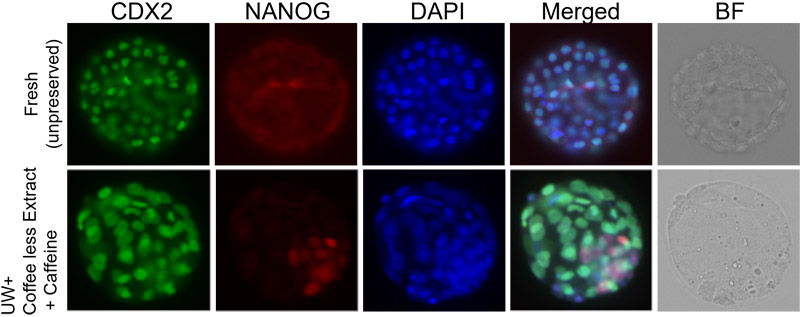
Blastocysts after 7-day supercooling
- [1] N. Gupta, V. Renugopalakrishnan, D. Liepmann, R. Paulmurugan, and B. D. Malhotra, “Cell-based Biosensors: Recent Trends, Challenges and Future Perspectives,” Biosens. Bioelectron., Vol.141, Article No.111435, 2019. https://doi.org/10.1016/j.bios.2019.111435
- [2] S. Wang and G. D. Elliott, “Synergistic Development of Biochips and Cell Preservation Methodologies: A Tale of Converging Technologies,” Curr. Stem Cell Rep., Vol.3, No.1, pp. 45-53, 2017. https://doi.org/10.1007/s40778-017-0074-8
- [3] J. Liebermann, J. Dietl, P. Vanderzwalmen, and M. J. Tucker, “Recent Developments in Human Oocyte, Embryo and Blastocyst Vitrification: Where Are We Now?,” Reprod. Biomed. Online, Vol.7, No.6, pp. 623-633, 2003. https://doi.org/10.1016/s1472-6483(10)62084-6
- [4] B. P. Best, “Cryoprotectant Toxicity: Facts, Issues, and Questions,” Rejuvenation Res., Vol.18, No.5, pp. 422-436, 2015. https://doi.org/10.1089/rej.2014.1656
- [5] T. A. Berendsen, B. G. Bruinsma, C. F. Puts, N. Saeidi, O. B. Usta, B. E. Uygun, M. L. Izamis, M. Toner, M. L. Yarmush, and K. Uygun, “Supercooling Enables Long-Term Transplantation Survival Following 4 Days of Liver Preservation,” Nat. Med., Vol.20, No.7, pp. 790-793, 2014. https://doi.org/10.1038/nm.3588
- [6] S. Fujikawa, C. Kuwabara, J. Kasuga, and K. Arakawa, “Supercooling-Promoting (Anti-ice Nucleation) Substances,” M. Iwaya-Inoue, M. Sakurai, and M. Uemura (Eds.), “Survival Strategies in Extreme Cold and Desiccation,” pp. 289-320, 2018. https://doi.org/10.1007/978-981-13-1244-1_16
- [7] H. Kawahara, E. Tagawa, C. Watanabe, J. Hamada, and S. Hamada, “Characterization of Anti-Ice Nucleation Activity of the Extract from Coffee Refuse,” Biocontrol. Sci., Vol.22, No.4, pp. 205-211, 2017. https://doi.org/10.4265/bio.22.205
- [8] F. Ariu, L. Bogliolo, G. Leoni, L. Falchi, D. Bebbere, S. M. Nieddu, M. T. Zedda, S. Pau, and S. Ledda, “Effect of Caffeine Treatment Before Vitrification on MPF and MAPK Activity and Spontaneous Parthenogenetic Activation of In Vitro Matured Ovine Oocytes,” Cryo Letters, Vol.35, No.6, pp. 530-536, 2014.
- [9] B. A. Pereira, B. R. Chaves, M. C. Teles, T. P. Pontelo, C. R. Oliveira, R. V. de Souza, J. E. Rodriguez-Gil, and M. G. Zangeronimo, “Chlorogenic Acid Improves the Quality of Boar Semen Subjected to Cooled Storage at 15°C,” Andrologia, Vol.50, No.5, Article No.e12978, 2018. https://doi.org/10.1111/and.12978
- [10] Y. Hoshino and E. Sato, “Protein Kinase B (PKB/Akt) Is Required for the Completion of Meiosis in Mouse Oocytes,” Dev. Biol., Vol.314, No.1, pp. 215-223, 2008. https://doi.org/10.1016/j.ydbio.2007.12.005
- [11] Y. Hoshino and T. Uchida, “Prolyl Isomerase, Pin1, Controls Meiotic Progression in Mouse Oocytes,” Cells, Vol.11, No.23, Article No.3772, 2022. https://doi.org/10.3390/cells11233772
- [12] S. Bessonnard, S. Vandormael-Pournin, S. Coqueran, M. Cohen-Tannoudji, and J. Artus, “PDGF Signaling in Primitive Endoderm Cell Survival Is Mediated by PI3K-mTOR Through p53-Independent Mechanism,” Stem Cells, Vol.37, No.7, pp. 888-898, 2019. https://doi.org/10.1002/stem.3008
- [13] G. D. Elliott, S. Wang, and B. J. Fuller, “Cryoprotectants: A Review of the Actions and Applications of Cryoprotective Solutes that Modulate Cell Recovery from Ultra-Low Temperatures,” Cryobiology, Vol.76, pp. 74-91, 2017. https://doi.org/10.1016/j.cryobiol.2017.04.004
This article is published under a Creative Commons Attribution-NoDerivatives 4.0 Internationa License.