
Paper:
Engineering of LNA-Modified DNA-AuNP Nanomachines for Intracellular miRNA Imaging
Maasa Yokomori*,**
 , Keitaro Yoshimoto**
, and Yoko Yamanishi***
*Department of Precision Mechanical Engineering, School of Science and Engineering, Chuo University
1-13-27 Kasuga, Bunkyo-ku, Tokyo 112-8551, Japan
**Department of Life Sciences, Graduate School of Arts and Sciences, The University of Tokyo
3-8-1 Komaba, Meguro-ku, Tokyo 153-8902, Japan
***Department of Mechanical Engineering, Faculty of Engineering, Kyushu University
744 Motooka, Nishi-ku, Fukuoka, Fukuoka 819-0395, Japan

DNA nanomachines based on gold nanoparticles (AuNPs) are promising platforms for intracellular sensing of microRNAs (miRNAs), which are biomarkers involved in a wide range of diseases. However, achieving robust performance under intracellular conditions remains challenging. In this study, we investigated the effect of locked nucleic acid (LNA) modification on an entropy-driven DNA-AuNP nanomachine designed for miRNA detection. By incorporating LNA into probe sequences, we evaluated signal generation, sensitivity, and selectivity under cytosol-mimicking conditions. Consequently, appropriately designed LNA modifications substantially restored nanomachine functionality under intracellularly relevant conditions. In contrast, excessive or unfavorably positioned LNA incorporation led to increased nonspecific background signals. Under optimized conditions, the LNA-modified nanomachine achieved a detection limit of approximately 10 pM for miRNA-21 with high sequence specificity. Furthermore, when delivered into MCF-7 cancer cells using a transfection reagent, the LNA-modified DNA-AuNP nanomachine showed a higher fraction of fluorescence-positive cells compared with the unmodified system. This study clarifies the critical role of probe modification in the design of DNA-AuNP nanomachines operating within living cells and presents an effective strategy for realizing live-cell miRNA imaging based on molecular robotics concepts.
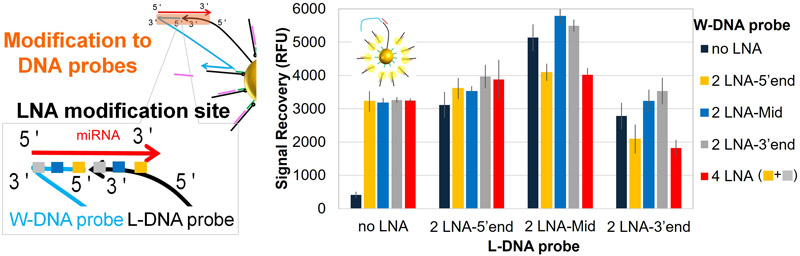
LNA positions affect signal recovery
- [1] A. Van Gool et al., “Analytical techniques for multiplex analysis of protein biomarkers,” Expert Rev. Proteomics, Vol.17, No.4, pp. 257-273, 2020. https://doi.org/10.1080/14789450.2020.1763174
- [2] M. Yokomori, O. Gotoh, Y. Murakami, K. Fujimoto, and A. Suyama, “A multiplex RNA quantification method to determine the absolute amounts of mRNA without reverse transcription,” Anal. Biochem., Vol.539, pp. 96-103, 2017. https://doi.org/10.1016/j.ab.2017.10.006
- [3] Y. Zhao et al., “Nucleic Acids Analysis,” Sci. China Chem., Vol.64, No.2, pp. 171-203, 2021. https://doi.org/10.1007/s11426-020-9864-7
- [4] S. Zhou et al., “Optimization of aptamer-triggered hybridization chain reaction for rapid visual ATP detection using gold nanoparticles,” Analytical Methods, Vol.18, No.7, pp. 1541-1547, 2026. https://doi.org/10.1039/D5AY01738F
- [5] D. P. Bartel, “MicroRNAs Genomics, Biogenesis, Mechanism, and Function,” Cell, Vol.116, pp. 281-297, 2004. https://doi.org/10.1016/S0092-8674(04)00045-5
- [6] L. F. R. Gebert and I. J. MacRae, “Regulation of microRNA function in animals,” Nat. Rev. Mol. Cell Biol., Vol.20, No.1, pp. 21-37, 2019. https://doi.org/10.1038/s41580-018-0045-7
- [7] Y. Wu, Q. Li, R. Zhang, X. Dai, W. Chen, and D. Xing, “Circulating microRNAs: Biomarkers of disease,” Clinica Chimica Acta, Vol.516, pp. 46-54, 2021. https://doi.org/10.1016/j.cca.2021.01.008
- [8] H. Dong, J. Lei, L. Ding, Y. Wen, H. Ju, and X. Zhang, “MicroRNA: Function, detection, and bioanalysis,” Chem. Rev., Vol.113, No.8, pp. 6207-6233, 2013. https://doi.org/10.1021/cr300362f
- [9] H. Peng et al., “Signal amplification in living cells: A review of microRNA detection and imaging,” Anal. Chem., Vol.92, No.1, pp. 292-308, 2020. https://doi.org/10.1021/acs.analchem.9b04752
- [10] H. Shibuya, S. Okada, and K. Shoji, “Control of Osmotic-Engine-Driven Liposomes Using Biological Nanopores,” J. Robot. Mechatron., Vol.35, No.5, pp. 1213-1218, 2023. https://doi.org/10.20965/jrm.2023.p1213
- [11] M. Akter and A. Kakugo, “Biomolecular Motor-Based Swarm Robot: An Innovation in Molecular Delivery,” J. Robot. Mechatron., Vol.35, No.4, pp. 1047-1051, 2023. https://doi.org/10.20965/jrm.2023.p1047
- [12] S. Yang, X. Zhan, L. Yuan, M. L. de la Chapelle, W. Fu, and X. Yang, “Entropy driven-based catalytic biosensors for bioanalysis: From construction to application—A review,” Anal. Chim. Acta, Vol.1338, Article No.343549, 2025. https://doi.org/10.1016/j.aca.2024.343549
- [13] Q. Zhang, S. Xu, J. Zheng, J.-R. Zhang, and J.-J. Zhu, “Advances in self-assembled Au-DNA nanomachines,” iScience, Vol.26, No.4, Article No.106327, 2023. https://doi.org/10.1016/j.isci.2023.106327
- [14] E. Dulkeith et al., “Fluorescence Quenching of Dye Molecules near Gold Nanoparticles: Radiative and Nonradiative Effects,” Phys. Rev. Lett., Vol.89, No.20, Article No.203002, 2002. https://doi.org/10.1103/PhysRevLett.89.203002
- [15] D. S. Seferos, A. E. Prigodich, D. A. Giljohann, P. C. Patel, and C. A. Mirkin, “Polyvalent DNA Nanoparticle Conjugates Stabilize Nucleic Acids,” Nano Lett., Vol.9, No.1, pp. 308-311, 2009. https://doi.org/10.1021/nl802958f
- [16] C. Liang, P. Ma, H. Liu, X. Guo, B. Yin, and B. Ye, “Rational Engineering of a Dynamic, Entropy-Driven DNA Nanomachine for Intracellular MicroRNA Imaging,” Angewandte Chemie, Vol.129, No.31, pp. 9205-9209, 2017. https://doi.org/10.1002/ange.201704147
- [17] J. Marmur and P. Doty, “Determination of the base composition of deoxyribonucleic acid from its thermal denaturation temperature,” J. Mol. Biol., Vol.5, No.1, pp. 109-118, 1962. https://doi.org/10.1016/S0022-2836(62)80066-7
- [18] M. Yokomori, M. Murasawa, M. Matsuo, M. Nagano, and K. Yoshimoto, “Design and Evaluation of Sticky End-Type Bivalent DNA Aptamers Containing M08s-1 as Anticoagulant Agents,” ChemMedChem, Vol.20, No.23, Article No.e202500688, 2025. https://doi.org/10.1002/cmdc.202500688
- [19] J. Xu and S. L. Craig, “Thermodynamics of DNA hybridization on gold nanoparticles,” J. Am. Chem. Soc., Vol.127, No.38, pp. 13227-13231, 2005. https://doi.org/10.1021/ja052352h
- [20] S. J. Hurst, H. D. Hill, and C. A. Mirkin, “‘Three-dimensional hybridization’ with polyvalent DNA–gold nanoparticle conjugates,” J. Am. Chem. Soc., Vol.130, No.36, pp. 12192-12200, 2008. https://doi.org/10.1021/ja804266j
- [21] P. S. Randeria et al., “What Controls the Hybridization Thermodynamics of Spherical Nucleic Acids?,” J. Am. Chem. Soc., Vol.137, No.10, pp. 3486-3489, 2015. https://doi.org/10.1021/jacs.5b00670
- [22] T. Mana, B. Bhattacharya, H. Lahiri, and R. Mukhopadhyay, “XNAs: A Troubleshooter for Nucleic Acid Sensing,” ACS Omega, Vol.7, No.18, pp. 15296-15307, 2022. https://doi.org/10.1021/acsomega.2c00581
- [23] M. Petersen and J. Wengel, “LNA: A versatile tool for therapeutics and genomics,” Trends Biotechnol., Vol.21, No.2, pp. 74-81, 2003. https://doi.org/10.1016/S0167-7799(02)00038-0
- [24] B. Vester and J. Wengel, “LNA (Locked Nucleic Acid): High-affinity targeting of complementary RNA and DNA,” Biochemistry, Vol.43, No.42, pp. 13233-13241, 2004. https://doi.org/10.1021/bi0485732
- [25] S. K. Singh, A. A. Koshkin, J. Wengel, and P. Nielsen, “LNA (locked nucleic Acids): Synthesis and high-affinity nucleic acid recognition,” Chemical Communications, Vol.34, No.4, pp. 455-456, 1998. https://doi.org/10.1039/a708608c
- [26] R. Thomsen, P. S. Nielsen, and T. H. Jensen, “Dramatically improved RNA in situ hybridization signals using LNA-modified probes,” RNA, Vol.11, No.11, pp. 1745-1748, 2005. https://doi.org/10.1261/rna.2139705
- [27] S. B. Zimmerman and A. P. Minton, “Macromolecular Crowding: Biochemical, Biophysical, and Physiological Consequences,” Annu. Rev. Biophys. Biomol. Struct., Vol.22, No.1, pp. 27-65, 1993. https://doi.org/10.1146/annurev.bb.22.060193.000331
- [28] M. Yokomori, H. Suzuki, A. Nakamura, S. S. Sugano, and M. Tagawa, “DNA-functionalized colloidal crystals for macromolecular encapsulation,” Soft Matter, Vol.18, No.36, pp. 6954-6964, 2022. https://doi.org/10.1039/D2SM00949H
This article is published under a Creative Commons Attribution-NoDerivatives 4.0 Internationa License.