
Paper:
Electrically Induced Bubble-Assisted Substance Delivery into Intact Plant Cells and Tissues
Yuudai Aokusa*
 , Kei Tateishi*, Nobutoshi Ota*
, Mayu Nakahigashi*, Shigeaki Miura*, Yasuhiro Moriizumi**, So Makabe**, and Yoko Yamanishi*
*Department of Mechanical Engineering, Kyushu University
744 Motooka, Nishi-ku, Fukuoka, Fukuoka 819-0395, Japan
**BEX Corporation
2-61-14 Itabashi, Itabashi-ku, Tokyo 173-0004, Japan

Substance injection into plant cells is typically performed using protoplasts, in which the cell wall has been removed. However, the process of removing the cell wall imposes significant stress on the cells, making injection into tissue-like structures difficult. Injecting substances into plants not only streamlines plant breeding but also enables the introduction of sensors for detecting plant hormone responses, thereby facilitating the understanding and control of plant physiological states. This study proposes a method for injecting molecules into plants without removing the cell wall by utilizing the cavitation effect of electrically induced bubbles. The proposed device consists of a metal wire positioned inside a glass tube. By varying the diameter of the metal wire, the electrical and mechanical stimulation applied to the target can be controlled. Using this method, successful gene delivery was confirmed by fluorescence observation and RT-PCR analysis in plant cells (Tobacco BY-2 cells, Nicotiana tabacum L.) and plant tissue (Arabidopsis thaliana, hereafter referred to as Arabidopsis) without removing the cell wall. Considering the limited efficiency of gene delivery into plants using conventional electroporation, these results suggest that combining mechanical stimulation with electrical stimulation is an effective approach for substance delivery. Furthermore, because the delivery conditions can be tuned by adjusting the electrical and mechanical parameters, the proposed method has the potential to be applied to a wide range of plant and animal tissues.
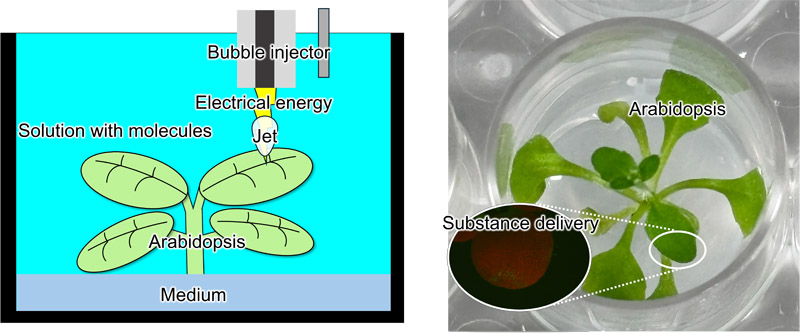
Substance delivery to plants by a bubble injector
- [1] J. D. Durand, “The Modern Expansion of World Population,” Proc. Am. Philos. Soc., Vol.111, No.3, pp. 136-159, 1967.
- [2] E. S. Deevey Jr., “The Human Crop,” Sci. Am., Vol.195, No.4, pp. 105-115, 1956. https://doi.org/10.1038/SCIENTIFICAMERICAN0456-105
- [3] T. Malthus, “An Essay on the Principle of Population, as it Affects the Future Improvement of Society, with Remarks on the Speculations of Mr. Godwin, M. Condorcet, and Other Writers,” K. A. Morrison (Ed.), “Charity and Philanthropy in Nineteenth-Century Britain,” Routledge, 2025.
- [4] K. Jiang and T. Asami, “Chemical regulators of plant hormones and their applications in basic research and agriculture,” Biosci. Biotechnol. Biochem., Vol.82, No.8, pp. 1265-1300, 2018. https://doi.org/10.1080/09168451.2018.1462693
- [5] J. R. Zupan and P. Zambryski, “Transfer of T-DNA from Agrobacterium to the plant cell,” Plant Physiol., Vol.107, No.4, pp. 1041-1047, 1995. https://doi.org/10.1104/pp.107.4.1041
- [6] S. Sabu, S. Khanam, and A. J. Subitsha, “Agrobacterium-Mediated Transformation in Oryza Sativa (Rice) to Improve Crop Yield: A Review,” Int. J. of Scientific Research and Engineering Development, Vol.3, No.6, pp. 762-770, 2020.
- [7] X. Du, J. Wang, Q. Zhou, L. Zhang, S. Wang, Z. Zhang, and C. Yao, “Advanced physical techniques for gene delivery based on membrane perforation,” Drug Delivery, Vol.25, No.1, pp. 1516-1525, 2018. https://doi.org/10.1080/10717544.2018.1480674
- [8] Y. Acanda, C. Wang, and A. Levy, “Gene Expression in Citrus Plant Cells Using Helios® Gene Gun System for Particle Bombardment,” A. F. Catara, M. Bar-Joseph, and G. Licciardello (Eds.), “Citrus Tristeza Virus: Methods and Protocols,” pp. 219-228, Springer, 2019. https://doi.org/10.1007/978-1-4939-9558-5_16
- [9] P. Vain, N. Keen, J. Murillo, C. Rathus, C. Nemes, and J. J. Finer, “Development of the Particle Inflow Gun,” Plant Cell Tissue Organ Cult., Vol.33, No.3, pp. 237-246, 1993. https://doi.org/10.1007/BF02319007
- [10] K. Akama, H. Shiraishi, S. Ohta, K. Nakamura, K. Okada, and Y. Shimura, “Efficient transformation of Arabidopsis thaliana: Comparison of the efficiencies with various organs, plant ecotypes and Agrobacterium strains,” Plant Cell Rep., Vol.12, No.1, pp. 7-11, 1992. https://doi.org/10.1007/BF00232413
- [11] M. R. Davey, P. Anthony, K. C. Lowe, and J. B. Power, “Plant protoplast technology: Current status,” Acta Physiol. Plant., Vol.26, No.3 suppl., pp. 245-246, 2004.
- [12] T. Eeckhaut, P. S. Lakshmanan, D. Deryckere, E. Van Bockstaele, and J. Van Huylenbroeck, “Progress in plant protoplast research,” Planta, Vol.238, No.6, pp. 991-1003, 2013. https://doi.org/10.1007/s00425-013-1936-7
- [13] A. B. Ghaghelestany, A. Jahanbakhshi, and E. Taghinezhad, “Gene transfer to German chamomile (L chamomilla M) using cationic carbon nanotubes,” Sci. Hortic., Vol.263, Article No.109106, 2020. https://doi.org/10.1016/j.scienta.2019.109106
- [14] Y. Yamashita, S. Sakuma, and Y. Yamanishi, “On-Demand Metallization System Using Micro-Plasma Bubbles,” Micromachines, Vol.13, No.8, Article No.1312, 2022. https://doi.org/10.3390/mi13081312
- [15] K. Ichikawa, N. Basaki, Y. Yamashita, and Y. Yamanishi, “Plasma-Induced Bubble Microjet Metallization of Elastomer,” Micromachines, Vol.10, No.6, Article No.389, 2019. https://doi.org/10.3390/mi10060389
- [16] K. Ichikawa, S. Maeda, and Y. Yamanishi, “Evaluation of Invasiveness by Breakdown Phenomena of Electrically Induced Bubbles for a Needle-Free Injector,” J. Microelectromechanical Syst., Vol.27, No.2, pp. 305-311, 2018. https://doi.org/10.1109/JMEMS.2018.2793314
- [17] Y. Ma, W. Huang, N. Tottori, and Y. Yamanishi, “Development of Repetitive Mechanical Oscillation Needle-Free Injection through Electrically Induced Microbubbles,” Cyborg and Bionic Systems, Vol.6, Article No.0225, 2025. https://doi.org/10.34133/cbsystems.0225
- [18] Y. Aokusa et al., “A needle-free bubble injector enabling depth-controlled isotropic and anisotropic perforation using electrically induced bubbles and heat generated by electric discharge,” Biomedical Microdevices, Vol.28, No.2, Article No.45, 2026. https://doi.org/10.1007/s10544-026-00819-9
- [19] Y. Minami et al. “Synthesis of Alumina Nanoparticles Using Plasma-Induced Microbubbles,” Micromachines, Vol.17, No.5, Article No.527, 2026. https://doi.org/10.3390/mi17050527
- [20] H. R. Azencott, G. F. Peter, and M. R. Prausnitz, “Influence of the Cell Wall on Intracellular Delivery to Algal Cells by Electroporation and Sonication,” Ultrasound Med. Biol., Vol.33, No.11, pp. 1805-1817, 2007. https://doi.org/10.1016/j.ultrasmedbio.2007.05.008
This article is published under a Creative Commons Attribution-NoDerivatives 4.0 Internationa License.