
Paper:
Local Chemical Delivery to Single Bacterium at Micro Narrow Gap
Yifeng Dong*, Dibo Yang*, and Tadashi Ishida*,**

*Department of Mechanical Engineering, Institute of Science Tokyo
4529 Nagatsuta-cho, Midori-ku, Yokohama, Kanagawa 226-8501, Japan
**Laboratory for Future Interdisciplinary Research of Science and Technology, Institute of Integrated Research, Institute of Science Tokyo
4529 Nagatsuta-cho, Midori-ku, Yokohama, Kanagawa 226-8501, Japan

Bacterial phenotypic heterogeneity is important to increase survival probability when the environment turns into a severe condition for bacteria. Conventional statistical analysis of bulk populations typically masks physiologically important signals from minorities owing to the averaging process of the mixture of minorities and majorities in the bacterial population. To study minor bacteria with phenotypic heterogeneity, single-cell analysis of a bacterial population is required. Although standard single-cell analysis investigates the condition of every bacterium at the moment of processing, a technique to investigate the temporal reaction of a single bacterium against local chemical exposure has not been developed. Here, we developed a microfluidic device with a narrow gap and size that was slightly smaller than the typical size of bacteria (approximately 1 μm). This device can trap a single bacterium at the narrow gap by applying pressure to attract bacteria, and expose the trapped single bacterium to chemical solution by adjusting the pressure balance between the narrow and wide ends of the gap. We achieved single-bacterium trapping of Escherichia coli and Bacillus subtilis, local chemical delivery to the single bacterium trapped at the narrow gap for 30 min, which is comparable to the bacterial generation time.
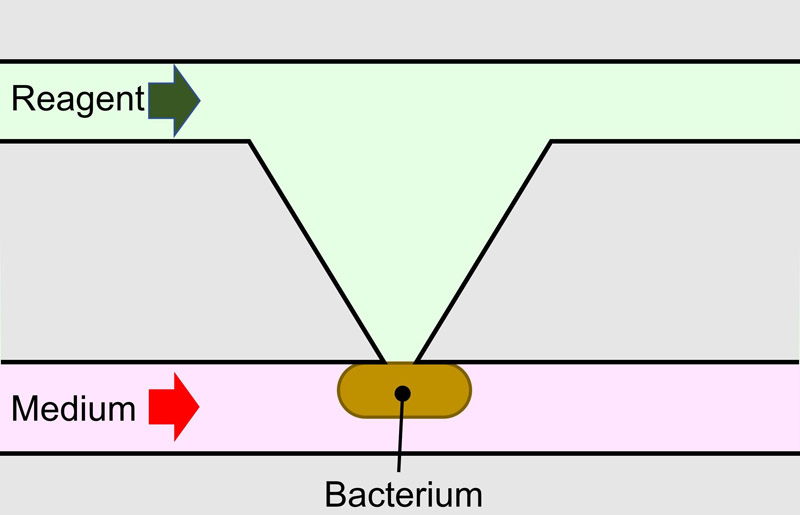
Chemical delivery to single bacterium
- [1] S. V. Avery, “Microbial cell individuality and the underlying sources of heterogeneity,” Nat. Rev. Microbiol., Vol.4, No.8, pp. 577-587, 2006. https://doi.org/10.1038/nrmicro1460
- [2] T. D. Evans and F. Zhang, “Bacterial metabolic heterogeneity: Origins and applications in engineering and infectious disease,” Curr. Opin. Biotechnol., Vol.64, pp. 183-189, 2020. https://doi.org/10.1016/j.copbio.2020.04.007
- [3] K. Kundu, N. Weber, C. Griebler, and M. Elsner, “Phenotypic heterogeneity as key factor for growth and survival under oligotrophic conditions,” Environ. Microbiol., Vol.22, No.8, pp. 3339-3356, 2020. https://doi.org/10.1111/1462-2920.15106
- [4] M. A. Sánchez-Romero and J. Casadesús, “Contribution of phenotypic heterogeneity to adaptive antibiotic resistance,” Proc. Natl. Acad. Sci. U.S.A., Vol.111, No.1, pp. 355-360, 2014. https://doi.org/10.1073/pnas.1316084111
- [5] L. P. Morawska, J. A. Hernandez-Valdes, and O. P. Kuipers, “Diversity of bet-hedging strategies in microbial communities—Recent cases and insights,” WIREs Mech. Dis., Vol.14, No.2, Article No.e1544, 2022. https://doi.org/10.1002/wsbm.1544
- [6] H. Niu, J. Gu, and Y. Zhang, “Bacterial persisters: Molecular mechanisms and therapeutic development,” Signal Transduct. Target. Ther., Vol.9, Article No.174, 2024. https://doi.org/10.1038/s41392-024-01866-5
- [7] P. J. Hare, T. J. LaGree, B. A. Byrd, A. M. DeMarco, and W. W. K. Mok, “Single-cell technologies to study phenotypic heterogeneity and bacterial persisters,” Microorganisms, Vol.9, No.11, Article No.2277, 2021. https://doi.org/10.3390/microorganisms9112277
- [8] G. C. R. Ellis-Davies, “Caged compounds: Photorelease technology for control of cellular chemistry and physiology,” Nat. Methods, Vol.4, No.8, pp. 619-628, 2007. https://doi.org/10.1038/nmeth1072
- [9] B. L. Bassler, “How bacteria talk to each other: Regulation of gene expression by quorum sensing,” Curr. Opin. Microbiol., Vol.2, No.6, pp. 582-587, 1999. https://doi.org/10.1016/S1369-5274(99)00025-9
- [10] R. Tollerson II and M. Ibba, “Translational regulation of environmental adaptation in bacteria,” J. Biol. Chem., Vol.295, No.30, pp. 10434-10445, 2020. https://doi.org/10.1074/jbc.REV120.012742
- [11] P. Kim et al., “Soft lithography for microfluidics: A review,” Biochip J., Vol.2, No.1, pp. 1-11, 2008.
- [12] S. L. Arias, J. Devorkin, A. Civantos, and J. P. Allain, “Escherichia coli adhesion and biofilm formation on polydimethylsiloxane are independent of substrate stiffness,” Langmuir, Vol.37, No.1, pp. 16-25, 2021. https://doi.org/10.1021/acs.langmuir.0c00130
- [13] V. Drebezghova et al., “Initial bacterial retention on polydimethylsiloxane of various stiffnesses: The relevance of modulus (mis)match,” Colloids Surf. B Biointerfaces, Vol.217, Article No.112709, 2022. https://doi.org/10.1016/j.colsurfb.2022.112709
This article is published under a Creative Commons Attribution-NoDerivatives 4.0 Internationa License.