
Paper:
The Three-Layer Temporal Structure Theory of Disaster Social History: Toward an Integrated Understanding of Social Resilience Through a Historical Approach
Atsushi Kawauchi†

Uehiro Disaster Risk Reduction Research Division, International Research Institute of Disaster Science (IRIDeS), Tohoku University
468-1 Aoba, Aramaki, Aoba-ku, Sendai, Miyagi 980-8572, Japan
†Corresponding author

Resilience research in disaster studies has advanced rapidly. However, it faces a fundamental methodological problem, that is the absence of historical context. Criteria for assessing resilience “success” vary across periods and regions; however, the risk of anachronism inherent in applying universal resilience models has been consistently overlooked. This study presents the “Three-Layer Temporal Structure Theory of Disaster Social History,” drawing on Fernand Braudel’s tripartite conception of historical time. The framework analyzes disaster phenomena through the mutually interpenetrating dynamics of geographic (millennia), structural (decades to centuries), and event-historical time (days to years), redefining “resilience” not as recovery capacity but as a process of “historical reconstruction” shaped by historical context. Analyzing flood response history from the seventeenth century to the present in the Igu region of Miyagi Prefecture, three theoretical findings were derived. First, transitions in the structural time layer produce “transitional vulnerability,” in which existing resilience forms are dismantled before new ones emerge. Second, interactions among the three layers are bidirectional: events in lower layers can transform upper layers. Third, the recurrent invocation of “beyond all expectation” constitutes critical evidence that normative criteria for “normality” are historically constructed within the structural time layer. The framework provides an interdisciplinary analytical axis bridging the natural sciences and humanities, while offering a critical historical perspective for contemporary disaster risk reduction policy.
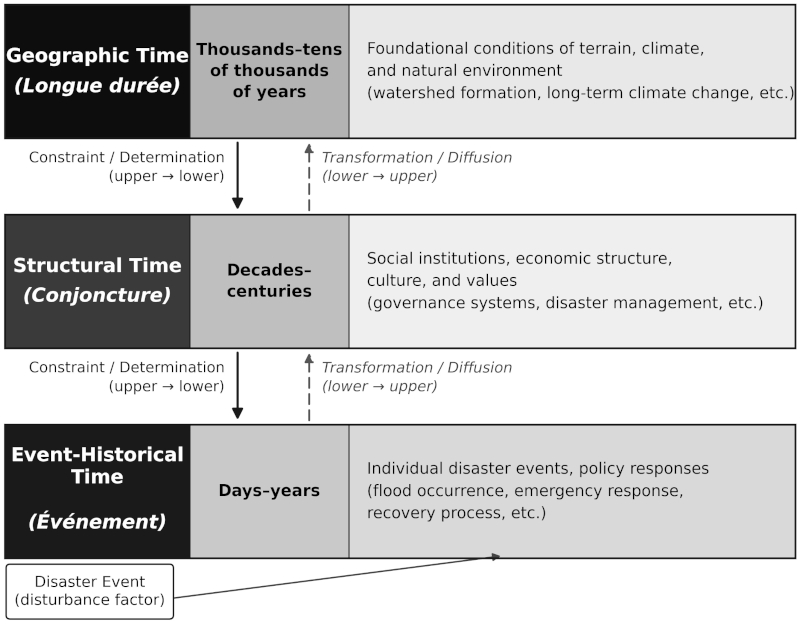
Three-layer temporal structure theory
- [1] A. S. Masten, “Ordinary magic: Resilience in development,” The Guilford Press, 2014.
- [2] B. Walker, C. S. Holling, S. R. Carpenter, and A. Kinzig, “Resilience, adaptability and transformability in social–ecological systems,” Ecol. Soc., Vol.9, No.2, Article No.5, 2004. https://doi.org/10.5751/ES-00650-090205
- [3] K. Tierney, “Disasters: A sociological approach,” Polity, 2019.
- [4] I. Kitahara, “Ima naze saigai-shakaishi ka?” [Why social history of disasters now?], J. Jpn. Soc. Nat. Disaster Sci., Vol.18, No.1, pp. 9-14, 1999 (in Japanese).
- [5] F. Braudel, “La Méditerranée et le monde méditerranéen à l’époque de Philippe II,” Armand Colin, 1949 (in French).
- [6] C. S. Holling, “Resilience and stability of ecological systems,” Annu. Rev. Ecol. Syst., Vol.4, pp. 1-23, 1973. https://doi.org/10.1146/annurev.es.04.110173.000245
- [7] M. Bruneau et al., “A framework to quantitatively assess and enhance the seismic resilience of communities,” Earthq. Spectra, Vol.19, No.4, pp. 733-752, 2003. https://doi.org/10.1193/1.1623497
- [8] C. Folke et al., “Resilience thinking: Integrating resilience, adaptability and transformability,” Ecol. Soc., Vol.15, No.4, Article No.20, 2010. https://doi.org/10.5751/es-03610-150420
- [9] S. Nagamatsu, “The evolution of the ‘disaster resilience’ concept and its implications for disaster risk reduction,” J. Disaster Res., Vol.20, No.5, pp. 737-745, 2025. https://doi.org/10.20965/jdr.2025.p0737
- [10] C. Béné, A. Newsham, M. Davies, M. Ulrichs, and R. Godfrey-Wood, “Review article: Resilience, poverty and development,” J. Int. Dev., Vol.26, No.5, pp. 598-623, 2014. https://doi.org/10.1002/jid.2992
- [11] P.-S. S. Lin, “Harnessing indigenous local knowledge for disaster risk reduction through social-ecological resilience,” J. Disaster Res., Vol.20, No.5, pp. 791-800, 2025. https://doi.org/10.20965/jdr.2025.p0791
- [12] I. Kitahara, “Ansei ōjishin to minshū: Jishin no shakai-shi” [The Ansei Great Earthquake and the people: A social history of earthquakes], San-ichi Shobo Publishing Inc., 1983 (in Japanese).
- [13] I. Kitahara, “Bandai-san funka: Sai-i kara saigai no kagaku he” [Mt. Bandai eruption: From calamity to disaster science], Yoshikawa Kobunkan, 1998 (in Japanese).
- [14] H. Tsuchida, “Saigai no Nihon kindai-shi: Daikyōsaku, fūsuigai, funka, Kantō daishinsai to kokusai kankei” [Disasters in modern Japanese history: Major crop failures, wind and flood disasters, volcanic eruptions, the Great Kantō Earthquake, and international relations], Chuokoron-Shinsha, Inc., 2023 (in Japanese).
- [15] K. Sato, “Saigai taiō to kin-gendaishi no kōsaku: Dejitaru ākaibu to shitsuteki dēta bunseki no katsuyō” [The intersection of disaster response and modern-contemporary history: Utilizing digital archives and qualitative data analysis], Kyoritsu Shuppan, Co., Ltd., 2024 (in Japanese).
- [16] M. Davis, “Late Victorian holocausts: El Niño famines and the making of the Third World,” Verso, 2000.
- [17] N. Luhmann, “Soziale Systeme: Grundriß einer allgemeinen Theorie,” Suhrkamp, 1984 (in German).
- [18] Y. Watabe, “Igu gun-shi” [History of Igu district], Privately printed, 1916 (in Japanese).
- [19] “Kakuda shi-shi 2: Tsūshi-hen ge” [History of Kakuda City, Vol.2: General history (Part II)], Kakuda-shi, 1986 (in Japanese).
- [20] “Marumori chō-shi: Shiryō-hen” [History of Marumori Town: Historical documents edition], Marumori-machi, 1980 (in Japanese).
- [21] “Marumori chō-shi: Tsūshi-hen” [History of Marumori Town: General history volume], Marumori-machi, 1984 (in Japanese).
- [22] “Ishikawa-shi issen-nen-shi gekan” [A thousand-year history of the Ishikawa Clan, Vol.2], Ishikawa-shi Shiryō Hensan-kai, 1918 (in Japanese).
- [23] “Ishikawa-shi issen-nen-shi zoku-kan” [A thousand-year history of the Ishikawa Clan, continuation volume], Ishikawa-shi Shiryō Hensan-kai, 1919 (in Japanese).
- [24] I. Shoji, “Abukumagawa no enkaku to kaishū undō shi,” [History of the Abukuma River and its improvement movement], Abukumagawa Karyū Kaishū Kisei Dōmei-kai, 1941 (in Japanese).
- [25] E. H. Carr, “Rekishi toha nanika” [What is history?], (translated by I. Shimizu), Iwanami Shoten, 1962 (original published 1961) (in Japanese).
This article is published under a Creative Commons Attribution-NoDerivatives 4.0 Internationa License.