
Paper:
The Three-Layer Temporal Structure Theory of Disaster Social History: Toward an Integrated Understanding of Social Resilience Through a Historical Approach
Atsushi Kawauchi†

Uehiro Disaster Risk Reduction Research Division, International Research Institute of Disaster Science (IRIDeS), Tohoku University
468-1 Aoba, Aramaki, Aoba-ku, Sendai, Miyagi 980-8572, Japan
†Corresponding author

Resilience research in disaster studies has advanced rapidly. However, it faces a fundamental methodological problem, that is the absence of historical context. Criteria for assessing resilience “success” vary across periods and regions; however, the risk of anachronism inherent in applying universal resilience models has been consistently overlooked. This study presents the “Three-Layer Temporal Structure Theory of Disaster Social History,” drawing on Fernand Braudel’s tripartite conception of historical time. The framework analyzes disaster phenomena through the mutually interpenetrating dynamics of geographic (millennia), structural (decades to centuries), and event-historical time (days to years), redefining “resilience” not as recovery capacity but as a process of “historical reconstruction” shaped by historical context. Analyzing flood response history from the seventeenth century to the present in the Igu region of Miyagi Prefecture, three theoretical findings were derived. First, transitions in the structural time layer produce “transitional vulnerability,” in which existing resilience forms are dismantled before new ones emerge. Second, interactions among the three layers are bidirectional: events in lower layers can transform upper layers. Third, the recurrent invocation of “beyond all expectation” constitutes critical evidence that normative criteria for “normality” are historically constructed within the structural time layer. The framework provides an interdisciplinary analytical axis bridging the natural sciences and humanities, while offering a critical historical perspective for contemporary disaster risk reduction policy.
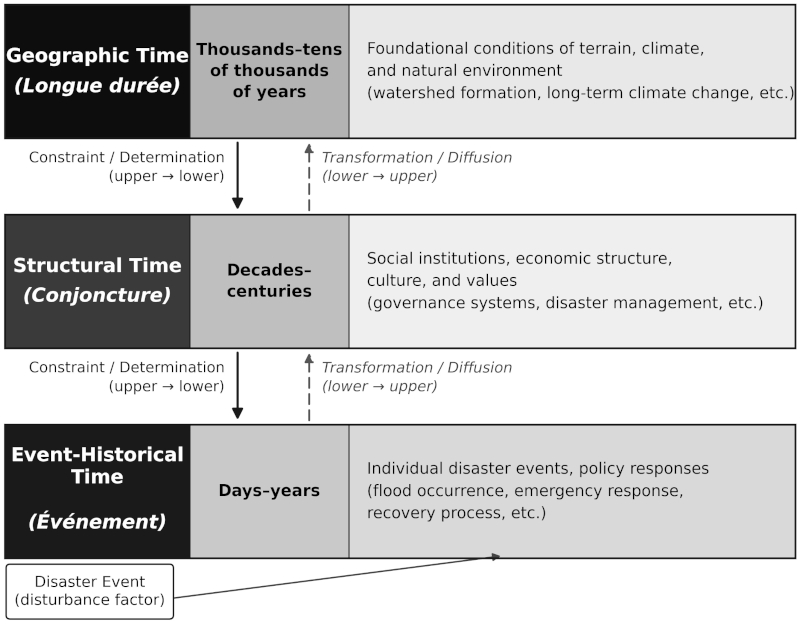
Three-layer temporal structure theory
1. Introduction: Statement of the Problem
In recent disaster research, “resilience” has become a widely accepted central concept. Adopted from ecology and developmental psychology, it has established itself as an analytical tool for describing how social systems respond to and adapt to disasters and maintain or transform their functions 1,2,3. In international disaster risk reduction policies, resilience building has been positioned as a core objective in documents, including the Sendai Framework for Disaster Risk Reduction (2015–2030).
Despite this conceptual diffusion, resilience research has methodological problems that cannot be overlooked. The first is the undervaluation of the historical context. When resilience is defined as “the capacity of a dynamic system to adapt to challenges threatening its function, survival, or development” 1 (p. 26), what constitutes the system’s “function” or “development”—and who determines this, when, and in what social context—is frequently bracketed. The second is the risk of anachronism. Uncritically applying contemporary concepts of “recovery,” “restoration,” and “adaptation” to historical cases from different eras and regions risks erasing historical particularity.
Historical inquiry possesses a distinctive capacity to address these problems. The methodological strength of history—analyzing social change over long temporal horizons, a thoroughgoing orientation to the historical context, and an empirical approach grounded in source criticism—illuminate the dimensions that resilience research has overlooked. The concept of “disaster social history” proposed by Kitahara 4 was conceived not merely as a record of past disasters, but as a perspective that aims to “reproduce the historical process through which societies have overcome diverse disaster damage to achieve social recovery, thereby identifying what challenges the present-day society should inherit from it” (p. 11).
Considering these methodological concerns, this study aims to theoretically construct an analytical framework called the “Three-Layer Temporal Structure Theory of Disaster Social History” and demonstrate its validity. This framework draws on the “three layers of historical time” proposed by French historian Fernand Braudel 5 and applies it to disaster research, offering a historical complement to existing resilience research while presenting an interdisciplinary foundation for the construction of “comprehensive disaster science.”
2. Review of Previous Studies
2.1. Developments in Resilience Research
After Holling 6 introduced the resilience concept to describe the stability of ecosystems, it was broadly transferred to developmental psychology, sociology, organizational theory, engineering, and disaster research. Bruneau et al. 7 presented a four-dimensional model of community resilience (robustness, redundancy, resourcefulness, and rapidity) for disaster research. Subsequently, conceptual refinement has progressed from “engineering resilience (recovery to the original state)” through “ecological resilience (transition to a new equilibrium state)” to “transformative resilience (fundamental transformation of the system)” 2,8.
As a recent conceptual framework, Nagamatsu 9 proposes the distinction between “inherent resilience” and “adaptive resilience.” The former reflects an engineering orientation toward “bouncing back”—returning to a prior state based on pre-existing capacities—whereas the latter refers to the ability of a system to adapt and reconstitute itself into a new state through “bouncing forward” via continuous learning and transformation. Béné et al. 10 further described resilience in terms of three capacities—absorptive, adaptive, and transformative—and demonstrated that capacity activation varies with the magnitude of an external shock. Building on this model, Nagamatsu 9 highlighted that the conceptualization of transformative capacity introduces new issues into disaster risk reduction policy: conflicts between maintaining and transforming capacity, conflicts among the subjects of resilience, and tensions with equity and fairness.
From a sociological perspective, Tierney 3 has noted that resilience is inseparable from political and economic relations of power, that is, the importance of asking “resilience for whom?” Moreover, studies focusing on the relationship between communities and social-ecological systems have also emerged. Using the case of the Seediq community in Taiwan, Lin 11 demonstrates that the interaction between local indigenous knowledge and ecosystems constructs social-ecological resilience. These studies suggest that resilience is not realized through technical or engineering measures alone, but is rooted in the social and cultural capacities formed through long-term human-environment interaction. Although all of these discussions have accumulated substantial insights, they tend to treat “present” social systems as their primary analytical object, and how the social, cultural, and institutional conditions that constitute resilience have formed historically has not been systematically addressed.
2.2. Points of Contact Between Historical Studies and Disaster Research
In recent years, historical research on disasters has developed rapidly. In Japan, following the pioneering work of Kitahara 12,13, research in “disaster history” and “disaster social history” has become increasingly active. In disaster history, Tsuchida 14 offers a comprehensive narrative of how major disasters—from crop failures and floods to volcanic eruptions and the Great Kantō Earthquake—intersected with the broader currents of modern Japanese history, demonstrating that disaster and historical transformation are inseparable. In disaster social history, Sato 15 examines the relationship between disaster response and social conditions across multiple historical cases, from the medieval Black Death and the 1755 Lisbon earthquake to the Great Kantō Earthquake and the 2011 Tōhoku disaster, tracing how the social structures preceding and following each disaster shaped its outcomes, and consequently, how those outcomes influenced subsequent social configurations. Although Sato’s framework shares a concern for the mutual embeddedness of disaster and social history with the present paper, his approach is primarily narrative and exploratory, drawing on secondary literature to map correspondences between disaster response and social context, rather than deploying an explicit theoretical apparatus for analyzing the mechanisms of temporal interaction. Davis 16 examined the relationship between climate change and imperialism from a long-term perspective, focusing on the formation of “historically structured disaster vulnerability.” However, these studies have primarily focused on the accumulation of cases, and attempts to systematize historical approaches have been limited. Building on these prior works, this study presents a generalizable analytical framework for connecting methodological strengths distinctive to history-to-resilience research.
3. Theoretical Framework: The Three-Layer Temporal Structure Theory of Disaster Social History
3.1. Braudel’s Three-Layer Structure and its Application
In The Mediterranean and the Mediterranean World in the Age of Philip II 5, Braudel divided historical time into three layers. The first layer is the longue durée, which unfolds on a scale of centuries to millennia as the geographical environment, climate, and foundational layer of civilization. The second layer is conjoncture, which changes on a scale of decades to centuries and encompasses social institutions, economic cycles, and population dynamics. The third layer is événement, which comprises individual occurrences and political decisions that arise over a scale of days to years. Braudel’s innovation lay in systematizing the existence of deep, long-term, structural dynamics that cannot be reduced to the event-historical dimension traditionally privileged by historians.
This study applies Braudel’s concept of time as an analytical framework for disaster social history to present the “Three-Layer Temporal Structure Theory of Disaster Social History” (see Fig. 1). However, this application is not a simple translation of Braudel. By positioning disaster as a “site of crisis” in which the interactions among the three layers appear most vividly, it constructs a specialized framework for analyzing disaster phenomena.
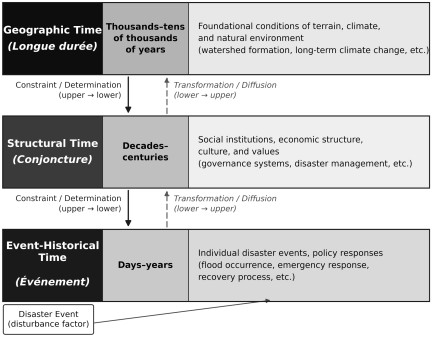
Fig. 1. Interactions among the three temporal layers.
3.2. The Content of the Three-Layer Temporal Structure
Table 1 presents the contents of each layer of the three-layer temporal structure proposed in this study.
| Temporal layer | Time scale | Principal elements | Logic of change |
| Geographic time | Thousands–tens of thousands of years | Foundational conditions of terrain, climate, and natural environment | Gradual geological and climatic change |
| Structural time | Decades–centuries | Social institutions, economic structure, culture, values | Institutional transition, structural transformation |
| Event-historical time | Days–years | Individual disaster events, policy responses | Accumulation of specific responses, institutional learning |
The first layer, “geographic time,” corresponds to Braudel’s longue durée. Geographical and natural factors, such as watershed formation, land uplift, subsidence, and long-term climate change, form the foundational conditions that persist for thousands of years. In disaster research, this layer provides the basis for the "structural necessity" of hazards.
The second layer, “structural time,” encompasses social factors—political regime, legal institutions, economic structure, cultural values, and technological systems—that change on a scale of decades to centuries. The “mode” of disaster response is determined within this layer. Disaster response under a feudal local domain lordship operates according to a fundamentally different logic from disaster response under a modern centralized state.
The third layer, “event-historical time,” is the layer in which individual disasters occur, policy makers make decisions, local residents take specific responsive action, and recovery operations unfold. Within this framework, the event-historical dimension reveals its historical meaning only by analyzing its interactions with the other two layers.
3.3. Interactions Among the Three Layers and “Historical Path Dependency”
The theoretical core of the Three-Layer Temporal Structure Theory lies in the mechanism of interaction among the three layers. The upper layers (geographic and structural time) constrain and shape the development of the lower layers (event-historical time), whereas the lower layers gradually transform the upper layers in a bidirectional relationship (see Fig. 2).
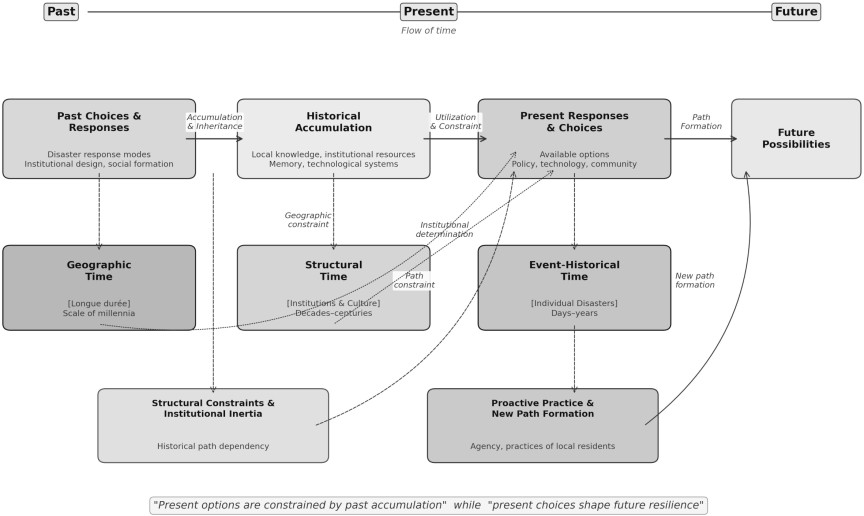
Fig. 2. Dynamic relationship between historical path dependency and resilience.
Mediating this interaction is the concept of “historical path dependency.” Present-day disaster response options are constrained by past institutional and cultural accumulation. For example, when a pre-modern system of mutual aid partially persists into the modern era, it appears as an individual response in the event-historical dimension; however, its persistence is explained by the continuity of value norms in the structural time layer. Conversely, structural transformations such as the Haihan-chiken (the 1871 Meiji reform abolishing feudal domains and replacing them with centrally appointed prefectures) sever indigenous disaster-response cultures and create new pathways.
This framework critiques the conventional view that “disasters are merely short-term events.” Disasters occur in the event-historical dimension, but their impact ripples through to the structural time layer and may sometimes accelerate changes in the geographic time layer. As the case analysis below demonstrates, the repeated construction of levees in the Igu region from the 17th century onward—a structural-time-layer practice—gradually raised the riverbed through sediment accumulation, producing the “perched river” (tenjō-kawa) condition that itself became a new geographical constraint on subsequent disaster response. This bidirectional dynamic, in which human intervention in the structural time layer transforms the geographic time layer, is one of the central mechanisms the framework seeks to illuminate.
3.4. Historical Redefinition of Resilience
The Three-Layer Temporal Structure Theory historically redefines the concept of resilience as follows: Masten’s 1 definition of resilience as the “capacity of a dynamic system” is used in this framework in its basic form. What the framework adds, however, is the recognition of historical relativity: “what counts as function and what counts as survival is determined by era and society.” Thus, the content and form of resilience are historically constructed within the structural time layer.
The framework further proposes a conceptual shift from resilience as “recovery” to resilience as “historical reconstruction.” A post-disaster society does not return to the “original state” (engineering resilience), nor does it simply reach a “new equilibrium” (ecological resilience); rather, it follows a distinctive process of reconstitution within historical context. This reconstitution is understood as the dynamic interaction of the three-layer temporal structure, which is shaped by historical path dependency, while simultaneously remaining open to the possibility of transformation through the agency of those involved. Although transformative resilience theory 2,8 and the “bounce forward” concept 9 both emphasize a vector directed toward a “better state,” what “historical reconstruction” interrogates is the fact that the very judgment of “what is better” has itself been historically constructed within the structural time layer. The direction of transformation cannot be separated from the historical context; this recognition constitutes the fundamental point of divergence between this framework and conventional resilience research.
Historical path dependency extends beyond the dimensions of institutions and norms. The body of local knowledge accumulated through long-term human-environment interactions in the structural time layer also constitutes a path-dependent knowledge system transmitted across generations. When rapid transformation of the structural time layer—through colonization, modernization, or urbanization—severs this inheritance, “transitional vulnerability” arises. As the case analysis below demonstrates, such processes of rupture and proactive reconstitution can be traced in the transitional periods of Japanese modernization.
This redefinition has affinities with Luhmann’s 17 theory of social systems. Luhmannian social systems reproduce structure and meaning through self-referential autopoiesis and disasters temporarily disrupt this process. Society self-regulatorily reconstitutes itself in a new form; however, the mode of reconstitution depends on the historical context of each era and region. The Three-Layer Temporal Structure Theory endows this systems-theoretic understanding of resilience with a historical dimension.
4. Case Analysis: History of Flood Response in the Abukuma River Basin, Igu Region
4.1. Overview of the Study Area and Geographic Time
The case analysis in this study focuses on the Igu region (present-day Kakuda City and Marumori Town) located in the middle reaches of the Abukuma River in southern Miyagi Prefecture.(1) The reasons for selecting this region are: first, the existence of diachronic records of flood response spanning from the early modern period (17th century) to the contemporary era (the 2019 Higashi-Nihon Typhoon [Typhoon Hagibis]); second, the region’s experience of structural transformations from the bakuhan system to the modern centralized state and then to the risk society; and third, the region’s geographical conditions in which the interactions of the three-layer temporal structure appear in a typical form.
In the geographic time layer (first layer), the formation process of the Abukuma River system determines the foundational conditions. The region is situated on an alluvial fan, with urban areas developing at the confluence of the main stream of the Abukuma River and its multiple tributaries. This topographical characteristic has maintained over thousands of years a “dual character of blessing and threat”—enabling water use and agricultural production, while repeatedly bringing flood damage. How did the people of each era respond to this foundational condition? The distribution of Jōmon-period (ca. 14,000–300 BCE) archaeological sites demonstrates that people primarily resided on hillsides and uplands, avoiding settlement on floodplains. From the Yayoi period (ca. 300 BCE–300 CE) onward, as lowland agricultural development advanced, flood risk came to be accepted as an inseparable condition of productive activity. In the early modern period, under the Sendai domain’s policy of reclaiming new paddy fields, settlements on floodplains were systematically promoted; the Abukuma River’s water transport was actively used as an artery of the regional economy, while levee construction and water channel development were attempted by local domain lords. From the modern period onward, the disposition toward controlling floods through state-led river improvements and the introduction of modern civil engineering techniques became dominant. Organizing this historical transition, social responses to geographical constraints can be broadly described as a shift across three modes: “avoiding floodplains (avoidance),” “using them while accepting flood risk (acceptance),” and “attempting to control them through technology (control).” However, notably, this is an analytical typology inductively derived from the concrete historical development of the Igu region; the boundaries between eras are not clear-cut, and the process contains complex overlaps and reversals between modes.
Surveying the flood history of the Igu region from primary sources over the period from the early 17th century to 2019, damaging floods are confirmed 44 times over approximately 400 years. For major events, the historical record suggests a frequency of roughly once every few decades. The 2019 Higashi-Nihon Typhoon inundation can in some respects be understood within this long-term “range of normality” in the geographic time layer. However, the total precipitation of that typhoon reached 1.6 to 1.7 times past observational records, and the impact of climate-change-driven transformation of the geographic time layer on the event-historical dimension is a newly emerging problem.
However, caution is required when treating the geographic time layer as purely natural and independent of society. A petition submitted by ashigaru (foot soldiers) residing in Marumori to the Sendai domain in 1730 (Kyōhō 15) requesting relocation records the recognition that “the river level has risen throughout” (kawanami subete takaku makarinari) 20 (p. 545). This should be read not as a visceral appeal about increasing flood frequency, but as the result of a process in which the repeated construction of levees since the 17th century—a human intervention in the structural time layer—raised the riverbed through sediment accumulation and thereby triggered the change in the geographic time layer known as a “perched river” (tenjō-kawa). The rising river level was not a natural change, but a cumulative consequence of flood control as a structural practice. This indicates an important qualification within the Three-Layer Temporal Structure Theory: the geographic time layer is not a static background condition sitting outside society, but can be transformed by human practices in the structural time layer. The relationship between the two layers must be understood not as unidirectional “determination” but as a mutually interpenetrating process.
4.2. Transformation of the Structural Time Layer and the Shift in Response Modes
Analyzing the structural time layer (second layer) confirms that the transition from the early modern Sendai domain’s local grant system (jikata chigyō-sei) to the modern centralized system fundamentally changed the modes of disaster response (see Table 2).
| Period | Governance structure | Logic of disaster response | Form of resilience |
|
Early modern (17th c.) |
Sendai domain local grant system (local domain lord rule) | Recovery as a means of establishing domain lord authority | Status-based community mutual aid |
|
Middle/late modern (18th c.) |
Development of “benevolent governance” (jinsei) ideology | Response through domain lord’s “paternalistic governance” | Transcendence of status hierarchy in emergencies and community formation |
| Late Edo/Meiji transition (19th c.) | Haihan-chiken; administrative vacuum of the early Meiji period | Administrative confusion and emergence of local autonomy | Voluntary organization such as the “Shingi-ren” |
|
Modern (early 20th c.) |
Centralized state; modern river engineering | State-led standardization and dependence on science and technology | Tensions between institutional responses and indigenous knowledge |
|
Contemporary (late 20th c.–) |
Risk society; high economic growth | Institutionalization of expert knowledge and technological optimism | Dissolution of regional communities and new vulnerabilities |
Particularly noteworthy is the case of the early Meiji period (the late Edo/Meiji transition). At the time of the “Satōji Storm” of 1870 (Meiji 3), the response from the newly established Kakuda Prefecture to requests for aid from the disaster-affected area was limited 20 (pp. 873–875). In contrast to the rapid assistance provided by a local domain lord under the old domain system, the records document the anger and distrust of victims under the new regime. In response to this, 30 young men of Marumori village organized the “Shingi-ren” in 1872, functioning as a voluntary organization responsible for maintaining public order and providing disaster relief 21 (pp. 435–437).
This case demonstrates that the abrupt transformation of the structural time layer (the Haihan-chiken) generated a temporary decline in response capacity in the event-historical dimension, and that a new form of community resilience emerged. This study terms this phenomenon “transitional vulnerability.” The voluntary organization of the Shingi-ren should be assessed as a proactive response by the local residents to this vulnerability.
Here we can observe a paradigmatic instance of “historical reconstruction.” The abrupt transformation of the structural time layer, the Haihan-chiken, dismantled the forms of resilience that functioned under the local domain lord system—the paternalistic governance of the domain lord, and the status-based community of mutual aid. Yet as the voluntary organization of the Shingi-ren demonstrates, residents did not simply attempt to restore the old forms, but followed a distinctive process of reconstitution under the new governance structure. Notably, this reconstitution was not designed toward the modern goal of “better disaster prevention” but formed in a way that carried meaning within the social context of the time—public order maintenance, mutual aid, and regional social order. From the perspective of modern disaster risk reduction policy, it may appear as a “pre-modern vigilante group,” but that is nothing other than anachronism: importing evaluation criteria that transcend the era. The Shingi-ren was completed as a form of resilience within the context of the structural time layer of the Haihan-chiken period—this recognition is what demonstrates the historical relativity of resilience.
4.3. The Particularity of the Event-Historical Time Layer and Three-Layer Interaction
Analyzing the event-historical time layer (third layer) confirms that the major flood cases in the Igu region—1680 (Enpō 8), 1723 (Kyōhō 8), 1799 (Kansei 11), 1870 (Meiji 3), and the 2019 Higashi-Nihon Typhoon—each carry distinctive social meaning through their interactions with the structural and geographic time layers.
During the flood of 1680, the Sendai domain’s local domain lord, the Ishikawa clan, repaired and extended levees after the disaster (22, p. 36; 23, pp. 3–9). This response functioned not only as a physical restoration, but also as a political act demonstrating the legitimacy of the domain lord’s rule to local residents. In 1703, an application was made to the Sendai domain to dredge the Kagawa River. However, this was rejected because of the domain’s austerity fiscal policy, leaving only emergency repairs. Here, the manner in which individual responses in the event-historical dimension are constrained by the structural time layer (domain finances and the subordination relationship between the domain and local lords) is clearly illustrated.
Modern and contemporary cases clearly demonstrate the capacity of transformations in the structural time layer to alter outcomes in the event-historical dimension. The Kanogawa Typhoon of 1958 (Shōwa 33) [Typhoon Ida] brought 327 mm of precipitation to the Marumori area and caused severe damage recorded as “the worst disaster in recorded history” 21 (pp. 813–816). In contrast, Typhoon No.23 of 1971 (Shōwa 46) recorded higher precipitation of 351 mm; however, no levee failure or river flooding occurred. Records explicitly identify all-night vigilance by 400 fire brigade members as the reason 21 (p. 1037). The different event-historical outcomes produced by equal or greater disturbance conditions in the geographic time layer were owing to the transformation of the structural time layer: advances in river improvement since 1958 and the establishment of an organized response system centered on the fire brigade. However, notably, this “success” was itself achieved only under specific structural conditions. The organizational foundation capable of mobilizing 400 fire brigade members was gradually dismantled alongside the advance of depopulation from the 1960s onward.
Conversely, cases can be confirmed in which individual disasters in the event-historical dimension transformed the structural time layer. The great flood of 1910 (Meiji 43) caused severe damage throughout eastern Japan, including in the Abukuma River basin, and became the direct impetus for formulating the nation’s First Long-Term Flood Control Plan 14. Furthermore, following the typhoon damage of 1913 (Taishō 2), the towns and villages along the Abukuma River formed the “Abukuma River Improvement Promotion League” and began organized advocacy directed at the national government 24 (pp. 45–61). This sequence of events is important in two senses. First, it demonstrates a bidirectional interaction among the three layers, in which events in the event-historical dimension can transform the structural time layer (the national flood control policy system). Second, it can be interpreted as a process in which local residents proactively promoted structural transformation through collective agency. If the Shingi-ren represented agency directed toward rebuilding internal community order, the Promotion League sought to intervene in the higher structural time layer through advocacy directed at national institutions, demonstrating the diversity of the circuits through which agency operates.
In the 2019 Higashi-Nihon Typhoon, the complex mutual interactions of the three layers appear most clearly. The structural vulnerability in the geographic time layer, combined with the extreme intensification of precipitation driven by climate change, produced an event exceeding the design standards assumed by modern hydraulic engineering. In the structural time layer, although the dissolution of regional communities owing to aging and population decline reduced mutual aid capacity, new forms of support mobilization via social media and digital technology emerged. In the event-historical dimension, the discourse of “beyond all expectation” functioned to deflect administrative responsibility; yet—just as with the “worst disaster in recorded history” of 1958—the very repetitiveness of this “unprecedented” discourse that recurs with each large-scale disaster demonstrates that the criteria for what counts as “normal” have been continually and cyclically updated in the structural time layer, and constitutes a matter requiring critical historical examination.
What emerges across these cases is the fact that the very criteria for “what constitutes a success of resilience” differ across historical periods. By modern standards, the levee repair of 1680 is “emergency stopgap work that does not constitute a permanent solution,” but in the logic of local domain lord rule it was a complete response in terms of “establishing domain lord authority and binding the community together.” The confusion in response to the “Satoji Storm” of 1870 is evaluated as a shortcoming of immature modern administration; however, from the perspective of the Three-Layer Temporal Structure Theory it is positioned as an inevitable “transitional vulnerability” during a period of structural transition. The discourse of “beyond all expectation” in the 2019 Higashi-Nihon Typhoon is itself the result of the criteria for what counts as “normal” being fixed within the structural time layer within the framework of modern hydraulic engineering, and the very history of the repetition of “unprecedented” discourse that has recurred with every major disaster is testimony to this. This shift in perspective is the substance of the “historical relativity of resilience” that this study’s theoretical framework aims to illuminate.
Yet this case analysis raises new questions. If each era has a distinctive logic of response shaped by its structural conditions, what historical conditions underpin present-day disaster risk reduction policy and what can serve as the basis for its legitimacy? Amid the repeated transitions of the structural time layer, what determines what is inherited and what is severed? To answer these questions, the findings inductively derived from the cases must be developed as theoretical implications and brought into dialogue with the existing resilience research.
5. Discussion
5.1. Theoretical Implications of the Three-Layer Temporal Structure Theory
The Three-Layer Temporal Structure Theory presented in this study has three interconnected theoretical implications for existing resilience research.
The first is the epistemological formulation of the “historical relativity of resilience.” The existing research on resilience often tacitly premises a linear progressivist view that “societies evolve toward higher resilience.” What the Three-Layer Temporal Structure Theory demonstrates, however, is that the very criteria for judging what constitutes a “success” of resilience are themselves historically constructed within the structural time layer. The levee repair of 1680, voluntary organization of the Shingi-ren, and modern river improvement projects each carried a distinctive logic of response within their respective structural time layers and “functioned” by different criteria. Cross-temporal comparisons and evaluations using universal resilience indices always carry the risk of anachronism, discarding this multilayered character.
The second concerns the concept of “transitional vulnerability.” If the criteria for evaluating resilience are determined by the structural time layer, then at times of transition, a “window of vulnerability” opens in which old criteria collapse while new criteria remain underdeveloped. The fact that the Shingi-ren was needed during the structural transition of the Haihan-chiken period historically demonstrates that the temporal lag—institutional transformation dismantles existing forms of resilience without immediately generating new ones. Although transformative resilience theory 2,8 affirms the possibility of fundamental systemic transformation, it has not sufficiently addressed the dimension of temporally lagged vulnerability that arises in the transformation process. The Three-Layer Temporal Structure Theory provides an analytical perspective that bridges this gap.
The third is the “historical positioning of agency.” If transitional vulnerability arises from an institutional vacuum, it is often not the institutions but the proactive practices of residents that bridge the gap. As the Shingi-ren case demonstrates, agency is not entirely enclosed within the constraints of the structural time layer; rather, it retains the possibility of opening new pathways while considering those constraints as given. That said, this is not “pure subjectivity,” free from structural conditions. Agency acquires its historical meaning only through the mutual determination of the three layers: the environmental constraints set by the geographic time layer, institutional and cultural conditions set by the structural time layer, and concrete judgments and actions of the event-historical dimension. The Three-Layer Temporal Structure Theory offers an analytical framework that reduces agency to neither systemic determinism nor voluntarism.
5.2. Contribution to Interdisciplinarity: Toward the Construction of “Comprehensive Disaster Science”
The contribution of the Three-Layer Temporal Structure Theory to interdisciplinary integration extends beyond simply “combining” multiple academic disciplines. The framework offers an intrinsic explanation for the structural reasons why existing disaster science and historical studies remain separate. Natural-scientific disaster research tends to focus primarily on the geographic time layer (terrain and climate) and the event-historical time layer (physical measurement of individual disaster events), whereas social-scientific disaster research tends to focus on the analysis of contemporary institutions and behavior. Historical studies, grounded in the event-historical time layer (individual events preserved in sources), have elucidated long-term structural transformation in the structural time layer as their distinctive strength. When the Three-Layer Temporal Structure Theory mediates, the temporal layers that each discipline has hitherto treated separately are connected within a single analytical framework, and in particular the intermediate “structural time layer” can function as a shared analytical axis for interdisciplinary work (see Fig. 3).
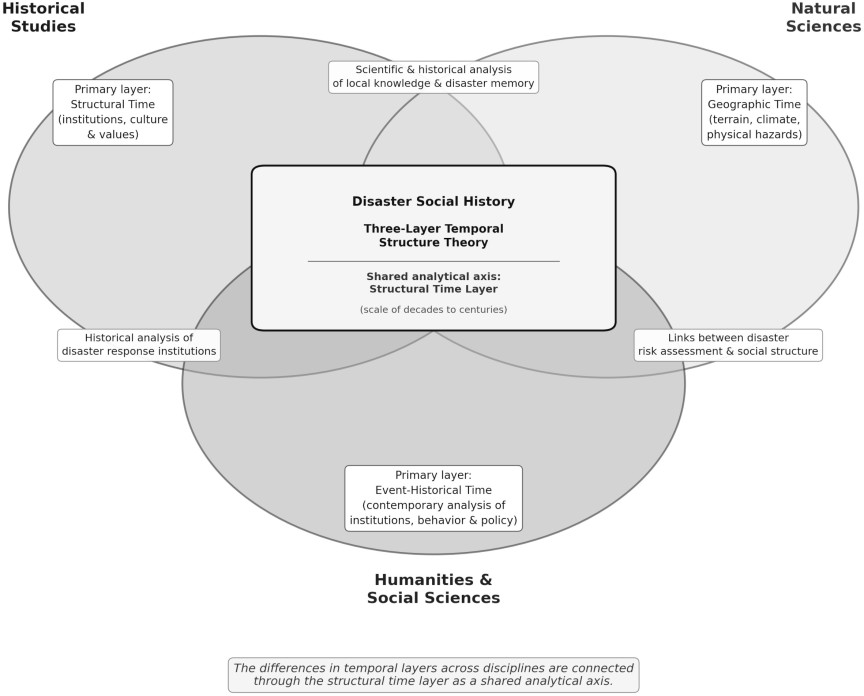
Fig. 3. The interdisciplinary structure of “disaster social history” and “comprehensive disaster science.”
This interdisciplinary integration carries concrete force in the critique of “beyond all expectation” discourse. Although the precipitation of the 2019 Higashi-Nihon Typhoon was “the largest on record” in the event-historical dimension, its character as “beyond expectation” can be questioned by analyzing long-term flood frequency in the geographic time layer and examining the historical formation process of the concept of “normality” in the structural time layer. What is considered normal and what should be anticipated are themselves social judgments formed within the structural time layer, and their critique becomes possible only by simultaneously illuminating them from both natural-scientific data and historical analysis. This is a horizon of knowledge that cannot be reached by natural science or historical studies alone.
Lin 11 demonstrates, through participant observation and in-depth interviews with the Seediq community in Taiwan, that indigenous local knowledge-based disaster risk reduction strategies enable communities to respond to and learn from environmental dynamics, fostering a resilient social-ecological system with the capacity to reorganize into a more robust state. The relationship between indigenous local knowledge and social-ecological resilience can be read as one example of the practical possibilities of this interdisciplinary integration. The body of knowledge accumulated through long-term human-environment interaction is located at the intersection of natural-scientific ecosystem analysis and historical studies on knowledge transmission, and the Three-Layer Temporal Structure Theory provides a framework for analytically organizing that intersection.
5.3. Implications for Contemporary Disaster Risk Reduction Policy
The practical implications of the Three-Layer Temporal Structure Theory for disaster risk reduction policy can be summarized as follows. The first is the need for policy design that considers “historical path dependency.” Present-day disaster prevention systems are products of past institutional accumulations, and their strengths and limitations are historically determined. If one seeks to leverage region-specific resilience, an understanding of the historical processes that form it is a prerequisite. Policies that rely solely on technical solutions while ignoring the inheritance process of local knowledge sometimes heighten regional vulnerability by overlooking this path dependency. The second is a policy response to “transitional vulnerability.” The dissolution of regional communities, accompanied by declining birth rates, aging populations, and depopulation, represents an ongoing transition in the structural time layer. Just as the Haihan-chiken of the modernization period prompted the voluntary organization of the Shingi-ren, transition periods open a “window of vulnerability” in which existing resilience forms are dismantled while new forms remain underdeveloped. Rendering this transitional period visible and supporting it through policy is required. The third is the practical realization of a critical perspective that historically interrogates the “direction of transformation.” Promoting “Build Back Better” or transformative resilience is not to be criticized. However, justifying transformation without asking “what is better?” “transformation for whom?” and “what historical conditions produced the present vulnerability?” is tantamount to abandoning the critical function of historical inquiry. The Three-Layer Temporal Structure Theory places these questions not as supplementary elements of policy evaluation but at the center of the analytical framework.
Practical work to advance these questions involves collaborations between disaster practitioners and historical researchers. Bringing the critical perspective of historical inquiry into the arena of policy formulation means—transcending the surface-level connection of “extracting lessons”—persistently interrogating the historical constructedness of the concepts of “normality,” “recovery,” and “resilience” on which disaster risk reduction policy depends. The Three-Layer Temporal Structure Theory seeks to provide a shared language for this collaboration.
6. Conclusion
This study draws on Fernand Braudel’s “three layers of historical time” to present an analytical framework called the “Three-Layer Temporal Structure Theory of Disaster Social History.” This framework analyzes disaster phenomena through the interaction of the three layers of geographic, structural, and event-historical time, and redefines “resilience” not as mere recovery capacity but as a process of historical reconstruction. In the case analysis of the Igu region of Miyagi Prefecture, confirmation was obtained regarding the political function of recovery under early modern domain lord rule, “transitional vulnerability” generated by the structural transition of the Haihan-chiken and voluntary organization of local residents (the Shingi-ren), and complex mutual interaction of the three layers in the 2019 Higashi-Nihon Typhoon.
What these cases collectively demonstrate is that the three dimensions of the criteria for evaluating resilience, their transition, and the proactive practices of actors during transitional periods are inseparably bound together with the structural time layer as their axis. This implies a fundamental reconsideration of existing disaster research that seeks to measure and manage resilience as an “attribute of the present social system.”
Residual challenges remain within the theoretical framework. A more precise description of the mechanisms of interaction among the three layers and further empirical deepening of the Igu region cases are tasks for future research. Promising candidates for comparative historical examination include the tsunami disaster history of the Sanriku Coast, where the recurrent cycle of destruction, reconstruction, and renewed vulnerability across the Keichō (1611), Meiji (1896), Shōwa (1933), and 2011 disasters provides a long-term record for tracing interactions among all three temporal layers. The Great Kantō Earthquake of 1923 presents another compelling case, in which the intersection of urban modernization, imperial state governance, and mass disaster experience produced a distinctive form of historical reconstruction within a rapidly transforming structural time layer. Beyond Japan, the long history of flood response in the Yellow River basin in China offers a further comparative horizon, where the interplay of geographical constraints, dynastic governance structures, and recurrent catastrophic flooding across millennia exemplifies the multilayered temporal interactions that the present framework seeks to illuminate. Extending the framework to such cases, encompassing different disaster types and regional contexts within and beyond Japan, remains an important topic for future research.
These comparative endeavors are ultimately in the service of a broader dialogue that history uniquely enables. Just as Carr 25 described history as “an unending dialogue between the present and the past,” what the Three-Layer Temporal Structure Theory aims for is also the promotion of a creative dialogue between past disaster experience and present disaster risk reduction practice. Yet that dialogue cannot remain confined to academic papers. Only when disaster practitioners and historical researchers share common questions and engage in the collaborative practice of persistently interrogating the historical constructedness of the concepts of “normality,” “recovery,” and “resilience”—will historical inquiry as a “critical discipline” be truly connected to disaster science. This study is one attempt to present a shared language for this collaboration.
Acknowledgments
The author would like to thank the anonymous reviewers for their careful reading and constructive comments, which have significantly improved the manuscript. This work was supported by JSPS KAKENHI Grant-in-Aid for Challenging Research (Exploratory), Grant Number 25K22138, and the Disaster Resilience Co-Creation Research Project of the International Research Institute of Disaster Science (IRIDeS), Tohoku University.
Footnotes
- [1] A. S. Masten, “Ordinary magic: Resilience in development,” The Guilford Press, 2014.
- [2] B. Walker, C. S. Holling, S. R. Carpenter, and A. Kinzig, “Resilience, adaptability and transformability in social–ecological systems,” Ecol. Soc., Vol.9, No.2, Article No.5, 2004. https://doi.org/10.5751/ES-00650-090205
- [3] K. Tierney, “Disasters: A sociological approach,” Polity, 2019.
- [4] I. Kitahara, “Ima naze saigai-shakaishi ka?” [Why social history of disasters now?], J. Jpn. Soc. Nat. Disaster Sci., Vol.18, No.1, pp. 9-14, 1999 (in Japanese).
- [5] F. Braudel, “La Méditerranée et le monde méditerranéen à l’époque de Philippe II,” Armand Colin, 1949 (in French).
- [6] C. S. Holling, “Resilience and stability of ecological systems,” Annu. Rev. Ecol. Syst., Vol.4, pp. 1-23, 1973. https://doi.org/10.1146/annurev.es.04.110173.000245
- [7] M. Bruneau et al., “A framework to quantitatively assess and enhance the seismic resilience of communities,” Earthq. Spectra, Vol.19, No.4, pp. 733-752, 2003. https://doi.org/10.1193/1.1623497
- [8] C. Folke et al., “Resilience thinking: Integrating resilience, adaptability and transformability,” Ecol. Soc., Vol.15, No.4, Article No.20, 2010. https://doi.org/10.5751/es-03610-150420
- [9] S. Nagamatsu, “The evolution of the ‘disaster resilience’ concept and its implications for disaster risk reduction,” J. Disaster Res., Vol.20, No.5, pp. 737-745, 2025. https://doi.org/10.20965/jdr.2025.p0737
- [10] C. Béné, A. Newsham, M. Davies, M. Ulrichs, and R. Godfrey-Wood, “Review article: Resilience, poverty and development,” J. Int. Dev., Vol.26, No.5, pp. 598-623, 2014. https://doi.org/10.1002/jid.2992
- [11] P.-S. S. Lin, “Harnessing indigenous local knowledge for disaster risk reduction through social-ecological resilience,” J. Disaster Res., Vol.20, No.5, pp. 791-800, 2025. https://doi.org/10.20965/jdr.2025.p0791
- [12] I. Kitahara, “Ansei ōjishin to minshū: Jishin no shakai-shi” [The Ansei Great Earthquake and the people: A social history of earthquakes], San-ichi Shobo Publishing Inc., 1983 (in Japanese).
- [13] I. Kitahara, “Bandai-san funka: Sai-i kara saigai no kagaku he” [Mt. Bandai eruption: From calamity to disaster science], Yoshikawa Kobunkan, 1998 (in Japanese).
- [14] H. Tsuchida, “Saigai no Nihon kindai-shi: Daikyōsaku, fūsuigai, funka, Kantō daishinsai to kokusai kankei” [Disasters in modern Japanese history: Major crop failures, wind and flood disasters, volcanic eruptions, the Great Kantō Earthquake, and international relations], Chuokoron-Shinsha, Inc., 2023 (in Japanese).
- [15] K. Sato, “Saigai taiō to kin-gendaishi no kōsaku: Dejitaru ākaibu to shitsuteki dēta bunseki no katsuyō” [The intersection of disaster response and modern-contemporary history: Utilizing digital archives and qualitative data analysis], Kyoritsu Shuppan, Co., Ltd., 2024 (in Japanese).
- [16] M. Davis, “Late Victorian holocausts: El Niño famines and the making of the Third World,” Verso, 2000.
- [17] N. Luhmann, “Soziale Systeme: Grundriß einer allgemeinen Theorie,” Suhrkamp, 1984 (in German).
- [18] Y. Watabe, “Igu gun-shi” [History of Igu district], Privately printed, 1916 (in Japanese).
- [19] “Kakuda shi-shi 2: Tsūshi-hen ge” [History of Kakuda City, Vol.2: General history (Part II)], Kakuda-shi, 1986 (in Japanese).
- [20] “Marumori chō-shi: Shiryō-hen” [History of Marumori Town: Historical documents edition], Marumori-machi, 1980 (in Japanese).
- [21] “Marumori chō-shi: Tsūshi-hen” [History of Marumori Town: General history volume], Marumori-machi, 1984 (in Japanese).
- [22] “Ishikawa-shi issen-nen-shi gekan” [A thousand-year history of the Ishikawa Clan, Vol.2], Ishikawa-shi Shiryō Hensan-kai, 1918 (in Japanese).
- [23] “Ishikawa-shi issen-nen-shi zoku-kan” [A thousand-year history of the Ishikawa Clan, continuation volume], Ishikawa-shi Shiryō Hensan-kai, 1919 (in Japanese).
- [24] I. Shoji, “Abukumagawa no enkaku to kaishū undō shi,” [History of the Abukuma River and its improvement movement], Abukumagawa Karyū Kaishū Kisei Dōmei-kai, 1941 (in Japanese).
- [25] E. H. Carr, “Rekishi toha nanika” [What is history?], (translated by I. Shimizu), Iwanami Shoten, 1962 (original published 1961) (in Japanese).
This article is published under a Creative Commons Attribution-NoDerivatives 4.0 Internationa License.